what is agent looping
for the last two years we prompted agents one task at a time. that is starting to change
instead of asking an agent to build the landing page and then driving every step yourself, you set up a loop that handles discovery, planning, the work, checking, and iterating until the goal is met
looping is a setup you build. almost any agent harness can run it, it just depends on how you wire it up
at its simplest, looping is one agent working on itself:
> researches
> drafts
> checks the draft against a goal
> fixes what is weak
> runs that cycle again until the work clears the requirements
you are not prompting each step anymore. the agent repeats the cycle for you
the bigger version is a fleet looping. you give an orchestrator agent a goal, it breaks the goal into pieces, hands each piece to a specialist agent, and those specialists hand smaller jobs to their own subagents
the whole tree keeps looping through discovery, planning, execution, and verification until the goal is met
one agent looping is like a person redoing their own draft. a fleet looping is a whole team running a project end-to-end
you create a goal, and the system runs the loop until it finishes within the reqs you set
open and closed looping:
OPEN LOOPING is exploratory. it still has conditions and a goal, but you give the agent or the fleet a wide space to move in. it can try different paths, discover things, build something you did not fully spec out
this is the exciting end, it is what Peter and others are doing, and tbh it is where I want to spend more time
the catch is cost, an open loop with real room to explore burns an insane amount of tokens. for the 90 percent of people without an unlimited budget it is not runnable yet, and pointed at projects with a loose standard it turns into a slop machine
CLOSED LOOPING is bounded. a human designs the end-to-end path first:
> clear goal
> defined steps
> an eval at each step
> a point where it stops or hands back to you (and feeds back performance data)
the agents still loop, but inside framework you built. it gets better every run because each pass feeds the next, and it runs on a normal budget because the path is tight.
for most marketing work, closed is the one that pays off today.
> the orchestrator owns the goal
> the specialists own the steps
> the subagents do the narrow work
> an eval gate make sure its not slop
Si kumis ngaceng "utusan" partai capLang ganti di keplak Feri Amshari.
Lagi lagi dia ngebet perbaiki tata kelola program MBG yg sebenarnya rakyat sendiri tidak menginginkan itu.
Apa yg skrg terjadi merupakan hasil coba-coba tanpa perencanaan yg akhirnya membuahkan dipenjaranya si Dadan CS (Celethong Sapi)
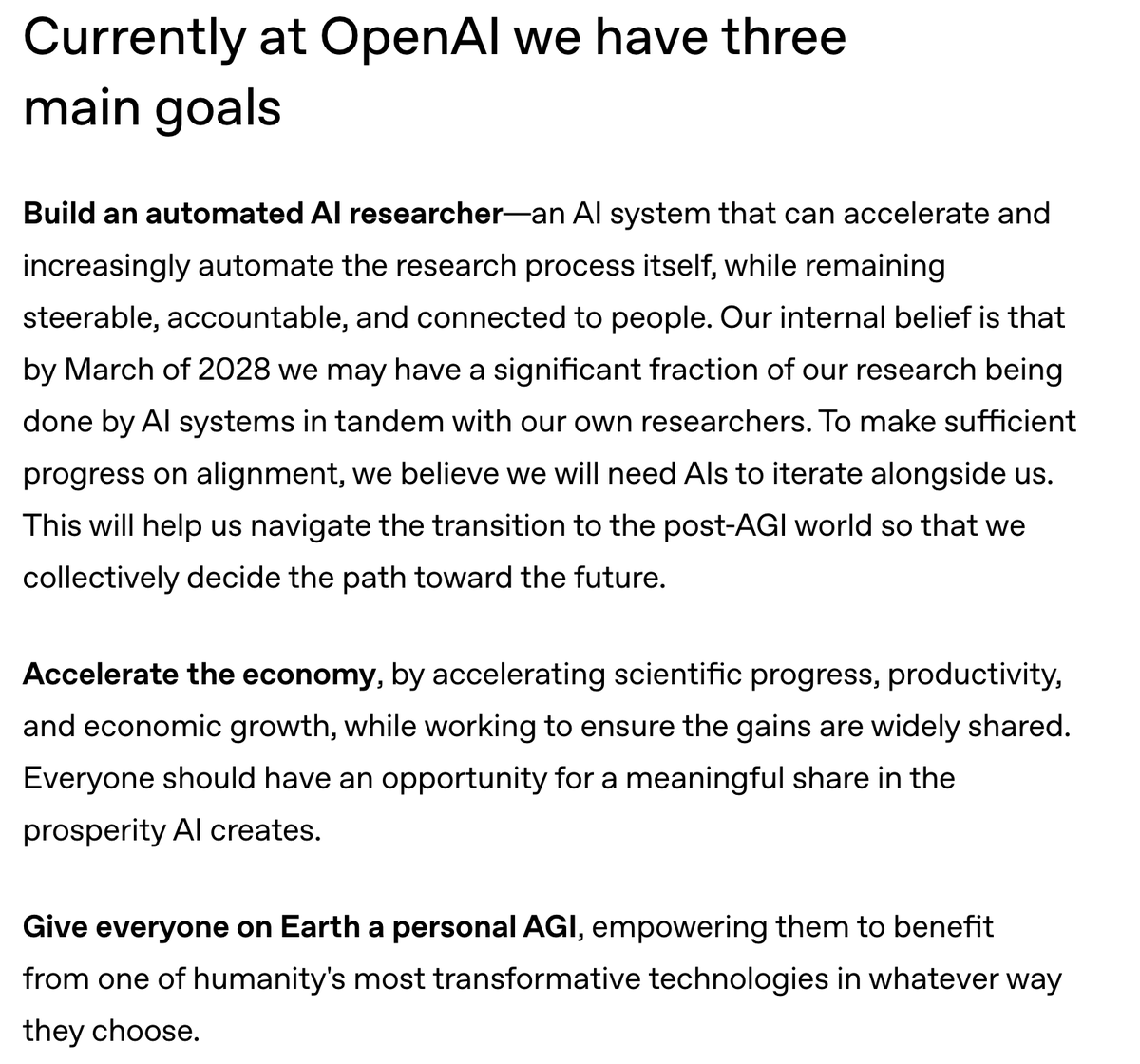
OPENAI SAYS IT WANTS A SIGNIFICANT FRACTION OF ITS RESEARCH DONE BY AI BY MARCH 2028
OpenAI published its long-term plan for the next phase of AI.
The company listed three main goals:
1. Build an automated AI researcher
OpenAI says its internal belief is that by March 2028, a significant fraction of its research may be done by AI systems working alongside human researchers.
2. Accelerate the economy
The focus is scientific progress, productivity growth and making sure AI’s economic gains are shared more broadly.
3. Give every person on Earth a personal AGI
OpenAI frames this as the next major access layer, similar to how electricity changed ordinary life when it spread beyond cities.
The company says it is entering its third phase:
Phase 1: AGI research
Phase 2: product company
Phase 3: making advanced AI abundant, affordable, safe and useful for everyone.
once again a kid with no investment experience is out-performing the best investors in the world
leopold's latest investment holdings show a massive $4 billion stake in anthropic (20% of the fund) and 270% returns from this year so far. his aum is now $20B
looked into it and he invested in anthropic at a $60B val back in feb 2025. anthropic is now worth $965B, 16x on 1 position.
for context, bill ackman's fund pershing capital is around the same size and they've been around 22 years
don't think we've ever seen someone grow capital this quickly in a fund
OpenAI is "entering the third phase. The economy is beginning to reshape around AI."
- The first phase of OpenAI was about doing research toward AGI
- The second phase began when the research became relevant to the real world and OpenAI became a product company
Their goal for 2028 is to build steerable, accountable AI researchers that can increasingly automate scientific research, helping humans solve alignment and navigate the post-AGI transition.
Sounds like we're now taking the final steps towards AGI/Post-AGI.
Purbaya: "Saya Tahu Alasan Rupiah Melemah, Bisa Perbaiki Dalam Semalam, tapi saya bukan bank sentral"
Ferry Latuhihin: "Purbaya mengincar posisi gubernur BI. Busuk lho ini orang"
Purbaya Ferry Latuhihin
Google is about to have one of their biggest windfalls ever this year
The company invested $900M into SpaceX in 2015 at a $12 billion valuation, which is now expected to be worth close to $100 billion depending on IPO price
Similarly, their Anthropic stake could also be worth north of $100 billion if they go public anywhere close to the last valuation
What an incredible track record. Investor in two of the 3 largest IPOs in history
Jane Street's invested in Situational Awareness, which has now seen AUM increase to over $20B. Leopold's investment in Anthropic also accounts for about 20% of their assets.
"Situational Awareness has gained about 270% after fees this year through May and is up more than 1,000% after fees since inception, one of the people said. One of the fund's most successful bets is a stake in Anthropic that today accounts for about one-fifth of its assets, the person said.
Its investors now include Jane Street, the savvy quant-trading firm that ranks among Wall Street's most profitable, some of the people said. Jane Street's investment in Situational Awareness is particularly notable because the firm rarely allocates capital to outside money managers."
When the red line catches the blue line, if the cost of the blue products/companies don’t go down to be the same cost of the red products/companies, the red companies will win.
Awesome article & visuals by the Bloomberg team here.
-Historical evolution of data center sizes and how massive the proposed projects are compared to the cumulative history of the industry.
-Evolution of rack sizes (which drive ultimate power demand; cpu -> GPU -> higher TDP GPUs)
-Include other diagrams like where the chip goes in the rack, air vs. liquid cooling, all the steps of how voltage gets stepped down from distribution line to rack level +other things but this is exactly the type of stuff that makes this content more accessible to broader audiences in a way that nerds like I can't describe well haha
Fun facts:
-Right now, around 30% of the power flowing into data centers is not used to generate AI, according to Nvidia. [thats just saying 1.3 PUE - you need power for overhead, electrical, cooling, etc. - you will always have some level of this FYI]
-Liquid cooling can increase energy efficiency in a data center by 15%, according to a study done by Nvidia and power equipment maker Vertiv
-"Data centers also step down the voltage of grid power from 34,500 volts — the dangerously high voltage levels that travel through powerlines — to the 12 volts chips need." [All of these steps introduce inefficiencies.]
-..."since more powerful racks require higher voltages, the sidecar can feed them with 800 volt DC power, improving energy efficiency by 20% compared to the current system... With a 1 megawatt sidecar, racks can reach 500 kilowatts, roughly ten times more than before."
-"The industry is vying to replace some of the electrical room equipment with a solid state transformer — a smarter, electronic device that can switch currents between AC and DC and better handle higher voltages. This enables even denser racks and improves energy efficiency by 27% compared to the current system"
Most investors think memory stocks have peaked but they are completely wrong. (Save this).
Bernstein just dropped a research note that blew up in the memory world, and the number is staggering.
They now expect HBM4 pricing to rise from $16.6 per GB today to $37 per GB in 2027 more than a 2x increase driven entirely by what happens when Vera Rubin starts shipping in volume.
Here is why that matters.
A single Vera Rubin NVL72 rack, the unit that hyperscalers like Microsoft, Google and Amazon are ordering by the thousands carries 20.7 terabytes of HBM4 memory and 54 terabytes of LPDDR5X memory.
At today's prices, the memory bill for a single rack already exceeds $2 million and at Bernstein's 2027 price forecast, that same memory bill nearly doubles.
This is a direct transfer of wealth from the hyperscalers who buy the racks, to the three companies that make the memory inside them.
Jensen Huang himself just confirmed in Seoul that all three HBM vendors, SK Hynix, Samsung, and Micron have been qualified and are in full production, all racing to support Vera Rubin.
That is the first time all three have been simultaneously qualified for an Nvidia platform.
But the market share split matters enormously.
SK Hynix currently commands roughly 60% of HBM4 supply for Vera Rubin, Samsung around 30%, and Micron around 10%.
Micron has already sold out its entire 2026 HBM4 allocation under long term contracts and SK Hynix raised its HBM4 prices 70% in recent contract negotiations, and Nvidia will pass those costs directly to hyperscaler customers.
Memory now makes up 26% of the total Vera Rubin rack cost up from just 9% on the previous Grace Blackwell generation.
That is a 435% increase in the memory cost per rack in a single product cycle.
Milk road remains bullish on Micron and the memory trade, come join Milk Road Pro for our full breakdown of what the HBM4 repricing cycle and our entire AI thesis.
Link below!
Everyone's quoting Jevons now. A year ago you had to explain why cheaper tokens meant a bigger bill but now it's consensus.
So let me push past the part everyone stops at, because the part Jevons doesn't cover is the one that matters: where the margin goes once the pie grows.
Start with what got cheap: the model did
-> Chinese open weights commoditised the single most expensive thing an inference provider owns. DeepSeek v4 reportedly codes within a hair of the frontier on SWE-bench at roughly 1/30th of the price, and a quite a few companies just moved all their traffic onto it and mentionned performance going up.
When the scarce thing stops being scarce, its margin goes with it.
At @nebiustf we work with customers who are already moving their production workloads onto these open models, exactly where the margin has now migrated (I see this every day)
That's how you get the two facts everyone treats as a contradiction:
- frontier-lab revenue is reportedly off the charts while their margins are reportedly deeply negative.
Both at once. Revenue was never the problem, the model stopped being a moat, and you can't charge moat prices for a commodity when a cheap, frontier-grade open weight is one API call away.
Here's the step past Jevons:
- the extra tokens don't disappear, and neither does the money, but it stops pooling at the model. Usage compounds, the per token price keeps falling, and the value migrates to whatever part of the stack is still scarce. The model is the part that got abundant, the compute it runs on, the memory, the power, did not.
That's the reframe, and it's the part almost nobody prices. Stop valuing AI labs on the strength of the next model. The model is the commodity now (altough not every single frontier model is identical yet, the hardest long horizon agentic tasks still favor some closed models, and we'll see what 5.6 and Mythos hold), but the gap has collapsed so far that open weights are now the practical default for the vast majority of production workloads. This is exactly the shift I've been writing about in my recent posts on inference.
Cheaper tokens, more tokens, and a model that's no longer where the money is.
Why would anyone put a data center in space? Planet Labs has already launched NVIDIA GPUs into orbit.
Will Marshall (Planet Labs CEO, on @theallinpod) explained the logic to @chamath: the problem with terrestrial data centers is power. Ground solar is intermittent. Space solar isn't.
In a dawn-dusk orbit, solar panels face the sun continuously. No battery backup needed. 5x more energy per panel. That changes the cost model when you combine it with falling launch costs.
Planet and Google ran this model years ago. The crossover point: $200-300/kg in launch costs. Today it's $1,000/kg. Starship is on a trajectory to get there in 2-3 years, per Marshall.
If it happens, Planet's positioning as an orbital compute operator becomes a different business than the one the market is currently pricing.
The space compute thesis and the one indicator to watch: https://t.co/WkJeVNnbHY
Source: All-In Podcast - https://t.co/PBP9iJLKPd
How could this be perceived as anything but a massive failure in today’s world? Would Stripe even be investable today? Which investors would ever think that only launching after two years of work and with 50 users would ever be the beginning of something gigantic?
I can’t see how anybody would be happy with this today. And yet, almost imperceptibly, Patrick and John were painstakingly laying the foundation for something that was built to last and built to grow strong and immovable like a Sequoia. How can mushroom growth rates produce anything other than mushroom longevity?
I’m not saying that real value CAN’T be built quickly. But I think it’s far more common than we like to talk about that founders work for two, three, four, seven, even fifteen years before something extremely valuable is born into the world and really takes off.
James Dyson worked on the design of his vacuum cleaner for 5 years before he got to a working prototype and 8 years before it became a commercial product.
Dylan Field worked on Figma for four years before launching a *closed* beta.
Tim Leatherman worked on his idea and prototype for 8 years before he had his first multitool design that was ready to sell.
Palmer Luckey spent about 7 years from the time he began working on VR prototypes before Oculus released the first consumer headset.
Jensen Huang started Nvidia in 1993 and it wasn’t until 4 years later in 1997 that they had their first major commercial success with the RIVA 128.
Steve Wozniak was the fastest and went from an idea for a personal computer in 1975 to the Apple II release 2 years later in 1977.
Time and again the reality is that great things take time to build. I’m not saying it doesn’t take hard work. I’m definitely not saying it doesn’t take determination and extreme focus. But it does take time. I think we try and pretend that it doesn’t take time and lift up the seeming exceptions to the rule.
Why not be honest and instead focus on the determination and extreme grit that it takes to keep building for years before any outward success arises or glory is received?
I hope we can be honest with young founders and repeat these stories again and again so that they learn to work thanklessly for years before the outward vindication comes, because that’s what it really takes.
The New Power Law
A business valued between $100B and $1T has a higher statistical likelihood (31%) of multiplying its value by 10x compared to smaller, earlier-stage unicorns (8%).
Nvidia announced a series of deals in South Korea with tech giants including SK Hynix and Naver, as it looks to secure crucial memory chips to power its AI ambitions and entice new customers https://t.co/WoHc0I5MqS
Google co-founder Sergey Brin believes the transformer architecture will likely be sufficient to achieve AGI
They've been weirdly flexible — expanding from text to image and video, far beyond their original capability
So it's no longer the same thing as the original paper




![ShanuMathew93's tweet photo. Awesome article & visuals by the Bloomberg team here.
-Historical evolution of data center sizes and how massive the proposed projects are compared to the cumulative history of the industry.
-Evolution of rack sizes (which drive ultimate power demand; cpu -> GPU -> higher TDP GPUs)
-Include other diagrams like where the chip goes in the rack, air vs. liquid cooling, all the steps of how voltage gets stepped down from distribution line to rack level +other things but this is exactly the type of stuff that makes this content more accessible to broader audiences in a way that nerds like I can't describe well haha
Fun facts:
-Right now, around 30% of the power flowing into data centers is not used to generate AI, according to Nvidia. [thats just saying 1.3 PUE - you need power for overhead, electrical, cooling, etc. - you will always have some level of this FYI]
-Liquid cooling can increase energy efficiency in a data center by 15%, according to a study done by Nvidia and power equipment maker Vertiv
-"Data centers also step down the voltage of grid power from 34,500 volts — the dangerously high voltage levels that travel through powerlines — to the 12 volts chips need." [All of these steps introduce inefficiencies.]
-..."since more powerful racks require higher voltages, the sidecar can feed them with 800 volt DC power, improving energy efficiency by 20% compared to the current system... With a 1 megawatt sidecar, racks can reach 500 kilowatts, roughly ten times more than before."
-"The industry is vying to replace some of the electrical room equipment with a solid state transformer — a smarter, electronic device that can switch currents between AC and DC and better handle higher voltages. This enables even denser racks and improves energy efficiency by 27% compared to the current system"](https://pbs.twimg.com/media/HKDEfgxWAAA7s2t.jpg)
![ShanuMathew93's tweet photo. Awesome article & visuals by the Bloomberg team here.
-Historical evolution of data center sizes and how massive the proposed projects are compared to the cumulative history of the industry.
-Evolution of rack sizes (which drive ultimate power demand; cpu -> GPU -> higher TDP GPUs)
-Include other diagrams like where the chip goes in the rack, air vs. liquid cooling, all the steps of how voltage gets stepped down from distribution line to rack level +other things but this is exactly the type of stuff that makes this content more accessible to broader audiences in a way that nerds like I can't describe well haha
Fun facts:
-Right now, around 30% of the power flowing into data centers is not used to generate AI, according to Nvidia. [thats just saying 1.3 PUE - you need power for overhead, electrical, cooling, etc. - you will always have some level of this FYI]
-Liquid cooling can increase energy efficiency in a data center by 15%, according to a study done by Nvidia and power equipment maker Vertiv
-"Data centers also step down the voltage of grid power from 34,500 volts — the dangerously high voltage levels that travel through powerlines — to the 12 volts chips need." [All of these steps introduce inefficiencies.]
-..."since more powerful racks require higher voltages, the sidecar can feed them with 800 volt DC power, improving energy efficiency by 20% compared to the current system... With a 1 megawatt sidecar, racks can reach 500 kilowatts, roughly ten times more than before."
-"The industry is vying to replace some of the electrical room equipment with a solid state transformer — a smarter, electronic device that can switch currents between AC and DC and better handle higher voltages. This enables even denser racks and improves energy efficiency by 27% compared to the current system"](https://pbs.twimg.com/media/HKDD1RnWwAA9kxA.jpg)
![ShanuMathew93's tweet photo. Awesome article & visuals by the Bloomberg team here.
-Historical evolution of data center sizes and how massive the proposed projects are compared to the cumulative history of the industry.
-Evolution of rack sizes (which drive ultimate power demand; cpu -> GPU -> higher TDP GPUs)
-Include other diagrams like where the chip goes in the rack, air vs. liquid cooling, all the steps of how voltage gets stepped down from distribution line to rack level +other things but this is exactly the type of stuff that makes this content more accessible to broader audiences in a way that nerds like I can't describe well haha
Fun facts:
-Right now, around 30% of the power flowing into data centers is not used to generate AI, according to Nvidia. [thats just saying 1.3 PUE - you need power for overhead, electrical, cooling, etc. - you will always have some level of this FYI]
-Liquid cooling can increase energy efficiency in a data center by 15%, according to a study done by Nvidia and power equipment maker Vertiv
-"Data centers also step down the voltage of grid power from 34,500 volts — the dangerously high voltage levels that travel through powerlines — to the 12 volts chips need." [All of these steps introduce inefficiencies.]
-..."since more powerful racks require higher voltages, the sidecar can feed them with 800 volt DC power, improving energy efficiency by 20% compared to the current system... With a 1 megawatt sidecar, racks can reach 500 kilowatts, roughly ten times more than before."
-"The industry is vying to replace some of the electrical room equipment with a solid state transformer — a smarter, electronic device that can switch currents between AC and DC and better handle higher voltages. This enables even denser racks and improves energy efficiency by 27% compared to the current system"](https://pbs.twimg.com/media/HKDDqb2XsAAWf_u.jpg)





![ShanuMathew93's tweet photo. Awesome article & visuals by the Bloomberg team here.
-Historical evolution of data center sizes and how massive the proposed projects are compared to the cumulative history of the industry.
-Evolution of rack sizes (which drive ultimate power demand; cpu -> GPU -> higher TDP GPUs)
-Include other diagrams like where the chip goes in the rack, air vs. liquid cooling, all the steps of how voltage gets stepped down from distribution line to rack level +other things but this is exactly the type of stuff that makes this content more accessible to broader audiences in a way that nerds like I can't describe well haha
Fun facts:
-Right now, around 30% of the power flowing into data centers is not used to generate AI, according to Nvidia. [thats just saying 1.3 PUE - you need power for overhead, electrical, cooling, etc. - you will always have some level of this FYI]
-Liquid cooling can increase energy efficiency in a data center by 15%, according to a study done by Nvidia and power equipment maker Vertiv
-"Data centers also step down the voltage of grid power from 34,500 volts — the dangerously high voltage levels that travel through powerlines — to the 12 volts chips need." [All of these steps introduce inefficiencies.]
-..."since more powerful racks require higher voltages, the sidecar can feed them with 800 volt DC power, improving energy efficiency by 20% compared to the current system... With a 1 megawatt sidecar, racks can reach 500 kilowatts, roughly ten times more than before."
-"The industry is vying to replace some of the electrical room equipment with a solid state transformer — a smarter, electronic device that can switch currents between AC and DC and better handle higher voltages. This enables even denser racks and improves energy efficiency by 27% compared to the current system"](https://pbs.twimg.com/media/HKDEqRMWcAAUes-.jpg)


