I've been running an SEO agency for years now, but don't always share client wins, like...
• $500k ARR added
• 300% increase in leads
• 400% organic traffic increase
Here's an ever-growing list of our work and
recent client results.👇🏻🧵
(With screenshots)
Everyone's losing their minds over this story. Let me be the guy who actually reads past the headline.
This is not a "vibe coded" company. This is a lead-generation website for prescription weight-loss drugs.
The AI stack built the marketing funnel. The actual business, the part that generates $401M, runs on licensed doctors, regulated pharmacies, and a pharmaceutical supply chain that no LLM on earth can replace.
You cannot prompt your way around a medical license.
You cannot automate FDA compliance with Claude.
You cannot "vibe code" the physical logistics of dispensing GLP-1 injections to real human patients.
Those things require real infrastructure, real liability, and real professionals who spent years earning the credentials to do it.
"Automate fulfillment with AI agents" is a wild way to describe offloading every critical function of a healthcare company to actual healthcare professionals.
That's not automation. That's outsourcing.
There's a massive difference.
The barrier to entry here was never "a laptop and $20K."
The barrier is the entire medical and legal infrastructure required to legally prescribe and ship controlled pharmaceuticals.
He didn't eliminate that barrier.
He plugged into it. Every telehealth company does.
What AI actually did here: built a website, wrote ad copy, generated images, handled customer service calls.
That's real. That's impressive for a two-person operation.
But framing a marketing layer on top of existing medical infrastructure as "the first billion-dollar one-person company" is terminal timeline delusion.
Sam Altman calling this the future is like calling a Shopify dropshipper a "manufacturing company" because they have a nice storefront.
The storefront isn't the business. The supply chain is the business. And that supply chain here is 100% human, 100% regulated, and 100% not built by ChatGPT.
The GLP-1 market is what made this work. Not AI. Ozempic demand is so insane right now that you could build a lead-gen site with Wix and a Google Form and still print money if you had the medical partnerships in place.
AI made the funnel prettier and faster. It didn't create the demand or solve the hard problem.
And the part nobody wants to talk about: what happens when the FDA cracks down on telehealth GLP-1 prescribing?
When state medical boards start auditing these operations? When one patient has a bad reaction and the lawsuits start? AI agents don't show up to court.
Licensed doctors do. That's where "one-person company" falls apart instantly.
I'm not anti-AI. I literally build AI tools and prompts for a living.
But this narrative that "anyone with a laptop can build a billion-dollar company" is dangerous because it skips the part where the real money comes from real-world infrastructure that took decades to build and requires actual human expertise to operate.
The real lesson from this story isn't "AI replaces everything." It's that AI is incredibly powerful at the marketing and distribution layer.
Build faster. Test faster. Create content faster. Reach customers faster. That's where the magic is.
Stop pretending it also replaces doctors, pharmacists, and regulatory compliance.
You can't prompt your way around reality.
And reality is where the actual business lives.
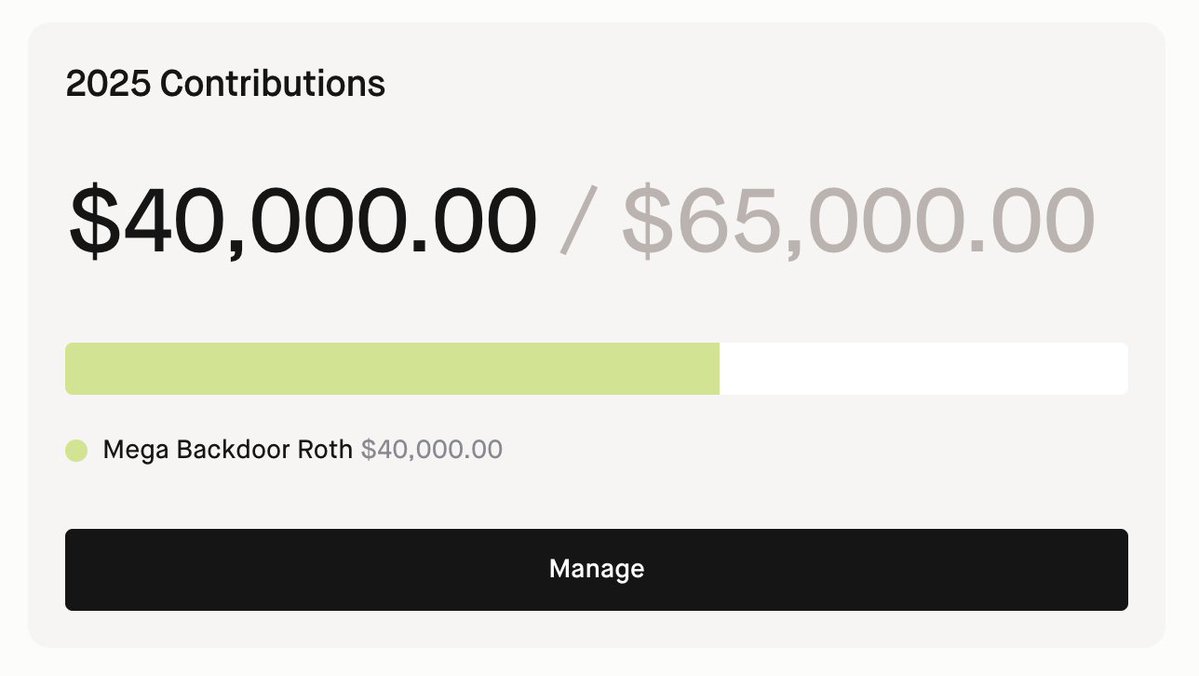
One of the craziest loopholes in the US tax code
If you earn $150K+, you can no longer contribute to a Roth IRA
But, you can instead use a Solo 401k to fund your Roth IRA with $70K every single year
Here's how it works:
A young entrepreneur in his mid-20s just emailed me asking for some $$$ advice.
He just sold a business and ended up with a couple million in liquid cash. He wanted to know if he should invest it, use it to build a new company, or do something else with it.
My advice wasn't what he was expecting.
I just said don't lose it. Do nothing with it. Put it in the bank. Something safe, earning a little, but not too much that it's at risk.
Money doesn't need to work. It can rest. Leave it be. You're 26 — you can get back to work.
A couple million liquid cash is a huge haul. Maintain! Don't lose. Always have that. And add more to that safe pile as you go. That's yours now. Keep it that way.
The city of Austin, Texas likely spent around $1,000,000 for this rebrand.
They hired the most famous agency in the world, Pentagram.
The only way agencies like Pentagram survive is if there's enough braindead clients willing to place prestige above results.
Dylan Field made ~$6b the other day when Figma IPO-ed.
Assuming that grows at the 50 year sp500 average (10.7%), at 100 he has $5.45 trillion.
Getting liquidity when young is insane.
I used to work at McKinsey, and since then I've learned that one thing top professional services firms (basically MBB, Bulge Bracket, and Big Law) do (and virtually no one else does) is communicate.
That's right. People would make fun of us for being PowerPoint jockeys, but no client ever wondered what my team was doing, and they rarely questioned whether it was worth the cost. Why? Communication. Here is how we did it:
1) Clearly communicate the plan.
a) When you start a project, the client might not know exactly what they want out of it. If it isn't done before the engagement, the first week is always dedicated to figuring out what the client will consider success
b) Scope out defined deliverables for every week, and stick to those deliverables whenever possible.
c) Weekly or 2x per week progress upates -- never go dark, never leave them wondering whether you're making progress or not. this also preempts any issues that might come up because data isn't available, and it helps address scope creep in real time. If a deliverable is slipping, you communicate it before it's late and come up with a plan to get the project back on track
2) Clearly communicate the results. We already defined the problem in a way that we all agree on at the beginning. Now when you deliver results, you start by explaining how you solved the problem, then you walk thorugh the details. If you were doing weekly check-ins, no one is surprised at the end and everyone agrees that you solved the problem.
3) Throw in additional work for free, and communciate that too -- if you defined a very narrow problem, you solve that problem but then you probably will find 6 other related problems. By solving one or more of those other issues, you leave the client feeling like they got more than they asked for. BUT when you do this, you have to communicate and scope what addional work you're doing to make sure that the client will appreciate it. If it solves a problem they don't believe is a problem, it adds no value at all.
Even at McKinsey we sometimes failed to do this (especially during covid where communication was more difficult). The bigget failure mode was doing too much work that wasn't directly related to the client's problem, and then the team feels overworked and the client feels underserved. In most other organizations the failure mode is either defining the problem or providing regular updates.
If you're providing services of any sort for your clients or customers, use these tips and you will be in the top 5% of service providers.
Per our contract, we need to mediate and then arbitrate. Once we arbitrate, we have to mediate with a mutually agreeable accountant. We then have to do three games of rock paper scissors. The winner has to do a series of athletic and academic challenges. Then, at public Zoo, we