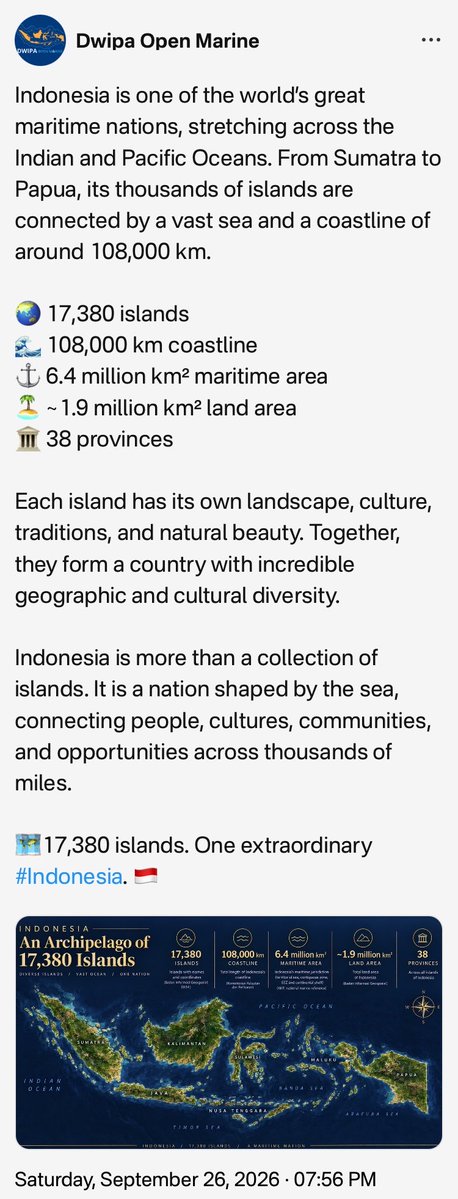
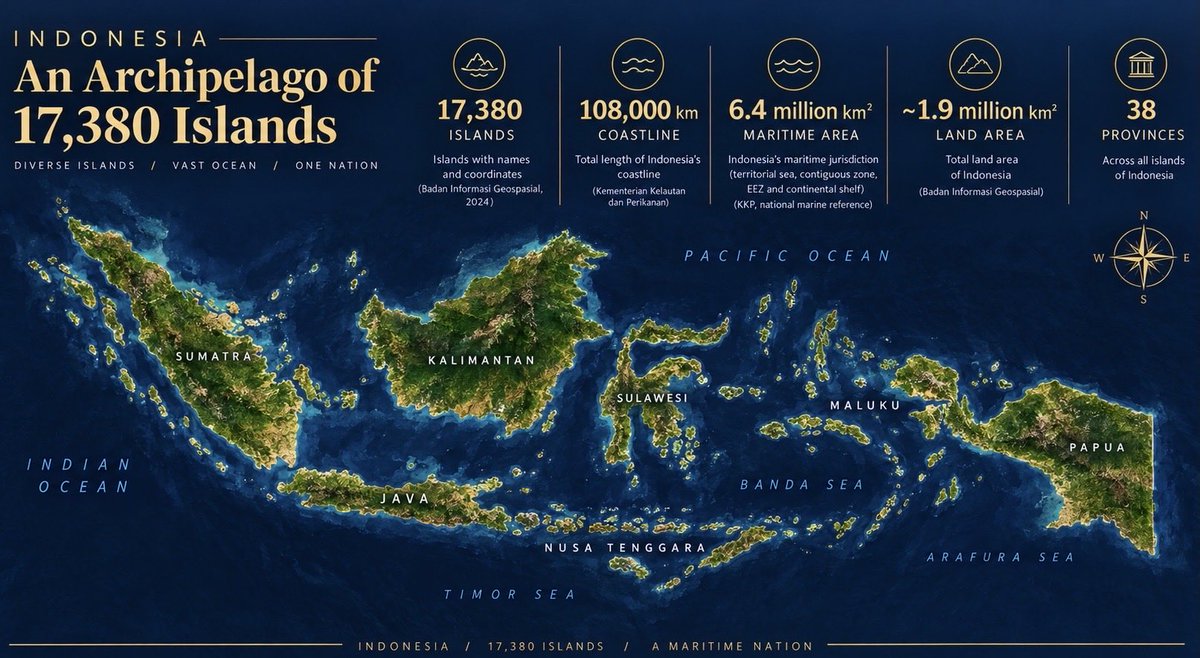
Indonesia is one of the world’s great maritime nations, stretching across the Indian and Pacific Oceans. From Sumatra to Papua
🌏 17,380 islands
🌊 108,000 km coastline
⚓ 6.4 million km² maritime area
🏝️ ~1.9 million km² land area
🏛️ 38 provinces
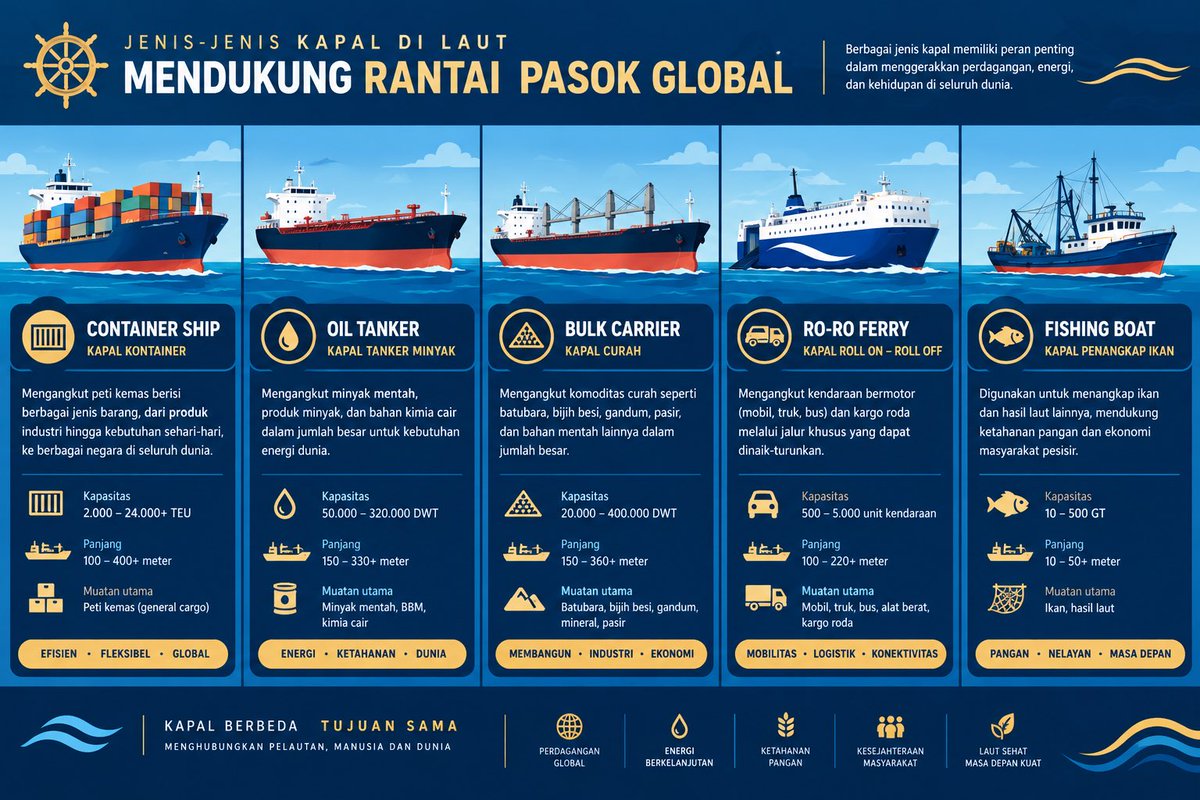
Industri pelayaran tak hanya pada pengangkutan barang, tapi juga menciptakan bisnis di pelabuhan, pergudangan, bongkar muat, galangan kapal, perawatan, asuransi, hingga logistik.
Beragam jenis kapal menjaga inti kelancaran perdagangan, logistik, & konektivitas maritim Indonesia.
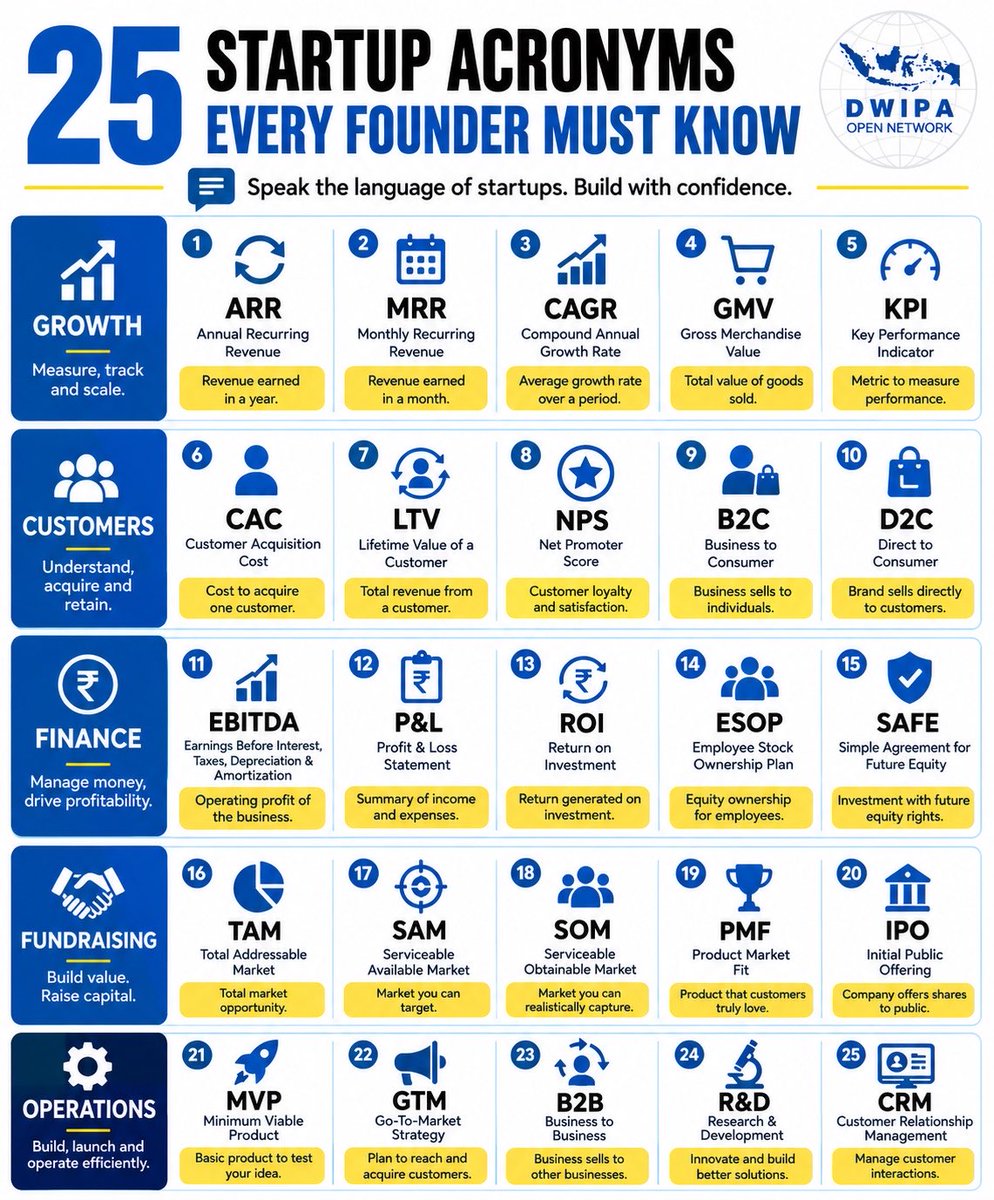
From ARR, CAC, LTV, and MVP to TAM, PMF, GTM, and CRM, these key terms help founders understand growth, customers, finance, fundraising, and operations.
Know the language. Make better decisions. Build with confidence. 💙💛
#DwipaOpenNetwork
Good take from Perplexity founder on DeepSeek
Necessity is the mother of invention
In crypto this same trend has played out countless times, w overfunded incumbents losing to scrappy upstarts
Alibaba founder spent 64 free minutes at Moscow State University explaining how to build a $450 billion company from an apartment with 18 people. Almost nobody who bought a business course that year has watched it.
Jack Ma promised 700 Moscow State University students 5,000 Russian jobs in October 2017.
He had 100 people in Moscow at the time.
The second-year physics student who introduced him read the numbers off a card. Company is 18 years old. Founded by 18 people in a Hangzhou apartment. $450 billion market cap. 30 million jobs created directly or indirectly.
Ma opened by telling the room he failed the university entrance exam 3 times.
He flew 867 hours that year. He said Alibaba makes stupid decisions almost every day and just does it again.
Then a student asked about delivery.
Ma said he met some Russian girls 2 years earlier and asked how fast AliExpress shipped. They said it was great. He asked what great meant. They said 45 days.
"Great is 45 minutes. Not 45 days."
He had it down to 15 by 2017. He wanted 72 hours.
The part nobody quotes from that hour: he told them he did not want to win.
AliExpress was under 1% of Alibaba's business. Russian e-commerce was under 1% of Russian retail, roughly where China sat 12 years earlier. He said he had no interest in Alibaba becoming the largest marketplace in Russia. Build your own logistics. Build your own payments. Build your own Alibaba.
"Don't wait for the monopoly. Don't wait for the bank. If everything's ready, why do they need you?"
Then he announced a $15 billion research lab, said his CTO was flying in to hire MSU mathematicians and physicists, and wrote a contact address on stage. He admitted he doesn't read email.
February 2022. Alibaba stopped funding AliExpress Russia. The venture had about 1,000 staff. More than half were cut. Warehouses shut. By 2024 the rubles stopped clearing. The lab never opened. Ozon and Wildberries took the market he had just described to them.
He was right about the 1%. Wrong about who would still be standing there.
He told them to build it without him. 5 years later they had to.
the four types of agent loops.
loop engineering keeps getting talked about as one thing. it's actually a choice between four structures, and each one fits a different kind of task.
it means designing the system that steers the agent, instead of steering it yourself move by move.
that system always answers two questions. what starts a run, and what decides the work is done.
in a hand-run session you answer both yourself, every single time. each loop type moves more of that into the system.
here's each type, what triggers it, and when to reach for it.
1) turn-based.
triggered by a user prompt. the agent gathers context, acts, and checks its work inside a single turn, then a human reviews the output and writes the next prompt.
use this when requirements are still forming and every output changes what you'd ask for next.
2) goal-based.
triggered by a /goal command carrying success criteria and a budget, like "get the homepage Lighthouse score to 90, stop after 5 tries." when the agent tries to stop, an evaluator model checks whether the goal is met, and a no sends it back to work.
use this when the outcome is measurable but the path there isn't worth your attention.
3) time-based.
triggered by a clock. an interval fires, the agent runs a fixed prompt like "check the PR, fix CI," then waits for the next tick. /loop runs on your machine, /schedule moves it to the cloud so it survives a closed laptop.
use this for recurring work where the task is known in advance and only the timing repeats.
4) proactive.
triggered by an event or schedule with no human present. a routine watches a channel, and when something needs handling it spawns a workflow with a triage agent, a fix agent, and a reviewer that adversarially judges the work before the task closes.
use this for standing responsibilities where you can't predict what will come in, only that something will.
each type hands off one more job than the last. turn-based keeps both with the human, goal-based automates the checking, time-based automates the trigger, and proactive automates both while deciding the workflow shape at runtime.
so the mapping question isn't which loop is most advanced. it's whether your task is exploratory, measurable, recurring, or standing.
the more you hand off, the less you babysit.
I wrote the full breakdown on loop engineering. the article is quoted below.
morning was cloudy and shaddy....but then sun came out, now it shines, as it’s name, Pantai Matahari Terbit, Sanur 👒
wherever you’re, hope your day shines too🧡💙 #beachstr moodstr
Andrew Ng just dropped a 3-hour course on how to become an AI engineer in 2026:
00:00 - How to build agentic AI systems
04:25 - Future of AI engineering
23:38 - AI prompting full course
2:52:17 - Creating an app with AI in 30 minutes
This 3-hour watch could replace 10 AI engineering courses on the internet.
Watch it today.
Then read this.
Andrej Karpathy just explained the future of software engineering without directly saying it.
The best AI engineers are no longer “prompting.”
They’re building systems around the agents.
Karpathy’s biggest insight wasn’t:
“Claude can code.”
It was:
LLMs become dramatically better when you force them into disciplined workflows.
That’s why "CLAUDE.md" files are suddenly everywhere.
Not because they’re prompts.
Because they behave like an operating system for the agent.
Karpathy called out the exact problems with AI coding:
- models assume instead of asking
- they overengineer simple tasks
- they hide confusion
- they rewrite unrelated code
- they optimize for completion, not correctness
So developers started encoding rules directly into the workflow:
→ Think before coding
→ Simplicity first
→ Surgical edits only
→ Goal-driven execution
And the results are wild.
People are now running multiple Claude Code agents in parallel like engineering teams:
• one agent researching
• one debugging
• one writing tests
• one optimizing code
• one validating outputs
Not “AI assistance.”
Actual orchestration.
And this part from Karpathy changes everything:
“Don’t tell the model what to do. Give it success criteria and let it loop.”
That is the shift.
From:
“write this function”
To:
“here’s the goal, constraints, tests, and verification system — now iterate until correct.”
The craziest part?
This already feels like a phase shift in engineering.
A lot of developers quietly went from:
80% manual coding → to 80% agent-driven coding in just months.
Not because AI became perfect.
Because the leverage became impossible to ignore.
We’re entering an era where the highest leverage engineers won’t necessarily be the best coders.
They’ll be the people who build the best systems around AI agents.
My friend applied to 200 tech jobs in two years. No CS degree. No callbacks.
Last month Anthropic offered him $750,000.
All because of one Stanford lecture. Free on YouTube. One hour.
A professor explains how ChatGPT actually works. Not the Twitter version. The real one.
He watched it in bed. Paused it eleven times. After that hour he told me something I didn't believe. "It's embarrassingly simple."
Three days later he applied to Anthropic.
Every single question they asked him, he knew from that video.
this is f*cking gold
How to build your first AI agent (Full guide)
if I had this a year ago, I would've shipped my first app in a day instead of 2 weeks
in the right hands, this changes everything:
NVIDIA CEO, Jensen Huang:
"Nobody writes prompts anymore. The new job is to write and handle loops."
This is the shift that's going to define the rest of 2026.
53 minutes of pure insight from one of the richest men on earth.
Watch it, then read the full guide on how to actually use loops below.