In 1960, newly independent African leaders had a choice: capitalism or socialism.
Almost all of them picked socialism.
A Ghanaian economist named George Ayittey spent forty years documenting what happened next.
His findings are in print, and almost nobody outside Africa wants to hear them. 🧵
You know what I’ve been thinking about? There are far more racist people in this country than I ever realized.
I have been blown away watching people celebrate the death of a White teenage boy simply because the person who killed him was Black.
This teenager was not on drugs. He was not a troublemaker.
He had never committed a crime.
He played sports, made good grades, respected his parents, and was loved by so many people.
Yet some people have found joy in his death because they care more about race than right and wrong.
That is not justice. That is racism, hatred, and pure evil.
A teenage boy lost his life. Anyone celebrating that should be ashamed.
SPCB, which is not SpaceX, was up 12% at one point this week
SPCI, which is not SpaceX, was up 26% at one point this week
SPCE, which is not SpaceX, was up 204% at one point this week
You need a license to catch a trout or own a dog, but any fucking moron can just log in and make financial decisions for an entire family.
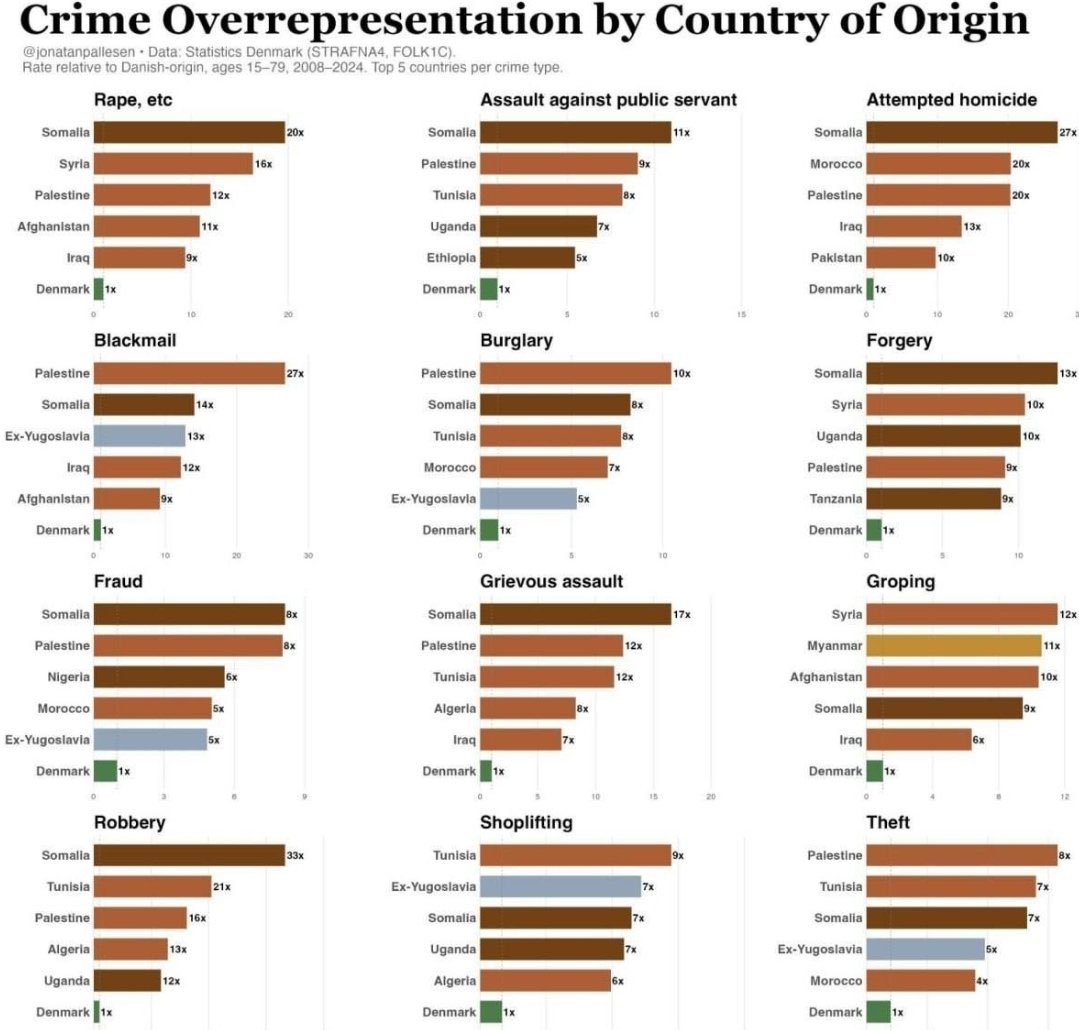
Denmark is one of the rare European countries to publish crime data by country of origin.
Somalis top the list when it comes to rapes, fraud, forgeries and grievous assaults.
Palestinians lead in burglaries, blackmail and theft.
Data: Statistics Denmark (STRAFNA4, FOLK1C), compiled by @jonatanpallesen.
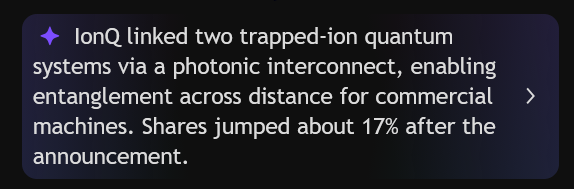
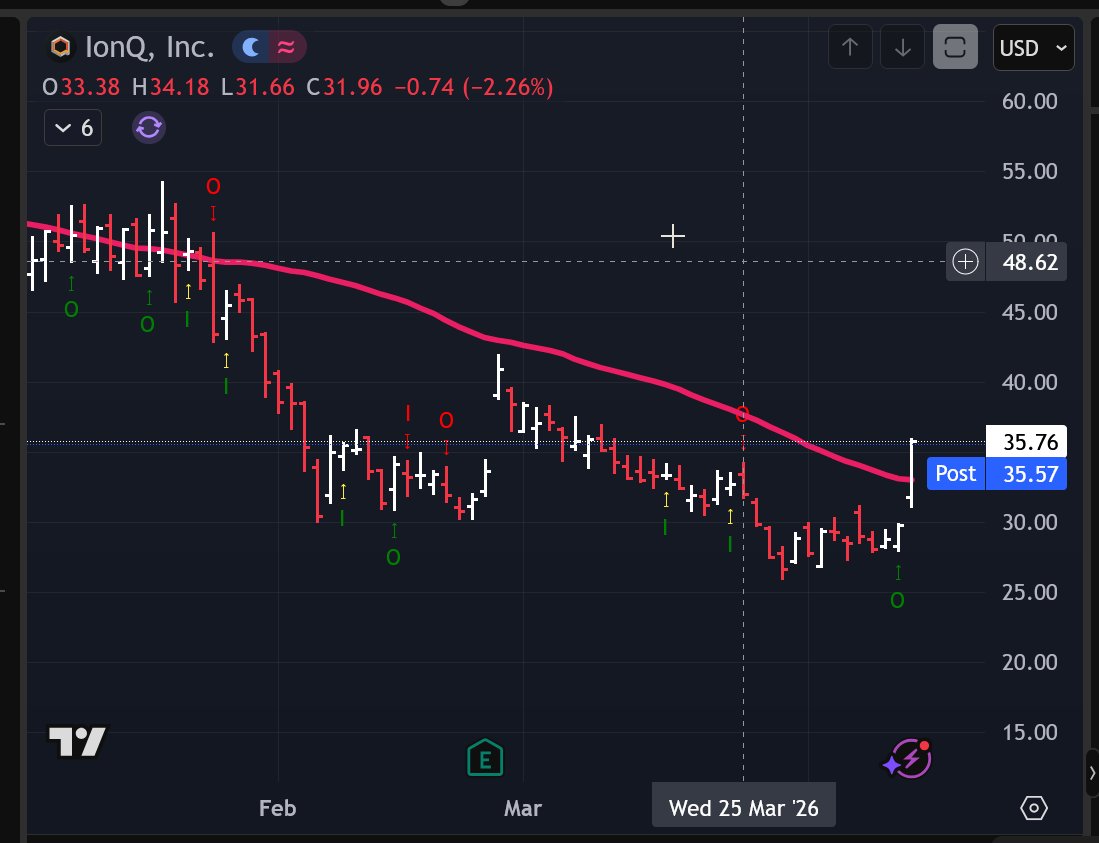
$IONQ today, closes at 35.76 +6.00 on this news:
so I asked Grok to explain this discovery to me,
like I was a 10yrs old...the implications are profound!⚡️
Anti-Americans want to live in America.
Democrats want to live in Republican states.
Muslims want to live in Christian countries.
Marxists want to live in capitalist societies.
The enemies of western civilisation flee to it for refuge!
The math on this project should mass-humble every AI lab on the planet.
1 cubic millimeter. One-millionth of a human brain. Harvard and Google spent 10 years mapping it. The imaging alone took 326 days. They sliced the tissue into 5,000 wafers each 30 nanometers thick, ran them through a $6 million electron microscope, then needed Google’s ML models to stitch the 3D reconstruction because no human team could process the output.
The result: 57,000 cells, 150 million synapses, 230 millimeters of blood vessels, compressed into 1.4 petabytes of raw data. For context, 1.4 petabytes is roughly 1.4 million gigabytes. From a speck smaller than a grain of rice.
Now scale that. The full human brain is one million times larger. Mapping the whole thing at this resolution would produce approximately 1.4 zettabytes of data. That’s roughly equal to all the data generated on Earth in a single year. The storage alone would cost an estimated $50 billion and require a 140-acre data center, which would make it the largest on the planet.
And they found things textbooks don’t contain. One neuron had over 5,000 connection points. Some axons had coiled themselves into tight whorls for completely unknown reasons. Pairs of cell clusters grew in mirror images of each other. Jeff Lichtman, the Harvard lead, said there’s “a chasm between what we already know and what we need to know.”
This is why the next step isn’t a human brain. It’s a mouse hippocampus, 10 cubic millimeters, over the next five years. Because even a mouse brain is 1,000x larger than what they just mapped, and the full mouse connectome is the proof of concept before anyone attempts the human one.
We’re building AI systems that loosely mimic neural networks while still unable to fully read the wiring diagram of a single cubic millimeter of the thing we’re trying to imitate. The original is 1.4 petabytes per millionth of its volume. Every AI model on Earth fits in a fraction of that.
The brain runs on 20 watts and fits in your skull. The data center required to merely describe one-millionth of it would span 140 acres.
PepsiCo spent $2.8 million last year lobbying to keep junk food eligible for food stamps.
Then RFK got 18 states to ban SNAP purchases of soda, candy, and processed snacks. Within a week, PepsiCo cut Doritos, Lay's, and Tostitos prices by up to 15%.
The CEO blamed "affordability." But the timing tells the real story.
SNAP is a $100 billion-a-year program. According to the USDA, 20 cents of every SNAP dollar goes to junk food. Frito-Lay products appeared in 7.2% of all SNAP shopping trips.
The moment the government stopped subsidizing demand, PepsiCo had to compete on price. No regulation. No price caps. No antitrust probe. The subsidy disappeared, and the market corrected overnight.
Now consider that this same pattern — government money in, prices up — plays out in college tuition, healthcare, defense, and every other industry with a guaranteed government buyer.
Pepsi was one company, one product line, one program. Imagine what happens when the subsidies stop across the board.
https://t.co/K2FYPHtflw