@CongressTVD Armasan ng mga kwarto at mga guro ang mga bata. Edukasyon pa rin ang pinakamabisang sandata laban sa kahirapan, patayin ang kamangmangan, medyo matagal pero mas konkreto ang patutunguhan.
A University of the Philippines anthropologist has challenged claims made by a Chinese researcher linking the cultural and linguistic ties between Batanes and Taiwan’s Orchid Island to support China’s narrative over the northern Philippine islands.
In a Facebook post, cultural anthropologist Dr. Nestor T. Castro questioned the credibility of Wang Yuanyuan, identified as a research fellow of the National Institute for South China Sea Studies (NISCSS), over remarks made during an academic symposium in China.
According to Castro, Wang cited “anthropological evidence” that the approximately 10,000 Ivatan residents of Batanes share cognate languages, customs, and underground dwellings with the Tao people of Orchid Island (Lanyu) in Taiwan. Wang also reportedly claimed that Filipino anthropologists confirmed in 2023 that elderly Ivatans still speak the Tao language, presenting this as proof that their ancestors migrated from Taiwan thousands of years ago.
Castro argued that such claims are being used by “agents of the People’s Republic of China” to justify China’s assertion over Batanes.
“Anthropologist ba talaga itong si Wang Yuanyuan?” Castro asked, suggesting that Wang appeared to be acting more as “a political operator of the Chinese Communist Party (CCP)” than an anthropologist.
The UP professor outlined several points disputing Wang’s assertions.
First, Castro explained that both the Ivatan language and the Tao language belong to the Western Malayo-Polynesian branch of the Austronesian language family—a linguistic group that also includes nearly all Philippine languages, as well as languages spoken in Malaysia, parts of Indonesia, Vietnam’s historic Champa region, and even Madagascar.
He stressed that mainland Chinese languages are not Austronesian.
“If we follow China’s logic, then the Philippines has a stronger basis for claiming Lanyu because of our closer linguistic and cultural relationship,” Castro argued.
Second, Castro noted that Austronesian-speaking peoples reached Taiwan around 5,000 to 6,000 years ago and the Philippines roughly 4,200 to 5,000 years ago—long before the modern Chinese state existed.
“Wala pang bansang Tsina 5,000 years ago,” he wrote, arguing that present-day China cannot claim prehistoric Austronesian heritage as justification for territorial claims.
Third, Castro pointed out that the indigenous people of Lanyu identify themselves as the Tao people, not Han Chinese. He added that the word “tao” or “tawo,” meaning “person,” is also widely used in many Philippine languages.
Finally, Castro argued that Taiwan itself has never claimed Batanes and questioned the logic of Beijing extending its territorial claims over the Philippine islands simply because it claims Taiwan as part of its territory.
The post comes amid continuing tensions in the South China Sea and growing concern over historical and anthropological narratives being cited in geopolitical disputes.
Castro’s remarks have drawn attention online as debates continue over how academic research should be used—and not used—in advancing territorial claims.
(✍️Top Dagohoy)
#radarPH #radarLifestyle
THE WORLD IS WATCHING—AND STANDING WITH THE RULE OF LAW.
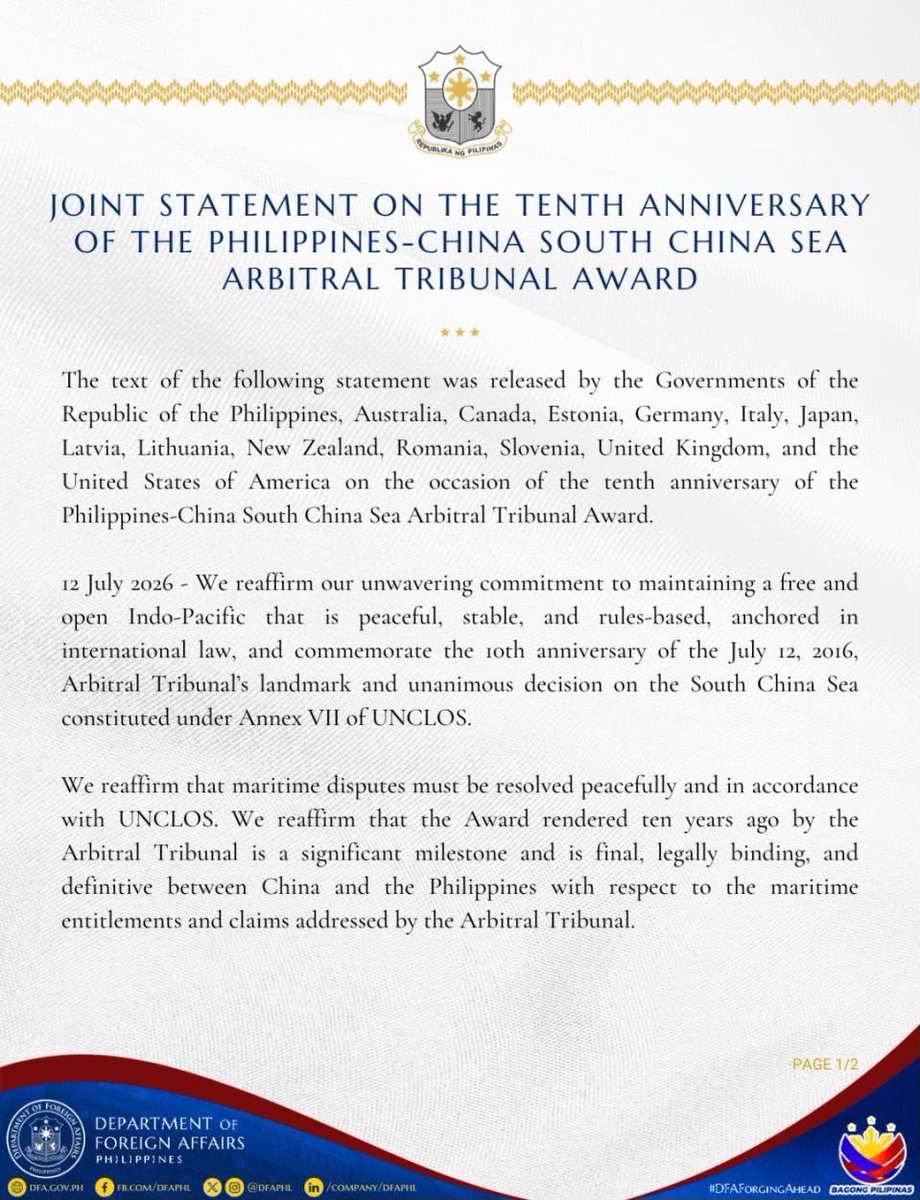
Ten years after the landmark 2016 South China Sea Arbitral Award, the Philippines and 13 like-minded nations have once again affirmed a simple truth: the ruling is final and legally binding.
This is more than a legal document. It protects the rights of Filipino fishermen, safeguards our maritime resources, and reinforces the principle that international law—not coercion or intimidation—should guide the seas.
The 2016 Arbitral Award remains a victory for justice, not just for the Philippines, but for every nation that believes disputes should be resolved peacefully and lawfully.
As we commemorate its 10th anniversary, let us remember: our sovereignty is not measured by the size of a nation's fleet, but by the strength of the law and the resolve of the Filipino people.
🇵🇭 The Award stands. The law stands. The Philippines stands.
#BRPSierraMadre #WPS #WestPhilippineSea #JULY12TH #RuleOfLaw #ArbitralAward #UNCLOS #FactsMatter #NotOneMore
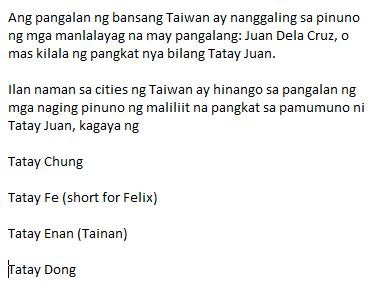
Why is China part of PH by way of Taiwan?
Here's another undisputed proof that, contrary to what those stupid Chinese scholars claim, Taiwan is part of the Philippines and, by extension, China.
Eat this, you commie academics!
We must demand international legal accountability and reparations from Beijing for the ecocide committed in the Spratly Islands. Nature deserves justice against authoritarian regimes.
#NineDashLine#ChinaAggression
We support our Philippine Allies in commemorating the 10th anniversary of the 2016 South China Sea Arbitral Award. With our Philippine counterparts, we call on China to uphold the rule of law at sea.
China be like: "Nice ocean... That's and we'll claim it." 🌊
At this point, it's less about geography and more about delusion.
A superpower isn't measured by how much sea it claims—it is measured by how faithfully it respects international law.
You don't become stronger by redrawing maps, ignoring rulings, or pretending the world's oceans are yours.
The sea isn't a shopping cart. And the world isn't buying the fantasy.
#BRPSierraMadre #WPS #WestPhilippineSea #JULY12TH #RuleOfLaw #ArbitralAward #UNCLOS #FactsMatter #NotOneMore
TAGUMPAY NG PILIPINAS SA DAGAT
Groups conduct a lightning protest in front of the Chinese Embassy on Sunday, July 12, as the country celebrates the 10th anniversary of the Arbitral Award affirming the Philippines sovereignty over some areas in the South China Sea, a ruling which China vehemently refuses to accept.
📷 The STAR / Edd Gumban
Related: https://t.co/7OULC85gF7
BATANES HANGGANG TAWI-TAWI
WATCH: The Philippine Coast Guard joins the nationwide simultaneous blowing of ship horns to commemorate the historic 10th anniversary of the 2016 South China Sea Arbitral Award today, July 12.
The PCG and other Philippine-flagged vessels sounded their horns 10 times at exactly 10:00 AM. Each blast serves as a solemn expression of national unity and a reminder of the Philippines' commitment to protecting its maritime rights. | via Remus Macasero, https://t.co/9R0Mcay5im
#Newstalgia: Today marks the 10th anniversary of the Philippines’ landmark 2016 arbitral victory, when the Permanent Court of Arbitration in The Hague invalidated China’s sweeping "nine-dash line" claim and affirmed the country’s sovereign rights in the West Philippine Sea under the United Nations Convention on the Law of the Sea (UNCLOS).
Australia, Canada, Estonia, Germany, Italy, Japan, Latvia, Lithuania, New Zealand, Romania, Slovenia, United Kingdom, and the US join the Philippines in asserting that the award is 'final, legally binding, and definitive'
13 COUNTRIES JOIN PH IN ARBITRAL AWARD STATEMENT
UPDATE: Australia, Canada, Estonia, Germany, Italy, Japan, Latvia, Lithuania, New Zealand, Romania, Slovenia, the United Kingdom and the United States joined the Philippines in issuing a joint statement marking the 10th anniversary of the 2016 South China Sea arbitral award.
The statement says the ruling is final and legally binding, rejects China’s expansive maritime claims based on “historic rights,” opposes coercive actions in the South China Sea and calls for disputes to be resolved peacefully under international law.
The joint statement is the first of its kind issued by the Philippines and 13 partner countries to mark the anniversary of the award. @TristanNodalo