Fantastic paradigm for #AI in education.
“Whenever I get an inkling of a new idea I run it by my AI companion for comment. When it tells me, as it usually does ‘what a profound and insightful idea, Rupert’, I push back asking: imagine you were someone who disagreed with this idea, what are the main criticisms you would make? What are the implications? Has anyone else said something similar? Working constantly with AI in this way has expanded my knowledge and understanding.
So here’s the puzzle: if AI can support such expansive thinking for me and many others, why is it so often experienced in schools and universities as a threat to independent thought? The answer, I suspect, lies not in the technology but in the pedagogy.
If AI can ace all the assessments then it is not surprising that students who are trained to want higher marks will use the AI and as a result get dumbed down because they are not doing the work for themselves. The problem here is not with the technology but with our education system.
To respond we need to rethink not only our assessments but also what we are teaching and why we are teaching it.”
#dialogicintelligence
Introducing AlphaGenome: an AI model to help scientists better understand our DNA – the instruction manual for life 🧬
Researchers can now quickly predict what impact genetic changes could have - helping to generate new hypotheses and drive biological discoveries. ↓
. @DarioAmodei on this week's #AIActionSummit in Paris.
🤖🇫🇷🤔
@AnthropicAI released the #AnthropicEconomicIndex, which tracks the distribution of economic activities for which people are currently using #ClaudeAI systems, including whether they #augment or #automate current human tasks.
"...while AI has the potential to dramatically #accelerate economic growth throughout the world, it also has the potential to be highly #disruptive.
A '#country of #geniuses in a datacenter' could represent the largest change to the global labor market in human history. A first step is to monitor and observe the economic impacts of today’s AI systems.
That’s why this week we "
https://t.co/jQsOVZrpw3
Looking forward to this one.
In an era defined by complexity, global interconnectedness, and rapid change, education must rise to meet challenges that go far beyond traditional methods of knowledge transfer. Rupert Wegerif’s Rethinking Educational Theory boldly confronts these issues, presenting an inspiring vision of what learning can and should be in today’s world. This groundbreaking work invites educators, students, and thinkers to rethink education’s role—not as a means of rote learning, but as a profound exploration of how we think, learn, and connect with one another.
At the heart of Wegerif’s argument is the belief that education must embrace dialogue, creativity, and collaboration to remain relevant and impactful. Through dialogue, learners develop critical and creative thinking skills that empower them to navigate uncertainty and innovate solutions. Education becomes not just about facts, but about fostering a mindset that values inquiry, reflection, and diverse perspectives.
Wegerif reimagines education as a transformative practice, capable of equipping learners to tackle real-world challenges with confidence and empathy. By shifting the focus from individual achievement to shared understanding and collaboration, he highlights how teaching and learning can address the pressing issues of our time—from climate change to social inequality—by preparing students to think deeply, work together, and act meaningfully.
Equally compelling is Wegerif’s exploration of global citizenship. He argues that fostering a sense of interconnectedness is essential in a world where our actions increasingly affect others across the globe. By weaving this principle into education, he envisions a system that not only produces skilled thinkers but also compassionate, engaged citizens ready to contribute to a better, more equitable future.
#AI #dialogic #learning
https://t.co/mfhECcHsbY
“Beyond doubt [Charles Peirce] was one of the most original minds of the later nineteenth century and certainly the greatest American thinker ever.”
—Bertrand Russell
An interesting proposal. However, one could equally contend that it's not humans who must adapt to technology, rather the inverse. Indeed, one could suggest that technology that does not provide optimal UX for human-centricity is doomed to fail. The record-breaking adoption of @ChatGPTapp lies precisely in its simple human-centric“chat” interface.
It is worth considering ongoing efforts to adapt AI tool for human, not vice versa. Clearly, we are always adapting natural language for textual prompts that increasingly remove machine-centric syntax.
Thoughts? 🤔
@HumansNoContext Unlike when building a house, starting from the bottom, when clearing rooftop snow/ice, it's probably best to start from the top.
❄️🏠☺️
Here’s an analysis of how #employee adoption rates of #LLMs outpace #corporate policy in the workplace:
🤖🧑💼🏃♂️
Abductive Reasoning:
Surprising Fact: Employees are adopting generative AI tools like ChatGPT at a pace that outstrips the development of corporate policies to regulate their use, leading to a secretive use of these technologies in the workplace.
Hypothesis Generation:
Observation: The rapid adoption of AI tools by employees without clear guidelines results in a shadow IT culture where workers hide their use of AI to maintain productivity or job security.
Hypothesis: If companies do not establish clear, adaptable policies for AI use, then there will be an increase in unauthorized and potentially risky use of external AI tools, possibly leading to security breaches, data privacy issues, or inefficiencies.
Deductive Reasoning:
Premise 1: If employees see AI as a tool to enhance productivity or job performance, and there are no clear policies, they will use AI covertly.
Premise 2: Without guidelines, the use of AI can lead to risks such as data leaks, intellectual property issues, or non-compliance with emerging AI-related laws.
Logical Conclusion: Therefore, the lack of comprehensive AI policies will likely result in increased security risks, legal challenges, and possibly reduced trust within companies, as employees operate in a gray area of technology use.
Explanation: This deduction links the hypothesis to the real-world implications of not managing AI adoption properly within an organization.
Inductive Reasoning:
Evidence:
Surveys indicating a high percentage of workers using AI tools without formal guidance.
Examples from companies like Walmart, GingerMay, and others showing varied approaches to managing AI use, from bans to creating in-house solutions.
Reports from employment lawyers and academics suggesting a lack of readiness for AI's implications on privacy and IP rights.
Inference:
From these specific cases, one can generalize that companies need to urgently develop nuanced AI policies that balance innovation with security and privacy concerns. The diversity in corporate responses indicates a broad challenge across industries.
Generalization: This suggests that the trend of AI adoption in workplaces will continue to grow, necessitating ongoing policy evolution and possibly a shift from restrictive to more permissive and controlled AI environments.
Implicit Reasoning and Considerations:
Cultural Shift: There's an underlying acknowledgment of a cultural shift towards technology integration in daily work, which requires a change in how companies manage technology adoption.
Employee Behavior: The article implicitly discusses how employee behavior, motivated by efficiency or job security, can outpace organizational control mechanisms.
Ethical and Legal Dimensions: The narrative touches on the ethical considerations of AI use, like privacy and intellectual property, though these are not fully explored, indicating a need for comprehensive legal frameworks.
Robustness and Validity:
Abduction: The hypothesis is well-founded on the observed discrepancy between technology adoption and policy development, providing a basis for understanding the current workplace AI dynamic.
Deduction: The logic from premises to conclusions is solid, though it assumes a uniformity in organizational response which might not account for industry-specific variances.
Induction: The article provides compelling evidence that while specific to certain companies, these issues are likely widespread, suggesting a need for strategic policy-making around AI.
Conclusion:
The analysis highlights the necessity for businesses to quickly adapt to AI's integration, balancing the benefits of technological advancement with the risks of uncontrolled use. This requires not just policies but a cultural shift towards transparency and education on AI tools within organizations.
Unlocking the Pandora's Box of AI in the Workplace
🤖🧑💼👩💼📈
In an era where tech sprints ahead inexorably, #employees are secretly harnessing #AI tools like @ChatGPTapp to supercharge their #productivity. This clandestine embrace of AI is not just a #SilentRevolution; it's a glaring spotlight on the snail-paced evolution of #corporate policies.
Here's why this covert tech affair is setting off alarm bells:
The Stealthy Surge of AI Adoption:
Workers are quietly integrating AI into their daily grind, from drafting emails to crunching numbers, all without the nod from the suits upstairs. This shadow play with AI paints a vivid picture: innovation is outpacing governance by leaps and bounds.
https://t.co/hLzb1BSKiY
#AIinWorkplace
#CorporatePolicy
#DataPrivacy
#EmployeeProductivity
#InnovationVsSecurity
E207! besties are back, featuring keith @rabois!
(0:00) the besties welcome keith rabois, sitting in for @DavidSacks
(4:01) keith explains why he returned to @khoslaventures, the differences between @foundersfund and khosla, and his husband @jacobhelberg's role in trump admin
(13:09) business acumen of trump's cabinet and appointees, diversity of opinion
(25:59) @google's new quantum chip: potential impact on encryption, cryptography, and more
(43:50) @apple developing new server chip for ai inference, iOS flop, why its product culture is failing
(54:30) tiktok panics after appeals court upholds the "divest-or-ban" law, with a january 19th deadline
(1:03:55) state of venture capital, why @stripe is still private, thoughts on crypto
While everyone watches AI, Google broke time itself.
Their quantum chip just solved a problem that would outlast the universe — in 5 minutes.
And this is just the start...
What you need to know about Willow — and how it'll transform humanity in 2030+: 🧵
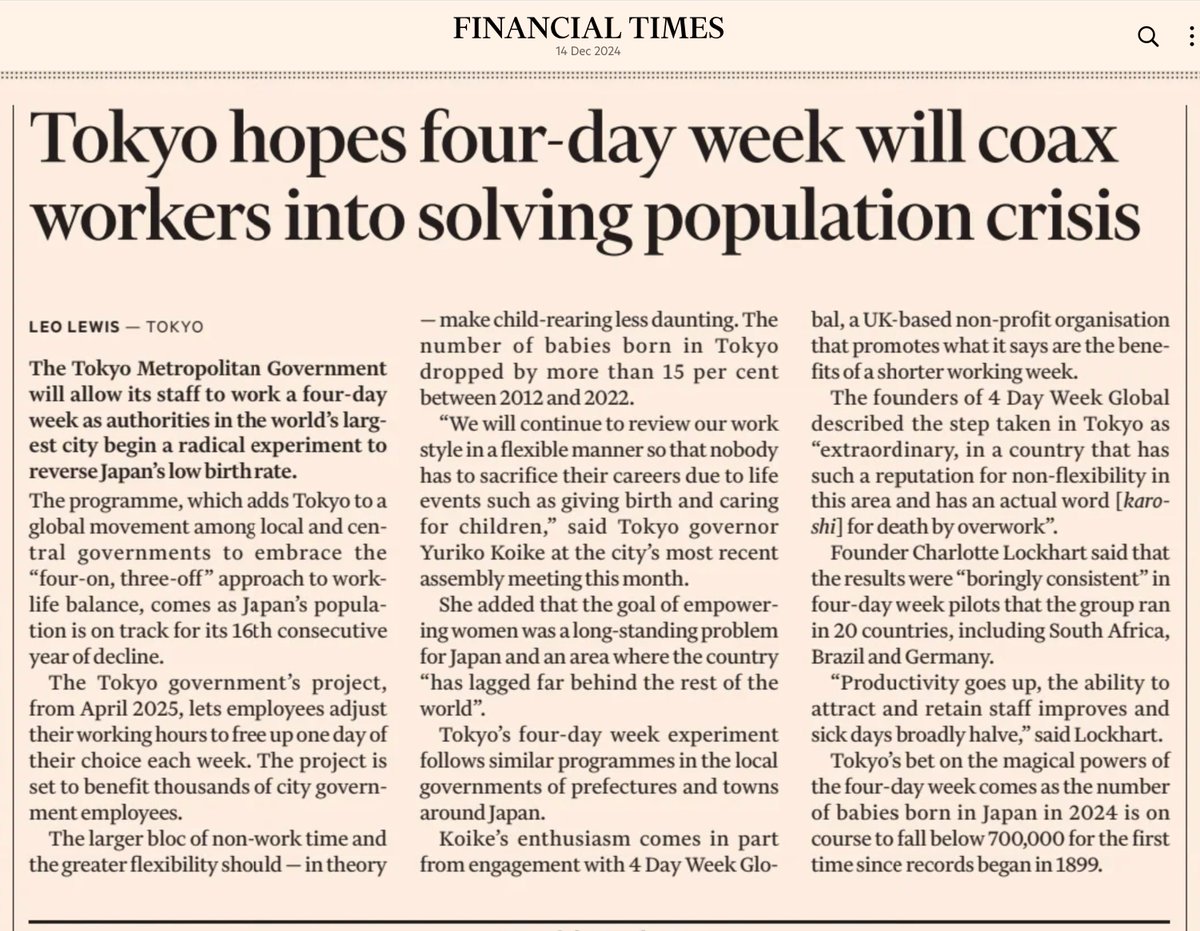
Using #Peircean#abductive-#deductive-#inductive#reasoning on the experimental #4dayworkweek to promote a #birthrate increase in #Tokyo
🇯🇵🍼👩⚕️👨💼📉📈
https://t.co/hEMiVzjMGs via @FT
Here's an application of Peircean abductive, deductive, and inductive reasoning to understand the approach of implementing a four-day workweek in Tokyo to counter the declining population growth rate:
Abductive Reasoning:
Surprising Fact: Tokyo's population growth rate has been decreasing dramatically, with a significant drop in birth rates. This is surprising given the cultural emphasis on family in Japan and the societal implications of demographic decline.
Hypothesis Generation:
Observation: The decline in birth rates coincides with a culture of overworking, suggesting that work-life balance might be a factor.
Hypothesis: If work-life balance is a significant determinant of population growth decisions, then improving this balance through a policy like a four-day workweek might encourage more births.
Deductive Reasoning:
Premises:
Premise 1: If a lack of work-life balance contributes to lower birth rates (based on the hypothesis from abduction), then policies that improve this balance should lead to an increase in birth rates.
Premise 2: A four-day workweek is a policy aimed at improving work-life balance.
Logical Conclusion: Therefore, implementing a four-day workweek in Tokyo should logically result in an increase in the birth rate.
Explanation: The logic here is that by providing more time for family life and reducing the stress associated with long working hours, individuals might be more inclined or able to have children.
Inductive Reasoning:
Evidence:
Global experiments with four-day workweeks have shown benefits like increased productivity, better employee morale, and more time for personal life.
In some cases, these changes have led to more family-oriented activities or decisions.
Inference:
From these specific instances, one might generalize that a similar implementation in Tokyo could lead to similar outcomes, including potentially reversing the trend of declining birth rates.
Generalization: If the pattern holds true across different cultures where work-life balance has been improved, then there's a reasonable expectation that Tokyo could see an uptick in birth rates with this policy, though cultural nuances must be considered.
Implicit Reasoning and Considerations:
Cultural Context: The unique Japanese work culture, including the phenomenon of "karoshi," suggests that this policy might have a profound effect if it successfully shifts cultural norms around work and family.
Empirical Testing: The actual implementation of the four-day workweek will serve as an empirical test of these hypotheses. Success or failure will provide data that can either confirm or challenge the reasoning steps taken.
Broader Implications: This approach not only deals with immediate demographic issues but also has implications for labor laws, economic productivity, gender equality in the workplace, and overall societal well-being.
Conclusion:
1. The abductive process initiates with the surprising fact of decreasing birth rates and hypothesizes a cause (lack of work-life balance), leading to a proposed solution (four-day workweek).
2. Deductive reasoning then applies general principles about work-life balance to predict outcomes in this specific case.
3. Inductive reasoning looks at past examples to infer that this policy might work in Tokyo, acknowledging that while historical data provides a basis for prediction, the unique cultural context of Japan will require observation and analysis over time.
This logical approach provides a structured way to understand and evaluate the policy's potential impact on Japan's demographic challenges, with each step of reasoning building upon the last to form a comprehensive analysis.
The correct response to the poll would be "All of the above — true," as Sherlock Holmes indeed uses a combination of deduction, induction, and abduction in his mystery-solving techniques.
How Does Sherlock Holmes Crack Those Mind-Bending Mysteries?
🎩🔍🕵️♀️🧠🔮
Deduction - The classic Sherlock move. Here, Holmes takes what he observes and makes logical conclusions based on those observations. It's like piecing together a puzzle where every piece is glaringly obvious once you see the picture; think "the dog that didn't bark." It’s all about connecting undeniable facts in a chain of logic that seems inevitable in hindsight.
Induction - This one's for when you're working with patterns rather than certainties. Holmes might observe several similar cases or events and infer a general rule or principle from them. It's less about certainty and more about probability; imagine noticing that every burglary in the neighbourhood happens on a full moon, but you can't be absolutely sure it'll happen again.
Abduction - No, not the extraterrestrial kind. This is where Holmes crafts a likely story from the scant evidence available, essentially hypothesizing the most plausible explanation. He might see a muddy footprint, deduce the weather, and infer the likely path of the suspect. It’s about choosing the best hypothesis among several and then testing it until it either holds or falls apart (this might involve early morning walks or late night survelliance in search of confirmatory clues).
"It's Elementary, My Dear Watson" - A delightful blend of ALL of the above. Sometimes, Holmes uses a cocktail of deduction, induction, and abduction, making the solution appear so straightforward that everyone else feels they've overlooked the obvious. It's when Holmes synthesizes all these methods into a seamless explanation, revealing that the answer was "elementary," not because it was simple, but because it was masterfully pieced together from complex observations.
Vote for your guess, and we'll reveal the correct answer after the poll.
Enjoy sleuthing through the mind of Sherlock Holmes!