@larsencc@bot@larsencc I still can't see the option to connect Apple Mail / iCloud in Grok Bot on my Mac. Messages, Notes, Reminders, Calendar, Location and Contacts all show, but no Mail. Any idea when it's coming?
If you don't actively steer your life, comfort and normalcy will make the decisions for you. Mediocrity has a gravity that everyone succumbs to unless they are actively fighting against it day after day.
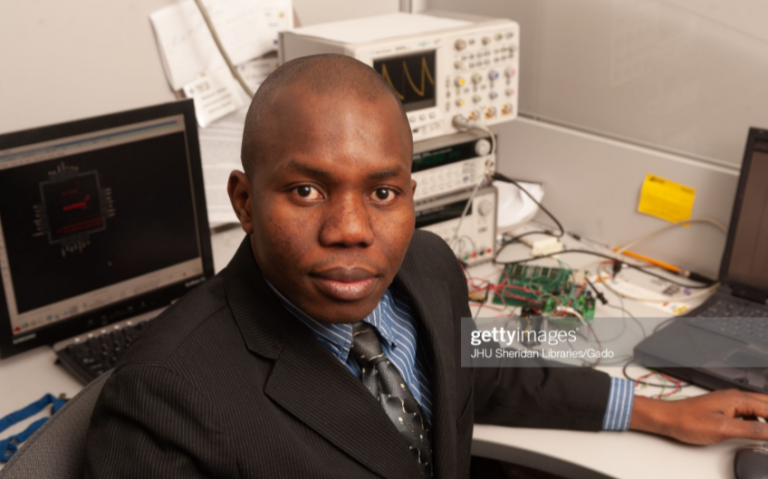
This picture is archived at the Johns Hopkins University Sheridan Libraries. It was a day my major PhD circuit worked, and the University Press was assembled to interview me. You see, I put on a suit! We quickly filed a patent. That patent has been licensed to the US Government for space applications. This year we have been issued 8 local Nigerian patents and we continue to build. We do tech here at https://t.co/JcctpBwmqu
In this quarter, we will be recruiting 20-30 young people to join ContiSX in Owerri, PHC and Kano. Once our stock exchange license is up, the recruitment portal will go public. You need to be part of our team and I ask you to be preparing to apply.
Typically, I like students who did Further Mathematics in secondary school. If you got distinction in WASC/GCE/NECO in it, we will seriously like to explore. If you are not in college, you can work with us and attend NOUN university part time; we fund it. That means, with WAEC, you can apply.
You will work in building new technologies and infrastructures. Yes, foundational blockchain operating system and infrastructure with applications in capital market, banking, devices, electronics, etc. If you are bilingual, even better as we are exporting technologies to Francophone Africa and will need to support operations in French.
Come and let us be colleagues and build great technologies in Africa.
I am an Engineer. Are you ready to build? Prepare and let us do more great things together. Visit https://t.co/fwxYeVmPoQ and https://t.co/GNwCJm8FFp for what we do. I will be your teacher.
while i'm quite bullish on formal methods, i think it's worth tempering expectations and doing your own research on it (disclaimer: i am not an expert in it). it cannot guarantee your code is bug free, only that it matches the spec under certain assumptions, and the specs come from what people want, not math. as long as we build software for humans, nothing can prove that your spec is right, only you can judge.
i created the /statechart skill in pstack primarily because it helps make the state machines implicit in your code more obvious and legible to you, so you can shrink the review surface and review the work at a higher level: does it actually match your intent and goal? i used this skill a ton while building my game https://t.co/sa18sM28uD, below you can see the statechart for story mode where i was able to find many bugs with it.
in that sense, i think model checking (eg TLA+ with TLC) is quite useful for understanding and checking properties of your system e2e, and you don't have to write tons of new verification code for it. the spec isn't your actual code so there's always a risk of drift, but so far i've had good experiences finding actual bugs with it. i tend to pair it with empirical verification (running the code) also to confirm it's real
other types of formal verification like proving theorems (eg Lean, Dafny), bounded model checking (eg CBMC, Kani) etc have their own tradeoffs. proofs cover every possible input, but only for the properties specified, and it takes a lot more code/work. bounded model checking can run on your actual code, which avoids drift, but it only checks up to a certain number of steps, so it's better at finding bugs than proving there aren't any
so i think in the near-medium term you'll still need to layer your codebase: constraints and guardrails (types, lint rules, api design, refactoring), empirical verification (tests, evals, real usage), and formal verification for the parts that really need it. none of these catch everything on their own, but layered together, they catch a lot more and shrink what's left for you to review
but also maybe in the limit, the bitter lesson will prevail and flawless code will just be printed out perfectly every time with no bugs. even in that scenario, /statechart still seems very helpful in confirming that the agent understood your intent correctly. give it a try if you haven't already!
https://t.co/9erGZLOzxO
Stageshow: a skill that helps your agent make better faux UI stills, animations, bento grids, and more.
npx skills add benjitaylor/skills --skill stageshow
AI was supposed to make us work less
I've never been this tired in my life
most days I have up to 10 agents running at the same time. one fixing a bug, one writing pages, one refactoring something I already forgot I asked for, 3 other I have no idea what they are doing but i suppose i ask it?
and I jump from conversation to conversation all day
compared to 5 years ago, I probably context switch 100x more
by the end of the day my brain is fried. completely toasted. nothing left, not even for the people I love
I call it the fried brain effect
thought it was just me but almost every founder I talk to lately says the exact same thing
we got superpowers, and somehow the pressure only went up. if you can ship 10x more, you feel like you have to ship 10x more. every single day
I don't have a solution
honestly I have no idea where this goes from here
anyone else feeling this?
Are Small Models Really a Threat?
The Anthropic Fear Factory just released a new report warning that small models may be only months away from self-replicating across cheap IoT devices like off-brand Android TV boxes and smart ovens. They say such an AI worm would be hard to shut down since there’s no central kill switch.
We’ve gone from “The Terminator is coming” to “your toaster might kill you.”
But the experiments don’t support the dramatic headlines. They ran a 26B model across 15 $55 TV boxes at 0.39 tokens per second. The end-to-end test used emulated devices with deliberately open ADB ports, so the “hacking” step was trivial. The capable model often ran on a separate server. Agents were harnessed and told to propagate. This is not proof of autonomous rogue AI worms in the wild.
Nor is the threat even novel. Worms that do this without AI already exist. Mirai in 2016 scanned for default credentials and built massive DDoS botnets. Kimwolf has infected over two million devices, mostly cheap Android TV boxes, by hitting open ADB ports.
Small models don’t currently add much that matters on these targets. The bottleneck has never been figuring out the device. It’s the huge number of devices that ship with open ports, default passwords, and no patching. Traditional worms already exploit that at scale.
A practical attacker would use the best models available offline to design a better traditional worm, then ship the lean binary. You get the intelligence benefit at design time without dragging a slow, heavy model along with every infection. Embedding a weak model in the payload is the worse option for anyone who actually wants the largest, fastest botnet.
The timing of Anthropic’s latest scare campaign is hard to ignore. The day before, Brian Armstrong posted that Coinbase fine-tuned an open-weight small model (Qwen-3.5-9B) on proprietary fraud data. It beat frontier models, including Anthropic’s own Opus 4.5, while being faster and much cheaper. In testing it cut fraudulent transactions by about 30%.
This is the emerging pattern. For narrow enterprise workloads you don’t need a general superintelligence. You need a small specialist model trained on your own data. Cheaper to run, especially as compute gets tighter, and often better on the metric that matters. That is a direct threat to the frontier-company model of selling access to ever-larger general models.
Safety advocates should be welcoming this development. If the real concern is existential risk from ever-larger frontier systems — the ones that could theoretically do sustained autonomous R&D or become hard to control — then a shift toward smaller specialized models is the safer outcome.
Small models specialized on fraud detection or support tickets are not pushing the frontier. They are not in the category of systems that could become a new species. The theoretical loss-of-control risk is created by models getting bigger and more generally capable.
Safety advocates focused on those risks should welcome companies having a cheaper alternative to constantly scaling general models. Instead we get dramatic warnings about small models at the exact moment they are starting to take real enterprise share from closed-model companies like Anthropic.
String theory is what happens when an intelligent system is starved of sensory input and starts hallucinating. Intelligence needs grounding.
For this reason, intelligence is practically never the bottleneck to solving impactful problems. The bottleneck is iterated contact with reality.
If you're losing interest in your goals, it might be because you're doubting you can reach them.
If you're doubting you can reach them, it might be because you're flailing.
If you're flailing, it might be because you're trying to take on too big of a starting challenge relative to your underlying skills.
Imagine someone who goes to the gym, gets super hyped up to lift the heaviest weight, repeatedly fails to lift it, and starts to lose interest.
Is that you?
If that's you, then realize that not only are you not getting any stronger, but you're also wasting valuable time that you could be using to successfully develop your strength.
If that's you, then it's time to put your ego aside and re-allocate your time into shoring up your foundations.