You can smell rain better than a shark can smell blood. 200,000 times better. Your nose picks up the compound behind petrichor (that smell after rain) at levels so tiny it's like finding one teaspoon spilled across 200 Olympic swimming pools.
That compound is called geosmin. It comes from soil bacteria. And the word "petrichor" itself didn't exist until 1964, when two Australian scientists, Isabel Joy Bear and Richard Thomas, published a paper in Nature trying to figure out why rocks smell after rain. They took the Greek words for stone and "the blood of the gods" and stuck them together. Blood of the stone.
When soil stays dry for weeks, certain plants leak an oil that the clay soaks up like a sponge. At the same time, soil bacteria called Streptomyces start making spores (tiny survival pods that can sprout into new bacteria later) and give off geosmin while they do it. The smell just sits there in the dirt, waiting.
Then rain hits. A 2015 MIT paper figured out the physics of what happens next. Raindrops land on dry soil and trap tiny air bubbles in the soil's pores. The bubbles rise up through the raindrop and pop out the top, flinging thousands of tiny droplets into the air. Each one carries a piece of the oil, some bacterial spores, and some geosmin. Wind does the rest. Light rain releases the most of these droplets. Heavy rain releases very few, which is why a drizzle smells more than a downpour. MIT estimated that rain across the planet throws between 10,000 and 800,000 trillion bacterial cells into the air every single year.
In 2020, scientists in Sweden and the UK published a paper in Nature Microbiology that explained why this smell exists at all. Streptomyces bacteria only release geosmin when they're about to die and make spores. The smell is a bacterial ad. It attracts tiny 1.5mm bugs called springtails, which eat the bacteria. Springtails have evolved enzymes that let them survive the antibiotics Streptomyces produce to kill everything else. In exchange, the bacterial spores pass through the springtail's gut alive and stick to its body, hitching a ride to new soil. This deal has been running for about 400 million years.
Same molecule, different stories. Geosmin is why raw beets taste like dirt. It's why catfish and tilapia taste muddy when raised in bad water. Acid breaks it down, which is why every recipe for muddy fish starts with vinegar or lemon juice.
Your nose catches all of this at parts-per-trillion. You're smelling a 400-million-year-old conversation between soil bacteria and the bugs that eat them.
The research behind this is wild. If you spent years bottling your feelings, huge chunks of your life were probably never recorded in the first place. Every time you push down a feeling, your brain has to choose: save the memory of what's happening, or shut the emotion up. It picks the emotion.
In 2000, a team at Stanford tested this. They showed people a surgical film. Half were told to react naturally, the way they would if they were alone. The other half were told to hide their reactions, like someone trying not to look upset at the dinner table. Then everyone took a surprise memory test. The suppressors did worse on every measure, on what they'd seen and on what they'd heard. The same pattern held in two more experiments in the same paper.
Brain scans later explained why. Your brain has three jobs when something emotional happens: tag the feeling, put what's happening into words, and save the scene to memory. When you reframe a feeling instead of suppressing it, all three regions fire together as a team. When you suppress, that teamwork falls apart. The memory-saving region goes quiet while the brain fights its own emotional response.
And it compounds over time. Suppression keeps cortisol (the stress hormone) high, and cortisol shrinks the part of your brain that saves memories. People under chronic stress can lose 10 to 15 percent of the volume there. Even three weeks of elevated cortisol shrinks the wiring between brain cells by about 20 percent. The damage can partly reverse once the stress drops. But not always.
The long-term cost shows up in the dementia data. A Finnish study followed 1,137 older adults for about a decade. People who said they habitually suppressed their emotions had nearly five times the risk of developing dementia. The researchers accounted for genetics, smoking, obesity, and education, and the gap still held.
There's a way out. It's called cognitive reappraisal. Instead of shoving a feeling down, you change the story you're telling yourself about what caused it. A tough meeting becomes practice. A short-tempered friend becomes a tired friend. Same event, new frame. And because reappraisal kicks in before the emotion fully fires, your brain never has to fight itself. A 2003 study from Stanford and UC Berkeley found reappraisers ended up with more positive emotion, better relationships, and higher wellbeing. Zero memory cost.
So when you say you don't remember half your life, you might be right about that. The part of you that saves the record had other orders the whole time.
The research behind this is wild. Your face as a kid shaped how teachers treated you, how many friends you made, how much practice you got being social, and even how much money you earn right now. It starts before you can crawl.
Babies just hours old already prefer attractive faces. Researchers at the University of Exeter showed newborns (average age: 2 days) pairs of faces and tracked which ones they stared at longer. The babies consistently picked the faces adults rated as good-looking. The sorting starts on day one.
Teachers do it too. In a 1973 study, they were given identical student profiles with different photos attached. The teachers rated the good-looking kids as having more academic potential, paid them more attention in class, and gave more detailed help when they struggled. Same kid on paper, different face, completely different treatment.
This creates a loop that psychologists have studied for decades. When people expect you to be friendly and capable, they act warmer toward you, and because they're warm, you actually become more social in return. Researchers at the University of Minnesota proved this in 1977 with a phone experiment. Men were shown a fake photo before a call (not the actual woman on the line). The ones who thought she was attractive were friendlier. And the women on the other end, who knew nothing about any photo, became more outgoing in response. The expectation changed real behavior in real time.
Now picture this running on repeat for an entire childhood. The good-looking kid gets picked for group projects, invited to birthday parties, gets smiles from strangers at the grocery store. Each of those is a rep. Social skills work like a muscle, and you get better by doing them over and over. The kid who got fewer invitations and fewer smiles fell behind for a simple reason: less practice.
The University of Texas pulled together 919 studies on attractiveness and found the same four things every time: people across cultures agree on who is good-looking, those kids get judged more favorably, they get treated better by the adults around them, and they end up with stronger social skills. Once the loop starts, it feeds itself.
It carries into your paycheck. Economists at UT Austin found that workers rated below average in looks earn 5 to 10% less per hour than average-looking coworkers, even when education and experience are the same. Over a 40-year career, that penalty alone runs into six figures. A 2026 study in Personality and Individual Differences tracked kids rated for their looks at ages 7 and 11, then checked back at age 50. The ones rated attractive in childhood still had better social skills four decades later.
So yeah, this tweet is more right than wrong. But the real driver is practice. Being less attractive as a kid meant fewer people reaching out to you, fewer good interactions, fewer chances to build the muscle. You didn't lack a social gene. You got fewer at-bats.
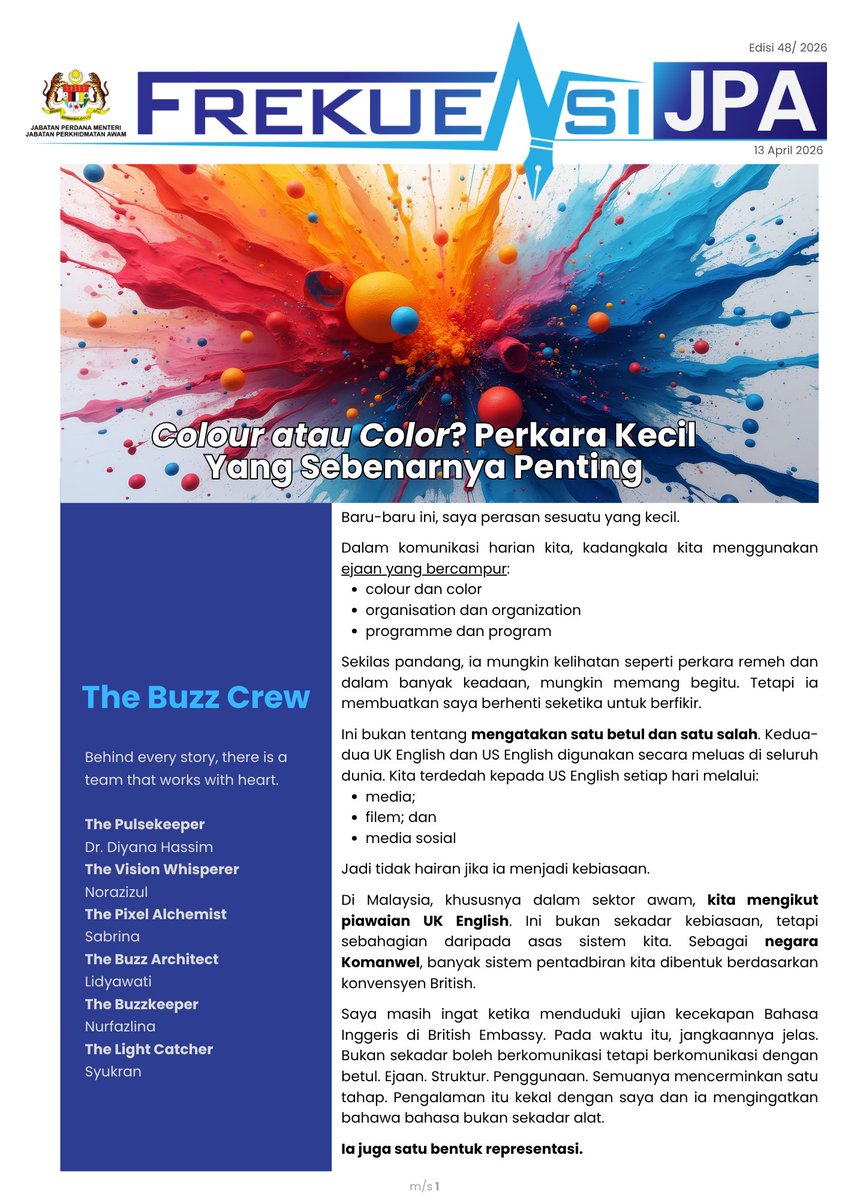
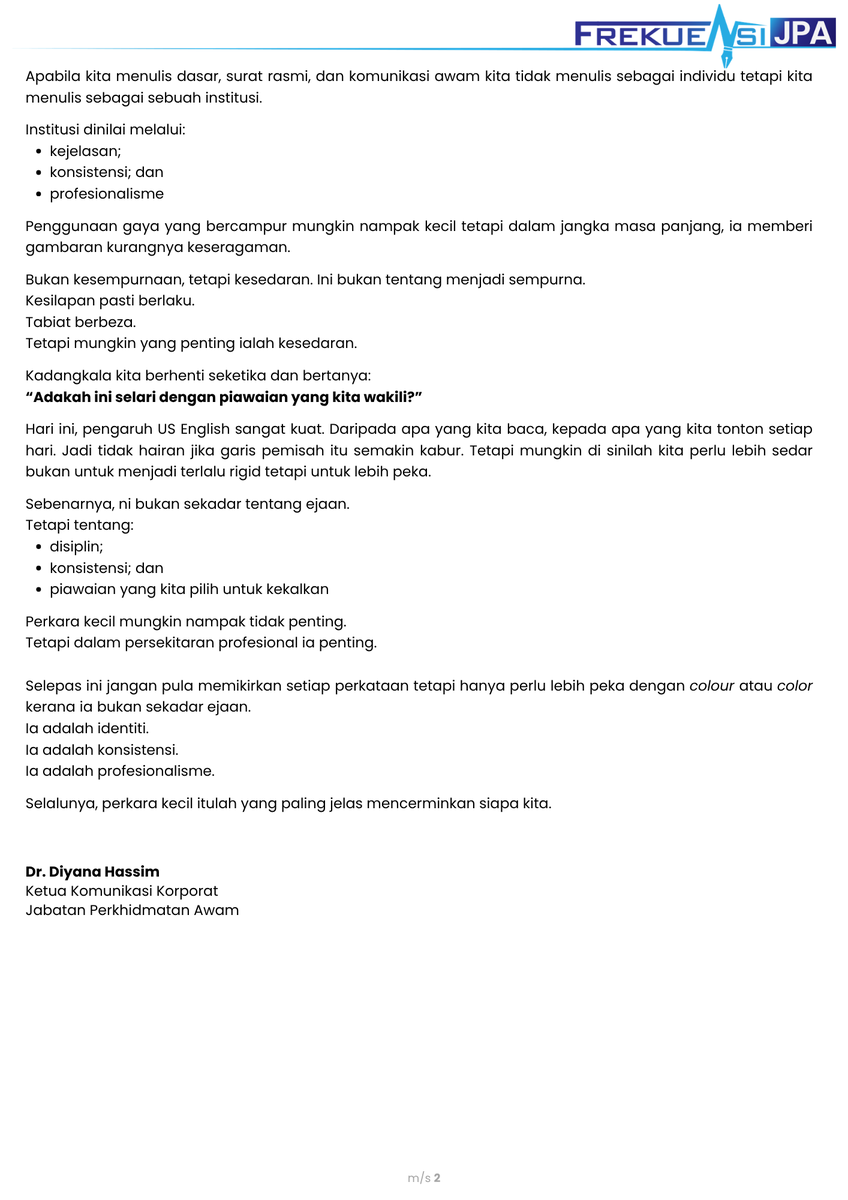
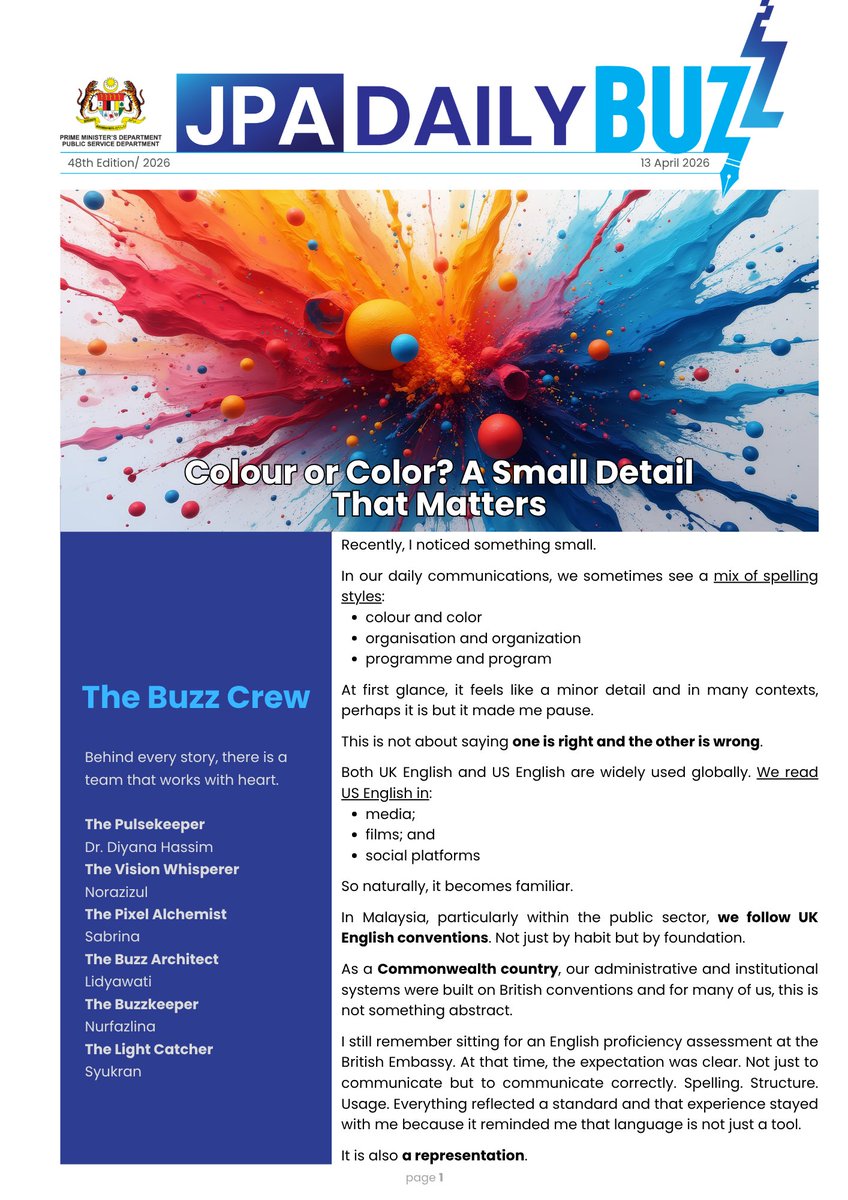
“Colour” atau “Color”?
Bukan sekadar ejaan, ini soal identiti, konsistensi dan profesionalisme.
Dalam komunikasi awam, perkara kecil mencerminkan siapa kita sebagai institusi.
Adakah setiap perkataan yang kita pilih selari dengan piawaian yang kita wakili?
You have your mother's cells in your brain right now. If she ever carried you, yours are in hers.
Scientists looked at the brains of 59 women after they died, ages 32 to 101. In 63% of them, they found their sons' DNA scattered across different brain regions. The cells had traveled from the womb, through the blood, past the wall that normally keeps foreign material out of the brain, and settled in. The oldest woman still carrying her son's cells in her brain was 94. In mice, those cells became functional brain cells.
The transfer starts as early as 7 weeks into pregnancy. Your cells slip through the placenta into your mother's body. Hers slips into yours. One study found a mother still had her son's cells in her blood 27 years after giving birth. After delivery, between 50 and 75% of women carry their child's cells. During pregnancy, up to 6% of a woman's blood DNA comes from the baby.
When a mother's heart gets damaged during or after pregnancy, the baby's cells travel to the injury, latch on, and turn into beating heart cells, blood vessel lining, and muscle. Heart failure tied to pregnancy has a 50% spontaneous recovery rate, better than every other kind. The Mount Sinai team behind the research thinks the baby's cells are fixing the mother's heart from the inside.
The cancer data caught me off guard. A study compared healthy women to women with breast cancer. 85% of the healthy group still carried their children's cells. Only 64% of the breast cancer group did. That works out to about 4x lower odds of getting breast cancer if you kept those cells. The working theory is that they patrol the body and catch cancer cells before they grow.
A 2022 study found that in developing mouse brains, a mother's cells controlled the brain's immune cells, preventing them from cutting too many connections between brain cells. Your mom's cells helped wire your brain before you were born.
And it stacks across generations. A woman can carry cells from her kids, from her own mother, and even from pregnancies her mother had before her. Three generations of cells from different people, living inside one body.
we need to talk about how seokjin didn't even let studio jin marinate that he was already outdoing himself /live/ to the point where he went viral with a whole new nickname for his immaculate vocals😭 Siren Jin no one is doing it like youuu
This clips of Yoongi trying to hold back his smile but failing then giving us the most beautiful gummy smile
One time for Two times for
the past. the present.
#Jin
Thank you for coming back immediately
Thank you for festa 2024
Thank your for all the fan events
Thank you for Run Jin
Thank you for Happy
Thank you for Echo
Thank you for all the variety shows
Thank you for the tour
Thank you for everything else
Thank you for loving us.
PENGGUNA IPHONE SILA AMBIL PERHATIAN
DarkSword adalah satu rantaian eksploitasi yang direka untuk mencuri data sensitif dengan pantas. Malaysia telah menjadi negara sasaran selain Ukraine, Turkiye dan Arab Saudi.
Pengguna iPhone dinasihatkan supaya kemas kini versi terkini.
When I look at my life, I see how kind Allah has been to me, so many du'as were answered without me even realizing it, so much protection was given when I didn't know I needed it, I can never be grateful enough for how far Allah's mercy and love has brought me...Alhamdulliah
Guys Malaysia baru saja melakukan sesuatu yang belum pernah dilakukan negara lain.
Mereka tidak tunda perjanjian dagang dengan Amerika.
Tidak minta renegosiasi.
Tidak bilang sedang dikaji ulang.
Mereka bilang perjanjian itu tidak ada lagi.
Null and void.
Batal demi hukum.
Kata-kata langsung dari Menteri Perdagangan Malaysia 'It is not on hold. It is no longer there.'
Ini perlu dipahami konteksnya.
Lima bulan lalu Trump dan PM Anwar Ibrahim tanda tangan perjanjian dagang di KL.
Tarif Malaysia dipotong dari 47 persen ke 19 persen.
Trump bilang ini bukti bahwa sistem tarif timbal baliknya berhasil. Dijadikan template untuk negara-negara lain.
Sekarang template itu tidak berlaku.
Kenapa?
Karena tanggal 20 Februari 2026 Mahkamah Agung Amerika memutuskan bahwa undang-undang yang dijadikan dasar hukum oleh Trump untuk membuat semua perjanjian tarif ini yang namanya IEEPA ternyata tidak memberi presiden kewenangan untuk bikin tarif sepihak.
Artinya semua perjanjian dagang yang Trump tanda tangani sejak 2025 sampai Februari 2026 fondasinya baru saja dinyatakan tidak sah oleh pengadilan tertinggi Amerika sendiri.
Malaysia baca putusan itu.
Dan langsung jalan.
Dan ini yang perlu digarisbawahi.
Malaysia bukan satu-satunya negara yang tanda tangan perjanjian dengan fondasi hukum yang sama. Ada banyak negara lain yang perjanjiannya berdiri di atas dasar hukum yang sama persis yang sudah dinyatakan tidak berlaku.
Setiap menteri perdagangan di setiap negara yang tanda tangan perjanjian itu sekarang sedang baca putusan Mahkamah Agung Amerika yang sama. Dan mereka semua sedang tanya pertanyaan yang sama.
Apakah perjanjian kita masih bisa ditegakkan secara hukum?
Jawaban teknisnya tidak.
Fondasinya sudah gugur.
Malaysia cuma yang pertama ngomong keras.
Dan ini menarik untuk Indonesia.
Kita sedang di tengah tekanan perang Iran yang bikin harga minyak naik dan rupiah melemah. APBN kita sedang disiapkan skenario defisit sampai 4 persen. Dan sekarang arsitektur perdagangan Amerika — yang selama ini dianggap stabil ternyata berdiri di atas kewenangan yang tidak pernah ada.
Sistem-sistem yang kita anggap kokoh ternyata lebih rapuh dari yang kita kira.
Malaysia baru saja menarik satu benang.
Dan tidak ada yang tahu berapa banyak benang lain yang akan ikut tertarik.
Scientists studying the brain at the moment of death have discovered something remarkable: the mind doesn’t simply stop it surges right at the end. Every person experiences it differently, yet Islam described this reality over 1400 years ago.
The Prophet PBUH explained that there are two types of death:
For the believer, angels arrive with faces like the sun, fragrances of Paradise fill the air and the soul flows gently toward Allah’s forgiveness, like water pouring from a skin.
For the one who turns away from Allah, the soul is violently pulled, as if torn by metal skewers from wet wool. SubhanAllah, the contrast could not be clearer.
This is a profound reminder: every moment in life is preparation for the reality of death and the Hereafter. Reflect, purify your soul, and strive to meet Allah in a state of faith and obedience.
This is even more significant when you have children. I used to be much less sentimental about the furniture or decor we brought into our home. But then I began to see these things through the eyes of our children. The coffee table is no longer just a coffee table. The cup or the pot is no longer a cup or pot. The cozy corner in the room is a space enhanced with life and wonder. These practical things once used to make the home more beautiful and functional become the context for core experiences. The way they are utilized supersedes their intended purpose. The house becomes their home and all that. The practical becomes inhabited with comfort and wonder.
Most childhood trauma isn’t in your memories.
It’s in your nervous system.
In the jaw that stays tight.
In the scalp that never relaxes.
In the back of the head where the body stays on alert.
This simple release helps the body finally let go.
↓
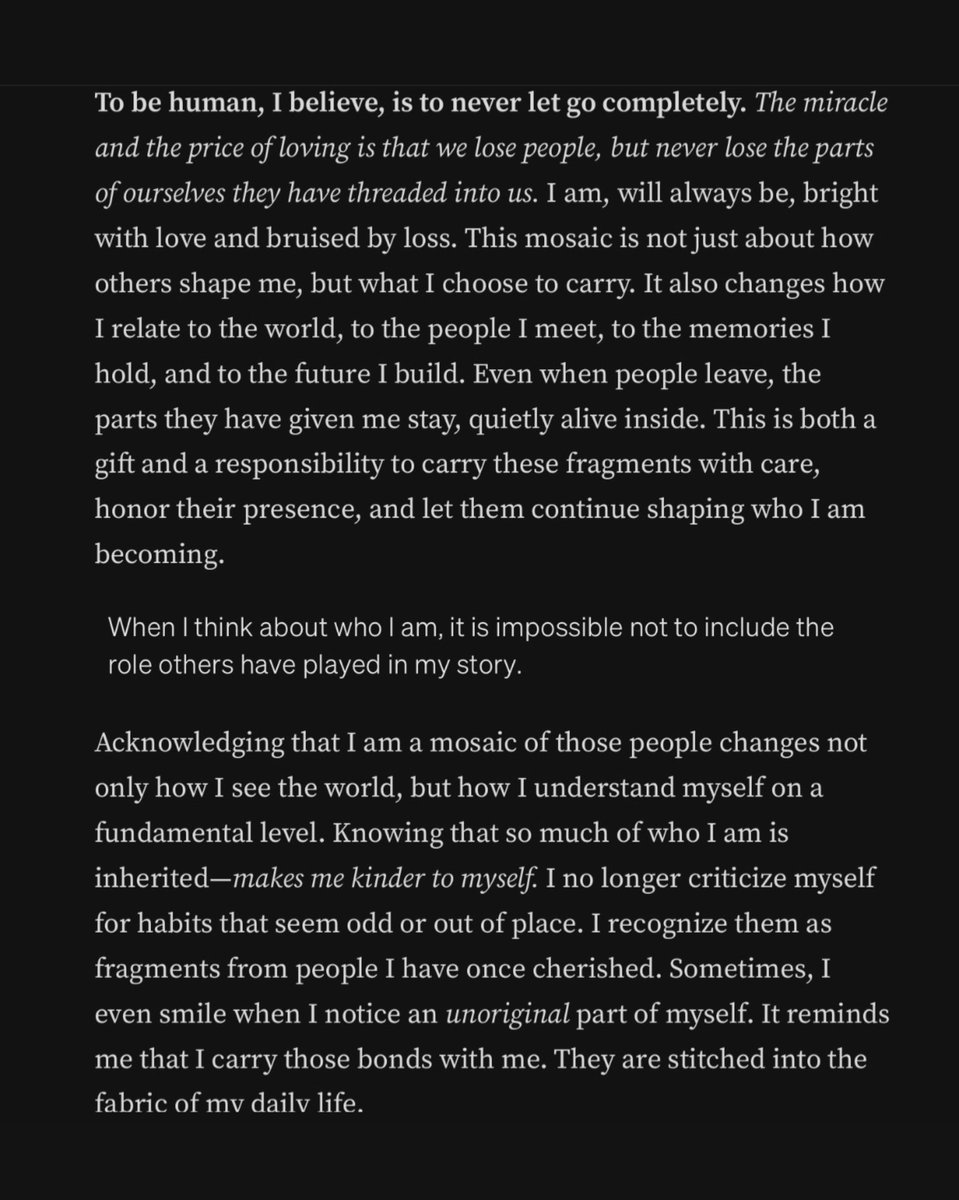
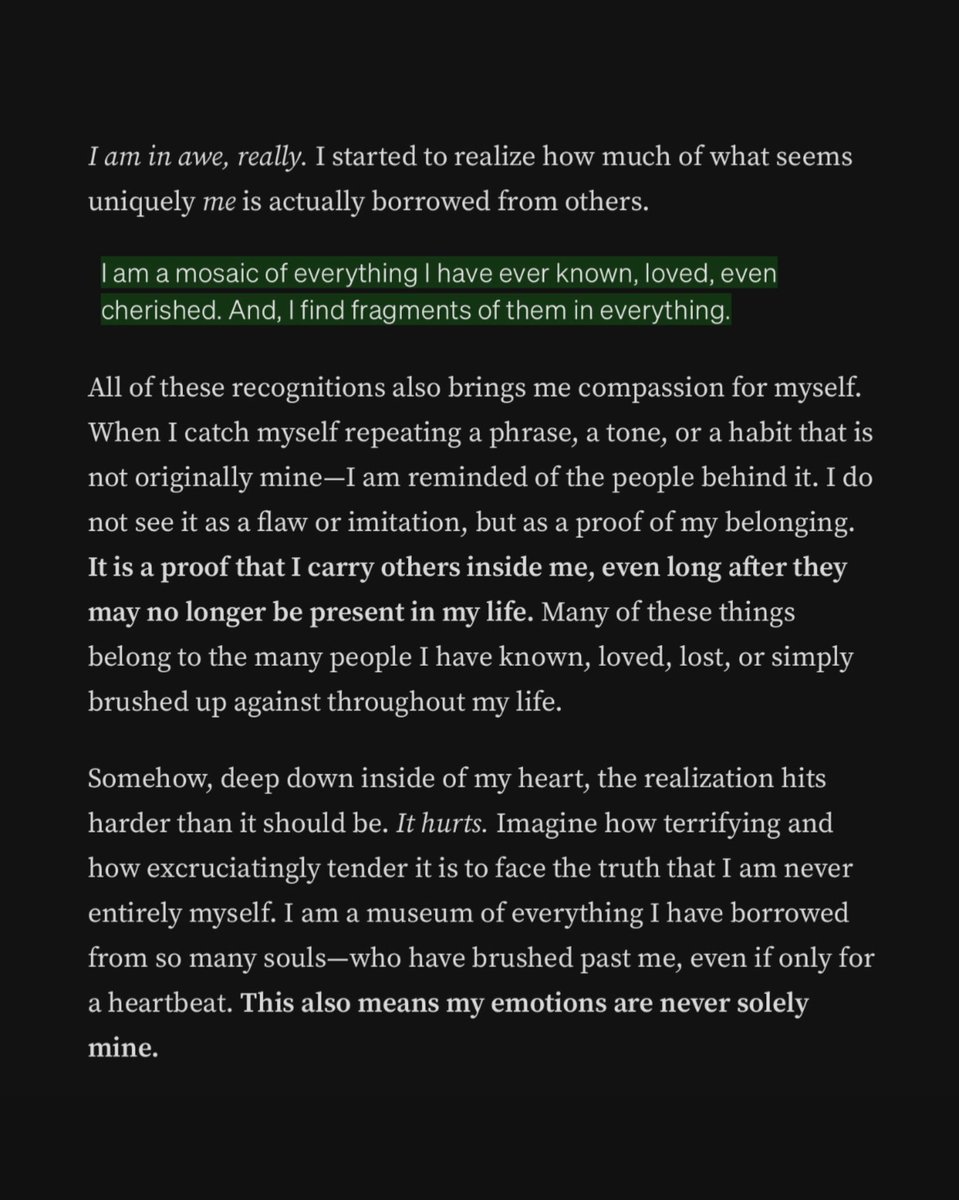
As human beings, we never truly let anyone go. It reminds us to cherish the fragments we carry, for they are proof of a life richly lived and loved. We are made whole by the fragments of others, endlessly carried forward in love. We are the mosaic of people we have ever loved.
Ada penelitian yang menjelaskan bahwa menekan emosi kita atas suatu kondisi emosional dapat menyebabkan memori spesifik pada kondisi emosional itu juga berkurang.
Jadi BUKAN sering menahan emosi bisa bikin pikun secara umum, tapi hanya 𝘀𝗽𝗲𝘀𝗶𝗳𝗶𝗸 𝗱𝗶 𝗸𝗲𝗷𝗮𝗱𝗶𝗮𝗻 emosional tersebut aja.
Sini gue jelasin!
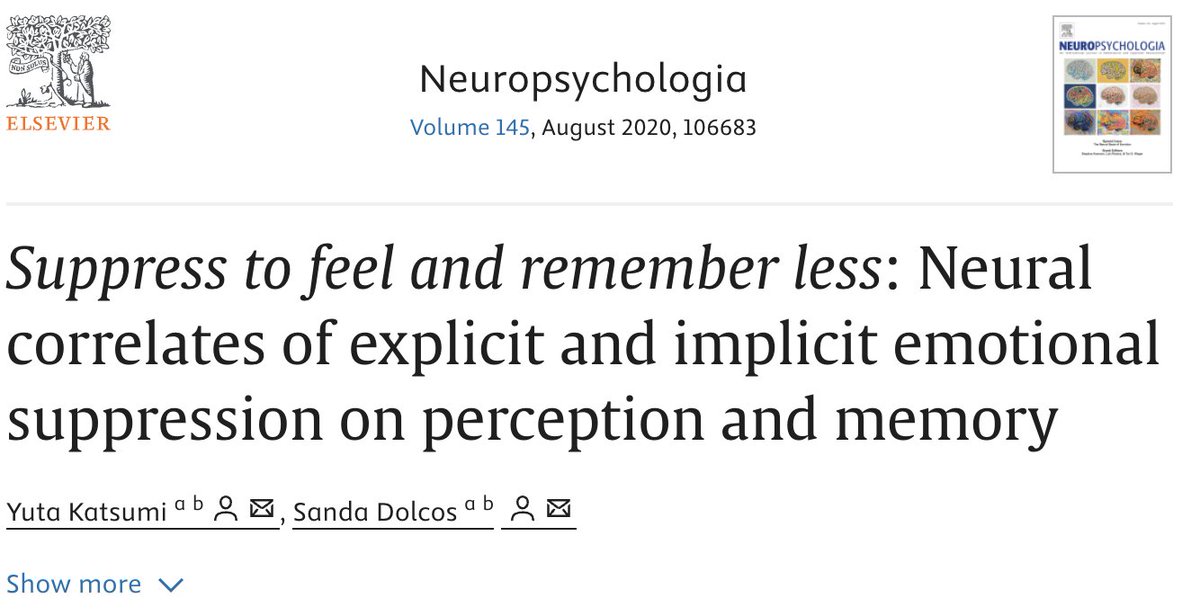
Jadi ada penelitian tahun 2018, judulnya Suppress to feel and remember less: Neural correlates of explicit and implicit emotional suppression. Nah penelitian ini mau mengetahui 𝗺𝗲𝗻𝗲𝗸𝗮𝗻 𝗲𝗺𝗼𝘀𝗶 𝗱𝗮𝗽𝗮𝘁 𝗯𝗲𝗿𝗽𝗲𝗻𝗴𝗮𝗿𝘂𝗵 𝗽𝗮𝗱𝗮 𝗺𝗲𝗺𝗼𝗿𝗶 𝗱𝗶 𝘀𝘂𝗮𝘁𝘂 𝗸𝗲𝗷𝗮𝗱𝗶𝗮𝗻 𝗲𝗺𝗼𝘀𝗶𝗼𝗻𝗮𝗹.
Hasilnya menunjukkan bahwa bila 𝗯𝗲𝗿𝘂𝘀𝗮𝗵𝗮 𝗺𝗲𝗻𝗲𝗸𝗮𝗻 𝗲𝗺𝗼𝘀𝗶 𝗸𝗶𝘁𝗮 pada suatu kejadian tertentu, maka akan terjadi 𝗽𝗲𝗻𝘂𝗿𝘂𝗻𝗮𝗻 𝗽𝗲𝗺𝗯𝗲𝗻𝘁𝘂𝗸𝗮𝗻 𝗺𝗲𝗺𝗼𝗿𝗶 𝗮𝘁𝗮𝘀 𝗸𝗲𝗷𝗮𝗱𝗶𝗮𝗻 𝘁𝗲𝗿𝘀𝗲𝗯𝘂𝘁, yang akhirnya kejadiannya akan mudah dilupakan.
Mekanismenya adalah karena berkurangnya interaksi antara amygdala dan hippocampus di otak, akibat penekanan emosi tadi, sehingga pembentukan memori mengenai kejadian emosional tadi jadi terganggu.
Semoga bermanfaat!