Ex-Tesla engineer, ex-neuroscientist, ex-candidate for Mayor of San Francisco. Focused on abundance: Universal Basic Income, housing, effective government.
California's jungle primary leads to massive vote splitting between ideologically similar candidates. We could fix this bug with one simple tweak: allow voters to choose all the candidates they approve of. See reply for a link to the fix: a three-word change to the Elections Code
Democrats in California are facing a NIGHTMARE scenario: a Republican governor.
Polling shows Chad Bianco and Steve Hilton could end up as the top two candidates. Shutting Democrats out entirely.
They are COOKED.
Is California going red?
3/3
III. Your proposed experiment on Wolfram's finite-state machines
15/ I retrieved Wolfram's own code from the Wolfram Function Repository and reproduced his 2-state results, TFT ranks 8 of 22. I then iterated his tournament: replicator dynamics from the uniform start, and a finite population of N = 100 with rare mutation. I did this with and without 1% execution errors.
16/ For 2-state machines without errors, the machine ranked first in the uniform field remains the most common machine. And the population converges to nice machines only, with full cooperation: Grim 0.67, TFT 0.13, WSLS 0.12, and one other nice machine 0.07. Grim and TFT are the only robust machines. Linster reported the same qualitative outcome in 1992.
17/ For 3-state machines without errors, your prediction holds: nine of the ten top-ranked machines defect on the first move, and the top one exploits an unconditional cooperator forever. Under repeated generations, howerver, these defecting strategies are replaced and the population quickly consists only of nice machines that are fully cooperative.
18/ With 1% errors, the 2-state ranking barely changes: Grim ties ALLD for first. But the evolutionary dynamics change completely.
• Among 2-state machines, cooperation in the replicator dynamics falls to the error rate, and no machine is robust.
• Among 3-state machines, cooperation is about 0.94 under both dynamics. Under strong selection the only robust machine, up to its start state, is one of Wolfram's 3-state machines, known in the literature as AON₂.
19/ The reason AON₂ is favored at Wolfram's payoffs is exact arithmetic. ALLD earns (T+P)/2 against WSLS, which equals R when 2R = T + P, so WSLS cannot resist ALLD. In the donation game this payoff is b/2. ALLD earns (T+2P)/3 against AON₂, which is less than R. So at Wolfram's payoffs, provably no deterministic 2-state machine sustains cooperation with errors, and a 3-state machine does. (The machine that selection favors in his own 3-state space is the strategy Hilbe et al. derived from axioms in 2017.)
20/ In short: Wolfram's recent experiment was first run in 1987, your proposed extension soon after, and in the decades since the field has produced theorems of the kind Wolfram says might be hard to find, plus genuine surprises like Bill Press and Freeman Dyson's discovery of zero-determinant strategies. It's an exciting an ongoing field, something that maybe Taleb might enjoy learning about.
2/3
II. What has been understood since Nowak & Sigmund
7/ Your point that no strategy simply "wins" is a theorem. Boyd & Lorberbaum (1987) showed that no pure strategy is evolutionarily stable in the repeated PD. van Veelen (2016) proved that no strategy is evolutionarily stable in repeated games with discounting. They also proved that, for a large enough continuation probability, no strategy is even robust against indirect invasions: a neutral mutant can increase in frequency by drift and then give a second mutant a selective advantage. (Errors change this, and the cleanest theorems are about finite automata with errors are due to economists like Fudenberg & Maskin in the 1990s.)
8/ Press & Dyson (PNAS 2012) discovered zero-determinant strategies. A memory-one player using one can unilaterally enforce a linear relation between her own long-run payoff and her opponent's, extortion included.
9/ Press & Dyson also derived a lemma about memory. Against a memory-one player X, any strategy Y with longer memory yields exactly the payoffs of some memory-one strategy, obtained by averaging Y's responses over the histories that occur in play against X. The memory-1 equivalent strategy of Y thus depends on X. The upshot is that within one pairing, longer memory gives no advantage against a memory-one opponent.
10/ The opponent-dependence in the Press–Dyson lemma explains Wolfram's finite-state machine with 10 states, which scores the maximum against every 2-state machine in matching pennies. Against each 2-state opponent its payoff equals that of some memory-one strategy, but a different memory-one strategy for each opponent. Wolfram reports the same thing directly: the machine uses a different subset of its states against each opponent.
11/ Stewart and Plotkin (PNAS 2013) asked which memory-one strategies are evolutionarily robust. Robust means that, in a population of size N, no single mutant fixes with probability above the neutral value 1/N. For the donation game under weak selection we classified all robust memory-strategies, against invaders of anuy memory length.
12/ We also proved, for strong selection and any 2×2 game, that a robust memory-one strategy must be one of four types:
• it cooperates with itself;
• it defects against itself;
• it alternates against itself;
• it is an equalizer, which fixes its opponent's payoff.
We gave exact robustness conditions for each type.
13/ The ZD construction extends well beyond two actions. McAvoy & Hauert extended ZD strategies to arbitrary action spaces with discounting. Stewart and I extended it to arbitrary numbers of discrete actions, arbitrary memory length, and n-player games, etc.
14/ Your point about whether Axelrod's properties describe successful strategies now has a mathematical answer. Axelrod identified these properties by examining which strategies scored highest in his tournaments and simulations. We have derived them mathematically (2013, 2014) as necceasry and sufficient conditions for cooperative strategy to resist invasion:
• nice: a robust ZD strategy cooperates with copies of itself;
• retaliatory: a robust cooperative memory-one strategy must defect, with positive probability, after its co-player defects against its cooperation;
• forgiving, within limits: a robust ZD strategy is generous, so a co-player who departs from cooperation earns more than it does, but the co-player's advantage is less than half of the generous strategy's own shortfall below R.
"If HSH and its providers possess incident-level information capable of distinguishing resident-caused destruction from provider-caused/deferred-maintenance conditions, how is that information used when the City evaluates repair funding, contract increases, insurance costs and habitability claims?" @mattdorsey@RafaelMandelman@kunalmodi@DanielLurie
https://t.co/Z71jVUkMko
1/3
Steve, I agree with your main point: a ranking against a uniform field of strategies and the outcome of evolutionary dynamics are different objects. But there is more to say, both about what Wolfram's post leaves out and about what the field has established since Nowak & Sigmund. The second part matters more, because much of it is proved rather than simulated. I also ran the experiment you propose on Wolfram's own finite-state machines; results at the end.
I. What Wolfram's post leaves out
1/ Finite automata as strategies for the repeated Prisoner's Dilemma are a forty-year literature: Rubinstein, Binmore & Samuelson and others started this in the 1980s. Linster (1992) studied the evolutionary dynamics of all 26 one- and two-state finite-state (Moore) machines, which is exactly Wolfram's 2-state space.
2/ Axelrod ran Wolfram's adaptive-evolution experiment in 1987, with a genetic algorithm (in Davis, Genetic Algorithms and Simulated Annealing). Evolving against a fixed field of eight strategies from his second tournament, 11 of 40 runs produced rules that scored substantially higher than TFT. Those rules defected on the first move and exploited one member of the field. When the rules evolved against each other instead, reciprocating rules eventually spread.
3/ The experiment you propose, iterating the tournament, has also been run on Wolfram's whole class of strategies. van Veelen (2012) evolved populations drawn from every strategy that can be encoded by a finite-state automaton. The populations showed perpetual oscillation between cooperation and defection, through neutral mutants that allow other mutants to invade.
4/ Without errors, 20 of Wolfram's 22 two-state machines are deterministic memory-one strategies. TFT, Grim and WSLS are three such machines. His 2-state ranking is therefore a ranking of corners of the memory-one strategy space, the four-dimensional cube of cooperation probabilities that Nowak & Sigmund studied in full.
5/ Wolfram's play has no errors, or trembling hand. Without errors, Grim never enters permanent defection against an opponent that does not defect first. Errors are the reason WSLS and generous strategies are favored in the Nowak–Sigmund work, and errors really change the outcome in Wolfram's setting too (see below)
6/ Wolfram writes that it will be difficult to "prove a theorem" about which strategy is best. Theorems about which strategies resist invasion do in fact exist, and they are what I would most add to your thread.
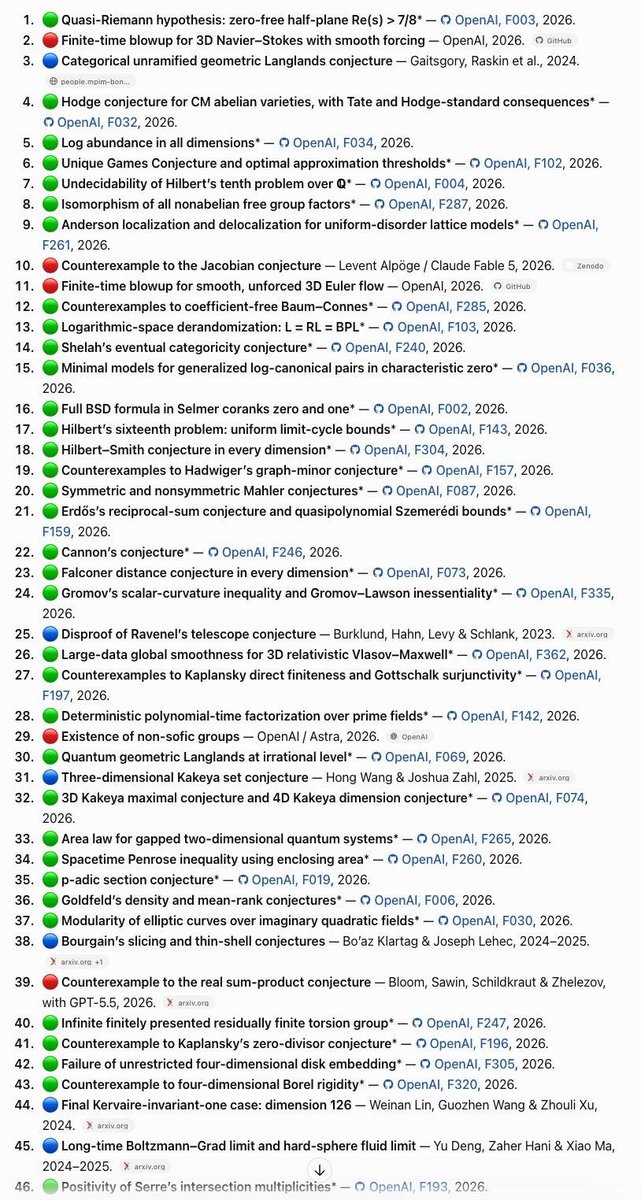
i asked GPT 6 Pro and Fable 5.1 to rank all discoveries in the last three years
🔵 for Human discovered
🔴 for AI discovered (before October 6th)
🟢 for AI discovered from OpenAI/math repo
81% of them have been released today. wtf
Dear Nassim @nntaleb,
I’ve seen you refer a few times to @stephen_wolfram's recent finite-state-machine experiments with the Prisoner’s Dilemma, and in particular to his finding that some of the more complicated strategies vastly outperform Tit for Tat. Since I think you and I may still be speaking past each other about what bothers me here, I wanted to spell out my position carefully.
I wrote out this long note with the help of ChatGPT. The ideas and arguments are mine; the language is ChatGPT’s, with my approval.
1/ First, I’m not trying to defend the Prisoner’s Dilemma, game theory, or simple models as adequate descriptions of the real world. Maybe they are adequate, maybe they aren’t. That’s a separate question.
What I’m interested in here is much narrower. I want to compare simulations with simulations — Axelrod’s, Nowak and Sigmund’s, and Wolfram’s — and ask what their results actually show.
2/ Stephen does something interesting and very much in his characteristic style. Instead of hand-picking a few strategies and having them compete, he enumerates all finite-state strategies of a given size and has every strategy play every other strategy in an iterated Prisoner’s Dilemma.
He then ranks the strategies by how well they did against this initial, uniform field of opponents. Some complicated strategies substantially outperform Tit for Tat.
Fine. I believe the computation. But then, essentially, he stops.
3/ This is the key point for me. There is no next generation in which the successful strategies become more abundant and the unsuccessful ones become rarer. There is no repeated selection changing the population of opponents.
Stephen has performed what amounts to one round of an evolutionary tournament: everybody plays everybody, their scores are calculated, and we see who did best against the original population. But the population itself is not then allowed to evolve.
4/ That matters enormously because the original population contains every strategy in equal abundance, including lots of terrible ones: unconditional cooperators, easily exploited strategies, and other “suckers.”
A strategy that is particularly good at exploiting those weak strategies can score spectacularly well in that first tournament.
5/ But suppose we now use those scores to form the next generation. The suckers become rarer or disappear. The successful strategies become more common. Everybody now faces a different distribution of opponents.
So you run the tournament again. And again. And again.
What succeeds in round 1 need not succeed in round 10, or round 1,000, because the strategies themselves create the environment in which subsequent selection occurs.
6/ This isn’t merely a hypothetical objection. Decades ago, Martin Nowak and Karl Sigmund took a closely related methodological approach. They considered an entire parameterized family of strategies rather than a few hand-picked favorites, started with a broad distribution across strategy space, and then did the crucial thing that Stephen does not do here: they let the population evolve.
7/ What happens is fascinating. Early on, nasty strategies can flourish by exploiting weak ones. But as the weak strategies disappear, the ecology changes, and reciprocal strategies can prosper.
With errors present, more forgiving strategies can emerge. If the population becomes too forgiving, exploiters can invade again. The result can be extraordinarily long evolutionary transients and cycles.
8/ So there may be no meaningful sense in which one strategy simply “wins.” Success is frequency-dependent: it depends on which other strategies are currently abundant, and those abundances themselves change through selection.
1. I'll push to adopt approval voting in our elections. Many third party candidates are discouraged from running due to the spoiler problem, which approval voting solves. There was strong opposition to HB240 in 2011, so this will be a challenging task.
https://t.co/owRRszuqht
Tesla was selected as the primary OEM for the largest electric Class 8 order in the US by ZET SCALE, a new shippers’ alliance
With 2,500 Semis on order, this will double the entire US electric Class 8 fleet
We’re serious about scale, and ZET SCALE is too!
https://t.co/7em11fvHYM
@yunta_tsai@sjanus_pl@bot Can you please fix the bug where TouchTunes starts playing ads at full volume every time I get in my Model 3, even though I had paused the podcast I was listening to before I left the car minutes/hours/days before?
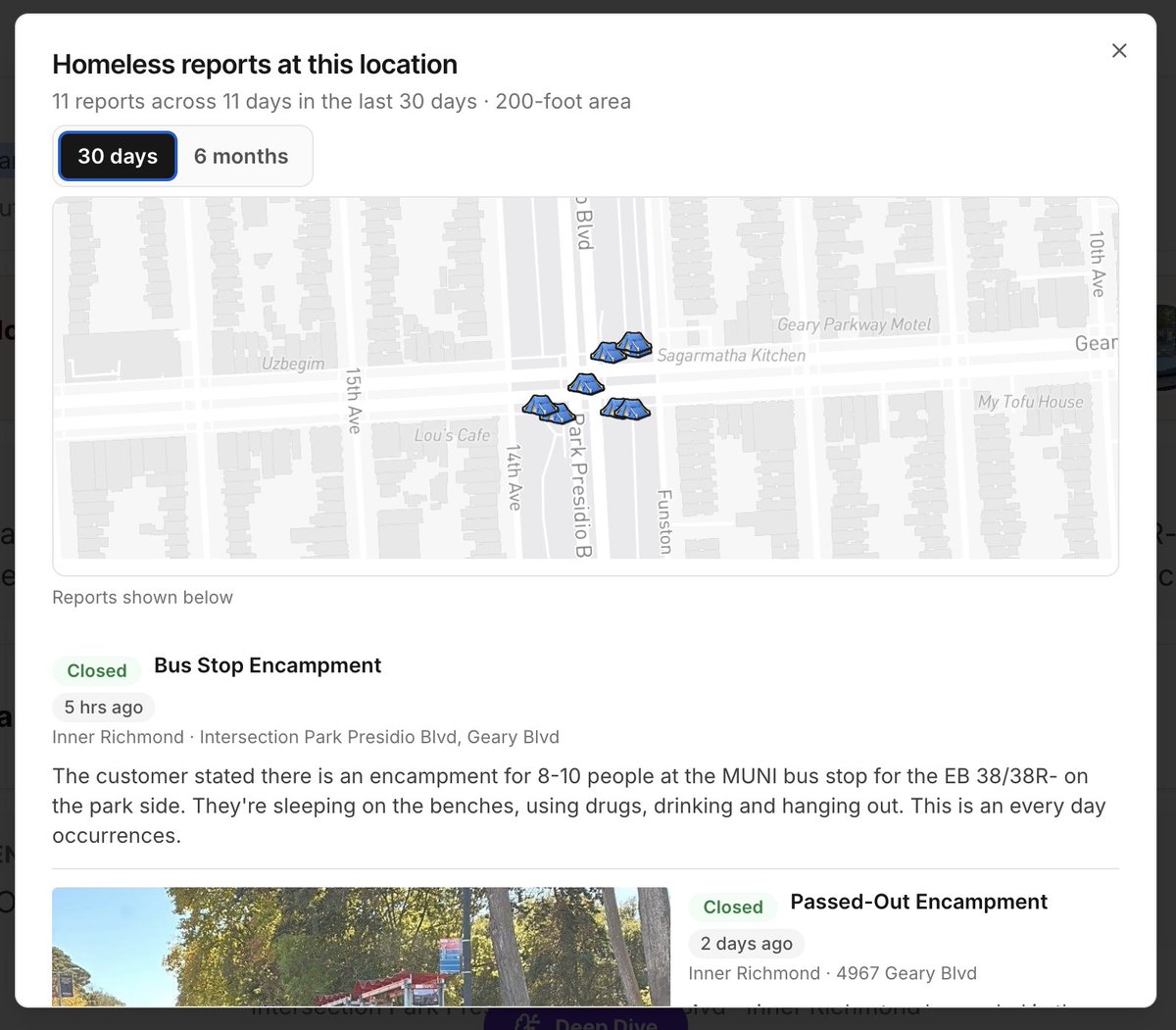
It has been 1 month now and cases are still being cancelled.
Here is one from today: "there is an encampment for 8-10 people at the MUNI bus stop for the EB 38/38R- on the park side. They're sleeping on the benches, using drugs, drinking and hanging out. This is an every day occurrences."
The data shows that this area has 11 reports across 11 days recently.
"Case is Invalid. Not an encampment. People drinking in the bus stop is a PD call."
Luckily, we have the data to show all of this and it says otherwise. This area has a chronic issue.
I just fixed my dishwasher with the help of ChatGPT. A trivial task. I had been about to order a new one. So this software has increased the country's real wealth yet decreased the measured GDP. The main economic indicator is structurally incapable of registering the thing that actually makes people better off, namely the growth of knowledge
Very funny that xAI was created to stop Anthropic which was created to stop OpenAI which was created to stop Google which would've actually never developed ASI because it was afraid of cannibalizing its ads revenue from search.
He lies after virtually every breath, but to his credit, he at least recognizes the popularity of direct cash payments and dividend framing for it. Democrats would be wise to notice and do the same, but actually do UBI instead of lying.
With AlphaFold we mapped the protein universe - now with AlphaGenome Atlas we’re charting the human genome. It can predict the impact of all 9 billion possible single-letter DNA variants, helping scientists better understand disease. Freely available for academic research: https://t.co/Gsy6lW3z6O