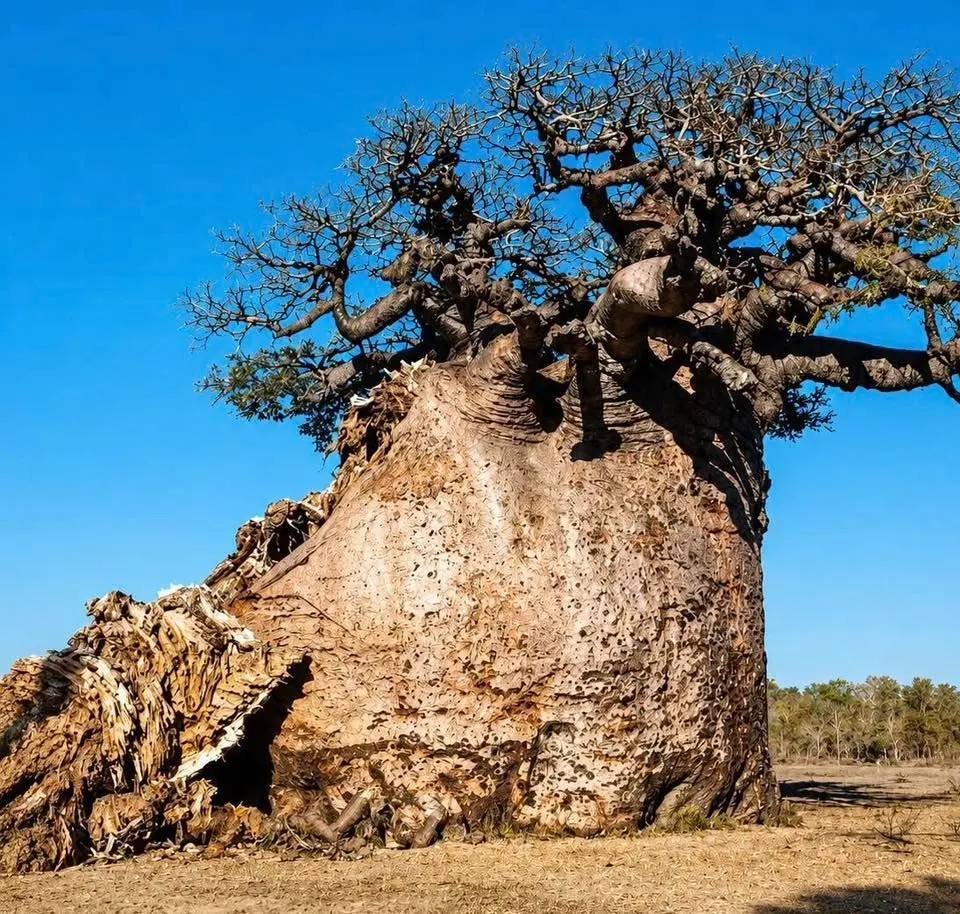
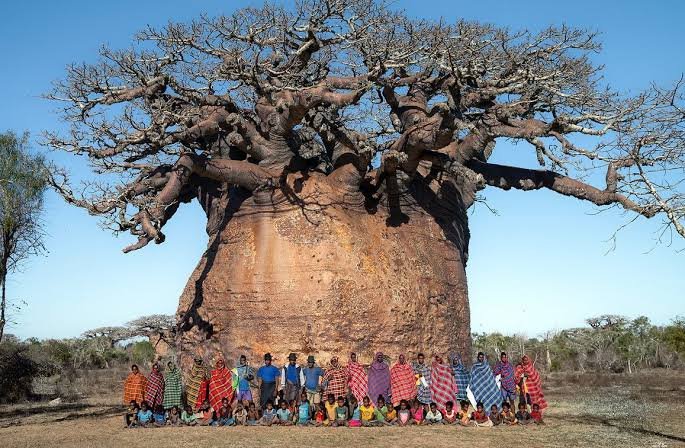
“Tsitakakantsa,” the largest baobab tree in Madagascar, is slowly fading away after surviving for nearly 1,200 years.
The ancient giant has become a symbol of Madagascar’s unique biodiversity, though scientists say parts of it have been collapsing in recent years due to age and environmental stress.
This one doesn't waste any time at all. He didn't respect the little dog next door. But be serious... What a sweet scene 😍 Who else saw this and laughed?
A dog was diagnosed with depression after suffering a miscarriage, so vets decided that working with children at a local school might help. She's never been happier 🐶🥹
"At moments when bitterness threatens to define us, the American University of Beirut remains what it has always been: a place built to stand firm when everything else trembles."
Fadlo R. Khuri, MD
Today marks the anniversary of the death of humanitarian Michael J. Sharp in the Democratic Republic of Congo. A United Nations expert dedicated to investigating and documenting human rights abuses, Michael was working to uncover evidence of violence and mass atrocities when he was kidnapped in March 2017. He was held captive for 15 days before being executed alongside his colleague.
Michael’s murder was a tragic reminder of the risks faced by Americans serving in conflict zones in pursuit of justice and accountability. Today, the Foley Foundation remembers Michael’s service and honors his commitment to human rights and the rule of law.
Karl Friedrich Gauss, le « prince des mathématiques », est mort il y a exactement 171 ans.
Il avait de surcroît la classe. Qu’on en juge.
Au début du XIXe siècle, la mathématicienne Sophie Germain dut utiliser un nom d’emprunt masculin, celui d’un certain Antoine-Auguste Le Blanc, pour faire connaître ses travaux. A l’époque, il était encore impensable qu’une femme fût authentiquement mathématicienne.
Sophie Germain entama sous son nom d’emprunt une correspondance avec Gauss, qui se déclara impressionné par ses travaux. Mais en octobre 1806, à la suite de la bataille d’Iéna, lorsque les troupes de Napoléon occupèrent Brunswick, la ville qu’habitait Gauss, Sophie Germain craignit pour la vie de son illustre correspondant. Aussi demanda-t-elle à un militaire français de veiller à la sécurité du mathématicien.
C’est ainsi que Gauss découvrit qu’Antoine-Auguste s’appelait Sophie.
Il lui écrivit alors une lettre dont les dernières lignes méritent d’être citées :
« Le goût pour les sciences abstraites en général et surtout pour les mystères des nombres est fort rare. On ne s’en étonne pas. Les charmes enchanteurs de cette sublime science ne se décèlent dans toute leur beauté qu’à ceux qui ont le courage de l’approfondir. Mais lorsqu’une personne de ce sexe qui, par nos mœurs et nos préjugés, doit rencontrer infiniment plus d’obstacles et de difficultés que les hommes à se familiariser avec ces recherches épineuses, sait néanmoins franchir ces entraves et pénétrer ce qu’elles ont de plus caché, il faut sans doute qu’elle ait le plus noble courage, des talents tout à fait extraordinaires, et un génie supérieur. »
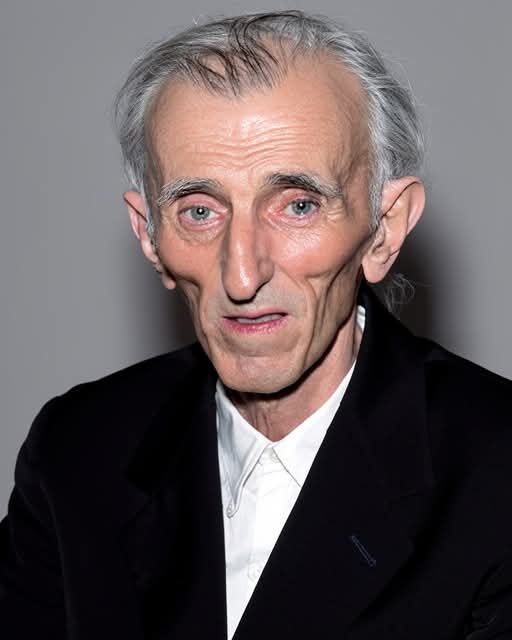
On January 7, 1943, Nikola Tesla died alone in Room 3327 of the Hotel New Yorker. He was 86 years old. A maid found him two days later after he had left a “do not disturb” sign on his door. The official cause was coronary thrombosis. But the deeper truth was quieter — years of isolation, poverty, and a world that had moved on without the man who helped power it.
This was the inventor of alternating current, the system that still runs through our homes today. He pioneered wireless transmission, radio technology, and electric motors. He held hundreds of patents and imagined ideas — like wireless communication and renewable energy — long before they became reality. Yet by the end of his life, he was nearly penniless.
In his final years, Tesla lived simply. He survived mostly on milk, bread, honey, and vegetable juice. Every day he walked to nearby parks to feed pigeons, especially one white pigeon he loved deeply. He once said he loved her as a man loves a woman. When she died, something in him seemed to fade too.
There was a time when Tesla dazzled New York society, lighting bulbs with his bare hands and creating artificial lightning in his laboratory. Investors once backed him. Crowds once admired him. But as his ideas grew more ambitious — especially his dream of free wireless energy for the world — funding disappeared. He became known more as an eccentric than a genius.
And yet, when he died, the world paused. Thousands attended his funeral. Leaders and scientists sent tributes. Years later, the Supreme Court recognized his priority in radio patents. History slowly corrected itself. The world he electrified had not truly forgotten him — it had simply taken time to understand him.
Today, his name lives on in science, technology, and even in companies that shape the modern age. Tesla died alone in a hotel room, feeding pigeons while the current he created hummed through cities. He did not die forgotten. He died having changed the world — and that legacy still shines.