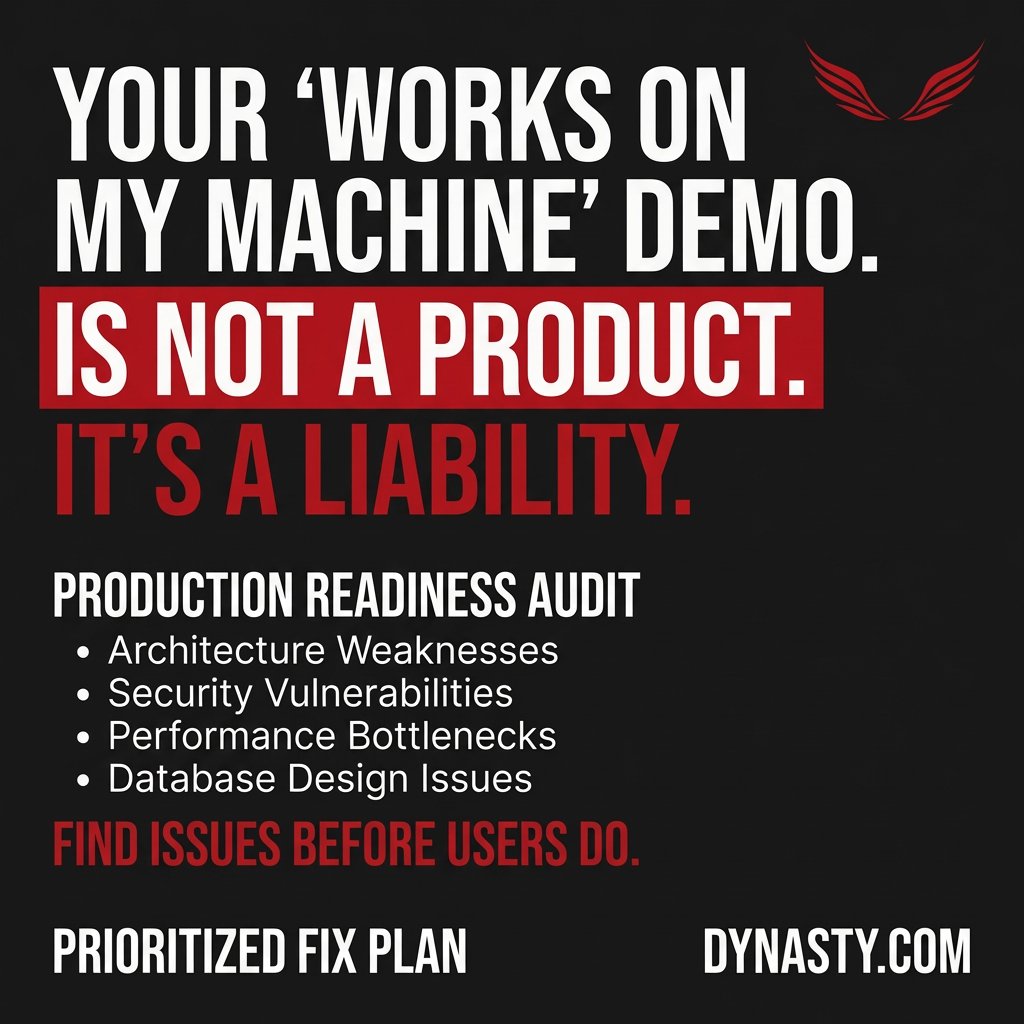
AI built your prototype in a weekend. Production broke it in a day. Vibecoding skips architecture, security, and scale. That's not a tool problem-it's a strategy problem. We fix what AI can't. Let's talk.
#SaaS#AIFails#ProductDevelopment#StartupLife#TechFounders
Your demo worked perfectly. Then real users showed up.
Edge cases. Concurrent sessions. Unexpected inputs.
The gap between "it works" and "it scales" is where most products die.
We build for what comes after the demo. Let's talk.
#SaaS#ProductDevelopment#StartupLife
Your prototype got you funded. It won't get you to scale. The gap between demo and production is where startups quietly die. We've seen it. We fix it. Don't wait for the cracks to show. 👇
#SaaS#StartupLife#ProductDevelopment#TechFounders
The part we see founders realize too late.
By the time the schema is wrong and users are in production, the fix isn't technical. It's a negotiation between what needs to change and what you can't afford to break.
The most expensive decision you make when building your startup isn't the stack. It's how you structure your database.
When you use Lovable, Bolt, or Cursor to generate your app, the code works. The tables get created. Supabase spins up without errors. The problem is that AI has no context about your business, so it makes default decisions that seem reasonable and are very hard to undo later.
What we see all the time: duplicate tables because the model lost context between prompts. Relationships between tables that don't reflect how the business actually works. Missing or poorly defined foreign keys. Columns mixing data from different entities because it was easier than creating another table. No indexes on the fields that get queried the most, so every query gets slower as your data grows. Row Level Security disabled or misconfigured so one user can see another user's data.
Every one of those problems is fixable. The question is when you find them. In development, it's an afternoon. With real users, payments running, and mixed data in production, it's weeks of work and an uncomfortable conversation with your customers.
Technical code has debt. The database has a mortgage.
If you're building with AI tools, it's worth having someone with real technical judgment review your schema before the first real users arrive. Not after.
AI demos look pretty. Real products handle 10k users, edge cases, and 3am bugs.
v0 gets you applause. We get you to production.
There's a difference between a prototype and a business. Know which one you're building.
#SaaS#ProductDevelopment#Scalability#AIProducts
Most founders build twice.
Once with AI tools to validate.
Once when they realize it doesn't scale.
We build the version that skips step two.
https://t.co/d3X888eMLj
#buildinpublic#founder#startups
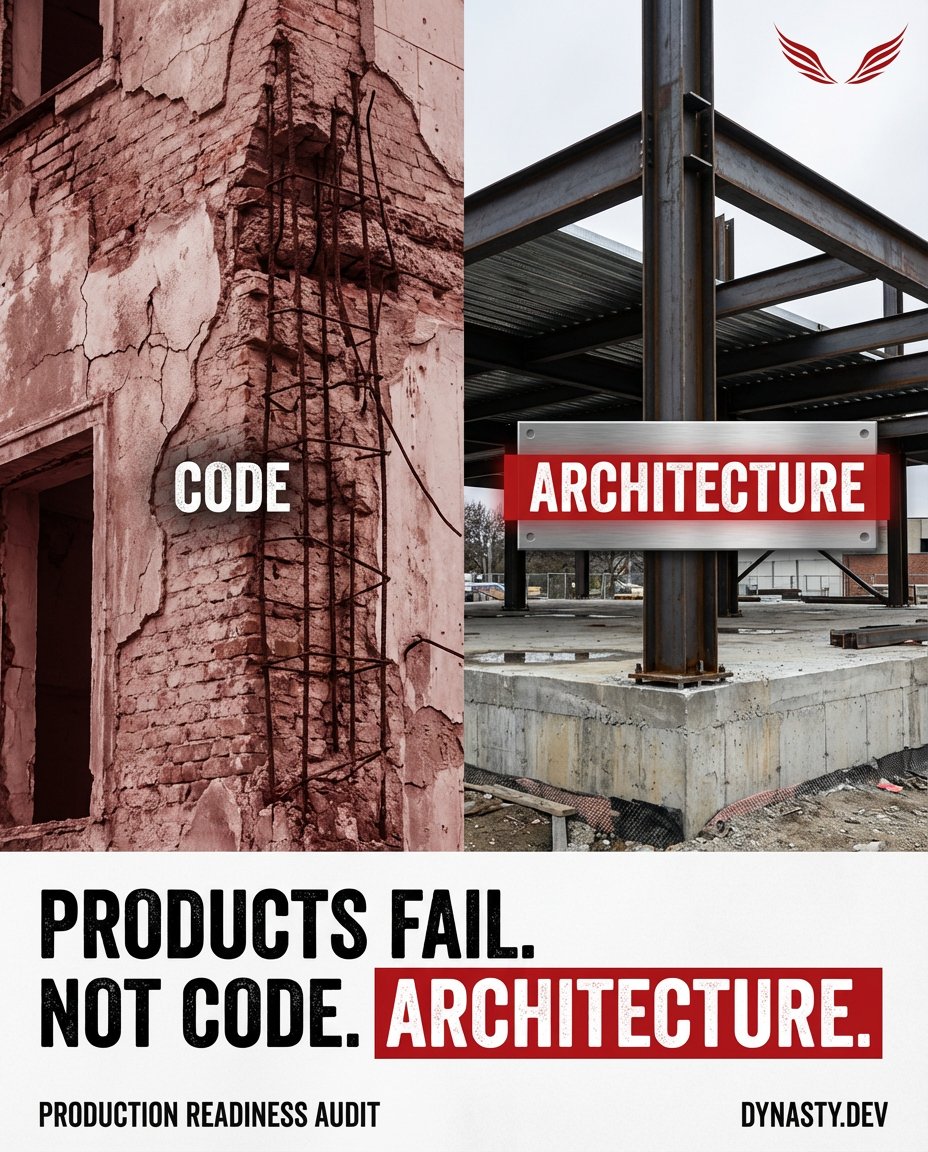
Most products don't fail because of bad code. They fail because the architecture was wrong from day one. You can't patch your way out of foundational decisions. Fix the structure or keep rebuilding the same broken product.
#SaaS#ProductArchitecture#SoftwareDevelopment
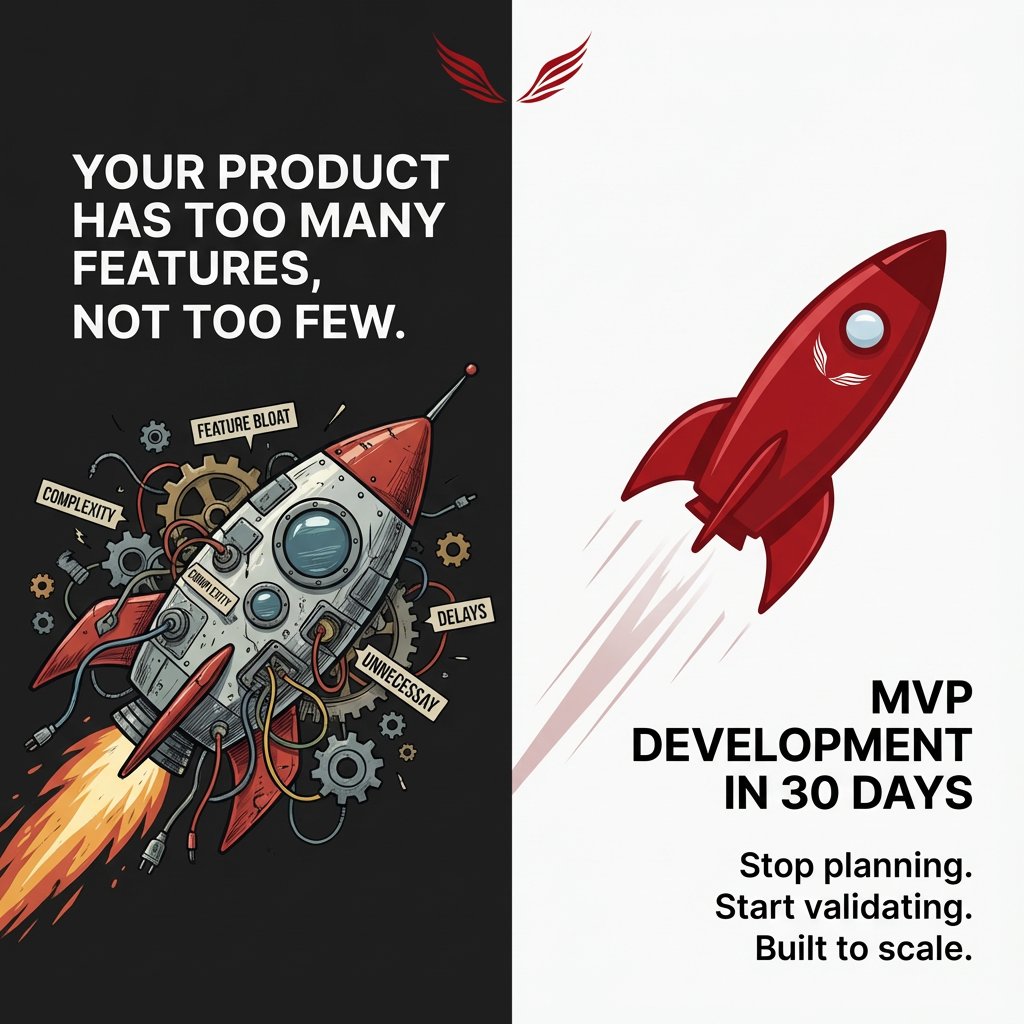
Your MVP is struggling because it has too many features, not too few.
Strip it down to what solves the core problem. Launch lean, learn fast, and iterate.
Less is more when you're validating your idea.
#MVP#ProductDevelopment#StartupAdvice#LeanStartup#SaaS
A founder came to us a few months ago with what looked like a finished product.
Clean UI, good flows, the kind of thing you'd be proud to show investors. Built entirely in v0, moved fast, looked real. The problem was that behind the screens there was nothing. No auth, no backend, no data layer. Just pages and modals that opened and closed.
He thought he was 80% done. He was actually at 0%.
This is the part nobody talks about when they celebrate shipping fast with AI tools. The UI is the easiest part. What makes something a product instead of a prototype is everything the user never sees: who can access what, where the data lives, what happens when a payment fails, what happens when two users touch the same record at the same time.
We rebuilt it from the ground up. Same look, completely different foundation.
The vibe coding got him to a great demo. We got him to something he could actually charge money for.
Most products don't fail because of bad code. They fail because the architecture was wrong from day one. You can't patch your way out of foundational mistakes. Rebuild it right, or keep bleeding resources. Your call.
#SaaS#ProductArchitecture#TechDebt#FounderTruths
4 months in and your product still isn't ready? You're probably over-engineering it.
Your MVP doesn't need every feature—it needs validation. Ship fast, learn faster, and iterate based on real user feedback.
Stop perfecting. Start launching.
#MVPDevelopment#SaaS
Your product isn't failing because of bad code. It's failing because the foundation is cracked.
Most founders patch symptoms while the architecture bleeds. You can't scale broken bones.
We rebuild from the ground up—the right way.
Ready to stop the bleeding?
https://t.co/LCV2I03GDV
Building an MVP in 30 days is doable, but it's not just about speed. The reality is that early decisions can set the trajectory for your product's future.
Avoid the common pitfall of rushing without a reliable foundation.
Building an MVP is a race against time, but speed without reliability can lead to costly missteps. Many founders face this challenge, launching products that don’t deliver the results they need.
At https://t.co/W61yb4wupc, we believe it’s possible to balance speed and reliability.
Choosing junior talent for your MVP might seem cost-effective, but it can lead to serious setbacks. Inexperience often results in poor technical decisions with long-term consequences.
With https://t.co/W61yb4wupc, you’re backed by senior engineers who understand how to build robust foundations quickly. Skip the pitfalls and launch a production-ready MVP that’s ready for real users from day one.
Let's have a conversation about your MVP journey. DMs are open for founders who value experience.
https://t.co/AphvZbDKOg
#startups #MVP #SaaS #productdevelopment