We just took part in the @CoinMarketCap hackathon. Here's what we built and why!
Over the last few months we kept hitting the same wall while researching tokenised assets. Two products point at the same underlying asset, so you line them up and compare. Look closer and one quotes per ounce while the other quotes per gram, or one holds spot and the other holds a derivative.
The comparison was never valid.
Nothing on the screen told us..
The clearest case we found sits in CoinMarketCap's own silver reference: five tokenised products, four issuers, quotes 31.1x apart. Silver is silver. The whole gap is in how they're quoted.
So we built Bell on the CMC API. It runs before the comparison and reports what the data actually supports, returning DO NOT SHORTLIST, INVESTIGATE or NO FLAGS, each attached to a dated receipt anyone can open and check themselves.
Feel free to look at our BUIDL: https://t.co/5fdB1M8yAc
#BuildwithCMC
ZIG Finance launched the zEMS Vault on BNB Chain, targeting a $100M raise from eligible institutional investors. The vault offers exposure to a diversified pool of Saudi SME loans originated through Beehive.
Nomura's @LaserDigital_ is the risk framework advisor, helping design risk governance and advising on tokenization. @KAIO_xyz handles tokenization, administration and KYC checks at subscription and redemption. Investors can subscribe and redeem in stablecoins. Zamanat is the structuring and Sharia advisory partner.
This is the first product from the @ZIGFinance and Laser Digital partnership. The part we are watching is the stack: a local originator, institutional risk design, and distribution on BNB Chain in one structure. The companies say they plan to apply that model in other emerging markets.
The $100M figure is a fundraising target, not an amount already committed.
Index Industries exited stealth with a $50M seed led by @lightspeedvp, with Polychain Capital, Galaxy Ventures and Wintermute Ventures participating.
@index_inds is the technology and services provider behind @USHP_Official, a tokenized index product that tracks U.S. home prices. The product references Index Industries' daily USHP Index, which the company says integrates data from the major housing indices into a single national measure. USHP Limited, a subsidiary of the USHP Foundation, will issue the token.
The part we are watching is that split. Index Industries builds the benchmark and the technology. A separate foundation company issues the investment product, planned for eligible institutional and non-U.S. investors.
USHP Limited plans to release USHP on $ETH in 2026, with a Q4 target on Ethereum mainnet, and to expand to Solana in 2027. The index itself is expected to launch imminently. Neither is live yet.
PNC Bank is piloting incoming $USDC payments for eligible Corporate and Institutional Banking clients. $USDC arrives on Ethereum through @coinbase Payment products and is converted 1:1 into dollars in a designated PNC deposit account.
@PNCBank is offering the service on a limited basis. The announcement covers incoming payments.
This expands a relationship the two companies announced in July 2025, when PNC said it would use Coinbase's Crypto-as-a-Service platform and provide select banking services to Coinbase.
The part we are watching is the last mile for a treasury team: a supplier or customer can pay in $USDC, and the funds still land as ordinary dollars in an account the company already holds at the bank.
PNC has not published fees, the size of the pilot, eligibility rules or a date for wider availability. We will be watching how clients use it once those terms are clearer.
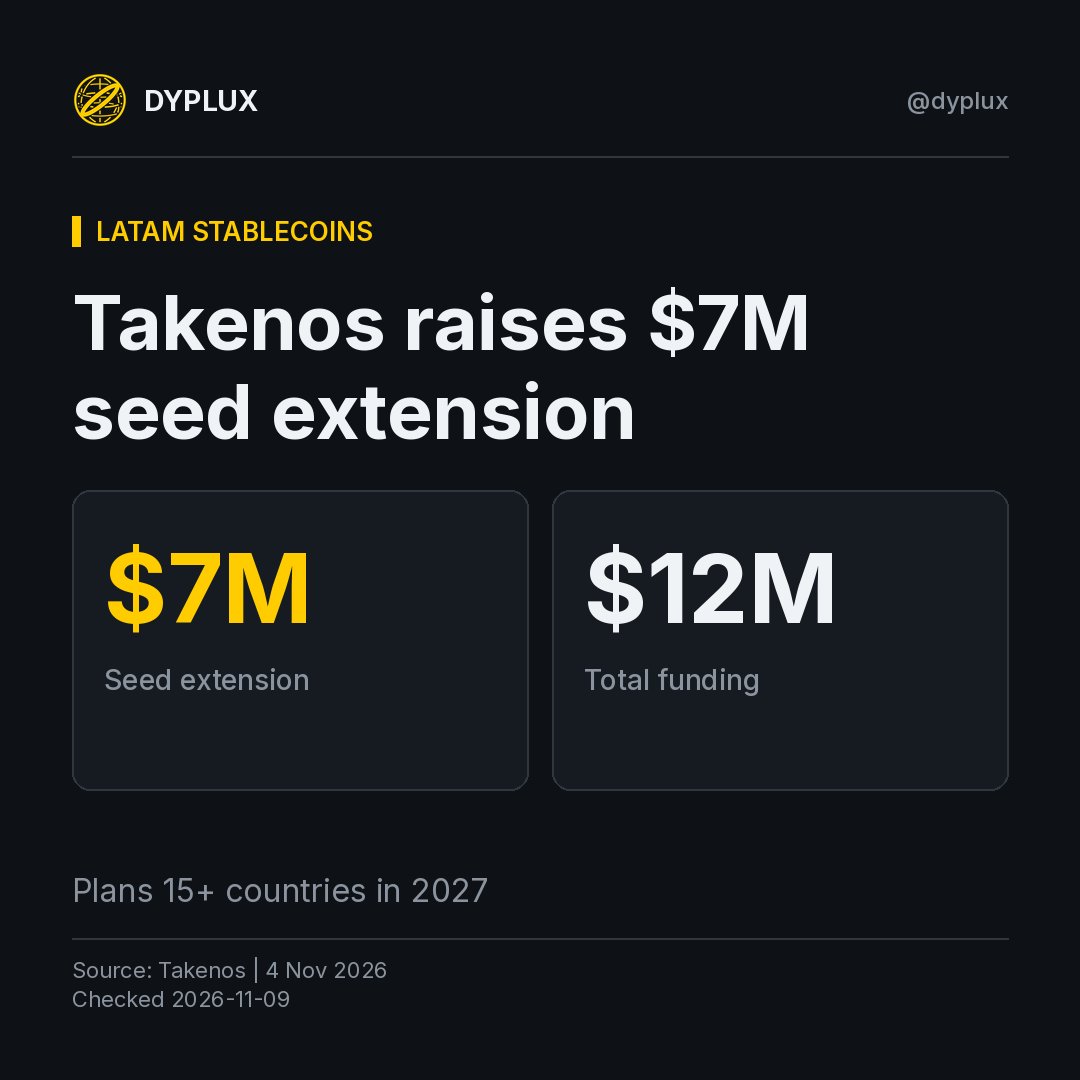
Takenos raised a $7M seed extension, led by North Island Ventures and Road Capital Management, with Variant, Lattice and Reverie participating. The round brings its total funding to $12M.
@TakenosApp is an Argentine stablecoin fintech. It says it processes more than $5B a year across six countries: Argentina, Bolivia, Ecuador, Peru, Paraguay and Guatemala.
The part we are watching is the stack. Takenos says it builds local licenses and rails, a consumer app, SME tools, corporate APIs and a trading desk on the same infrastructure.
That kind of vertical integration matters for cross-border dollar payments, where on-ramps, off-ramps and local compliance have to work in every market the company enters.
Takenos says the new capital will fund licenses and local rails as it plans to serve more than 15 countries in 2027. For now, those expansion figures are company plans.
Aave Labs has acquired the team and technology behind Avon, including its fixed-rate and floating-rate lending protocols and onchain order book.
The part we are watching is what this could change for borrowers.
A floating rate can move while a loan is open. A fixed rate agreed for a defined term gives a borrower a clearer financing cost, useful when planning treasury needs or building a lending product for customers.
Aave Labs says the team will help develop capabilities such as fixed-rate lending across its network and product layers. Its announcement puts Aave at more than $33B in deposits and $13B in active loans.
That creates an interesting engineering question: how do you offer predictable borrowing costs while managing liquidity and risk across different maturities?
We will be watching the product terms, collateral requirements and availability. The acquisition announcement gives no launch date or financial terms.
Spent the morning in the fine print of Coinbase's new gold loans. One line in it matters more than the launch.
You can now put $PAXG into the Coinbase app and borrow $USDC against it, keeping the gold. @Morpho runs it on @base, the same rails Coinbase already uses for its crypto loans. It's the first collateral Coinbase Borrow takes that isn't crypto.
Gold is a nearly $30T market and about $5B of it is on-chain. For most holders, that token just sat in a wallet. Borrowing against it inside the app is what turns holding into using.
This market's gold price only updates while gold markets are open. Liquidation sits at 77%, and over a weekend nothing moves. A Monday gap hits the loan in one print.
Whoever borrows close to that line on a Friday is the one carrying the gap.
US only, except New York.
Video powered by @dyplux
Read the withdrawal and the agencies' discussion of nearly 3,000 comments on the original proposal. Publication is scheduled for 9 November: https://t.co/VejD3RwTFr
I checked a new US payments filing today. A notice scheduled for publication on Monday says @FinCENnews and the @federalreserve are withdrawing a proposal to lower a cross-border transfer threshold from $3,000 to $250!
That threshold governs when banks and money transmitters must collect, retain and pass sender and recipient information along the payment chain. The proposal targeted transfers that begin or end outside the US, and it spelled out coverage for crypto.
I read the agencies' reasoning. They point to changes in the crypto market, including the GENIUS Act for payment stablecoins, and say further public input is needed before finalizing amendments.
The lower threshold in this proposal won't take effect!
For stablecoin payment teams, the cost question remains concrete: how much extra data collection, storage and partner integration would smaller transfers require? I'd want those costs documented before the next proposal reaches a comment period.
Link in the comments
Dyplux just submitted Praeva to @BNBCHAIN's Tokenized Stocks hackathon!
An AI agent proposes a trade. Praeva checks the evidence and gives it a decision, reasons and a receipt!
@BNBCHAIN The live test bought solana:k18WJUULWheRkSpSquYGdNNmtuE2Vbw1hpuUi92ondo with 10 $USDT on BNB Chain after Praeva returned ALLOW and both the RPC and Binance simulations passed. Read the recorded checks and transaction evidence:
https://t.co/fzS7sAkhS3
Dyplux just built Praeva for @BNBCHAIN's Tokenized Stocks hackathon!
An AI agent proposes a trade. Praeva checks the evidence and gives it a decision, reasons and a receipt.
We tested it with a real $USDT purchase of solana:k18WJUULWheRkSpSquYGdNNmtuE2Vbw1hpuUi92ondo. Demo and proof in the replies.
@BNBCHAIN Use with either version. Keep the link in this reply.
Try the console: inspect the proposed trade, see which evidence is missing and verify the receipt. The three demo cases are labelled observed or synthetic.
https://t.co/HdQVZSUZ7S