Thrilled to share that I'll be joining the University of Michigan as an Assistant Professor in Fall 2027!
My lab will work on Robot Learning, Dexterous Manipulation, Robot Foundation Models & 3D Perception. I'm looking for students to join me. Please apply and reach out.
(1/2)
Incredibly excited to welcome @dustinvtran to @ElorianAI as our new Chief Reasoning Architect! 🚀
We had an amazing time working together at Google Brain, and after seeing his incredible work leading post-training at xAI, I couldn't be more thrilled to be teaming up again. Let’s build something special!
Welcome to the team, Dustin!
personal news: i've joined Elorian as Chief Reasoning Architect. multimodal AGI is the most critical frontier as we move from the era of chatbots to coding agents to models that reason and act over the physical world. i'm really excited to design natively visual models across thinking, agents, architectures, and the systems stack with the amazing team at Elorian.
i wish the best to everyone at xAI & SpaceX — driving posttraining was a unique experience with so many memorable stories. all the best to the team, and to Elon.
Does classical computation theory help explain the success of inference time compute in RL? We study this question in our #ICML2026 oral
We prove that policies with higher inference compute solve and generalize to a larger set of tasks. Empirically, we show that such policies can outperform 5x larger ResNets.
Website - https://t.co/yeYq3MtlNC
🧵👇
@NVIDIA is working on one of the hardest problems in Physical AI so you don’t have to: generalist robotic pick-and-place.
We are excited to introduce GraspGenX at #CVPR2026—a foundation model for robotic grasping that works out of the box for unknown robots, novel objects, and unseen environments.
Unlike Vision-Language-Action (VLA) models or dedicated grasp networks that require expensive, embodiment-specific training, GraspGenX is cross-embodiment and works zero-shot. You simply pass a "robot prompt" alongside an image of the object to generate actions.
🚀 Key Highlights:
1) Scaling: Trained on over 2 Billion 6-DoF grasp rollouts entirely in physics simulation—a dataset size practically impossible to collect via real-world teleoperation.
2) Zero-Shot Transfer: Works out of the box for several common robot grippers widely used across the research community and industry.
3) Built for the Agentic Era: Features native MCP support, client-server architecture, and skills.md, allowing seamless integration into LLM/Agentic robotics workflows.
4) Full Pipeline Integration: Pair it with other open foundation models (like SAM3) and advanced motion solvers like cuRoboV2 for full deployment in entirely unknown environments.
If you are currently executing pick-and-place with a VLA or WAM, you can use GraspGenX to generate sim-verified trajectory data and inject it into your pipeline. No need to waste precious real-world engineering hours on data collection for standard manipulation tasks.
🌐Website: https://t.co/a7acm4Pw7N
💻Code: https://t.co/eYUYxCb7Jp
📄Paper: https://t.co/pDOVp0VJLL
📍CVPR Booth: Poster 619 on Jun 6 1:45 session at ExHall F
This work was led by the incredible @BeiningH (Princeton), in collaboration with a phenomenal team at NVIDIA: @erwincoumans, @yu_wei_chao, @balakumar_, @clembow, and Stan Birchfield
#CVPR2026
Releasing RecGen: a collaboration between @ToyotaResearch, @toyota_europe, and @UvA_Amsterdam tackling a core 3D vision challenge: reconstructing complete multi-object scenes (parts, poses, textures, even occluded geometry) from just 1 to a few RGB-D views.
Trained purely on synthetic data, RecGen achieves SOTA on real-world robotics and 6D pose benchmarks, handling occlusions, symmetry, and complex interactions.
A step toward scalable, high-fidelity digital twins for robotics, and better evaluation and training of generalist policies.
https://t.co/x4EEcRy77V
I’d previously thought that single-view reconstruction would be tough with only synthetic data, but it turns out it’s not! Check out this very cool work applying procedural 3D data to *full* reconstruction.
Releasing RecGen: a collaboration between @ToyotaResearch, @toyota_europe, and @UvA_Amsterdam tackling a core 3D vision challenge: reconstructing complete multi-object scenes (parts, poses, textures, even occluded geometry) from just 1 to a few RGB-D views.
Trained purely on synthetic data, RecGen achieves SOTA on real-world robotics and 6D pose benchmarks, handling occlusions, symmetry, and complex interactions.
A step toward scalable, high-fidelity digital twins for robotics, and better evaluation and training of generalist policies.
https://t.co/x4EEcRy77V
@holoday_ The baselines we use are wider than that (>4 cm), but you can always change the code to generate your own. You should definitely check out @_ilya_c's very great work on this (though they consider the unsupervised setting).
https://t.co/sEAbZmyPf9
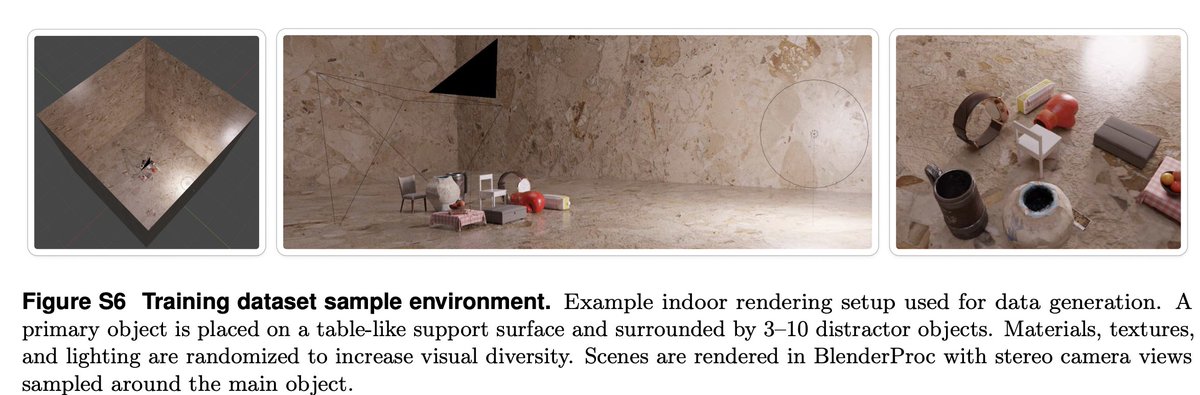
Stereo depth is important in robotics, and relies heavily on synthetic data. But what actually makes for good synthetic data?
In WMGStereo, we study dataset design and discover a powerful data recipe - just 500 samples of our data can match 40k Sceneflow samples! 🧵[1/7]
Our work is open-source and you can also check it out in-person at our #CVPR2026 Highlight this summer!
Dataset: https://t.co/IuwrftHdHZ
Code: https://t.co/clP9qZ6xk8
[7/7]
By collecting the best design choices from our study, we create a full-scale dataset, WMGStereo-150k. Our data is super sample efficient and scales well! [6/7]





![dzyan01's tweet photo. By collecting the best design choices from our study, we create a full-scale dataset, WMGStereo-150k. Our data is super sample efficient and scales well! [6/7] https://t.co/UkgxRtwj0F](https://pbs.twimg.com/media/HFy0tndWAAA5Gnm.png)


