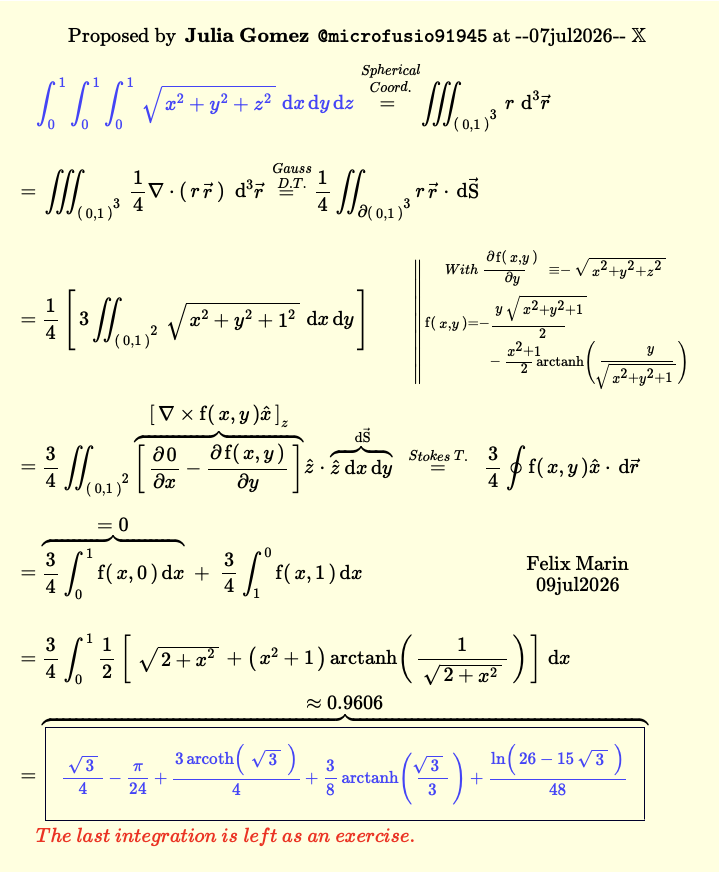
My lovely forum, 🥰
I would like to share my solution to the following problem that Julia @microfusio91945 shared with us. Using a simple elementary factorization, it is possible to obtain a natural generalization of the problem, which I'll share in the next few minutes.
Have+
Fark ettiniz mi bilmiyorum, insan layık olmadığı şeyi üzerinde taşıyamıyor. Bilgi fazla gelirse kibirleniyor, zenginlik fazla gelirse görgüsüzleşiyor, güç fazla gelirse başkalarını aşağılıyor. Yani özne ile edim arasında bozulan o orantıyı saklayamıyor, mutlaka sızdırıyor dışarı.
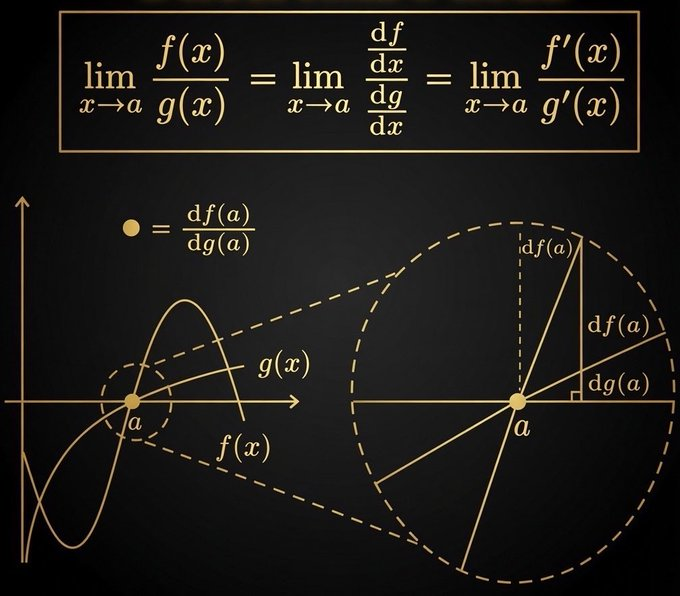
Most complex integrals look impossible at first glance. The Cauchy Residue Theorem changes that.
Instead of solving the entire integral directly, it tells us to focus only on the singularities inside the closed contour. Find their residues, add them together, and multiply the sum by 2πi. That single idea turns many difficult contour integrals into straightforward calculations.
It is one of the most elegant examples of how a deep mathematical insight can make a complicated problem remarkably simple.
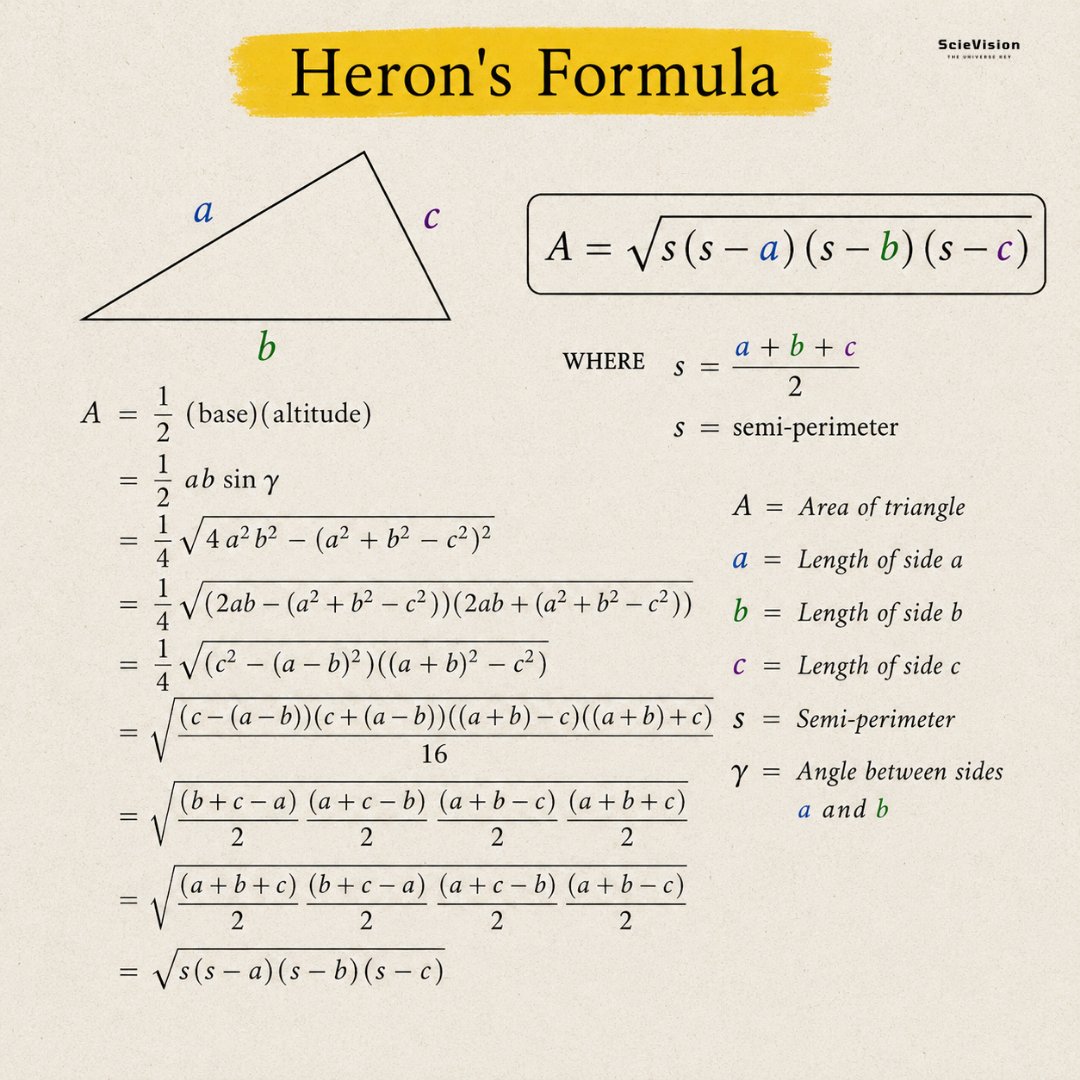
Heron's formula ✍️
Heron of Alexandria was a remarkable Greek mathematician and engineer who lived around two thousand years ago in Alexandria, Egypt. He discovered one of the most elegant and useful formulas in mathematics. This formula allows anyone to calculate the area of any triangle if they know the lengths of its three sides. There is no need to measure the height, angles, or any other property of the triangle. This feature makes it incredibly practical. Measuring the three sides of a triangle is straightforward, while measuring the height a line that often falls outside the triangle can be quite difficult in real-world situations like land surveying or construction.
To understand the formula, you first need to recognize that every triangle has three sides. Adding the lengths of all three sides gives you the perimeter, which is the total distance around the triangle. Dividing that total by two yields the semi-perimeter, represented by the letter s. This semi-perimeter is the most important part of Heron's formula. It acts as a central reference point from which each side length is subtracted to create the four factors that the formula multiplies to find the area.
The formula works by taking the semi-perimeter and subtracting each of the three side lengths separately. This produces three new numbers. Then, you multiply all four numbers together: the semi-perimeter itself, the result of subtracting the first side, the result of subtracting the second side, and the result of subtracting the third side. Finally, you take the square root of that entire product to find the area. Each of these subtraction results has real geometric meaning. When the semi-perimeter minus a particular side is very small, it indicates that side is almost as long as the other two sides combined. This means the triangle is very flat and thin, with almost no area. Larger differences indicate a more spread-out triangle with more area.
The journey to derive this formula starts with the basic rule everyone learns: area equals half the base multiplied by the height. It then uses trigonometry to replace the height with an expression involving two sides and the angle between them. Next, the Law of Cosines is applied to eliminate that angle completely, expressing everything in terms of the three side lengths. A series of clever algebraic steps, using a technique called difference of squares, simplifies complicated expressions into easier multiplied pieces. After several rounds of factoring and simplification, the semi-perimeter structure becomes visible inside the algebra, revealing the formula in its final beautiful form.
What makes this formula truly remarkable is its perfect symmetry. It treats all three sides of the triangle in exactly the same way, with each side playing an identical role. This reflects the truth that the area of a triangle does not change regardless of which side you label a, b, or c. The formula also detects impossible triangles. If someone provides three lengths that cannot create a valid triangle, one of the subtraction results will be negative. Consequently, the product inside the formula will be negative, and taking the square root of a negative number is impossible. This is the formula's way of indicating that such a triangle cannot exist.
This single formula has been applied for nearly two thousand years in many practical fields. In land surveying, surveyors measure distances between boundary markers and use the formula to calculate property areas. In architecture, triangular roof sections and structural elements require area calculations. Navigators, including sailors and explorers, used triangulation to determine their positions. In computer graphics, modern software represents three-dimensional surfaces as millions of small triangles and calculates their areas millions of times per second for rendering and lighting.
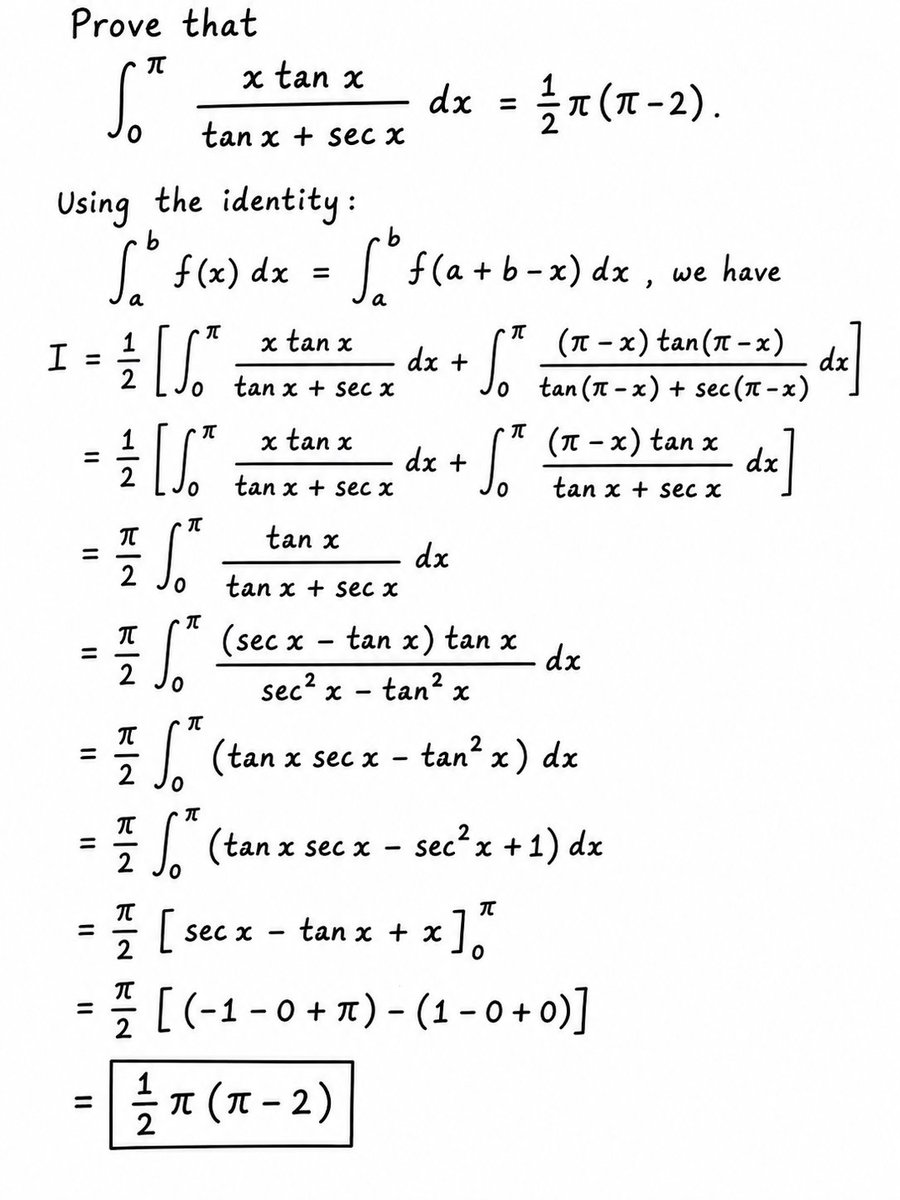
A beautiful definite integral solved using the symmetry property of definite integrals and a clever trigonometric identity.
Watch the complete handwritten step-by-step proof and master this elegant calculus technique.
Can you solve it before seeing the answer?
#Calculus #Integration #Mathematics #EngineeringMath #LearnMath
De Moivre's Formula - Every complex number can be described in two equivalent ways: either by its real and imaginary components or by its distance from the origin and the angle it makes with the real axis. For complex numbers on the unit circle, which are at a distance of one from the origin, the angle alone defines them. De Moivre's Formula offers a clear insight into what happens when you raise one of these unit circle complex numbers to an integer power. The distance remains one, and the angle is multiplied by that power. If you raise a complex number at angle x to the power n, you end up with a complex number at angle nx. That sums up the formula in simple terms.
This makes sense geometrically because multiplying two complex numbers adds their angles. So, multiplying a unit circle number by itself once adds the angle to itself, resulting in 2x. Multiplying again gives 3x, and doing this n times gives nx. What would usually require n separate multiplications with a lot of algebra simplifies to one observation about angle multiplication.
The proof shown in the diagram is short and clear. It uses Euler's formula, which connects exponentials and trigonometry through the imaginary unit, to rewrite the complex number as e raised to an imaginary power. Then the basic rule of exponents applies: raising a power to another power multiplies the exponents. Finally, Euler's formula can be reversed to convert back to trigonometric form, with the result appearing immediately. Four steps, each fully explained, and the formula is proven. The benefits are immense. Computing a complex number raised to the hundredth power becomes a single step of angle multiplication instead of ninety-nine separate multiplications. All the trigonometric identities for multiple angles the formulas for cosine of three times an angle, four times an angle, and so on emerge automatically by expanding the formula algebraically. Finding roots of complex numbers works by dividing angles rather than multiplying them. De Moivre's Formula is ultimately a direct result of the same key insight Euler had: that rotation in the complex plane and exponential functions are essentially the same thing, making powers of complex numbers as simple as multiplying a single number...
Solution: Following the prior expressions based on Metallic means x²-nxy-y² (→n=2 Silver Mean, n=3 Bronze Mean...); for this expression n=4 and it factors over ℚ[√5]. This is the shifted version of x²-4xy-y² along the x and y axis
#mathematics#algebra#question#factorization
Master quadratic equations through their core formulas and relationships.
The equation ax² + bx + c = 0 has solutions
x₁ = [-b + √(b² - 4ac)] / (2a) and
x₂ = [-b - √(b² - 4ac)] / (2a).
Vieta’s formulas give the sum of roots as x₁ + x₂ = -b/a, the product as x₁ · x₂ = c/a, and the difference as x₁ - x₂ = ±√Δ / a where the discriminant Δ equals b² - 4ac.
Civil engineers depend on these when designing bridges and calculating load distributions involving curved structures.
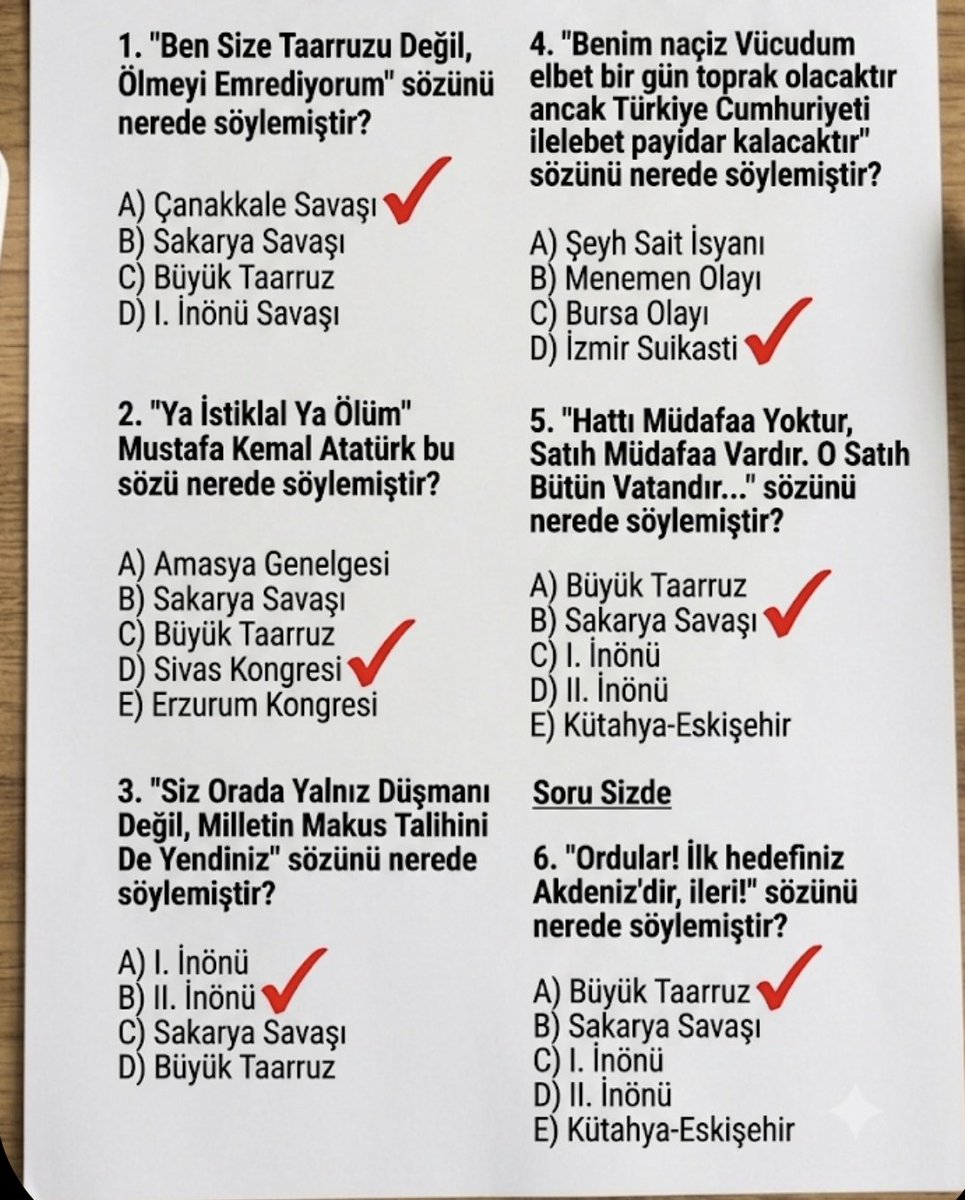
KPSS Tarih'de defalarca sorulmuş, 10 saniyede fark atacağınız sorular
Soru: Mondros Ateşkes Antlaşması'nda Osmanlı'yı kim temsil etti?
Cevap: Rauf Orbay
Soru: Montrö Boğazlar Sözleşmesi'nde Türkiye adına kim vardı?
Cevap: Tevfik Rüştü Aras
Soru: Gümrü Antlaşması'nda TBMM adına kim vardı?
Cevap: Kazım Karabekir
Soru: Moskova Anlaşması'nda heyette kimler vardı?
Cevap: Ali Fuat Cebesoy, Yusuf Kemal Tengirşenk, Rıza Nur
Soru: Kars Antlaşması'nda yine kim var?
Cevap: Kazım Karabekir











![OnuncuSoru's tweet photo. Solution: Following the prior expressions based on Metallic means x²-nxy-y² (→n=2 Silver Mean, n=3 Bronze Mean...); for this expression n=4 and it factors over ℚ[√5]. This is the shifted version of x²-4xy-y² along the x and y axis
#mathematics #algebra #question #factorization https://t.co/9ZYKaQaG3d](https://pbs.twimg.com/media/HMocjebXwAEwtBG.jpg)
![mathemetica's tweet photo. Master quadratic equations through their core formulas and relationships.
The equation ax² + bx + c = 0 has solutions
x₁ = [-b + √(b² - 4ac)] / (2a) and
x₂ = [-b - √(b² - 4ac)] / (2a).
Vieta’s formulas give the sum of roots as x₁ + x₂ = -b/a, the product as x₁ · x₂ = c/a, and the difference as x₁ - x₂ = ±√Δ / a where the discriminant Δ equals b² - 4ac.
Civil engineers depend on these when designing bridges and calculating load distributions involving curved structures.](https://pbs.twimg.com/media/HMjnvoUasAAYBbb.jpg)