Setting up ICU beds is only the first step. Making them operational requires trained teams, specialist support, reliable systems and ongoing clinical oversight.
But how can hospitals build this capacity when specialist doctors are limited?
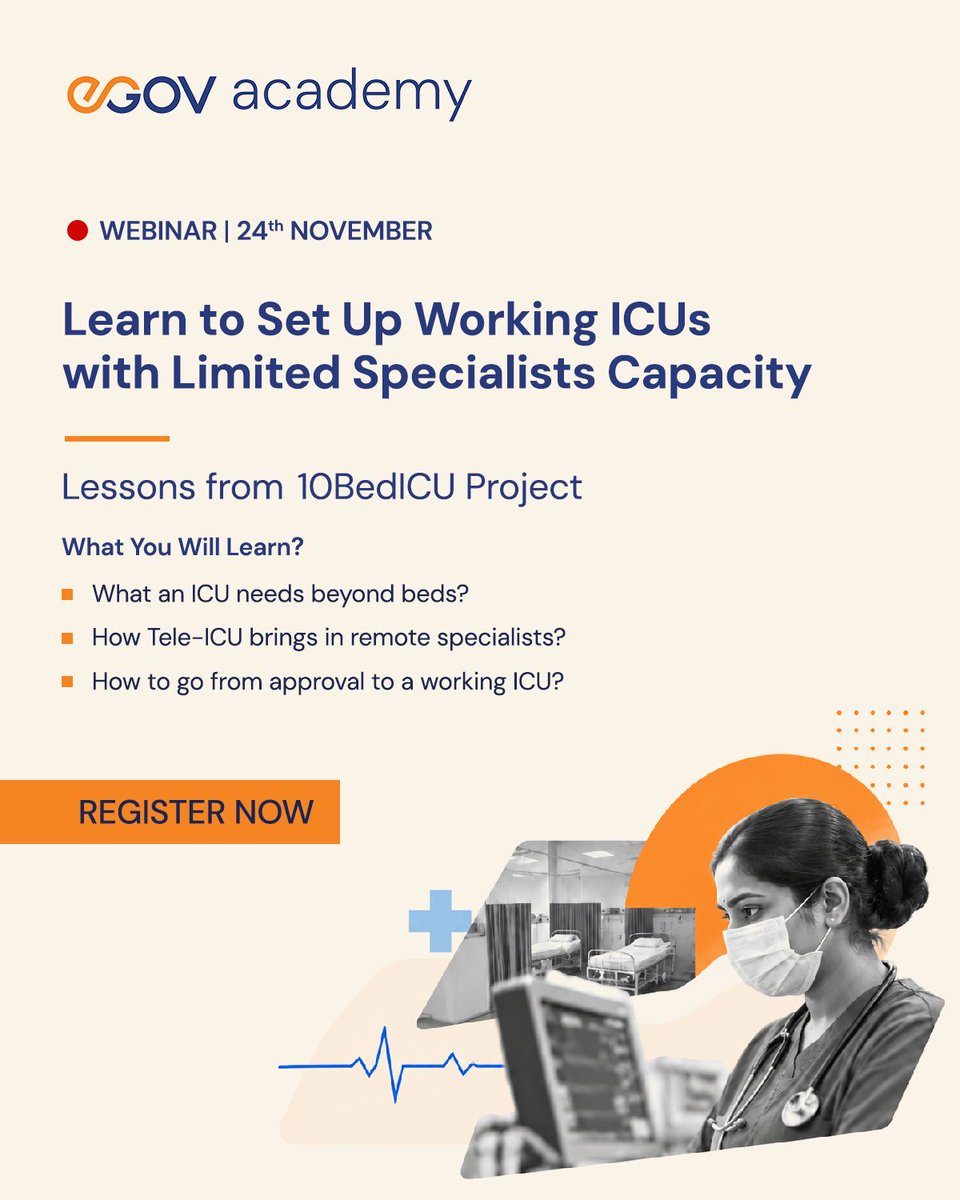
eGov Academy is hosting a #webinar that explores this challenge through the experience of the 10BedICU Project across five Northeastern states, Karnataka and Jharkhand.
Designed for #healthcare leaders, hospital administrators and clinicians, the session will examine:
•What it takes to set up a fully functioning ICU beyond physical infrastructure.
•How Tele-ICU connects hospital teams with remote critical-care specialists.
•How to move from approvals and installation to operational ICUs that can sustain quality care.
Drawing on real implementation experiences, the webinar will share practical lessons on building critical-care capacity in hospitals with limited specialist availability.
Date: 24th November 2026
Time: 2:00 PM IST / 8:30 AM GMT
Register now: https://t.co/ay73z52F5g
#eGovAcademy #DigitalHealthcare #PublicHealth #DigitalPublicInfrastructure #DIGIT
eSanjeevani makes it possible to consult a doctor remotely. But for many rural communities, poor internet connectivity, limited awareness and a lack of trust in virtual consultations can stand in the way of using the service.
A digital public service may exist, but does that mean people can actually benefit from it? In the final episode of our Policy Conclave series, @topno_johnson , Executive Director of @phiaindia , draws attention to the realities of rural India, where limited connectivity, lack of awareness and low trust can prevent people from accessing essential public services.
He talks about why the next generation of public services must be designed with rural communities in mind, and why collaboration between governments, technology experts and civil society is critical to making that happen.
His larger point: Digital public infrastructure can reach the last mile only when connectivity, awareness and community trust come together to make services accessible and usable.
Watch the conversation.
#PolicyConclave #eGovFoundation #DigitalPublicInfrastructure #DigitalPublicGoods #PublicServiceDelivery #DigitalInclusion #ViksitBharat
Bomet County in Kenya wanted to make it easier for citizens to report civic complaints and get them resolved. But putting a digital platform in place was only part of the challenge.
Across Africa, governments are investing in digital public services. Taking these services to scale requires the right infrastructure, technical expertise, local partnerships and the capacity to sustain them.
In the latest episode of our Policy Conclave series, Santhosh Sampige Nagaraj, CEO, eGov Global, shares insights from working with 11 African countries across sectors such as health, payments and citizen grievance redressal. From large-scale health campaigns to the experience of Bomet County in Kenya, he explains how governments, technology providers and local partners can work together to build and sustain digital public services.
His larger point: Scaling digital public infrastructure requires technology, partnerships and local capabilities to work together, so that services can reach more citizens and continue to deliver over time.
Watch the conversation.
#PolicyConclave #eGovFoundation #eGovGlobal #DigitalPublicInfrastructure #DigitalPublicGoods #PublicServiceDelivery #GovTech
What if a farmer in Africa or a student applying for a scholarship could benefit from the same kind of digital infrastructure that made UPI possible in India?
In the fifth episode of our Policy Conclave series, Santhosh Sampige Nagaraj, CEO, eGov Global, discusses about the possibilities of building open digital infrastructure that governments and other organisations can use to develop solutions for their citizens, and how India's experience with Digital Public Infrastructure (DPI) could help countries rethink the way public services are delivered at scale.
His larger point: The future of public services isn't about building a separate solution for every problem. It's about creating infrastructure that others can build on, adapt and scale.
Watch the conversation.
#PolicyConclave #eGovFoundation #DigitalPublicInfrastructure #DigitalPublicGoods #PublicServiceDelivery #GovTech
Imagine applying for a factory licence. The application is just four pages, but the supporting documents run into 200.
Here's the irony: many of these documents have already been issued by another government department. Yet, the entrepreneur must collect, photocopy, notarise, and submit them all over again.
What if government departments could securely verify and share this information? In the fourth episode of our Policy Conclave series, Rishi Agrawal, CEO, TeamLease Regtech Pvt. Ltd., shares how Enterprise Digital Public Infrastructure (DPI) could simplify regulatory processes, eliminate repetitive paperwork and dramatically reduce approval timelines.
He makes a larger point: The next generation of public services must go beyond ease of doing business to enable speed of doing business.
Watch the conversation.
#PolicyConclave #eGovFoundation #DigitalPublicInfrastructure #DigitalPublicGoods #EaseOfDoingBusiness #PublicServiceDelivery #ViksitBharat
You apply for a water connection. The entire process is digital and seamless. But what good is it if clean water doesn't reach your home on time?
India has made significant progress in digitising public services. But a complaint registered online doesn't mean a problem has been resolved. A smooth application process means little if the service doesn't arrive on time.
In the third episode of our Policy Conclave series, Viraj Tyagi, CEO, eGov Foundation talks about why the next generation of public services must move beyond digital access to reliable, timely delivery.
Drawing on examples from Andhra Pradesh and Odisha, he shares how governments are rethinking service delivery to reduce delays, improve accountability and build citizen trust.
His larger point: Good public service delivery should be the norm, not the exception. And it should work for every citizen, everywhere.
Watch the conversation.
#PolicyConclave #eGovFoundation #DigitalPublicInfrastructure #DigitalPublicGoods #PublicServiceDelivery #ViksitBharat
What if citizens didn’t have to search for the public services they are entitled to?
For millions of Indians, accessing welfare benefits still depends on knowing what schemes exist, understanding eligibility and navigating the application process.
In the second episode of our Policy Conclave series, Ayushi Khare, Senior Lead, Indus Action looks at a different possibility: public services that can identify eligibility, reach out proactively, seek consent, and make access far easier for citizens.
She makes a larger point: The next generation of public services begins with a simple shift: from citizens chasing services to services finding citizens.
Watch the conversation.
#PolicyConclave #eGovFoundation #DigitalPublicInfrastructure #DigitalPublicGoods #PublicServiceDelivery #ViksitBharat
Public services are often discussed in terms of reducing friction. But better public services also depend on something more fundamental: having reliable data that different systems can use together.
At the second edition of the Policy Conclave co-hosted by eGov Foundation and the Center for Digital Public Goods (CDPG), we asked panelists what the next generation of public services in India could look like.
In the first of our new video series, Prof. Srinivasan R, Chairperson, Indian Institute of Management Bangalore - CDPG talks about how DPI and DPGs can help bring different pieces of information together to make public services more accurate, reliable and easier for citizens to access.
He also makes a larger point: the future is not about standalone DPIs, but about DPI ecosystems where different digital public goods can work together.
Watch the conversation.
#PolicyConclave #eGovFoundation #DigitalPublicInfrastructure #DigitalPublicGoods #PublicServiceDelivery
🚀 eGov Academy Learning Series 2026 | Session 2
1 day to go! Join us tomorrow for the second session of the eGov Academy Learning Series 2026, 100 Days, 121 Cities | Scale at Speed.
How do you take a digital platform from 2 pilot towns to 121 cities in just 100 days?
As part of Shared Rails: The Building Block Story, this session takes us inside the Punjab rollout that became eGov’s proof of concept for scaling shared digital infrastructure. We’ll have Jasminder Pal Singh Saini and Parminder Pal Singh Sandhu joining us to help set the context and take us through the process as they experienced it.
Jasminder is Associate Director at eGov Foundation, where he leads Partnerships and Growth to help governments adopt scalable, open digital solutions and Digital Public Goods. With prior senior roles in the Government of Punjab, including the State e-Governance Mission Team and the Chief Minister's Office, he brings deep experience in digital governance, citizen-centric services, and public-sector technology across the Global South.
Mr. Parminder Pal Singh Sandhu is a Punjab-cadre IAS officer with over two decades of experience in public administration, governance reforms, and digital transformation, having served as Sub-Divisional Magistrate, Municipal Commissioner, Managing Director of the State Cooperative Bank, and Director of Governance Reforms. Across Local Government, Education, Skill Development, and Home departments, he has led efforts to strengthen public institutions, improve service delivery, and drive technology-enabled governance.
They will be exploring the decisions that shaped the rollout, from selecting the pilot towns and sequencing modules, to structuring teams for scale, managing trade-offs, and deciding what stayed fixed and what came later.
📅 Tomorrow, 8 October 2026
⏰ 4:00–5:00 PM IST
💻 Online Webinar
👉 Register here: https://t.co/dB6apdWIxd
Join us for a practical look at what it takes to move shared digital infrastructure from pilot to scale. We look forward to having you with us!
#egovacademy #eGovFoundation #DigitalPublicInfrastructure #LearningSeries #PublicServiceDelivery
Some days leave you thinking long after the conversations have ended. The Second Annual Policy Conclave, 2026, co-hosted by eGov Foundation and the Center for Digital Public Goods (CDPG) at Indian Institute of Management Bangalore was one of them.
Over the course of the day, we had the chance to hear from policymakers, academics, and ecosystem leaders as we explored this year’s theme: “Envisioning the Next Generation of Public Services in India.”
From conversations on digital infrastructure, data, and AI, to panel talks on health, WASH, education, agriculture, commerce, and financial services, the day brought together people looking at public services from a vast variety of vantage points.
Easwaran V, ED & COO, Protean eGov Technologies, as well as Viraj Tyagi, CEO, eGov Foundation, and Prof. Srinivasan R, Chairperson, CDPG and faculty of the Strategy area at IIM-B, released the second edition of the 'State of DPI in India 2026' report, examining the evolution of India’s DPI across the sectors mentioned above.
The emphasis on the importance of privacy, accountability, transparency, was centered in every conversation. What truly stayed with us was how many of the conversations came back to the same underlying shift: moving beyond simply digitizing processes, towards thinking about the systems, institutions and the ecosystems needed to deliver better outcomes.
A lot to reflect on, a lot to learn from, and lots of ideas to carry forward.
Here’s a look back at the day!
#DigitalPublicInfrastructure #DigitalPublicGoods #DigitalIndia #CDPGConclave2026 #PublicServices
🚀 eGov Academy Learning Series 2026 | Session 2
10 days to go for the next session of the eGov Academy Learning Series 2026 - 100 Days, 121 Cities | Scale at Speed
How do you take a digital platform from 2 pilot towns to 121 cities in just 100 days? Join us as we explore the rollout that became eGov’s proof of concept.
We’ll explore how the pilot towns were selected, what they were meant to prove, which modules went live first (and why), how the team was structured to support the rollout at scale, and how each decision contributed to the final result.
The session will also look at what stayed fixed through the rollout, what was deliberately taken up later, and the operational choices that helped the platform move from a pilot to state-wide scale.
📅 Thursday, 8 October 2026
⏰ 4:00–5:00 PM IST
👉 Register here - https://t.co/RmTldcp5dv
Join us for a practical look at what it takes to take shared digital infrastructure from a pilot to scale, we look forward to having you join us!
#eGovAcademy #LearningSeries #DigitalPublicInfrastructure #eGovFoundation
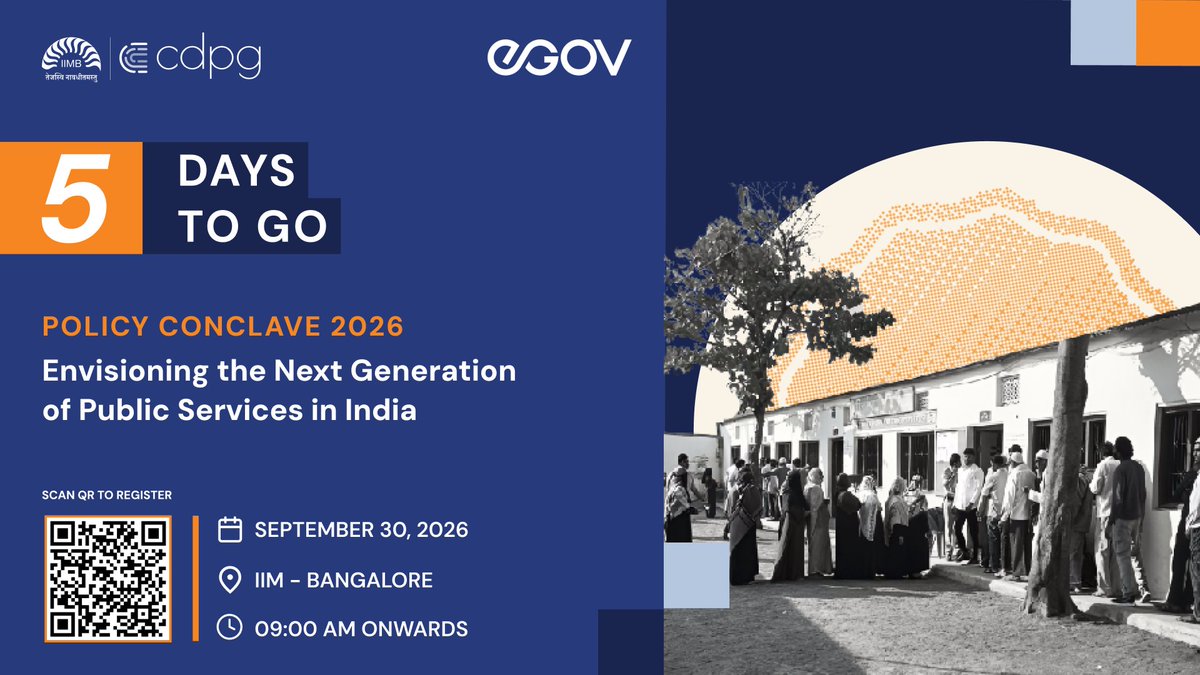
5 days to go for the Annual Policy Conclave 2026!
The next generation of public services will be shaped by what we ask of digital infrastructure now.
The first wave of digital transformation made services digital. The second made them interoperable. The harder question is what comes next: How do these systems create better outcomes for people, not just better-connected processes?
That is the question we’ll explore at the Annual Policy Conclave 2026, organised by the Indian Institute of Management Bangalore and the Center for Digital Public Goods (CDPG), in partnership with eGov Foundation on 30th September. The day brings together practitioners and leaders across sectors to examine what it takes to make public services more citizen-centric as digital infrastructure, data, and AI reshape how they work.
Viraj Tyagi, CEO of eGov Foundation, will open the day by reflecting on eGov’s journey with building for public service delivery, and what the decades of working with governments has revealed about building digital foundations that can endure, adapt, and enable transformation at scale.
Five cross-sector conversations will take that question into practice:
Commerce: Can DPI keep markets open and contestable as AI reshapes them?
Education: Can interoperable credentials support learning journeys that move beyond institutions?
Agriculture: Can DPI reduce information gaps and strengthen resilience for farmers?
Healthcare & WASH: How can interoperability strengthen services while protecting privacy, consent and human agency?
Financial services: What can the payments DPI story teach us about the next generation of financial infrastructure?
We may not have all the answers. But these are questions that practitioners across the ecosystem will have to work through together.
The day closes with a fireside conversation between Gautham Ravichander and Prof. Srinivasan R on where DPI goes from here.
Five days left to be part of the conversation. If this is where your work sits, register now
Registration Link: https://t.co/PawdJlTIRM
📅 30 September 2026
📍 IIM Bangalore
🕐 09:00 AM onwards
#CDPGConclave2026 #eGovFoundation #IIMBangalore #PublicServices #DigitalPublicInfrastructure #DigitalPublicGoods
45. That’s the life expectancy some estimates give the people who empty our sewers and septic tanks. For most Indians, it’s around 70. And one of them still dies on the job every five days, in our smart cities.
On 9 September, 13 people from across the sanitation ecosystem came together at India International Centre, Delhi, to ask: what will it take to change this?
UN bodies, researchers, policy experts, systems thinkers, activists, grassroots organisations and former bureaucrats, including people from ILO, CFAR, Praxis, Safai Karmachari Andolan, NCDHR and beyond.
No speeches. No presentations. No panels. Just dialogue.
We moved from personal stories to root causes to the question: where can each of us act?
Because making sanitation work safe and dignified requires action across policy, systems, and communities. And while many are working on different pieces of the same problem, they rarely have the opportunity to sit together and think through it.
That’s what Sanman set out to create: a space to think together, challenge each other, and move towards action.
And nobody left with a polite “let’s stay in touch.” Everyone picked a working group, claimed a piece of the problem, and left with a clear sense of what they wanted to do next.
That’s the kind of ecosystem we want to help build.
To the 13 who brought their stories, questions and candour to the table:
Andre Ling, Aveek De, Beena Pallical, Bharti Birla, Gunjan Jain, Kalpana Biswakarma, Lakshmi Hegde, Pradeep N., Rajib Das, Raman VR, Shreyas TR, and Tejas Singh Sandhu, to more of such conversations!
Sanman | eGov Foundation
Making sanitation work safe and dignified.
🚀 eGov Academy Learning Series 2026 | Session 1
Built Once, Used Everywhere
The real value of shared infrastructure lies in what it makes possible next.
As part of the eGov Academy Learning Series 2026, we’re kicking off our first topic, Shared Rails: The Building Block Story.
The first session under this topic will cover how shared digital building blocks can reduce the need to reinvent solutions across governments, creating opportunities for reuse, adaptation, and scale.
📅 23 September 2026
⏰ 4:00–5:00 PM IST
👉 Register here: https://t.co/EIENtgoggk
Join us as we begin the journey of understanding how shared rails can enable governments to build, scale, and deliver more effectively.
#eGovAcademy #LearningSeries #DigitalPublicInfrastructure #eGovFoundation
Public services are where a country’s development translates into people’s everyday lives. As India moves towards Viksit Bharat 2047, a truly developed India will require an equally ambitious vision for public service delivery.
At Charcha 2026, eGov Foundation will co-host a conversation on reimagining public service delivery for Viksit Bharat. We’ll explore what it takes to ensure that a service does more than simply reach a citizen.
How do we make services inclusive across language, ability, geography and digital literacy? How do we ensure they are assisted where needed, connected across institutions, and dependable from request to resolution? And what must Sarkaar, Samaaj and Bazaar do differently to make this possible?
Drawing on over 20 years of working with governments and partners, the conversation will bring together perspectives on how we can move from access for all to outcomes for all, and create public services that work better for every citizen.
Join us at Charcha 2026 for the conversation.
15–16 September | India Habitat Centre, New Delhi
#Charcha2026 #eGovFoundation #PublicServiceDelivery #DigitalPublicInfrastructure #ViksitBharat @thesparkorg_in
100+ submissions. One award. Punjab for the win.
The mSeva team at @pmidcpunjab has been recognised at Technology Sabha 2026, organised by the ET Group, for its AI use case on Property Enumeration. The use case was selected from numerous entries across AI-for-governance programmes nationwide.
Property enumeration is one of those unglamorous problems that shapes a city's own-source revenue and enables its financial independence. Punjab chose to solve for this multi-faceted problem with AI.
For eGov, this is a milestone in an eight-year partnership with the Government of Punjab that began with the rollout of mSeva, powered by DIGIT, our open-source platform. We've since worked closely with PMIDC on Own Source Revenue and Digital Adoption.
Yet another win for government and ecosystem partnerships that identify real problems, experiment together, and generate evidence so that ideas actually reach the ground.
Congratulations to Simarjeet Kaur and the entire PMIDC team, and to everyone at eGov and ARF who contributed in making this innovation a success.
The award, presented by Saina Nehwal, was received by Jasminder Pal Singh, Associate Director – Growth & Partnerships, eGov Foundation, and Dinesh Kumar, Manager – IT, PMIDC, on behalf of Ms. Deepti Uppal, IAS, Special Secretary - Department of Local Government and CEO - PMIDC, Government of Punjab.
#eGovFoundation #PMIDC #mSeva #DIGIT #ArtificialIntelligence #UrbanGovernance
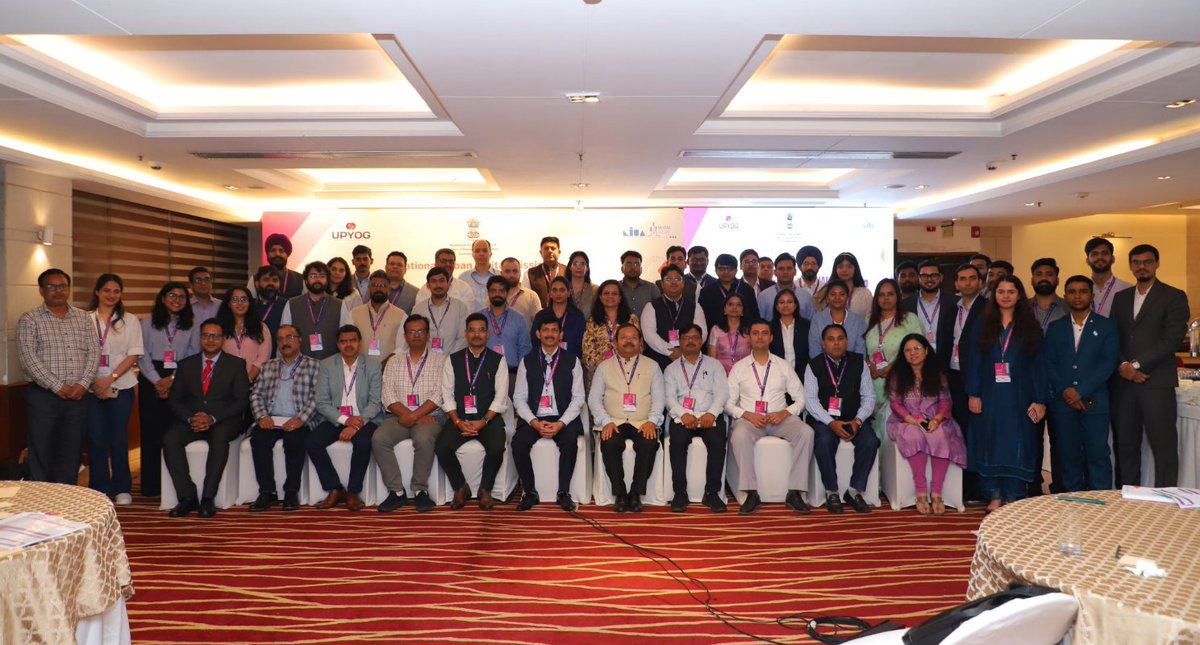
@eGovFoundation participated in the National Urban Digital Mission (NUDM) Industry Consultation Workshop, convened by the Ministry of Housing and Urban Affairs (MoHUA) to help shape the next phase of National Urban Digital Mission @NUDM_NIUA
Our association with NUDM dates back to the Mission’s initial phase. Launched in February 2021 on the principles of the National Urban Innovation Stack, it leveraged eGov’s DIGIT as the base platform, along with nine open-source, interoperable and microservices-based reference applications.
At the workshop, Viraj Tyagi, CEO of eGov Foundation, joined the plenary to reflect on eGov’s journey of contributing to shared digital infrastructure for the urban sector. The distinguished panel included Mr. Satendra Singh (Secretary, Department of Urban Development, MoHUA), Mr. Manish Sinha (CEO Office, GSTN), Ms. Usha Padhee (ACS, Govt. of Odisha), Mr. Praveer Kumar (JS, MoHUA), Mr. Manish Srivastava (CEO, ARF) and Ms. Debolina Kundu (Director, NIUA).
Eight years ago, around 450 cities had some form of digital service. Today, 3,000+ Urban Local Bodies are adopting the UPYOG platform. This journey has unlocked a wider ecosystem of innovation for states to improve public service delivery beyond municipal services as well. Because of the open interoperable architecture, many states like Odisha, Punjab, Kerala, and others have built new services across sectors like sanitation, livelihoods, rural services, etc., and have enabled interdepartmental linkages on the shared digital rails.
Viraj highlighted few key priorities for the next phase of NUDM:
Reducing friction in accessing high-fidelity data for AI and better decision-making.
Creating more structured ways for State-level innovations to travel quickly across States.
Making adoption easier through familiar channels such as WhatsApp and simple voice-based interfaces.
Enabling climate change related interventions on shared digital rails to make cities more resilient.
The workshop included three round-table discussions focused on UPYOG’s technical architecture, AI and citizen-centric innovation, and implementation approaches across States and Union Territories.
Across the discussions, a few themes emerged consistently: citizen outcomes must remain the test of technology; states need a small common core on which they can build; strong data foundations must come before AI; adoption pathways must reflect differences between States and ULBs; and institutional capacity, governance, and predictable funding will determine the Mission’s long-term sustainability.
Building on the foundations of NUDM, the Ministry’s forward looking vision for a unified urban stack was articulated by JS, NUDM, which will aim to create a common digital backbone for cities.
@VirajPositive | @ushapadhee1996 | @manishsv | Praveer Kumar | Satendra Singh | Manish Sinha | Debolina Kundu
#NUDM #IndiaUrbanStack #UrbanGovernance #DigitalPublicInfrastructure #CitizenCentricGovernance #DigitalTransformation #eGovFoundation #MoHUA