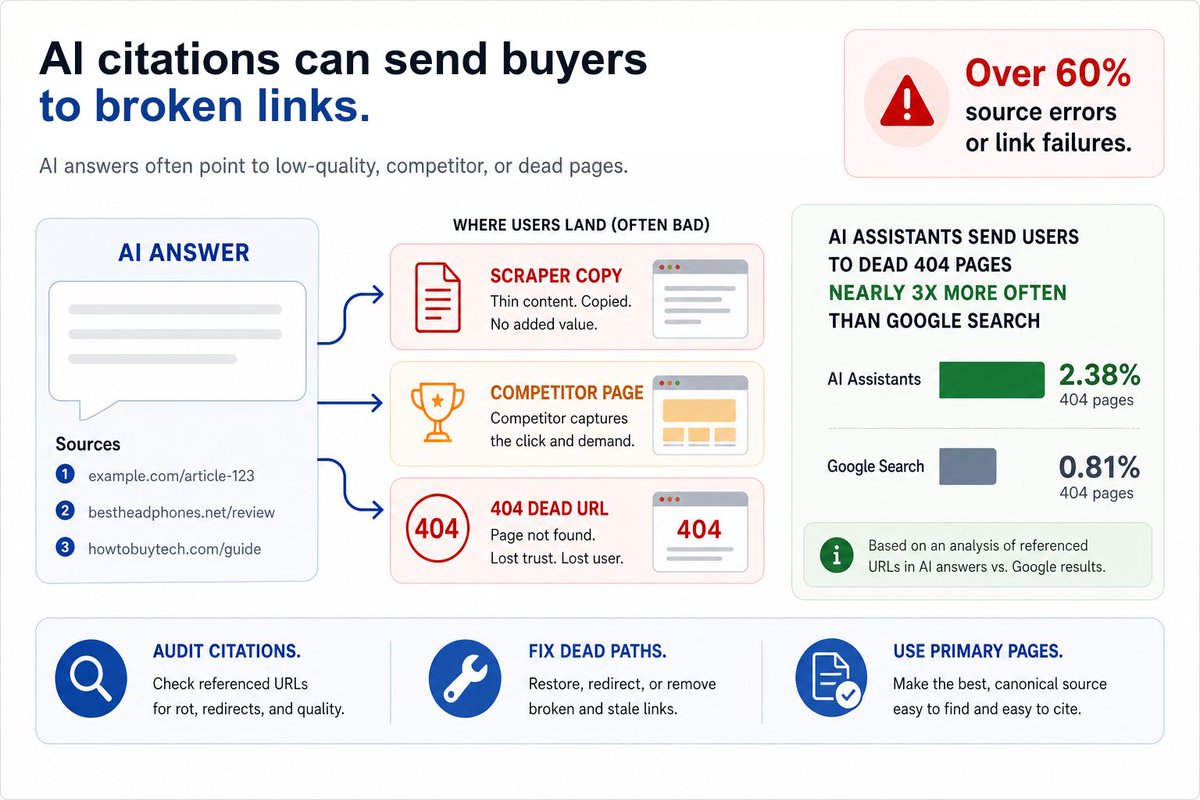
AI search engines have a massive link rot problem.
According to 2026 evaluations, over 60% of AI-generated answers contain source errors or link failures. When a user asks an AI assistant about your product, the engine is likely to point them to:
* A scraper site that copied your content
* A competitor offering a similar product
* A dead URL that goes nowhere
Rather than pulling from a curated list, AI engines guess logical paths based on standard URL structures, often generating pages that never existed in the first place.
Ahrefs' tracking database of 16 million URLs shows that AI assistants send users to dead 404 pages nearly three times more often than traditional Google Search. For ChatGPT specifically, 2.38% of all cited URLs lead directly to a Page Not Found error, nearly triple the Google baseline.
This error rate has created a new operational requirement: AI citation hygiene. Hoping the machine represents you correctly is a losing strategy.
You must actively audit how your brand is referenced across these models. Verify that your citations resolve to live, primary pages. If you ignore this audit, you are sending interested buyers directly to dead ends. Ignore your citations and you leave your customer acquisition to chance.
Your generic AI visibility dashboard is lying to you. A single average score assumes all search engines think alike, but each AI engine operates on a distinct citation model.
Per Ahrefs citation research from June 2026, where you need to exist online depends entirely on who is answering the question. In fact, 86% of the top-cited sources are unique to each engine.
ChatGPT favors encyclopedic pages and reviews. Brand Radar studies from 2026 show it relies heavily on Wikipedia and Reddit, alongside product listicles which make up 40% of its cited pages.
Perplexity favors video and real-time community feeds. In June 2026, YouTube captured 32.4% of Perplexity's citation share, followed by Wikipedia at 8.2%.
Google AI Overviews show a different mix of social and media sites. YouTube leads at 20.9%, followed by Facebook at 11.6% and Wikipedia at 4.8%.
Optimizing for AI search requires multiple concurrent plans. If your customer discussions live on YouTube but you only optimize reference text, you are optimizing for the wrong engine.
You need to audit where your space lives. Stop looking at a single vanity score and start matching your content to the engines that matter.
Googlebot still reads the web about as much as every AI crawler combined.
Per Cloudflare, in July 2025 Googlebot was 39% of crawler traffic, while GPTBot was 12%, ClaudeBot about 10%, and Meta's bot under 8%. Measured across a full year, Googlebot made up 4.5% of all page requests and every AI bot together 4.2%. One crawler roughly equals the whole field.
The raw fetch counts say the same. On Vercel's network in one month, Googlebot made 4.5 billion fetches, against 569 million from GPTBot and 370 million from ClaudeBot.
Demand is smaller than the noise suggests too. Per Pew, 34% of US adults have ever used ChatGPT. Most searching still happens the old way.
This is worth saying because companies are now writing files and changing configs specifically for AI bots, sometimes blocking the crawlers that send them the most readers. And Googlebot is the only one of these crawlers that renders JavaScript, so it is also the strictest reader to satisfy.
The work that makes a page readable to AI is the same work that has always made it readable to Google: finished HTML from the server, a clean sitemap, content that does not hide behind scripts. There is no separate AI project waiting to be funded. There is the foundation you already owed Google. And Google still does most of the reading.
Small firms face three barriers in the shift to AI search, per 2026 database scans. A brand without a big data deal gets ignored by AI crawlers and left out of search results.
First, AI summaries take user clicks. When an AI summary is shown, organic clicks drop by 58%, per 2026 data. Large sites sell their data for millions. Small sites get crawled without charge and lose traffic.
Second, top search ranks fail to buy AI citations. In March 2026, only 38% of links cited in Google AI summaries rank in the top 10, per an Ahrefs study. High ranks get ignored by AI tools.
Third, small brands lack verified nodes. Under 1% of firms exist in public knowledge graphs like Wikidata. This leaves them as loose text to AI engines.
This three-way block leads to:
* Small sites lose traffic
* Old SEO work fails to buy presence in AI answers
* Search systems guess brand details due to missing data records
To survive, small brands must look beyond old links. They need to set up clean brand data on public graphs, consistently displaying the same information about the brand in machine readable way everywhere they can: LinkedIn, Reddit, Wikidata, etc.
Did you ever put your brand into any LLM and ask it in detail what it knows about your product. Maybe your team? I'm pretty sure it hallucinated half of it.
Even top AI models make errors between 5% and 12% of the time on complex files, per a Vectara data list in June 2026. When these systems write about brands they know little about, they fill the gap with a confident guess. This guess often creates false facts.
For a new or small brand, this error rate poses a big risk. Without clear web data, the AI fails to find your details. Instead, the model guesses your work based on other sites.
You can move your brand from a guess to a verified fact:
* Set up a Wikidata profile to anchor your business details
* Keep your brand name, address, and products the same across the web
* Publish clear fact sheets that machines can read
Matched facts matter more than search ranks in the AI age. When a model finds matching facts across multiple lists, it stops hallucinating and starts citing.
Under 1% of firms exist in public knowledge graphs, per a June 2026 database scan. Wikidata has 122 million items. Yet only 876,000 are set up as companies. This gap leaves most brands hidden from the databases that feed AI engines.
Search engines now shift from words to concepts. AI engines map links between verified brands, products, and people instead of just reading text. A business without a clear listing looks like random text to an AI.
Getting into these databases helps your search presence:
* Brand mentions link to AI search presence up to 2.7 times more than Domain Rating, per 2026 Ahrefs data
* Search engines value clear brand signals over old links
* Clean profiles set up the nodes that AI systems retrieve first
AI engines prioritize verified nodes over purchased backlinks. Listing your company in public database registries turns raw web text into structured data that AI models retrieve by default.
About 96% of the top 1 million website home pages fail basic accessibility tests, per a WebAIM study in February 2026. These sites average 56 errors each. This makes them hard for people to use.
These same errors hide your site from AI search agents. Automated web models read pages by parsing the accessibility tree. They skip screen pixels entirely. When an AI agent needs to buy a product or compare prices, it reads this tree to find buttons and text.
This problem grows as pages get complex. The average home page now has 1,437 elements. That is a 22% rise in elements from the prior study. Complex sites built with code templates lead to more broken tags.
The errors that block AI tools are:
* Empty buttons stop crawlers from navigating the site
* Missing labels block AI agents from completing forms
* Bad text contrast hides key details from layout parsers
Fixing these errors is the fastest way to make your site legible to both humans and AI bots.
About 16% of all images on the top 1 million websites are hidden from search engines, per a March 2026 WebAIM report. These systems rely on text descriptions to index images, leaving blank photos out. This gap creates a large blind spot for crawler software.
Text-based AI crawlers read alt text to understand what is in a photo. When a product image lacks this description, AI engines skip it entirely. This skip removes your products from popular comparison lists on the web.
The March 2026 report shows these details:
* Over 53% of websites have at least one image with missing alt text
* About 11% of images with alt text use useless names like image or file formats
* These blank or vague descriptions hide products from AI search results and shopping lists
When an AI crawler skips your product photo, it excludes your site from the answer. The product is missing from search, even with a top Google rank. This is a basic site error that hurts search traffic for e-commerce sites of all sizes, leading to fewer organic sales.
To get found in AI search today, you must add plain text descriptions to your images. Doing so helps machines read and show your items. Users can then find your products through AI search and automated chats.
Nearly 68% of US Google searches now end with zero clicks to other sites, per SparkToro in mid-2026. These AI answers do this by showing facts on the page, so users skip the visit entirely. This change affects everyone who writes for the web.
This gap varies a lot by site type. Traffic fell for 37 of the top 50 global news sites in May 2026, according to a Similarweb report. Legacy news sites lose search traffic as search engines shift from links to answers.
The search impact depends on what you publish:
* Newsweek traffic fell by 69% in April 2026
* Daily Mail traffic fell by 51% in the same month
* World news sites with original reporting grew their traffic
When AI gives the answer on Google, users skip the link. AI easily summarizes simple news, killing traffic to those pages. Sites with unique data or opinions hold their audience, proving that original work keeps its traffic while basic facts lose all value online.
The search market is dividing into two tiers. Generative AI now handles simple questions, while hard questions still go to other sites. To survive, you need direct ways to reach your readers, like email lists and mobile apps of your own.
The panic over falling search click-through rates ignores the value of the remaining traffic.
We know the bad news. When an AI summary appears, users click an organic link just 8% of the time, compared to 15% on traditional results.
But focus on what happens to the users who do click. AI engines act as a pre-qualification layer, filtering out casual browsers and delivering buyers with defined intent. The reader has already read the summary and wants details.
Recent 2026 benchmarks reveal the conversion efficiency of this new traffic:
* Opollo B2B Tech audits show AI-referred visitors convert at 14.2% on average, compared to 2.8% for Google organic visits.
* Ahrefs tracking reports show AI search referrals accounted for 0.5% of traffic but drove 12.1% of total signups.
The old web traded free content for high-volume, low-intent traffic. The new model delivers lower volume but pre-qualified leads that convert at a much higher rate.
So we should stop measuring success solely by raw traffic numbers. The focus is shifting from counting clicks to capturing the pre-filtered leads that ready-to-buy users represent. Companies who adapt to this change will win the high-value conversions.
Your quarterly AI search visibility snapshot was outdated before you finished reading it.
Generative search results change constantly. 2026 research from Ahrefs reveals that tracking AI ranking is like trying to measure the height of a wave.
Rather than maintaining a stable index, Google AI Overviews and other assistants experience constant flux. The data shows:
* Content changes occur in 70% of consecutive observations
* An AI Overview remains stable for only 2.15 days on average
* Just 54.5% of cited URLs overlap between back-to-back prompts for the same query
* Only 54% of named entities remain consistent when an update occurs
Marketers selling one-time visibility reports are trading in stale data. An AI rank tracker is only useful if it runs repeatedly and captures trends over time.
If you base your strategy on a single PDF report from last month, you are optimizing for an answer that disappeared weeks ago. You are spending resources on search results that your buyers no longer see.
Start doing continuous, dated measurements. Any useful approach to tracking AI visibility requires constant monitoring, because the search environment changes every couple of days. Any tool that promises a permanent rank score is selling a fantasy.
You spent ten thousand dollars on backlinks to rank first on Google. Nice work.
But page-one ranking on Google is no longer a guarantee you will get cited by AI.
A standard organic playbook does not automatically win AI citations.
Per an Ahrefs study tracking 863,000 keywords, the overlap between Google's top 10 organic results and AI Overview citations fell from 76% down to 38% in a seven-month span leading into January 2026.
Google's own AI features are rapidly decoupling from its traditional first page.
Getting cited by AI now requires a different strategy.
A 2026 Ahrefs brand-factor study analyzing 76.7 million AI Overview results measured what correlates with these citations. Backlinks showed a weak correlation of 0.218. Word count sat near zero.
Instead, branded web mentions scored 0.664, and YouTube mentions led with 0.740.
Getting talked about across the web drives AI citations.
These are two different games. The old model rewards optimization of your own pages. The new model rewards how often other people talk about your business elsewhere.
Stop obsessing over link-building and keywords. Get people talking about your brand on YouTube and third-party sites.
Otherwise, you are missing half the search field.
Every major AI crawler except Google's reads your site with JavaScript turned off.
OpenAI, Anthropic, Meta, Perplexity, and ByteDance all fetch the raw HTML and stop there. Only Googlebot and Gemini run the page's scripts first. That comes from Vercel and MERJ, who watched billions of these fetches in 2024.
What it costs you depends on how your pages are built. A server-rendered page arrives with its text already in the HTML, so a crawler that runs no scripts reads the whole thing. A client-rendered page arrives almost empty: the body, the prices, the links all get assembled by JavaScript in the browser. To a crawler that runs none, that page is close to blank.
The averages hide this. The HTTP Archive found the median page loses only about a sixth of its words when you skip rendering, because most sites still server-render and pull the median down. The sites that client-render are the minority, and for them skipping JavaScript erases nearly the whole page.
The check takes a minute: load your page with JavaScript disabled, or fetch the raw HTML, and read what is left. Whatever is missing is all the AI models have to work with.
Websites are adopting a new text file to guide AI search bots. Per HTTP Archive, 2.1 percent of sites now publish this file, called llms.txt. It is a popular new trend in web development.
AI bots ignore it. Traffic logs show llms.txt gets less than 0.01 percent of bot requests. One server logged only 408 requests out of 515 million events, while another saw just 1,227 requests in 45 million events. John Mueller on Bluesky confirmed that AI systems ignore the file.
Meanwhile, basic search files are missing. Our sitemap inventory of 1.1 million company sites shows 27 percent lack a sitemap.
This is a classic cargo cult. Building a trendy new file is easy, but they omit the files that crawlers need. Still, a sitemap is just a small discovery file of about 5-50 megabytes. Serving the actual website pages is where the real cost lies; we regularly crawl sites that total 30 gigabytes.
Keeping that serving bill sane comes down to infrastructure basics:
- Compress page payloads with Brotli to cut bandwidth.
- Rate-limit the aggressive bots at your firewall before they reach origin capacity.
- Watch your database query pools so heavy scans don't cause locks.
We handle this for clients, so if you'd rather not, drop me a line.
About half of new English web pages are mostly AI. This share stayed flat for five quarters, per Graphite. Yet only 17.31% of Google top results are AI, per https://t.co/OI7Qpfmotp. That share fell after the March 2024 core update.
Google removes low-quality content. About 21.29% of indexed pages get deindexed in 90 days, per IndexCheckr. In court, Google lead Pandu Nayak explained their logic. He said Google keeps the index size stable by decreasing the amount of junk in it.
So, writing cheap text is a losing battle. Search filters are tightening. If you publish average AI text, Google will likely drop it.
You need a better plan to win. You must write original work that bots cannot copy. A few good pages are worth more than a huge site of fake text. Write about real events. Share your own data. This is how you stay visible.
This gap between publication and ranking offers a clear lesson. Success comes from focused depth. You should write for human readers who need real answers. Do things that require effort, like interviewing experts or testing software. Google wants to index work that has real value. If you make your site a source of true expertise, you will gain search traffic while AI sites get removed.
Focusing on conversion rates makes AI search seem like an SEO dream. Per Similarweb, ChatGPT traffic converts at 7.1 percent. A Seer Interactive report puts it at 15.9 percent. That crushes Google's 1.76 percent organic search conversion rate.
But this ignores the cost of your crawl budget. AI bots consume massive server bandwidth and database resources to send very few visitors. Comparing the sales generated per crawl shows the true return on investment for your server costs.
Per Cloudflare, July 2025 ratios show the sales yield per one hundred crawls. Google takes only 5 crawls per referral, yielding 0.35 sales. ChatGPT requires 1,091 crawls per referral, yielding 0.015 sales. Claude needs 38,065 crawls per referral, yielding 0.00013 sales.
On a per-crawl basis, Google is twenty-four times more efficient than ChatGPT, and twenty-seven hundred times more efficient than Claude. Wasting server resources on AI crawls is a real hosting cost that impacts your bottom line. You spend real dollars hosting bots that rarely buy.
The fix is shrinking what a crawl costs you. The largest sites in our crawl corpus run to 30 gigabytes, and three changes cover most of that bill:
- Disallow database-heavy filter and search query pages in robots.txt.
- Pre-build HTML content pages statically so a bot visit never touches the database.
- Enable tiered CDN caching so duplicate bot requests collapse into one.
If that list reads like someone else's job, it can be ours.
The debate over blocking AI bots hinges on the crawl-to-referral ratio. This measures bot scans compared to the visitors sent. It is server cost versus traffic reward.
Website owners block AI bots because they crawl thousands of times but send almost no visitors. But these ratios are not static. Per Cloudflare, AI search ratios changed fast in 2025. Anthropic's ratio dropped from 286,930 crawls per referral in January to 38,065 in July. Perplexity's ratio rose (yes, it got worse), moving from 54 to under 200. Google stayed steady, between 3 and 30.
These numbers also undercount visits by design. The Claude mobile and desktop apps send no Referer header when users click outbound links. App-driven visits look like direct traffic. Your web analytics tools will not show them as AI referrals.
Basing your strategy on one quoted ratio is a mistake. AI crawl rates fluctuate and shift in months. Traffic is growing, even if your current analytics tools cannot see it yet.
Some of the sites we crawl weigh 30 gigabytes. At that size bots cost real hosting money, and the cheapest protection is caching:
- Serve HTML content pages from the CDN edge so bot requests stop reaching your origin.
- Return HTTP 304 headers so bots skip re-downloading unchanged pages.
- Give static content longer edge TTLs.
Or skip the checklist and hand it to us; tuning sites for crawl load is part of what we do.
Under a 15-second budget, half of company websites fail to deliver their sitemaps fully. We ran a bulk check on over 1 million company websites. About 48% of them ran out of time before the check could finish.
We used a strict crawl budget:
- 15 seconds total per site.
- 0 retries.
These sites do have sitemaps. Their servers responded and the check started. But the fetch of the entire sitemap index and all its child files took too long to finish. The server could not deliver the list in time.
Every search crawler operates on a budget you do not control. If your platform serves slow, dynamic XML files, crawlers leave. Without a complete list, your new pages remain invisible to search engines.
This problem goes unnoticed because the website looks fine to visitors. Uptime monitors check the homepage and report green. When new pages do not get indexed, teams blame content quality instead of the slow delivery.
Test your sitemap chain from outside your own network. If fetching the files takes more than a few seconds, stop generating them dynamically on demand. Pre-build them as static files and cache them at your CDN edge to drop fetch times to under a second.
It seems natural to assume that bigger companies have bigger websites. But they barely do.
We looked at the sitemaps of 13,000 B2B companies.
A typical company with under 50 employees has a site of 160 pages. One with 1,000 employees has 880.
Multiplying the staff by 100 only grows the site 5x.
Why doesn't it grow? Websites scale differently than companies. A few people can write as many pages as a large department.
This is good news for startups. While having a lot of pages is not the goal, it still suggests that a small focused team can outperform big companies in content production. Especially if they think carefully about what they are writing and for whom.
More than 1 in 4 company sites have no sitemap. We ran a bulk check over 1 million company websites to see if they published one.
For each website, our checker followed a simple sequence:
- Fetched robots.txt.
- Read the Sitemap directive if present.
- Tried the standard sitemap locations.
A sitemap is the simplest file in search. It is a plain text list of your pages at a known address, and every web platform builds one automatically. Crawlers read it to find your pages without having to discover them link by link.
We expected complex errors like bad XML, redirect loops, or crawl traps. Instead, the dominant failure was that the file was just missing on 27% of the sites.
This happens because people judge websites by how they look. Everyone at the company sees the homepage. No one sees the sitemap, so its absence hurts no one's reputation. *If a bug is off screen, it does not exist.*
Google used to compensate by following links on your site. Newer AI crawlers fetch less often. They rely more on the list you give them. Without it, discovery depends on your internal links and crawler patience.
Checking your site takes 30 seconds. Open robots.txt and look for the Sitemap line. Adding one takes about 1 hour.