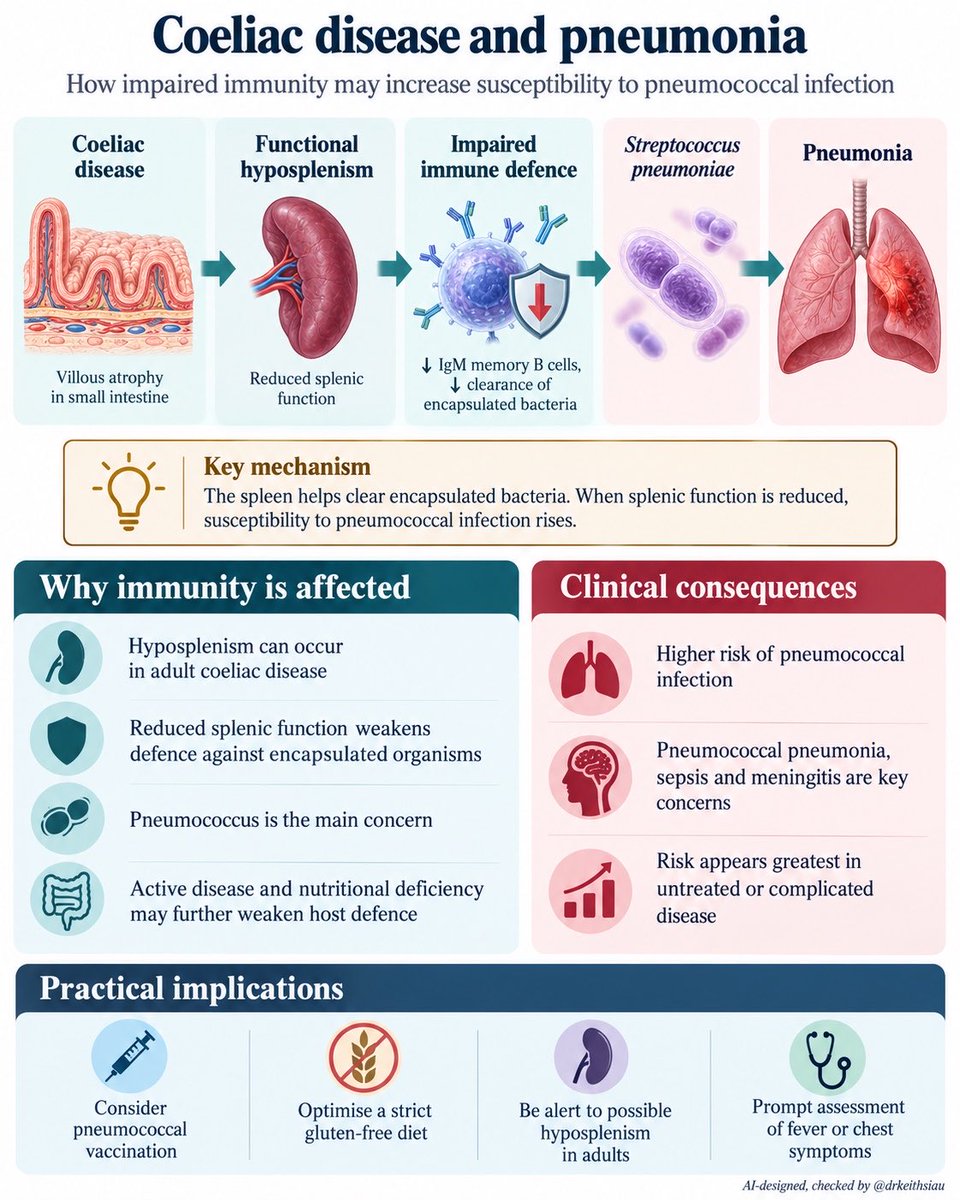
@DrJStewart_GS Nailed it sir! Our guidelines recommend for all newly diagnosed patients with coeliac to consider pneumococcal vaccine, precisely for this reason! Although I must admit I have this was the first case of coeliac + pneumonia that i remember!
Did you know we find birdsong relaxing because our brains associate it with safety since birds stop singing when predators are near?
On top of this, their songs are particularly pleasant to your ear also because of the striking similarities between theirs and human music.
A single bee can produce 1 tablespoon of honey in its lifetime.
683 bees fly roughly 32,550 miles to gather 5.93 lbs of nectar from about 1,185,000 flowers in order to make one 9.5 oz. jar of honey.
HiP-CT is a new technique that can hierarchically image whole human organs, beginning with the resolution of a human hair (25μm/voxel) down to a resolution where we can see single cells (1.5μm/voxel)
[📹 Paul Tafforeau]
We’ve found a “third state” between life and death.
Some cells refuse to accept death when the organism does. Instead, they adapt, reinvent themselves, and sometimes start over.
Researchers have found that certain cells, taken from a recently deceased body and placed in the right conditions, can awaken into a surprising new existence. They self-organize into living, moving entities that behave in ways their original bodies never did. Scientists describe this neither as full life nor true death, but as a third state—something in between.
In a landmark experiment, skin cells from deceased frog embryos were scattered into a dish. Within days, they gathered into multicellular clusters called xenobots. These tiny creations could crawl, self-repair, and—most astonishingly—reproduce by sweeping loose cells into piles that then became new xenobots.
The phenomenon isn’t limited to frogs. Human lung cells, harvested postmortem, recently formed anthrobots—microscopic blobs that propel themselves through liquid and can even encourage healing in damaged neural tissue nearby.
This remarkable plasticity reveals that even after the organism dies, many of its cells retain not only basic function but a kind of creative agency—the ability to change identity and build entirely new structures.
The implications are profound. In the near future, patient-derived biobots could be engineered to deliver drugs directly to tumors, scrape plaque from arteries, or mend injured tissue, then harmlessly dissolve after weeks without triggering immune reactions.
Death, it turns out, is not always final at the cellular level. Some of our cells may still have work left to do long after we’re gone.
["Biobots arise from the cells of dead organisms − pushing the boundaries of life, death and medicine." The Conversation, 2024]
Congratulations to all the Democratic candidates who won tonight. It’s a reminder that when we come together around strong, forward-looking leaders who care about the issues that matter, we can win. We’ve still got plenty of work to do, but the future looks a little bit brighter.
Compound found in broccoli kills 90% of cavity-causing bacteria.
Scientists have discovered that a molecule produced when we eat cruciferous vegetables — like broccoli, kale, cabbage, and Brussels sprouts — can wipe out the bacteria that cause cavities. The compound, known as 3,3′-Diindolylmethane (DIM), killed 90% of Streptococcus mutans biofilms in lab tests, according to a new study by Ben-Gurion University, in collaboration with researchers from Singapore and China.
Streptococcus mutans is the main culprit behind plaque and tooth decay. It forms sticky biofilms on tooth enamel, which trap acids that erode the surface and cause cavities. DIM appears to disrupt the bacteria’s ability to form those films, effectively dismantling their protective layer and leaving them vulnerable.
The findings are still preliminary — the experiments were conducted in vitro, not yet in humans — but researchers believe DIM could someday be added to toothpaste or mouthwash to prevent decay naturally.
A single dose of a new cancer drug made a brain tumor almost disappear – in just five days.
Doctors at Massachusetts General Hospital reported “dramatic and rapid” tumor regression in the first patients treated with a next-generation form of CAR T-cell therapy for glioblastoma, one of the most aggressive brain cancers known.
The therapy, called CARv3-TEAM-E, was developed to overcome a major hurdle in treating solid tumors: their ability to hide from the immune system.
The personalized treatment reprograms a patient’s immune cells to attack the tumor, and in one extraordinary case, nearly eliminated the cancer within just five days. This novel therapy is designed to target multiple features of the tumor at once, a strategy that may help overcome the common challenge of treatment resistance in solid tumors like glioblastoma.
Although the tumors eventually returned, the early outcomes were described as unprecedented. One patient saw a 60% reduction in tumor size that lasted for half a year—an impressive result in a cancer known for its aggressiveness.
The trial’s success marks a major step forward for immunotherapy in brain cancer and raises new hopes for long-term control or even a cure. Researchers are now working to refine the treatment and extend its effects, with the ultimate goal of turning a once-terminal diagnosis into a survivable condition.
The next generation of anti-inflammatory drugs might be inspired by psychedelics.
Psychedelics such as LSD, DMT, and psilocybin are being studied for more than their hallucinogenic properties. Emerging research indicates they could transform treatment for chronic inflammatory diseases without inducing a psychedelic "trip." These compounds can reduce key inflammatory markers like TNF-alpha, IL-6, and CRP, which are associated with conditions like depression, asthma, arthritis, and heart disease. Unlike steroids, psychedelics may reduce inflammation while preserving healthy immune function.
In one study, a single psilocybin dose lowered inflammation for a week. Another showed ayahuasca reduced inflammation in individuals with treatment-resistant depression, with greater reductions linked to improved mood.
Notably, the anti-inflammatory effects may not involve the same brain pathways responsible for hallucinations, paving the way for psychedelic-inspired, non-hallucinogenic drugs.
Early examples, such as DLX-001 and DLX-159, are demonstrating antidepressant effects in trials without causing hallucinations. These “PIPIs” (psychedelic-informed, psychedelic-inactive) compounds could provide safe, effective treatments for millions.
["From trips to treatments: how psychedelics could revolutionise anti-inflammatory medicine." The Conversation, 6 October 2025]
A newly found organism is challenging our definition of life itself.
Called Sukunaarchaeum mirabile – named after a tiny Japanese deity – this strange organism doesn’t fit neatly into biology’s rulebook. It’s not quite a virus, but not a fully independent cell either. Instead, it appears to live in the grey zone between life and not-life.
Scientists from Canada and Japan stumbled on it while analyzing DNA from a marine plankton species. Within the data, they found a genetic sequence unlike anything they’d seen before. Closer analysis showed that Sukunaarchaeum belongs to the domain Archaea – ancient microbes that are thought to have given rise to all complex life, including us.
Like a virus, it relies heavily on its host for energy and most metabolic functions. Its stripped-down genome suggests it has evolved to focus almost entirely on replication, outsourcing nearly everything else.
That makes it a biological paradox: part virus, part cell, wholly unique.
["A cellular entity retaining only its replicative core: Hidden archaeal lineage with an ultra-reduced genome.” bioRxiv, 2025]
The post summarizes a 2025 twin study published in PNAS identifying two gut bacteria—Eisenbergiella tayi and Lachnoclostridium—from the Lachnospiraceae family in MS patients' ileums, which triggered MS-like autoimmune responses when transplanted into germ-free mice models.
This breakthrough builds on prior microbiome research by isolating specific microbial triggers, minimizing genetic confounders through 81 monozygotic twin pairs, and suggesting ileal dysbiosis as a key environmental factor in MS onset.
Potential therapies include targeted antibiotics, bacteriophages, or fiber-rich diets to modulate these bacteria, with early trials showing symptom relief, though human validation is needed to confirm causality and safety.
A major breakthrough in medical research has pinpointed a specific bacterium linked to the onset of multiple sclerosis (MS).
Understanding this microbial trigger could revolutionize treatment strategies and offer new preventative measures for a disease that affects millions worldwide.
By studying patients’ microbiomes, scientists discovered that certain bacterial strains interact with the immune system in ways that provoke the autoimmune attacks characteristic of MS.
This discovery opens the door to targeted therapies, such as vaccines or probiotics, aimed at mitigating or even preventing disease progression.
The best decision I ever made was marrying you, @MichelleObama. For 33 years, I’ve admired your strength, grace, and determination — and the fact that you look so good doing it all. Happy anniversary!