🌐 Tech Enthusiast | 🌍 World Traveler | 🦮 Dachshund Dad | Investor | Sharing insights and discoveries from my journey.
🌟 #Tech#Travel#HealthyLiving#Austin
Tesla: A New Book: "It's Going To Be the Best" - Elon Musk https://t.co/HFEEnvyUdQ
🚀Inspired by @elonmusk's 2024 Tesla Shareholder Meeting, Let's inspire the next generation together! 🌟 #Tesla
@adelbucetta I like the simplicity
So in this case do you think both are a guess because of the multiple?
Adobe has strong ability for repeat with their lock in, but the product is less and less needed
Duolingo people seem to love, but will they love it as much if AI bot can also gamifify
Adobe trades at roughly 12x earnings.
Duolingo trades at roughly 14x earnings.
At first glance, the market is valuing them similarly.
But they're very different businesses facing very different AI risks.
Adobe built one of the strongest software brands in history.
"Photoshopped" became a verb.
Yet today, more and more people simply say, "That's AI generated."
I've also found myself replacing parts of Adobe's product suite with AI tools and lower-cost alternatives.
The moat feels less obvious than it did 5 years ago.
Duolingo feels different.
People genuinely enjoy using it.
The product is sticky.
Engagement is strong.
And learning a language may prove harder for AI to completely commoditize than many people think.
That got me thinking about valuation differently.
Maybe AI-era investing isn't just about earnings growth.
Maybe it's about the durability of those earnings.
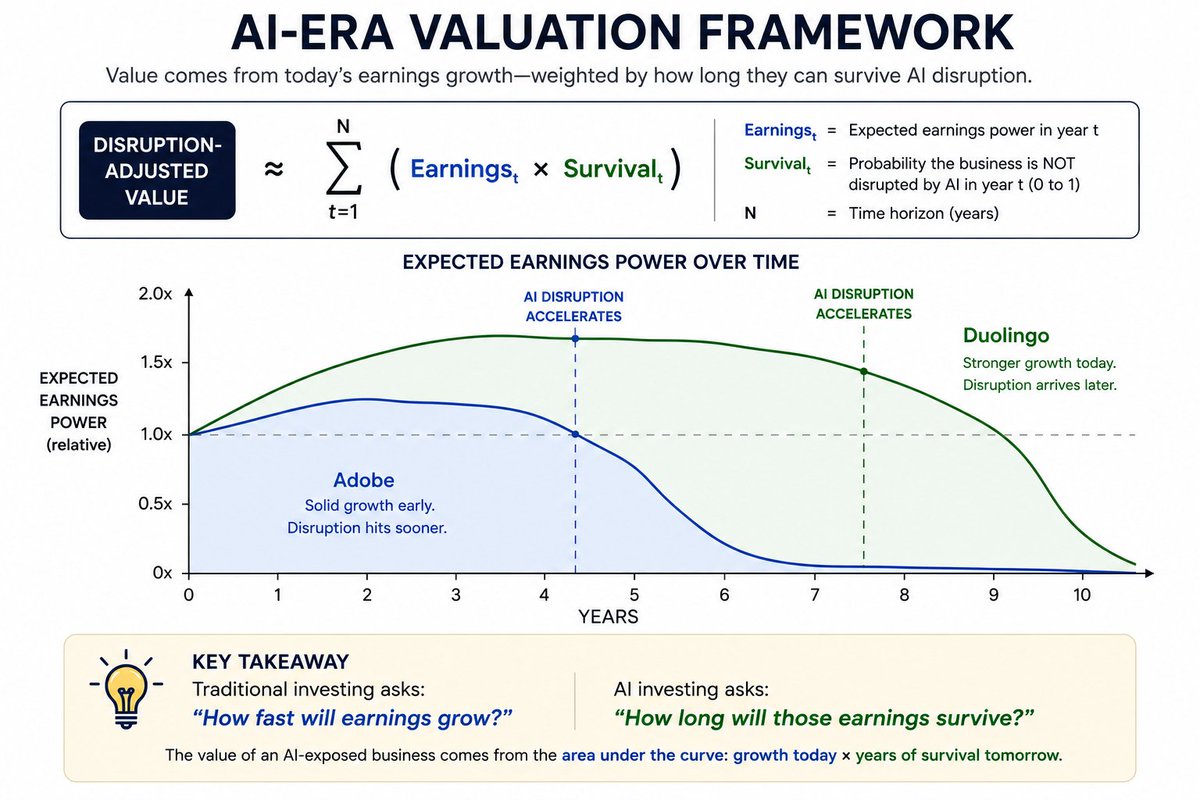
The chart below is a framework I've been thinking about.
Both companies are growing today.
The question is what happens next.
How many years can earnings continue growing before AI disruption starts to outweigh that growth?
The value of the business isn't just today's earnings.
It's the area under the future earnings curve.
Traditional investing asks:
"How fast will earnings grow?"
AI investing asks:
"How long will those earnings survive?"
The most important variable may no longer be the growth rate.
It may be the slope of the disruption curve.
What would your curves look like for Adobe and Duolingo?
"It only recently occurred to me while preparing this, how totally absurd this whole charade was.
It reminded me that often times we do all sorts of silly things to avoid appearing different.
Conforming happens so naturally that we can forget how powerful it is.
We want to be accepted by our peers. We want to be part of the group. It's in our biology.
But the thing that makes us human are those times we listen to the whispers of our soul and allow ourselves to be pulled in another direction." @evanspiegel
One of these days, someone will actually do the work and realize that $JOE owns dozens of miles of waterfront… Their land is not only valuable, but appreciating rapidly…
The gap isn't closing. It's widening.
Every time GPT ticks from 5.1 to 5.2, Lemonade automatically gets better.
Legacy insurers are still trying to figure out how to query their own data.
This is what AI-first actually looks like.
The CEO's prediction:
"I think we 10x our business and don't have a big change in our cost structure.
And I think we 10x it again and still don't have a huge change."
That's the AI leverage nobody's pricing in.