Rescaté un gatisi para adoptar y unirme más al mame millennial. Hasta ahora pues todo bien, va mejorando, estaba muy enfermo, al menos ha ganó algo de peso y se le ve más animado 🐈
Do you recognise the three family members?
It is Madame Marie Skłodowska Curie (middle) with her two daughters Irène (left) and Eve (right).
Marie Skłodowska Curie dedicated her life to science and became the first person to be awarded two Nobel Prizes, the 1903 physics prize and the 1911 chemistry prize. Curie, quiet, dignified and unassuming, was held in high esteem and admiration by scientists throughout the world.
Her daughter Irène was also a pioneering scientist and was awarded the Nobel Prize in Chemistry 1935 alongside her husband, Frédéric Joliot. Marie’s second daughter Eve became a writer and activist and wrote a book about her mother’s life, ‘Madame Curie’.
Read more about this remarkable family: https://t.co/2yjfOwU8dQ
¡Oro para México🥇🇲🇽❤️!
Yareli Acevedo 🇲🇽 es CAMPEONA DEL MUNDO🥇🌍 en la prueba de puntos en el Mundial de Ciclismo de Pista 🚴♀️
Gran momento para el ciclismo mexicano 🥰
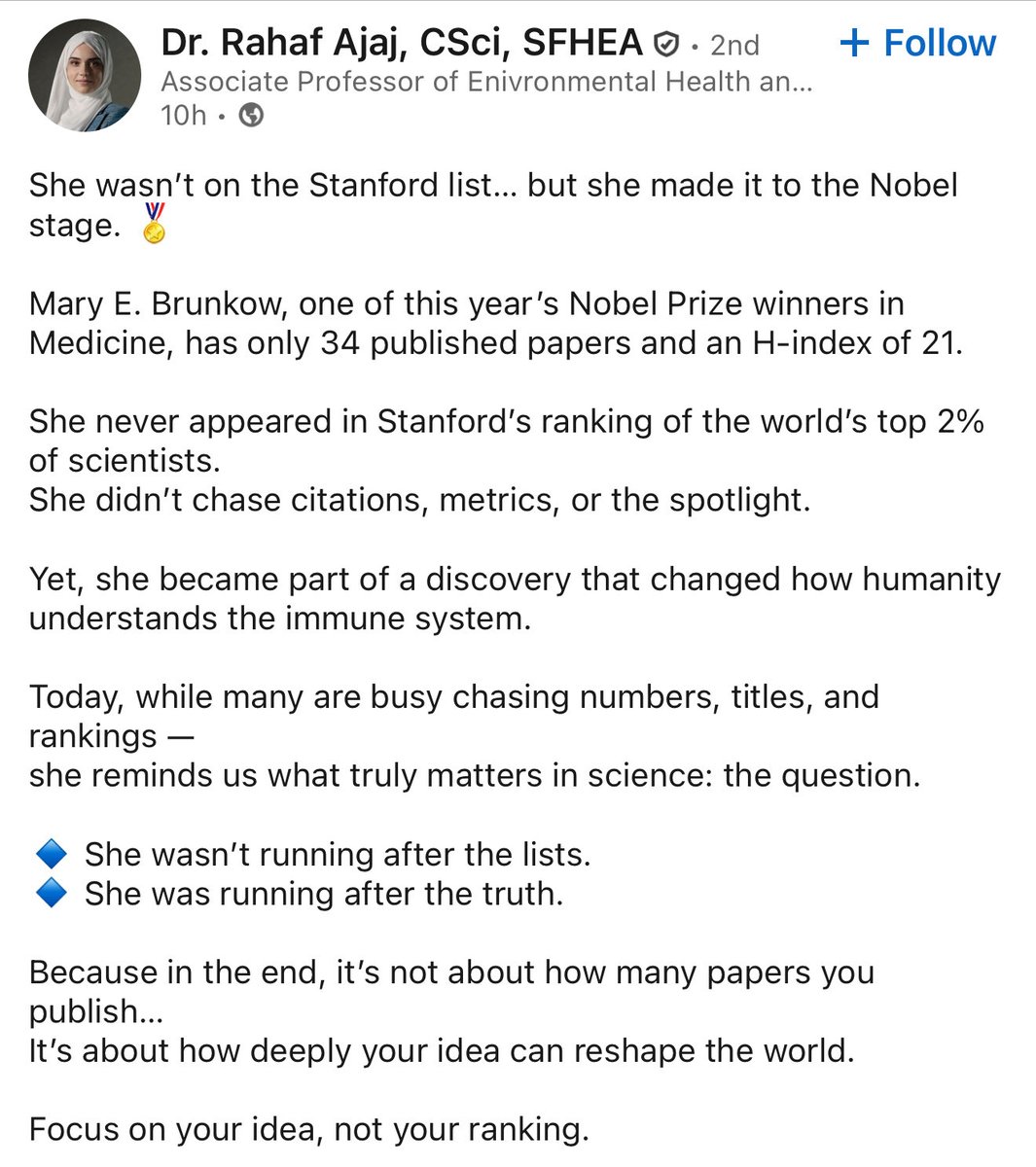
✅✅ A reminder by Dr. Rahaf Ajaj:
She wasn’t on the Stanford list… but she made it to the Nobel stage. 🏅
Mary E. Brunkow, one of this year’s Nobel Prize winners in Medicine, has only 34 published papers and an H-index of 21.
She never appeared in Stanford’s ranking of the world’s top 2% of scientists.
She didn’t chase citations, metrics, or the spotlight.
Yet, she became part of a discovery that changed how humanity understands the immune system.
Today, while many are busy chasing numbers, titles, and rankings —
she reminds us what truly matters in science: the question.
🔹 She wasn’t running after the lists.
🔹 She was running after the truth.
Because in the end, it’s not about how many papers you publish…
It’s about how deeply your idea can reshape the world.
Focus on your idea, not your ranking.
The 2025 medicine laureates identified the immune system’s security guards, regulatory T cells, which prevent immune cells from attacking our own body.
The fundamental knowledge that researchers have gained through the discovery of regulatory T cells and their importance for peripheral immune tolerance, has spurred the development of potential new medical treatments. Mapping of tumours shows that they can attract large numbers of regulatory T cells that protect them from the immune system. Researchers are therefore trying to find ways to dismantle this wall of regulatory T cells, so the immune system can access the tumours.
In autoimmune diseases, researchers are instead trying to promote the formation of more regulatory T cells. In pilot studies, they are giving patients interleukin-2, a substance that makes regulatory T cells thrive. Researchers are also investigating whether interleukin-2 can be used to prevent organs being rejected after transplantation.
Another strategy researchers are testing to slow an overactive immune system is to isolate regulatory T cells from a patient and multiply them in a laboratory. These are then returned to the patient, who will thus have more regulatory T cells in their body. In some cases, researchers also modify the T cells, putting antibodies on their surface that function like an address label. This allows researchers to send these cellular security guards to a transplanted liver or kidney, for example, and protect the organ from being attacked by the immune system.
There are many more examples of how researchers are testing how regulatory T cells can be used to combat diseases. Through their revolutionary discoveries, Mary Brunkow, Fred Ramsdell and Shimon Sakaguchi have provided fundamental knowledge of how the immune system is regulated and kept in check. They have thus conferred the greatest benefit to humankind.
The 2025 Nobel Prize in Physiology or Medicine has been awarded to Mary E. Brunkow, Fred Ramsdell and Shimon Sakaguchi “for their discoveries concerning peripheral immune tolerance.”
Un regalo muy especial✨
Renata Zarazúa🇲🇽 recibió una pelota con una placa por haber conseguido el primer triunfo de su carrera en el Estadio Arthur Ashe
🎾La mexicana jugará su partido de segunda ronda en el #USOpen el próximo jueves
😭 "LE HABLÉ A MI MAMÁ PORQUE NO QUERÍA SALIR A LA CANCHA".
"TENÍA MUCHO MIEDO DE SALIR. NO QUERÍA".
El lado más humano de Renata Zarazúa tras hacer historias 👏 🇲🇽
👏🇲🇽 ¡UN DÍA QUE NO OLVIDARÁ NUNCA!
¡HISTÓRICO TRIUNFO DE RENATA ZARAZÚA EN EL ARTHUR ASHE ANTE UNA TOP10! 🌟
LÁGRIMAS DE LA MEXICANA 🥹
Lo viste en ESPN y #DisneyPlus Premium
From @TheAthletic: Renata Zarazúa, the world No. 82 from Mexico, came from a set and 3-0 down to stun the No. 6 seed and Australian Open champion Madison Keys. https://t.co/EP6iTxYeZW
@drjefemaestro Se murió. Lo peor es que el paciente a mi parecer deseaba el hemoderivado, pero la presión de sus padres (eran los familiares presentes) no le permitieron aceptar la terapia. La frase del papá fue: no quiere la transfusión! Si dios quiere va a responder con vitaminas!