Congrats to EAPS Professor Richard Teague on being named an NSF CAREER recipient! His research is focused on developing new methods to detect planetary formation across our universe.
https://t.co/NVk66fkbVu
A scientific career can span many disciplines, from fiuid dynamics to paleoclimate to exoplanet habitability - just ask EAPS Professor of Practice Raymond Pierrehumbert.
https://t.co/mN25qwKSut
New research has found that peptides - short strings of amino acids - remain stable in extremely acidic environments such as the clouds of Venus. This opens up the types of planets that could host life.
https://t.co/VQGspG5Fv2
By looking at ancient mineral grains in a meteorite sample collected in Antarctica, EAPS Professor Ben Weiss and alumni Cauê Borlina estimate that magnetism likely playing a significant role in the formation of the our solar system, including the sun.
https://t.co/54Yg5A0nTS
NASA's Pandora mission has started scientific observations! The satellite will observe exoplanet transits, helping refine our understanding of exoplanet atmospheres and how they interact with light as we search for habitable planets in our universe.
https://t.co/2qxh9dmFoU
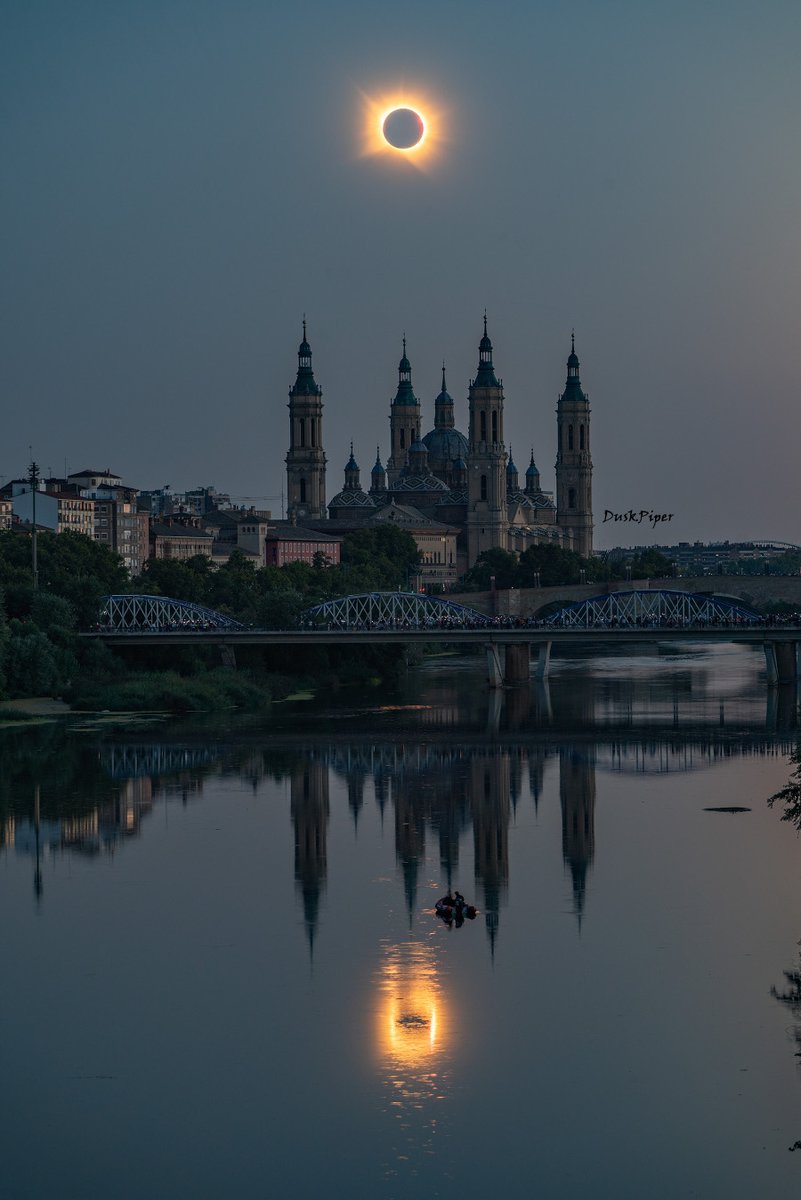
On August 12th, 2026, the Moon totally eclipsed the Sun and cast its shadow across Siberia, Greenland, Iceland, Spain, and Portugal. Today’s image features two total solar eclipses viewed from Zaragoza, Spain, one over the Cathedral-Basilica of Our Lady of the Pillar and the other reflecting in the Ebro River. For a few moments, Spain saw its first major total solar eclipse since 1905. Those witnessing totality may experience a chill in the air, the quieting of birds, the confused chirps of insects, and the shared awe of many. It’s the corona’s time to shine as the Sun’s bright disk is blocked by the Moon. Among other reasons to study eclipses, they help scientists understand why the corona is millions of degrees hotter than the Sun’s surface. Enthusiastic citizens can contribute to these studies by recording how wildlife responds, imaging the corona, and monitoring air temperature and clouds.
Image Credit & Copyright: Ruiyu Zhang Text: Keighley Rockcliffe (NASA GSFC, UMBC CSST, CRESST II)
Earth is ready for a solar eclipse on Aug. 12th (stream it live at https://t.co/d6szYZ44nB). Other planets have eclipses, too! This view came from our Juno spacecraft at Jupiter in 2019. If you looked up from within this shadow cast by the moon Io you'd see a total solar eclipse.
On Earth, solar eclipses happen when the Moon passes in front of the Sun as seen from the ground. On Mars, sometimes one of its moons does the same thing…but they’re too small to fully cover the Sun’s disc. Perseverance captured this look at Phobos transiting the Sun in 2024.
A solar eclipse will be visible in much of the Northern Hemisphere today!
A solar eclipse occurs when the Moon passes in front of the Sun. Those in the path of totality will see something like the left photo; others may see a partial solar eclipse like the right photo.
Eclipse day! ☀️
Today's total solar eclipse is visible from Greenland, Iceland, northeastern Portugal and Spain.
Most of the rest of Europe, northern North America and western Africa will witness a partial solar eclipse.
More info: https://t.co/YIFZdsIiCA
#EuropeanSolarEclipse
Tomorrow, a total solar eclipse is passing over part of the Northern Hemisphere, and you can watch it with us!
We'll be broadcasting live views of the eclipse beginning at 1:15pm ET (1715 UTC) on Aug. 12. Check out ways to tune in: https://t.co/KYlmEefqSd
On Aug. 12, you have the chance to experience a total solar eclipse from anywhere in the world.
Starting at 1:15pm ET (1715 UTC), we'll stream live as the Moon passes in front of the Sun, bringing the views and the science straight to you.
Get safe viewing tips in this video.
New system upgrades means that MIT's Haystack Observatory can now become a critical piece of instrumentation for MIT's Planetary Defense Project, measuring space objects that could pose a hazard to Earth.
https://t.co/m9osSUnHCh
Congrats to recent MIT-WHOI graduate Liam Moser on his Fulbright award! On top of his research on subduction zones, Liam helped found the annual MIT-WHOI Geophysics Retreat and taught incoming graduate students in the MIT-WHOI Summer Math Review.
https://t.co/SenT0IN4AS
EAPS PhD student Perrin Davidson does theoretical work on the carbon cycle to explore the powerful mechanisms that keep our planet habitable — when he's not playing bluegrass music with his EAPS advisor, Professor Dan Rothman.
https://t.co/558PSwzEW6
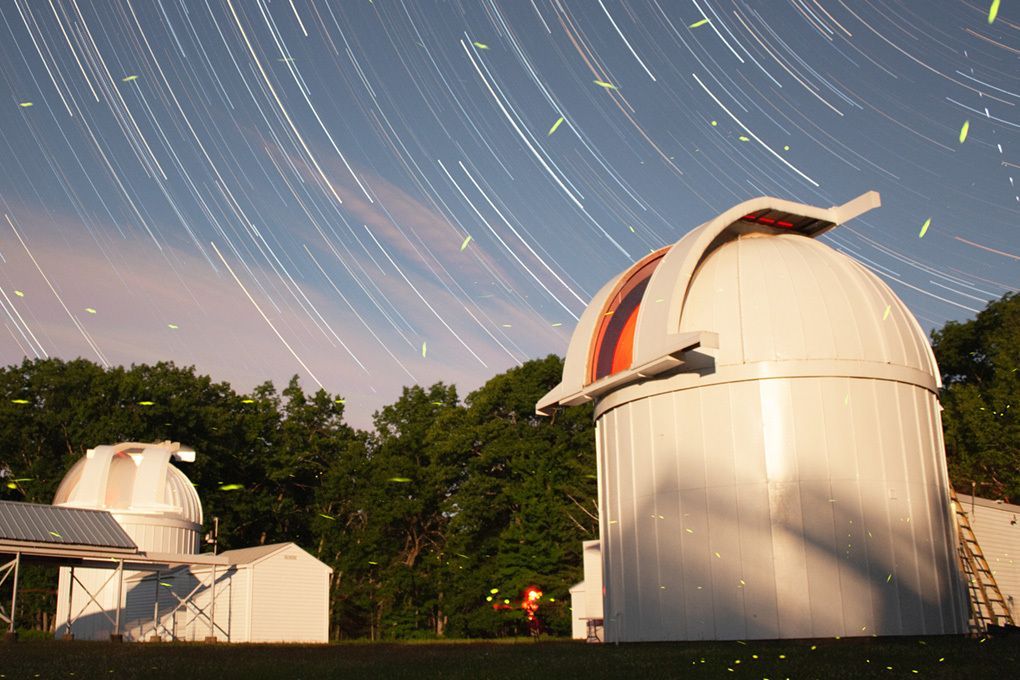
University observatories like MIT's Wallace Astrophysical Observatory play a key role in providing students hands-on astronomy experience and important research opportunities that larger observatories may not have time for.
https://t.co/KG1SfTj8VI
Congrats to EAPS grad student Angelina Serafini for receiving a Dwornik Award for best grad poster presentation at this year's Lunar and Planetary Science Conference! She used moon samples to constrain the strength of the ancient lunar magnetic field.
https://t.co/vn0r9DXzUU
Hello, Mars 👋 The NASA Psyche spacecraft completed a flyby of the red planet in May, and took the opportunity to test out its on-board instruments to make sure everything is functioning properly on its @MissionToPsyche in 2029.
https://t.co/9PrU53kQ7k
Is there another period in Earth's past where the climate changed as quickly as it is today? Geologic records like ice cores and ocean sediments show that the last 50 years warmed faster than any other 50-year period in at least 2,000 years.
https://t.co/kS2jXkc9GT