The thing that stands out most of all in the Milburn report is that he repeatedly treats autism like a treatable mental illness as opposed to pervasive, lifelong neurodevelopmental difference in cognition. He also explicitly ties the fact that it is treatable (false) as a reason
@kazdeanie I just made these tonight in a bit of a rush but I can make ones with better clarity tomorrow, I was just shocked by the scale of it laid out visually. These have some readability issues but they're still useful.
This works out at £20,000 for one 45 day placement. That was more than my graduate engineer yearly salary after 5 yrs in the job.
Just a massive transfer of wealth to rich owners for free Labour.
Corporate #welfare for Tesco on the backs of the young and young.
#LabourLogic
@kazdeanie yes share with as many people as possible and if you have more questions let me know
I'm still improving my understanding but I'm making more progress, I'm trying to be as accurate and conservative as possible - without exaggerating.
Assumptions around the APA cash replacement are conservative in eligibility rate and cash amount. Modelling likely understates scale of cuts. It is likely the Lose Health + PIP group will be larger than 55% of total existing disabled cohort.
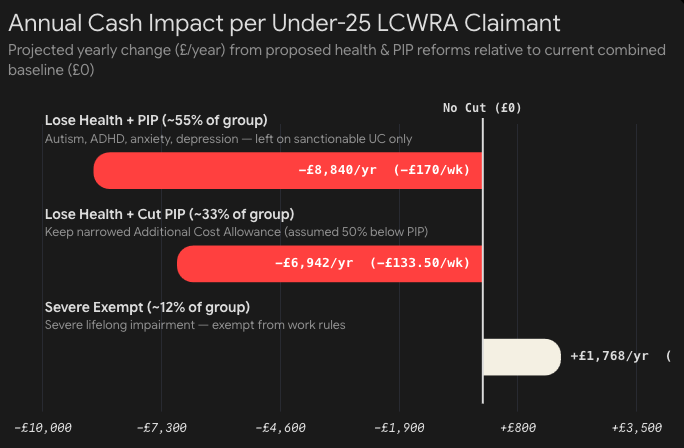
Scale of Milburn cuts to disability benefits visualised.
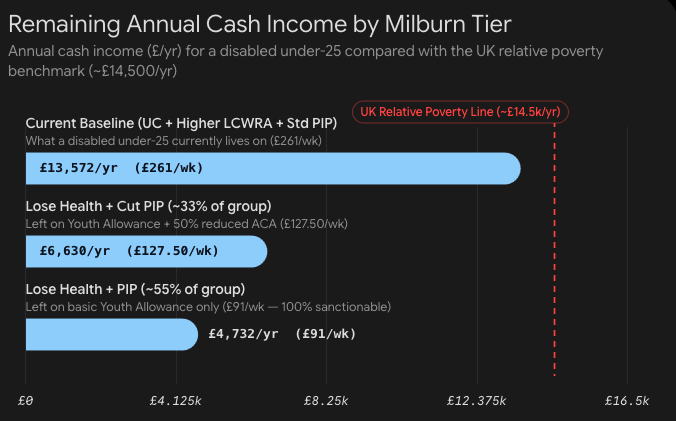
The majority of disabled under 25s could lose almost £9,000 a year of income, plunging them into extreme poverty.
Others with more serious disabilities will lose almost £7000 annually in welfare benefits.
Just how far will the Milburn cuts push disabled people into poverty?
The red line is the UK relative poverty rate.
Assumptions around the APA cash replacement are conservative in eligibility rate and cash amount. Modelling likely understates scale of cuts.
Scale of Milburn cuts to disability benefits visualised.
The majority of disabled under 25s could lose almost £9,000 a year of income, plunging them into extreme poverty.
Others with more serious disabilities will lose almost £7000 annually in welfare benefits.
Likewise estimates around the number of people of the existing LCWRA cohort who would qualify for the new version of PIP is likely too large given the language of the Milburn report, but I have against used a defensible, conservative assumption that may understate scale of cuts.
If you get the chance please can you retweet my modelling of the scale of the cuts for young disabled people. I break down my methodology also and it helps people understand exactly what the proposals are.
https://t.co/BONcpSEygK
Scale of Milburn cuts to disability benefits visualised.
The majority of disabled under 25s could lose almost £9,000 a year of income, plunging them into extreme poverty.
Others with more serious disabilities will lose almost £7000 annually in welfare benefits.
Lets be honest, employers are not crying out to employ hundreds of thousands of people with huge, sometimes decade+ long employment gaps, complex co-morbidities and medical issues, who require substantial accommodations, likely can only work part time.
Workfare and conditionality always opens up a substantial risk of benefits being arbitrarily removed from vulnerable people. In fact, the risk is more acute among disabled people, as their capacity to engage in workfare activities is often negatively affected by their disability.