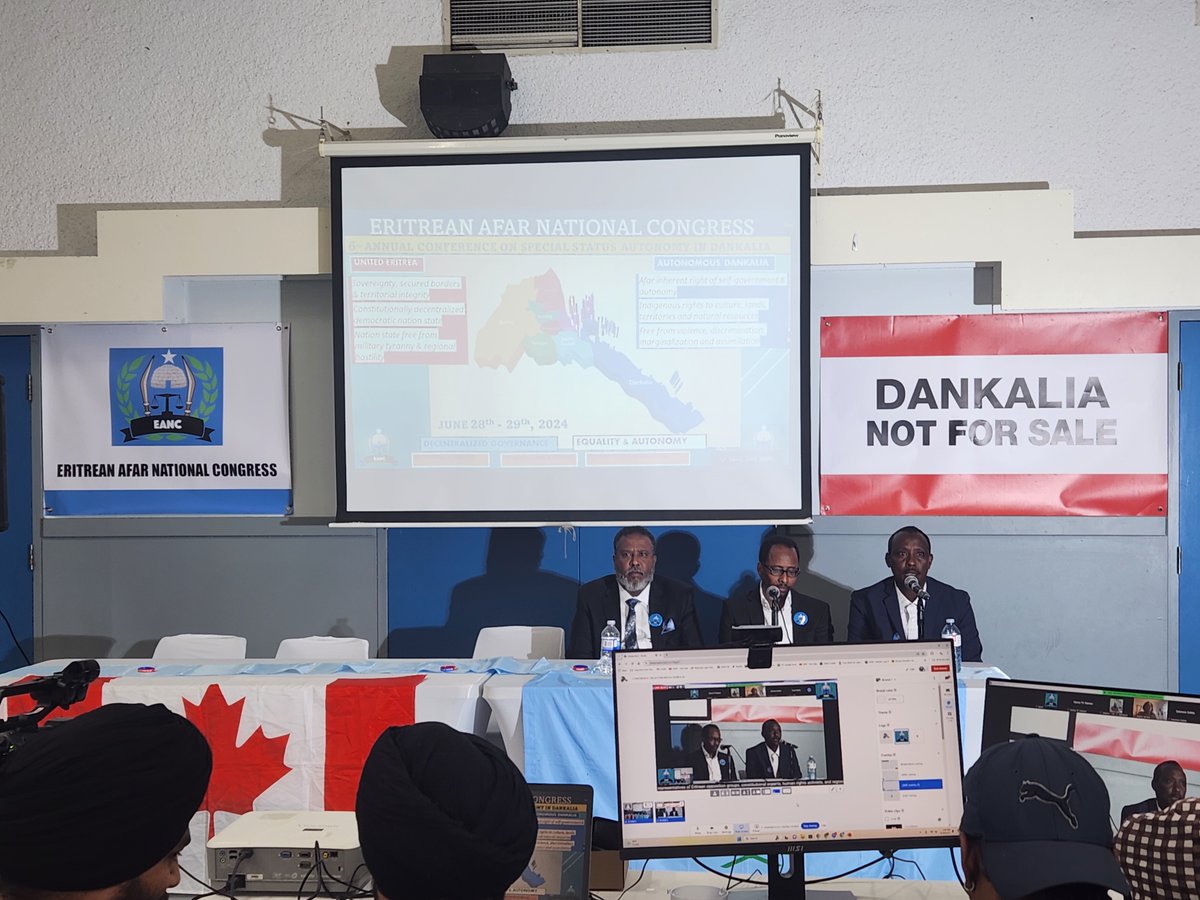
Eritrean Afar National Congress (EANC) is an exiled Eritrean Afar political organization dedicated to self-determination and self-rule of Eritrean Afar people.
INTERNAL COLONIZATION OF INDIGENOUS AFAR NATION IN ERITREA (PFDJ RULE, 35 YEARS OF FAILED STATE). FOUR MECHANISMS OF STATE CONTROL AND THE COLONIZATION OF AFAR IN ERITREA
https://t.co/4PaN8lch3V
@TiborPNagyJr,@AJEnglish, @AfricaMediaHub, @US_SrAdvisorAF
Under 35 years of PFDJ, A failed state built in “structural Sin” and the internal colonization of Afar in Eritrea.
Time-May 23, 2026 03:00 PM NY Time
Please join us to register using the link below
https://t.co/nkPki4wNyF
@Titina_lmn@Habtishgreat Eritrea is failed state. PFDJ is a cancer that should be removed. Afar nation's sovereignty predates PFDJ's colonial project. Unless you recognize ppls rights you will face fragmentation. It is in your best interest.
@Habtishgreat Fascinating to see the so called Eritreans defending the indefensible crimes of PFDJ in this page. They claim to defend Eritrean sovereignty, but they're nothing but far-right expansionist Tigrigna extremist. Afar will free Dankalia soon.
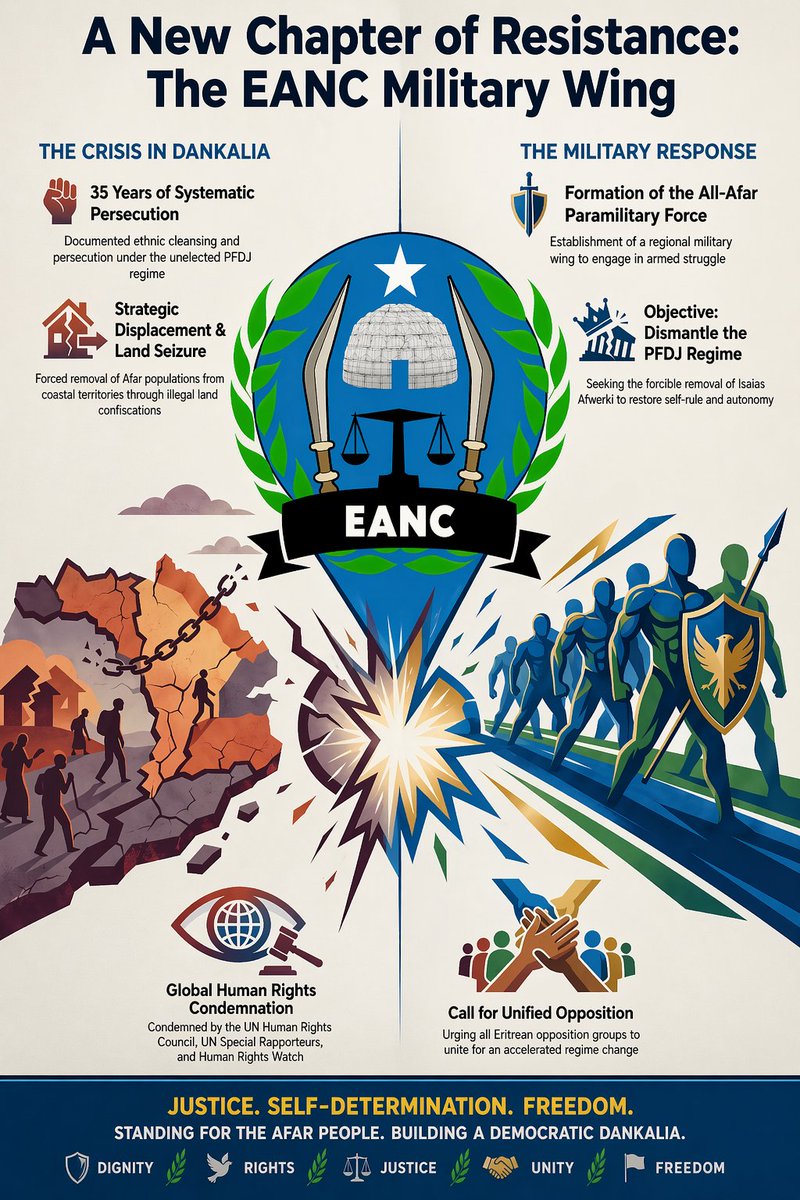
Eritrean Afar National Congress Establishes Military Wing to Dismantle the Current Eritrean Regime through Armed Struggle!
PRESS RELEASE: April 20, 2026
Assab-Dankalia | Eritrea
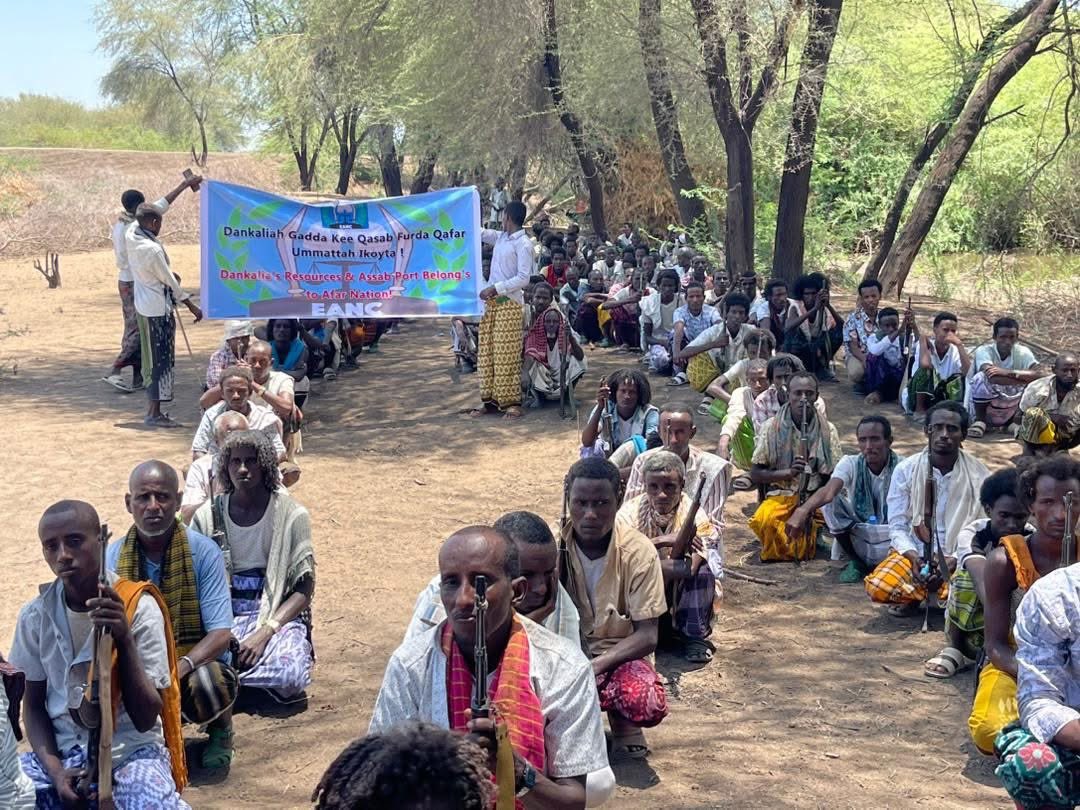
The Eritrean Afar National Congress (EANC), a leading indigenous Afar movement dedicated to restoring the rights to internal self-determination, autonomy, and self-governance for the Afar people in their coastal homeland of Dankalia, Eritrea, has taken a decisive step amid ongoing marginalization, persecution, and ethnic cleansing by the ruling Eritrean regime, the People's Front for Democracy and Justice (PFDJ) under unelected President Isaias Afwerki. Having long collaborated with various Eritrean opposition groups in exile, the EANC has now introduced an all-Afar paramilitary force operating within the region.
Historically, the EANC has documented severe human rights violations against the Afar, including ethnic cleansing, illegal land confiscations, systematic forced displacement, economic devastation, and government policies aimed at removing Afar populations from Dankalia's strategic coastal territories. Prominent organizations—including those in the United Nations, UN Special Rapporteurs on the situation of human rights, the United Nations Human Rights Council, Human Rights Watch, and other indigenous and human rights advocacy groups—have condemned the treatment of the Afar people and urged respect for their rights as indigenous and minority communities.
After 35 years of Isaias Afwerki's dictatorial rule—akin to other global dictatorships—the consensus among Eritreans and numerous Eritrean opposition groups is that only forcible removal can end the PFDJ regime. The EANC is now committing to a military victory to dismantle the current Eritrean regime through armed struggle, marking a new chapter in restoring Afar self-determination and autonomy in Dankalia. It calls on all Eritrean forces to unite in accelerating the downfall of the Afwerki regime and urges opposition groups to join the Afar in the struggle for regime change in Eritrea.
Political Manifesto of EANC https://t.co/RGcELVfOOB
For media inquiries, please contact us via email: [email protected]
Regime Change in Eritrea Now. Establish decentralized federal Eritrea. Afar self rule& Autonomy in Danaklia. Dankalia self governed by Afar, land &Natural resources(Assab) belong to Afar.
@abino11 Indeed, our case as an indigenous people, (Afar Nation) are justified. We'll defend Afar rights against a failed state that was born in "structural Sin" from day. Free Dankalia from PFDJ!
When Closed Systems Produce Violent Alternatives: Understanding the EANC Turn
The Eritrean Afar National Congress’s (EANC) decision to establish a military wing should not be read merely as an escalation of conflict, but as a political signal emerging from a structurally closed system. In contexts where institutional channels for dissent are systematically absent, the boundary between peaceful opposition and armed resistance becomes blurred—not by ideological preference, but by political necessity.
For over three decades, Eritrea under the People’s Front for Democracy and Justice (PFDJ) has exhibited the classic features of what political scientists describe as high-coercion, low-legitimacy governance: indefinite national service, suppression of political pluralism, absence of constitutional implementation, and the elimination of independent civil society. Within this broader structure, peripheral communities such as the Afar—inhabiting the strategic coastal region of Dankalia—have articulated long-standing grievances related to land dispossession, cultural marginalization, and exclusion from state power.
From the standpoint of political theory, the EANC’s shift can be interpreted through the doctrine of remedial resistance. While international law strongly privileges territorial integrity and non-violence, it also recognizes—at least normatively—the right of peoples to self-determination. In extreme cases where a state persistently denies basic political participation and commits systemic abuses, some scholars argue that resistance, including armed resistance, becomes a derivative right rather than a primary choice.
This reasoning does not emerge in a vacuum. Historically, anti-colonial struggles—from Algeria to Eritrea itself—were framed in similar terms: when institutional reform is impossible, coercive pressure becomes the only language the state responds to. The irony in the Eritrean case is stark. A state born out of armed liberation now confronts a new generation of actors who invoke that very legacy to justify their own methods.
Supporters of the EANC’s move therefore advance three interrelated arguments:
First, they argue that non-violent avenues have been structurally foreclosed. Eritrea has no functioning parliament, no independent judiciary, and no legal opposition. In such an environment, appeals to peaceful change risk becoming purely symbolic.
Second, they frame the Afar issue as one of collective survival rather than political preference. Allegations of forced displacement, demographic engineering, and exclusion from coastal resources are interpreted not simply as governance failures, but as existential threats to an indigenous community.
Third, they view armed mobilization as a form of strategic leverage. In highly securitized regimes, power asymmetries are so entrenched that only countervailing force can compel negotiation or reform. In this reading, militarization is not the end goal, but a means to reopen a closed political field.
Yet even within this sympathetic framework, the move raises difficult questions. Armed resistance is rarely linear; it fragments, proliferates, and often produces unintended civilian harm. Moreover, the regional geography of the Afar—spanning Eritrea, Ethiopia, and Djibouti—introduces a transnational dimension that could internationalize the conflict in unpredictable ways.
The deeper issue, therefore, is not simply whether the EANC is justified, but what its emergence reveals about the Eritrean state. When opposition consistently shifts from civic to military forms, the problem is less the disposition of the opposition than the design of the political system itself.1/2
@US_SrAdvisorAF@MichaelYadeta@martinplaut@SecRubio@_hudsonc@BerhanuTsegaye@RAbdiAnalyst@reda_getachew@statedeptspox@TiborPNagyJr@IGADsecretariat@AmbNebiyuTedla
@ynetnews Correction. Afar a nation (Not tribe) sliced into 3 modern states after colonial Europe's expedition of scramble for Africa. Yes, Both Ethiopia and Israel should recognize Afar right to Self determination. Eritrea is a colonial state. UN SR rpt https://t.co/UsdE2edC6P
@addisstandard The Year 2026, we be the year of geopolitical transformation. Somaliland recognition by Israel will not stop there. The Afar Nation of Eritrea has been severely marginalized under Eritrean rule. Time to recognize Afar rights in Eritrea.
@MFAEthiopia Since 1991, Eritrean state has colonized the indigenous Afar nation in the country, systematically ethnic cleansed Afar people from the strategic coastal ports and resources in Assab. Ethiopia has the obligation to protect Afar in the country under international law.
@MFAEthiopia Your excellency Min. Gedion, as you have excellently explained, Eritrea is a failed state which used its sovereignty not for development and uplift its people from abject poverty but tragically to destabilize its neighbors.
@realyonaswoldu I wonder if some of the comments about Afar Eritreans are written by the Hegdefits? Do these ppl think that denying the rights of their fellow citizens, will strengthen the sovereignty of Eritrea? Granting individual & group rights constitutionally will make Eri united & strong.
@realyonaswoldu Brother Yonas, the Eritrean Afar value your friendship and championing of their causes for internal autonomy in Dankalia and the decentralized constitutional👍 governance of Eritrea. Thanks my friend!