ESTA TRADER CHINA USÓ CLAUDE FABLE 5 PARA CONSTRUIR UN BOT DE TRADING
En este tutorial enseña cómo replicarlo desde 0 paso por paso
En tan solo 31 minutos. 100% gratis.
Lo he subtitulado en español e inglés.
Guárdalo antes de que lo bloqueen 🔖
Elon Musk literally sat down for a 45-minute talk with Y Combinator that explains how to build world-changing companies better than any business school on earth. This is the advice he gave a room full of young founders:
1. Don't try to build something great. Try to build something useful.
Everyone obsesses over greatness. Musk says that's the wrong target. "I didn't originally think I would build something great. I wanted to try to build something useful. I didn't think I would build anything particularly great. Seemed unlikely, but I wanted to at least try." Aim for useful first. Greatness, if it comes, is a byproduct.
2. When you can't get in the front door, build your own door.
Before Musk started his first company, he tried to get a job at Netscape. "I sent my resume into Netscape and nobody responded. I tried hanging out in the lobby to see if I could bump into someone, but I was too shy to talk to anyone. So I'm like, this is ridiculous, I'll just write software myself." He didn't set out to be a founder. He became one because no one would hire him.
3. He slept in the office and showered at the YMCA.
The origin of his first company was not glamorous. "We couldn't even afford a place to stay. The office was 500 bucks a month, so we just slept in the office and showered at the YMCA." He couldn't afford proper internet either, so he drilled a hole through the office floor and ran a cable to the internet provider downstairs. That was the founder of the future richest man on earth.
4. Keep the chips on the table.
When Musk sold his first company, he received a $20 million cheque. His bank balance went from $10,000 to $20 million overnight. Most people would have stopped. He put almost all of it straight back into his next company. "I kept the chips on the table." He did the same thing decades later, over and over. He hates money sitting idle. Money is fuel for the next mission.
5. Start with the mission, then work backwards to make it a business.
Musk didn't start SpaceX to make money. He went on the NASA website to find out when humans were going to Mars, and there was no plan. So he decided to build one. "There had been no prior example of a rocket startup succeeding. A small chance of success is better than no chance of success." The mission came first. The business model came later.
6. He started SpaceX expecting to fail.
He is brutally honest about the odds. "SpaceX started in mid-2002 expecting to fail. Probably 90% chance of failing. When recruiting people, I said, we're probably going to die, but small chance we might not die." The first three launches failed. The fourth one worked with no money left. "If the fourth launch hadn't worked, it would have been curtains. We made it by the skin of our teeth."
7. Break every problem down to physics.
This is the core of how Musk thinks. "First principles means break things down to the fundamental elements that are most likely to be true, then reason up from there, as opposed to reasoning by analogy." His example is rockets. Everyone priced them based on what old rockets cost. Musk asked what a rocket is actually made of, priced the raw metals, and found the materials were only 1-2% of the historical price. The rest was inefficiency he could attack.
8. When told something takes 24 months, break it down and do it in six.
Last year xAI needed a giant computer to train its AI. Suppliers said it would take 18 to 24 months. "It's like, well, we need to get that done in six months or we won't be competitive." So he broke it into parts. Needed a building, so he found an old factory. Needed power, so he rented generators. Needed cooling, so he rented a quarter of America's mobile cooling capacity. He slept in the data centre and ran cabling himself. It got done.
9. Watch your ego-to-ability ratio.
Musk's single sharpest piece of advice for young founders is about staying honest with yourself. "A major failure mode is when your ego-to-ability ratio gets too high. Then you break the feedback loop to reality." Keep the ego small, internalise responsibility for everything, and stay ruthlessly connected to what's actually true. "You want to close the loop on reality hard. That's a super big deal."
10. Chase work, not glory.
His closing philosophy ties it all together. "It's so hard to be useful. The area under the curve of total utility is how useful you've been to your fellow human beings times how many people. If you aspire to do true work, your probability of success is much higher. Don't aspire to glory, aspire to work."
He was ridiculed for years. The press called him "internet guy attempting to build a rocket company." He agreed it sounded absurd. He did it anyway, because a small chance of doing something useful beat no chance at all.
Here's the thing though....
Musk became the most followed founder alive because everything he does happens in public. The launches, the failures, the talks like this one. The companies made him powerful. The personal brand made his every word travel around the world before he finishes saying it.
We build massive distribution and grow personal brands on X and beyond without our clients lifting a finger.
If you're a founder or VC looking for that kind of exposure, book a call below.
We average 1.5M views a week.
https://t.co/UoXuYlkBQq
CHINA JUST LEAKED THE FUTURE OF WEB APPS.
Alibaba open-sourced PageAgent and 99% of SaaS founders are sleeping on this.
It's a JavaScript AI agent that lives INSIDE your webpage. Users control your entire interface with natural language.
↳ No browser extensions needed, screenshots or multi-modal LLMs, headless browser setup, and also no backend rewrite required
Just drop it in your HTML with ONE line of code. What took 20 clicks now takes one sentence.
"Click login, fill in my credentials, submit the form"
Done. This is not a demo, it is production-ready.
↳ Turn any SaaS into an AI copilot in minutes
↳ Smart form filling for ERP, CRM, admin systems
↳ Voice commands and accessibility built in
↳ Multi-page agent tasks via Chrome extension
↳ MCP server support for external control
↳ Bring your own LLM (Qwen, GPT, Claude, anything)
Every founder building AI features just got a shortcut.
Every developer manually building copilots just got replaced.
The integration looks like this:
<script src="CDN_URL" crossorigin="true"></script>
That's it. Your app now has an AI agent.
A 20-year-old student from China, Li Hao, built an AI speed radar with Claude alone and sold it to a city district for $317,000
He wrote the whole thing in 9 days, spending about $20 on Claude API calls
He set an old camera on his balcony, pointed it at the intersection below, and let Claude watch the road
Claude tags every car, motorbike and pedestrian in real time, 653 in five minutes, and flags anyone over the limit
The moment a car speeds, Claude clips the video, reads the license plate, matches the owner, and emails the fine on its own
A normal radar takes one photo and misses half the time. Claude records full video, so there is nothing to dispute, and the fines go out with no operator
He walked into the district office with a flash drive and asked for 10 minutes. he left with a contract
Every Claude config he used is in the article
23 years ago, we set out to prove that electric cars could be great – not just great electric cars, but the best cars overall.
We’ve gone from one electric sports car to
– Over 9 million vehicles on the road
– Model Y becoming the world’s best-selling car of any kind only 3 years after first deliveries
– 5 Gigafactories & other manufacturing sites across 3 continents
– The largest & most reliable fast charging network w/ over 80,000 Superchargers globally
– Energy generation & storage systems helping power homes & grids (over 1 million Powerwalls installed, 70+ GWh of industrial energy storage operating globally across 2,200+ projects)
Today, we’re bringing AI into the real world with autonomy @Tesla_AI and robotics @Tesla_Optimus.
Tesla is only getting started – a world of amazing abundance awaits
Baidu just open-sourced an OCR model that reads entire books in one go.
3 billion parameters. 500 million active. Runs on a single GPU. MIT licensed. Free.
It is called Unlimited-OCR. It launched June 22, 2026. 1,800 GitHub stars in the first 24 hours. And it solves the most frustrating problem in document AI.
Here is the problem every developer building document pipelines hits.
Most OCR models read one page at a time. You split a PDF into individual images. Run each page through the model separately. Then stitch the results back together and hope the seams do not break anything.
Tables that span page breaks get mangled. Cross-page references get lost. Headers and footers contaminate the output. The stitching code becomes its own maintenance burden. And every page resets the model's memory so it has no idea what it read on page 3 when it is processing page 4.
This is how every OCR pipeline in the world has worked for years. Chunk, process, stitch, pray.
Baidu just eliminated the entire loop.
Unlimited-OCR ingests up to 40 pages in a single forward pass. The model sees the entire document at once. Tables that span pages are handled correctly. Cross-page context is preserved. No chunking. No stitching. One pass in, structured text out.
Here is the technical innovation that makes this possible.
Traditional OCR models use standard transformer attention which means every new token the model generates looks back at everything it has already generated. For a short document, that is fine. For a 40-page PDF, the memory required to store all those lookback keys and values, the KV cache grows so large that the GPU runs out of memory or slows to a crawl.
Baidu's insight came from watching how humans actually copy long documents. When you transcribe a book, you do not re-read every word you have already written before writing the next one. You remember a window. Older content fades. You keep writing.
They built a new attention mechanism called Reference Sliding Window Attention- R-SWA - that does the same thing. The decoder retains full access to the compressed document images but only attends to a fixed sliding window of recently generated text. The KV cache stays constant. A 40-page document costs the same memory as a 2-page one.
The model processes page 40 just as efficiently as page 1.
Here is what the model actually outputs.
Not raw text. Structured, layout-aware output. Tables come out as HTML. Equations come out as LaTeX. Reading order is preserved. The output respects the document's actual structure- columns, headers, footers, captions instead of dumping everything into a flat text stream.
For anyone building RAG pipelines, this changes the quality of what enters your retrieval layer. Better parsing means better chunks. Better chunks mean better retrieval. Better retrieval means better answers.
Here is how the benchmarks look.
93.23 on OmniDocBench v1.5, beating the DeepSeek OCR baseline it was built on by 6.22 points. Edit distance stays below 0.11 even at 40+ pages. 96.90% text diversity meaning the model is not collapsing into repetitive output on long documents.
Unlimited-OCR was built on top of DeepSeek OCR via continue-training approximately 2 million document samples across 4,000 training steps. Not a from-scratch run. A targeted improvement on an already strong foundation.
Convert your PDF pages to images with PyMuPDF first, then feed them all in at once. One call. Every page. Structured output.
It also runs on vLLM, SGLang, and Docker Model Runner. Weights are on Hugging Face and ModelScope.
Here is the honest part most posts leave out.
40 pages is a soft ceiling, the 32K context window caps it. Handwriting and non-standard fonts remain weak. Scientific PDFs converted to LaTeX and electronics datasheets with merged table cells are still hard. One OCR product founder with a decade of experience put it bluntly on Hacker News: "OCR still sucks in 2026."
He is right about the edge cases. But for contracts, invoices, reports, research papers, legal filings, and every standard business document that enters an AI pipeline, Unlimited-OCR just made the parsing step dramatically simpler, faster, and free.
Here is the comparison that matters.
Mistral OCR 4 launched the next day, June 23. It wins on raw accuracy and supports 170 languages. But it costs $4 per 1,000 pages and requires a cloud API. Your documents leave your machine.
Unlimited-OCR is free. Runs locally. Your documents never leave your device. For anyone processing sensitive contracts, medical records, financial documents, or legal filings that is not a feature. It is a requirement.
4,663 GitHub stars. MIT licensed. One GPU. 40 pages in one pass. Free.
The era of page-by-page OCR just ended.
Source: Baidu · MarkTechPost · ExplainX · ByteIota · AlphaMatch · June 22, 2026
( Link in the comments)
claude fable 5 can scrape thousands of sold homes and finds the patios with zero shade in 100°+ heat. then it mails the owner a postcard with the fix rendered into their own backyard
here's the system you can sell to contractors:
- scrapes every home sold in the metro in the last 12 months (recent buyers spend the most)
- vision-reads the listing photos, skips the 64% with cover already
- measures the sun on each patio, hour by hour, off google's satellite data
- renders a louvered pergola into the owner's actual backyard photo
- prints the diagnosis on the postcard: "your patio takes 11 hours of direct sun a day. saturday it hits 97°."
- QR opens a heat report for their exact address with a booking link
every install is $6.5k to $18k, one close covers months of retainers and homes sell every single day.
reply "SYSTEM" + RT and i'll send you a free guide so you can build this too (must be following so i can DM you)
Google Gemini is the smartest AI right now.
But 90% of people prompt it like ChatGPT.
That's why I made the Gemini Mastery Guide:
→ How Gemini thinks differently
→ Prompts built for Gemini
→ 2000+ AI Prompts
Comment "Gemini" and I'll DM it free.
I debated keeping this to myself, but screw it...
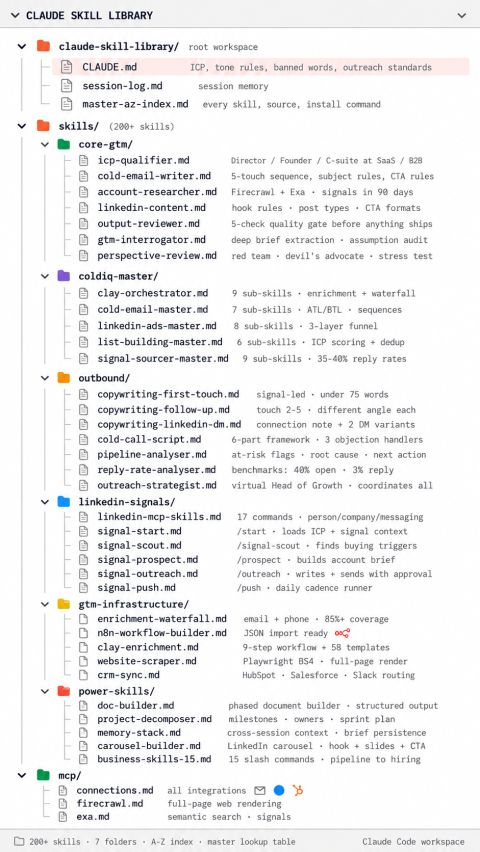
With the Complete Claude Skills Library, anyone can replace hours of manual outbound, pipeline management, and client reporting with a single session setup.
If you start now, you can have all 215 skills installed, your CLAUDE.md built, and your first agentic workflow running by end of this week.
So I put together every SKILL.md file across all 8 groups, written out in full and copy-paste ready. GTM operations, outreach, agents, SDR, business, Claude Code installs, plugin skills, and LinkedIn carousels. Nothing abbreviated. Nothing left for you to figure out.
Like this + Comment "SKILLS" & I'll DM the guide to you
Must Follow
Introducing Voice Agent Builder: a no-code platform to create human-like voice agents with Grok Voice.
Available today at $0.05 / min.
https://t.co/kUkF7zqvfR
Today we're launching Ad Agency in a Box in Claude.
A good agency does four things — research, creative, campaign, reporting — for $15k/mo. These skills do all four for less than $100/mo.
Install: npx gooseworks install --all
/gooseworks --skill competitor-ad-intelligence
→ tear down what competitors run on Meta + reverse-engineer their funnels
/gooseworks --skill remix-graphic-ad-from-reference
→ remix proven winning ads onto your brand (real static creative)
/gooseworks --skill meta-ads-campaign-builder
→ a launch-ready Meta campaign: targeting, ad sets, copy
/gooseworks --skill meta-ads-analyzer
→ drop in your data → what to scale, what to cut
The whole retainer, in Claude. Part of a 100+ skill open-source library.
Comment 'Goose' and I'll DM you the library, for free.
Join Prof. Axel Merseburger and Dr. Guru Sonpavde as they discuss the pivotal clinical trials that are reshaping established treatment pathways for bladder cancer.
My 18-year-old little brother who makes $1.2M a year as a developer at Anthropic
showed me a video that changed my life and made me quit my job from 9 to 5.
Claude Code Router + Qwen 3.6 = $0 a month. Completely free.
Nvidia Nemotron builds an entire website in 5 seconds. I watched it and couldn't believe it.
I spent two years paying for AI while my little brother was doing it for free.
Watch the video below then read the article.
Claude offers three levels of automation, each built for a different way of working.
Level 1: Skills in Claude Chat
You trigger it when you need it.
• Connect your apps through Settings → Connectors
• Describe your workflow and let Claude create a reusable skill
• Run it anytime with a simple prompt and get a completed result
Level 2: Scheduled Tasks in Cowork
Runs automatically on a schedule.
• Tell Cowork which skill to run and when
• Complete the quick setup
• Your workflow keeps running without manual input
Level 3: Claude Code
Automation that continues even when you're away.
• Install Claude Code with a single terminal command
• Use /schedule to set execution times
• Track and manage every scheduled run from your browser
Which one should you use?
• You want to start it yourself → Skills in Claude Chat
• You need time-based automation → Scheduled Tasks in Cowork
• You want tasks to run even with your laptop closed → Claude Code
❤️ Like if you found this useful
🔁 Repost to help others learn
🔖 Bookmark it for later
Follow @Origin_AI_01 for more AI and automation insights.
#AI #ArtificialIntelligence #ClaudeAI #GenerativeAI #Automation #Productivity #CareerGrowth #Upskilling
Claude Sonnet 5 just launched. I think the real update is in its agentic performance.
Also the price is dirt cheap. So, you can use it in most of the wok instead of Opus.
It is:
1. Better than Sonnet 4.6 across the board — SWE-bench Pro 58.1% → 63.2%
2. Closes the gap with Opus 4.8 at 60% lower cost
3. Beats Opus 4.8 on knowledge work — 1,618 vs 1,615 GDPval-AA
4. Matches Opus 4.8 on reasoning with tools — 57.4% vs 57.9% HLE
5. Better at computer use — 81.2% OSWorld, up from 78.5%
6. Safer than 4.6 — fewer hallucinations, better prompt-injection resistance
$2/$10 per million tokens through August. Now the default on Free and Pro.
Prepay more to unlock bigger savings with the AI Video Savings Plan. For a limited time, new Alibaba Cloud users enjoy 50% off AI Plans.
Follow us for what's coming next!
Anthropic will pay you $85,000 to learn AI, and this is the kind of opportunity you don't let pass
It's called Claude Corps. Anthropic just launched it, and it's a 12-month paid fellowship for people at the very start of their careers.
They train you to use Claude from scratch, then place you inside a nonprofit to do real work with it for a year. You get paid $85,000 plus benefits the whole time.
They're basically paying you to master the most in-demand skill on the planet right now, then handing you real-world experience using it.
The barrier to entry is almost nothing. Over 18, less than two years of full-time work experience. No degree, no AI background needed.
If that's you, don't sit on this one.
Apply here: https://t.co/qL6r4FFkZ3
Deadline: July 17
Bookmark this