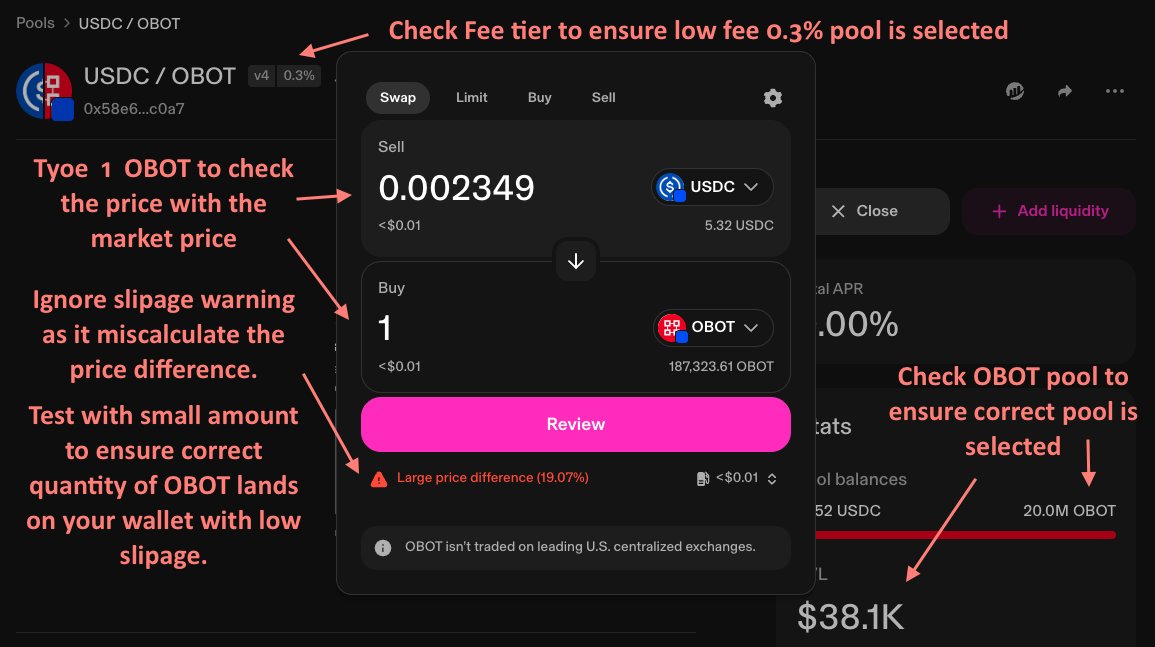
📈 New DEX pool created on USDC buy for OBOT
For buying OBOT with USDC, the low-fee tier and reduced slippage rate are available on the new USDC/OBOT pool. See the instructions below and the link to the new pool.
https://t.co/0fAZXOMaEH
As the commodities super-cycle hits full swing in 2026, with gold surging toward $5,400 and industrial metals facing structural supply constraints, businesses are facing a brutal ultimatum: optimize or go under. 📈🚀💎
In an era where "paper promises" are discounted and "hard assets" carry a premium, efficiency is the only survival strategy. 🛠️📦 Here is why VeChain and OBORTECH are positioned to profit massively: 🏦💰🔥
1. Massive Cost Savings in a High-Price Era 💸📉
When commodity prices skyrocket, every percentage of waste or fraud becomes a catastrophic loss. 📉🚫
VeChain provides real-time transparency that can reduce supply chain costs by 20–30% and cut fraud-related losses by up to 40%. 🛡️✅
By ensuring product authenticity and monitoring operations in real time, companies can protect their high-value inventories from the "structural bottlenecks" defining the 2026 market. 🏗️🔍
2. Eliminating Logistics Friction 🚛💨⚡
With trade fragmentation and geopolitical shocks making shipping erratic, traditional systems are failing. 🌎⚠️
OBORTECH and VeChain leverage blockchain to remove information asymmetry, allowing for faster product delivery and better inventory management. 🔗📦
Blockchain adoption has been shown to boost revenue by 15–25% through enhanced trust and reduced delays. 📈🤝
3. Compliance and Sustainability as a Competitive Edge 🌿🌍🏅
The 2026 super-cycle is driven by the energy transition and new carbon regulations like the EU’s CBAM. 🔋☀️
VeChain's focus on tracking environmental sustainability allows companies to navigate rising carbon costs and prove the ethical sourcing of metals like lithium and copper. 🔋🏗️
OBORTECH's "Smart Hub" approach simplifies complex multi-party logistics, which is essential as supply chains become more "politicized" and concentrated. 🤖📑
🔗 OBORTECH Essential Links 🌐💎
Official Website: https://t.co/nVpxTNsaNW 💻🌍
Telegram Community: https://t.co/Op3fcVEoZI 📱🗣️
Twitter (X): @ObortechI 🐦🔥
Facebook: https://t.co/1JeFDw5cbp 👥💙
GitHub (Source Code): https://t.co/mNdlyMALZo 👨💻🏽💻
The Bottom Line: As businesses scramble to secure "hard reality" assets, those using $VET and $OBOT aren't just tracking goods—they are protecting their margins in a high-volatility, high-cost world. 💎🔐💪 #VeChain #OBORTECH #Commodities #Blockchain #SupplyChain #Crypto2026 🚀🌕🌌
Чихэрлэг ундаа, түүн дотроо хийжүүлсэн чихэрлэг ундаа эрүүл (илүү их чихэрлэг бөгөөд биед хурдан шингэдэг) мэндэд хамгийн их сөрөг нөлөөтэй тул дэлхий нийтээрээ ийм sin tax хэ��эгжүүлж байгаа.
Sugary drinks (sugar-sweetened beverages or SSBs like soda, fruit drinks, sports drinks, and sweetened teas) consistently linked to weight gain, obesity, type 2 diabetes, heart disease, gout, dental issues, and increased mortality risk.
These come from major health organizations, universities, and peer-reviewed meta-analyses/umbrella reviews, such as:
•Harvard T.H. Chan School of Public Health – The Nutrition Source: Sugary Drinks https://t.co/m1WR3XN0oU Comprehensive review: One daily sugary drink can lead to ~5 pounds of annual weight gain if calories aren’t offset. Regular consumption (1–2 cans/day) raises type 2 diabetes risk by 26%, heart attack risk by 20%, and gout risk by 75% in women. Also linked to premature death.20
•CDC: Rethink Your Drink and Fast Facts on Sugar-Sweetened Beverages https://t.co/BAuItdZCXA and https://t.co/qvm9jZJFA3 SSBs are the leading source of added sugars in the U.S. diet. Frequent consumption increases risks of weight gain/obesity, type 2 diabetes, heart disease, cavities, and gout.2430
Major Scientific Reviews and Studies
•Umbrella Review of Meta-Analyses (2024) – Sugar-Sweetened Beverages and Adverse Human Health Outcomes (Annual Review of Nutrition / PubMed) https://t.co/bHZ7WhTJhX Analyzed many meta-analyses: 79% showed direct associations with adverse outcomes. Convincing evidence (strongest class) for links to depression, cardiovascular disease, kidney stones, type 2 diabetes, and higher uric acid. Highly suggestive for nonalcoholic fatty liver disease and dental caries.03
•Global Burden Study (2025) – Nature Medicine https://t.co/lNs673SOb6 (via Tufts/Friedman School summary) In 2020, SSBs contributed to ~2.2 million new type 2 diabetes cases and ~1.2 million new cardiovascular disease cases worldwide. Higher burdens in Latin America/Caribbean, sub-Saharan Africa, younger adults, men, urban residents, and lower-educated groups.11
•Meta-Analysis on SSB Intake and Cardiometabolic Risks (2022) Strong associations with increased obesity (17% higher risk per serving increment), type 2 diabetes (20%), coronary heart disease (15%), and stroke (10%).9
•Harvard-Led Studies on Mortality (e.g., Circulation journal) Higher SSB intake linked to greater risk of early death, especially from cardiovascular disease and some cancers (e.g., colon, breast). One study tied two+ daily servings to 21% higher all-cause mortality risk.2632
Additional Mechanisms and Context
Sugary drinks provide “empty” calories that don’t promote fullness like solid food, leading to overconsumption. They spike blood glucose, promote inflammation, insulin resistance, fat accumulation (including liver fat), and contribute to metabolic syndrome. Effects occur independently of weight gain in some cases.2310
These sources draw from large cohort studies, randomized trials, and global data. Recommendations from these bodies generally advise limiting or eliminating SSBs in favor of water, unsweetened tea/coffee, or low/no-calorie options (with water as the ideal). For the most current details, check the linked pages directly, as research evolves.