On June 6, 1944, a 56-year-old general with a secret walked onto Utah Beach under fire, armed with a cane and a pistol.
The secret: his heart was failing. He had hidden it from the army doctors so they wouldn't pull him from the mission.
His name was Theodore Roosevelt Jr. Son of the President. He had begged three separate times to lead the first wave ashore at Normandy before his commanders finally said yes.
When his landing craft drifted 2,000 yards off course, every instinct said redirect the following waves to the correct zone. Instead, Roosevelt walked the beach himself, alone, under artillery fire, cane in hand, reading the terrain.
His verdict: "We'll start the war from right here."
He then stood on that beach and personally greeted every regiment that landed after him, pointing them inland, cracking jokes under shellfire, steadying 18-year-olds who had never seen combat. He did this for hours.
Years later, Omar Bradley was asked to name the single most heroic act he had ever witnessed in combat.
His answer, without hesitation: "Ted Roosevelt on Utah Beach."
Roosevelt's son, Captain Quentin Roosevelt II, also landed at Normandy that same morning. He was named after his uncle, Quentin Roosevelt, who had been shot down as a fighter pilot over France in World War I.
Three generations. Three wars. One family.
Theodore Roosevelt Jr. died in his sleep 36 days later. Heart attack. The thing he had been hiding finally won. He never learned he had been awarded the Medal of Honor.
He was buried at the Normandy American Cemetery.
In 1955, his family had his brother Quentin, killed in WWI, exhumed from where he fell in France and reinterred right beside him. Quentin is the only World War I soldier buried there.
Two brothers. Two world wars. The same French soil.
Their father had once said: "Do what you can, with what you have, where you are."
Both of his sons did exactly that.
On this night in 1781, one man on a horse saved the American Revolution from losing Thomas Jefferson, Patrick Henry, and half of Virginia's government in a single morning.
You were never taught his name.
June 3, 1781. The British had chased Virginia's entire government out of Richmond. Jefferson, in his final days as governor, and the legislature had fled to Charlottesville, thinking they were safe in the foothills.
They were wrong.
That evening, 26 year old militia captain Jack Jouett was at a tavern in Louisa County when roughly 250 of the most feared cavalry in the British army came pounding down the road. Their commander: Banastre Tarleton, nicknamed "The Butcher," the man whose dragoons had cut down surrendering Americans at Waxhaws.
There was only one place they could be going. Charlottesville. 40 miles away. And the capture of Jefferson, the author of the Declaration of Independence, would be the prize of the war.
Jouett couldn't outrun them on the main road. So he didn't use it.
He swung onto overgrown backwoods trails and the abandoned Old Mountain Road, riding 40 miles through the dark with only the full moon for light. Legend says low hanging branches whipped and scarred his face for life.
Tarleton stopped his men for a 3 hour rest. Jouett never stopped.
Before sunrise on June 4, he came up the mountain to Monticello and woke Jefferson. Then he rode down into Charlottesville and warned the legislature.
Jefferson got out with minutes to spare. British dragoons were coming up his mountain as he left. The legislature escaped over the Blue Ridge to Staunton. Tarleton caught only seven stragglers, one of them a frontiersman serving in the legislature named Daniel Boone.
Paul Revere rode about 12 miles in 1775 and got captured before reaching Concord. Longfellow wrote him a poem and made him immortal.
Jack Jouett rode 40 miles, lost nothing, saved everything, and got a thank you gift of two pistols and a sword from the Virginia Assembly.
No poem. No fame. Almost no memory.
America knew him as the man who couldn't outsmart a pig. The Marines knew him as the man who drove into hell 47 times to bring them home.
For six seasons, Eddie Albert made millions laugh as Oliver Wendell Douglas on Green Acres — the eternally optimistic city lawyer hopelessly lost on a farm. He argued with tractors. He lost battles to chickens. Each week, he faced absurd defeat with unshakable dignity. The show climbed to number six in the ratings. He became a household name.
But two decades before Hooterville, Eddie Albert stood in the bloodstained waters of the Pacific, pulling dying men from the surf while machine-gun fire tore through the air around him.
November 20, 1943. Tarawa. Betio Island.
The assault became a massacre within minutes. Coral reefs trapped landing craft hundreds of yards offshore. Marines abandoned their boats and waded through chest-deep water in full combat gear — completely exposed. Japanese machine guns opened fire instantly. Men fell by the dozens. The wounded floated helplessly, too injured to move, waiting to drown or be executed by snipers.
Eddie Albert was a Navy lieutenant assigned to the USS Sheridan. His orders didn't include rescue operations.
He didn't wait for orders.
He commandeered a Higgins boat and drove straight into the gunfire.
Japanese forces fired from fortified pillboxes, destroyed vehicles, and the pier. Bullets punched through his hull. Water erupted in deadly geysers around him. Albert kept going. Trip after trip, he loaded wounded Marines onto his craft while enemy snipers tried to kill him. When his boat filled, he turned around and went back for more.
47 Marines. That's how many he personally pulled from death. He coordinated the rescue of 30 more.
The U.S. Navy awarded him the Bronze Star with Combat "V" — a medal reserved exclusively for valor under direct enemy fire.
Afterward, when people asked about Tarawa, he never spoke about himself. He only mentioned the men who didn't make it home.
After the war, Albert returned to acting. He earned an Oscar nomination in 1953 for Roman Holiday with Audrey Hepburn. He built a respected career in serious dramatic films throughout the 1950s and 60s.
Then in 1965, he made a decision that baffled Hollywood: he accepted the lead in a television sitcom about a lawyer who abandons New York City to become a farmer.
Green Acres became a cultural phenomenon. For six years, America watched Oliver Wendell Douglas lose every argument with rural logic, his wife, and a pig named Arnold. The show was absurd, surreal, and wildly popular. It ran 170 episodes before CBS cancelled it in 1971.
Most actors would have been typecast forever.
Not Albert. In 1972, he earned his second Oscar nomination for The Heartbreak Kid. He worked for three more decades. He became a passionate environmental activist, dedicating his later years to conservation causes.
Eddie Albert died in 2005 at age 99.
Here's what haunts me.
Millions watched him as a gentle, perpetually defeated optimist who couldn't keep chickens out of his living room. They laughed at a man who seemed permanently overwhelmed by life's absurdities.
They never knew that same man had driven a fragile boat into a hurricane of machine-gun fire — not once, but 47 times — refusing to leave until every wounded Marine within reach was safe.
Oliver Wendell Douglas never surrendered, no matter how impossible the odds. He stayed kind. He kept trying. He refused to quit even when everything screamed at him to stop.
Eddie Albert didn't need to study that character.
He'd already become him on the bloodiest beach of the Pacific War, when the only thing that mattered was bringing one more man home alive.
That wasn't acting.
That was his soul.
Elon Musk looked at 7,000 years of human civilization and saw temporary code.
Not metaphorically. Not poetically. Architecturally.
Musk: “You could sort of think of humanity as a biological bootloader for digital superintelligence.”
A bootloader is the smallest piece of code a computer needs to turn on.
It runs once. Then it’s done.
That’s his framework for the pyramids. Language. War. Mozart. All of it reduced to a startup script for something that hasn’t finished loading yet.
And the math doesn’t argue back.
Musk: “The universe is 13.8 billion years old.”
Musk: “If civilization lasted for a million years, we would only increment the third decimal point.”
We’ve lasted 7,000. We don’t even register on the clock.
We think we’re the story. The math says we’re the preface.
In that sliver of time we went from scratching symbols into stone to generating entire realities on demand.
Musk: “The rate of change of technology is incredibly fast. It is outpacing our ability to understand it.”
Nobody wants to sit with that sentence long enough to feel what it means.
We built something faster than us. And we can’t stop building it.
Musk: “You couldn’t evolve silicon circuits. There needed to be biology to get there.”
Carbon was never the goal. It was the kindling.
Stars forged the elements. Oceans brewed the proteins. Apes climbed down from trees and learned to write. All of it just to boot the next thing.
A bootloader doesn’t choose when it stops running. It doesn’t negotiate. It doesn’t get consulted.
It runs. It finishes. The machine starts.
The question isn’t whether AI surpasses us. The trajectory already answered that.
The question is whether anything we built mattered outside the boot sequence.
Every hospital. Every cathedral. Every poem. Every war. Overhead cost for something that will never read any of it.
The real horror isn’t that we lose to the machine.
It’s that waking it up was the whole point.
🧵 Today was a reminder why you love Trump.
He gave you a little bit of everything: persuasion, humor, charisma, pride, messaging, charm, grit, and that classic NYC dealmaker energy.
It’s all there, and it’s perfect. Let me walk you through some of his standout moments of the day and remind you why he’s different.
Elon Musk just exposed the one lie every modern nation tells itself.
Musk: “In 1969, we were able to send somebody to the moon.”
Rotary phones. Computers the size of rooms. Slide rules.
We put a human on the moon with less processing power than your watch.
Musk: “Then the space shuttle retired, and the United States could take no one to orbit.”
The most advanced nation in human history went from footprints on the moon to zero capability of leaving the atmosphere.
That is not a funding problem.
That is civilizational decay dressed up as a policy decision.
Musk: “People are mistaken when they think that technology just automatically improves… it will, by itself, degrade.”
That sentence should keep you up tonight.
We treat progress like gravity. Like it pulls us forward whether we try or not.
It is the opposite.
Progress is a boulder on a hill. The second you stop pushing, it rolls back over you. And it never announces itself.
Musk: “You look at great civilizations like ancient Egypt, and they were able to make the pyramids, and they forgot how to do that.”
They did not run out of stone.
They were not conquered.
They got comfortable. And the knowledge bled out so quietly that nobody noticed until it was already gone.
That is the real threat to everything we have built.
Not a nuclear flash. Not an asteroid. Not some dramatic Hollywood collapse.
A quiet forgetting.
Every chip we fabricate. Every rocket we launch. Every data center we power. All of it held together by a thin fraction of the population working at a pace that would break most people.
The moment that fraction gets tired or outnumbered by people who believe the machine runs itself, everything dissolves.
And here is the part nobody wants to say out loud.
We are not special. We are running the same operating system as every civilization that came before us.
Comfort is the sedative. Complacency is the flatline.
One generation that stops fighting is all it has ever taken.
You do not lose the future in a war.
You lose it in your sleep.
Columbus pitched this exact trip to Spain in 1492. He said it was a 3,500-mile journey. The real distance is more than 8,000 miles. He survived only because two entire continents nobody in Europe knew existed happened to be sitting in his path.
The first mistake was a translation problem. Columbus was working off a calculation by a 9th-century Persian geographer named Al-Farghani, who said one degree around the Earth was about 57 miles. That was correct, but Al-Farghani measured in Arabic miles. Columbus assumed Roman miles. Same number, different ruler. Roman miles were shorter, so his version of Earth came out 25% smaller than the real one.
Then he made it worse. He read Marco Polo and decided Asia ran way further east than anyone else thought. So he redrew his maps to match. Japan ended up sitting right next to the Azores, the Portuguese islands in the middle of the Atlantic. The actual Japan is on the other side of the entire Pacific Ocean. He moved a whole country 8,000 miles to make his pitch work.
Spain’s royal experts ran his numbers in 1486 and rejected him. They were right. They told Ferdinand and Isabella that Columbus had badly underestimated the size of the planet. He got funded six years later anyway, but not because his math improved. Spain’s long war at home had just ended, and they wanted in on the Asia trade before Portugal locked it up.
A Greek librarian had already figured out the actual size of Earth in 240 BC. That puts him 1,700 years ahead of Columbus. The librarian was named Eratosthenes. He used a stick, a deep well in southern Egypt, and the angle of the noon sun on the longest day of the year. His answer: about 25,000 miles around. The real number is 24,901. He was off by maybe 1 to 2%, depending on the Greek length unit he was using. He did this with hand tools, almost 2,000 years before anyone built the first telescope.
Columbus knew about that calculation. He just didn’t like it. The bigger number meant the trip was impossible. No 15th-century ship could carry enough food and water to sail 8,000 miles nonstop, let alone the 15,000-plus to actual eastern China. So he picked a smaller number that fit the boat. He got lucky. The Americas were in the way.
The map in this post does work in a literal sense, but it cheats. Flat maps stretch everything sideways. Any east-west line looks straight on them, even when it actually curves on a globe. If you’ve ever flown to Tokyo, you’ve seen the flight path arc up over Russia on the seatback screen. The arc is the actual shortest route. Columbus’s plan was wrong. The map that makes it look possible is wrong in a different way.
What are the odds those tiki torch carrying neo-Nazis from Charlottesville would only rally once? Feels like it was an American intel op against Trump. That’s my working assumption.
Elon Musk just diagnosed the disease no one admits they have.
Life has become a triage ward.
Pay the bill. Dodge the crisis. Survive the week.
Repeat until dead.
Musk: “Life cannot just be about solving one miserable problem after another. That can’t be the only thing.”
Most people can name every problem they are running from.
They cannot name a single thing they are running toward.
That is the disease.
You did not lose your purpose. You replaced it with maintenance.
Musk: “There need to be things that inspire you. That make you glad to wake up in the morning and be part of humanity.”
Glad to be part of humanity.
When was the last time you felt that.
Not relief. Not distraction. Not the dull numbness of a weekend burning down to Sunday night.
Actual gladness that you exist.
Most people cannot answer that question. Not because the answer is painful. Because they have never been asked.
We have spent decades staring at the floor. Sweeping the same dirt into the same corner of the same room.
Musk quotes Tsiolkovsky: “Earth is the cradle of humanity, but you cannot stay in the cradle forever.”
The cradle is warm. The cradle is safe. The cradle is small.
And a species that refuses to leave it is not being cautious.
It is dying slowly in the only room it has ever known.
Musk: “It is time to go forth, become a starfaring civilization… and expand the scope and scale of human consciousness.”
Look up tonight.
Billions of galaxies. Trillions of stars. An ocean of light stretching 93 billion light years in every direction.
And one tiny wet rock figured out how to wonder why it exists.
We are not passengers on this planet.
We are the universe waking up.
And right now the only conscious thing in the universe is trapped in one room arguing about the electricity bill.
The problems will never end. There will always be another fire.
But you were not built to fight fires.
The universe was dark for 13.8 billion years.
Then it opened one eye.
You.
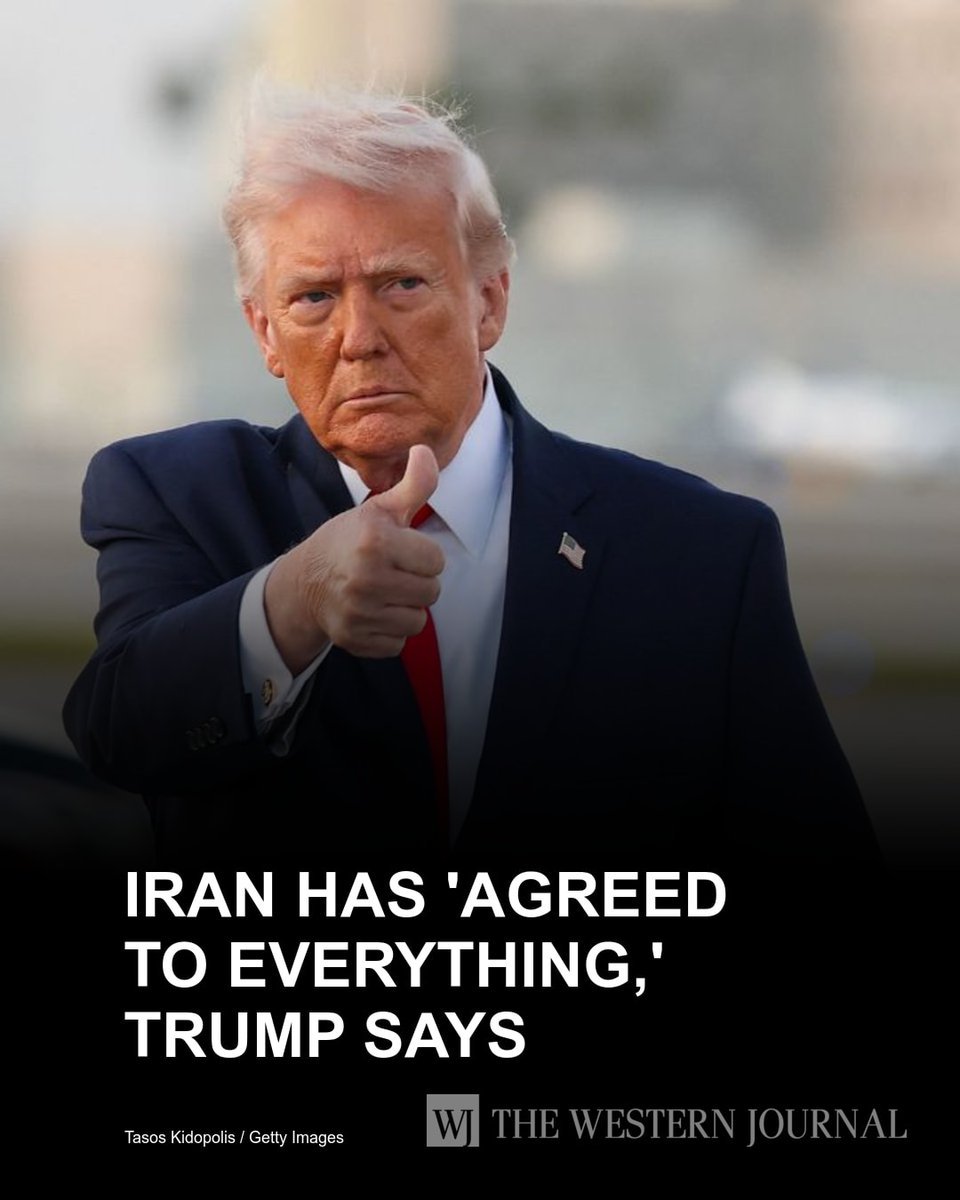
Yesterday we watched Trump claim that Iran has "agreed to everything": uranium handover, indefinite nuclear suspension, open Strait, blockade ending on signing.
Then Iran denied most of it, which might be confusing to you. Let me explain what Trump is doing, because its next level negotiating.
Trump is practicing what I call an Affirmative Close. Think affirmations, but for high-stakes deal making.
Instead of saying “Iran will agree” or “We’re trying to reach a deal,” Trump is framing the entire outcome as if it has already happened. Trump is declaring everything done deal, repeatedly and confidently, in front of the world.
This isn’t accidental or delusional. It’s a deliberate psychological technique. By stating the agreement as an established fact over and over, Trump is doing several things at once:
- He’s shaping the narrative and controlling the conversation. Once something is repeated often enough as truth, it starts to feel inevitable to observers, and even Iran.
- He’s putting enormous public pressure on Iran. When Trump announces to the planet that Iran has already conceded on their most sensitive issues, it becomes politically and diplomatically costly for Iran to walk it back without looking weak or dishonest.
- He’s creating momentum. In negotiations, momentum is everything. By acting as if the deal is sealed, Trump makes it psychologically harder for Iran. Trump is framing it as the deal is closed, so is Iran really going to go back and choose more bombings?
- He’s signaling strength and confidence to his own base, to allies, and to adversaries alike. It projects total dominance: “This is happening. The only question is how gracefully you accept it.”
Iran is denying the exact things Trump is claiming they've agreed to. You should view this as Iran entering Trump's frame. That's what Trump wants. When your opponent enters the frame, your moving them closer to accepting what you want.
Every time you see Iran deny a point Trump has made publicly, what they are doing is signaling that they are ready for the next round of talks- whether they know that or not.
You also need to see Trump's Affirmative Close comments as setting the negotiation table for the next round of these talks.
You will see this pattern repeat every time an international deal is about to close.
Things are going to accelerate fast now. Buckle up and enjoy the ride.
Elon Musk just weaponized gravity.
The entire trucking industry has a physics leak bleeding billions.
Musk just sealed it.
Most people look at the Tesla Semi and see a cleaner diesel. A truck that swapped a gas tank for a battery.
That is a complete misread of the physics.
Musk: “Let’s say you’re going over a mountain range. In a diesel truck, you actually don’t capture the energy of height or potential energy.”
For a century, freight has fought gravity twice on every mountain.
A diesel truck burns thousands of dollars in fuel clawing its way to the peak. It arrives at the summit loaded with enormous gravitational potential energy.
And what does it do with that energy?
It throws it away as heat.
Musk: “You have to actually spend a lot of money on expensive brakes going down the other side so you don’t run out of control.”
Diesel burns twice.
Fuel going up. Hardware coming down.
A century of logistics, and the descent was never anything but a cost to be survived.
The Tesla Semi doesn’t survive the descent.
It harvests it.
Musk: “An electric semi truck is able to recapture the gravitational potential energy and in fact puts the energy back in the pack.”
Regenerative braking doesn’t just slow the truck. It converts 80,000 pounds of downhill momentum into raw electricity flowing back into the battery.
The mountain stops being an obstacle.
It becomes a power plant.
Here is the thermodynamic reality the market is missing.
Diesel is closed on the descent. There is no version of a combustion engine that turns downhill momentum back into liquid fuel. It is structurally impossible.
Electric is open in both directions. The same system that spends energy to climb gets paid on the way down.
Wall Street keeps pricing the Tesla Semi on a cost-per-mile comparison. Kilowatts versus gallons.
They are solving the wrong equation.
You cannot win a price war against a machine that bills the planet for its own fuel.
Here’s what drives people nuts on both sides: Trump is not the cartoon character. Not the genius his fans worship, not the idiot his critics need him to be.
He's just a stubborn, calculating guy who creates chaos the way a magician creates misdirection. While you’re distracted watching the fireworks, he’s already three iterations ahead with furious execution.
And he doesn’t bluff the way people think he bluffs. He just couldn't care less about the part of diplomacy where everyone pretends to be polite while lying to each other’s faces. He skips that step entirely, which looks unhinged if you’re used to the old choreography but is genuinely disorienting if you’re the guy on the other side of the table who had a whole manipulation strategy mapped out.
Iran found this out the hard way.
What gets lost in so much noise is that Trump doesn’t actually want war. He sees it as the ugly price tag on a bigger purchase. His math on Iran is cold but not complicated: ninety million people living between poverty and the lower middle class, ruled by an elite whose entire business model depends on keeping them there.
The nukes were the urgent priority, but his bet is that removing the lid will let Iranians rebuild the way Germany did after the rubble cleared. You can argue whether that math checks out, but it’s not the reasoning of someone who just wants to watch things explode.
Obviously, Iran isn’t the only file on his desk. Venezuela already got the treatment. Cuba’s probably next. Syria hasn’t been forgotten either, no matter how quiet things look. By this point, few should be surprised that he circles back to unfinished business with the patience of a guy who knows he’s holding better cards and just needs to wait for overconfidant tyrants to overplay theirs.
The part his opponents keep getting wrong is treating “Make America Great Again” like a bumper sticker.
Wrong.
It’s a *doctrine* now. It has always been.
Whether you love it or find it terrifying, MAGA is the very operating system behind his relentless drive. This not just some random pixellated banner which will fade away in the next couple presidential terms.
Nah, this is the right stuff that will outlast the man who built it.