@ItzWarLockOp@Flipkart@flipkartsupport@flipkartsupport
Stop fooling people
Though people have already started to avoid flipkart for any kind of buying. When bigger fools like us try to order something on @Flipkart
This is what happens and this is not one off.
I was supposed to get my order on 15th of this month😬
Initiating coverage: Innomet Advanced Materials ltd (The most niche business listed on SME board with a strong moat)
-Engineers properties of metals on powder level (very difficult/very niche) for specific applications.
-25 years of powder-metallurgy know-how
-They also sell Tungsten powders & bars which has high powered application in defence, aerospace & radiation shielding
-RCMA approval for balance weights and spacers used in HAL helicopters.
-It has had technology-transfer/collaboration relationships involving ARCI, DMRL, IIT Madras and IIT Hyderabad.
-Mukul Agarwal entered last quarter
-YoY H1 sales up 137%, PAT up 133%, P/e crashed from 250 to 100
Understand why the product is so niche 👇
#innomet #innometadvancedmaterials #sme #multibaggers
Shortage of castings, forgings, bearings etc hitting Honeywell aerospace.
-Honeywell Aerospace has a problem most companies would love to have: more demand than it can make parts for. Backlog grew 12% in a year to $19.3 billion, and the CFO said growth this year would have been above 8%, not 4% to 5%, if supply had kept pace.
-The parts that are missing aren’t chips. They’re the old-fashioned metal parts: castings, forgings, complex machining and bearings. Of roughly 3,000 suppliers, about 70 are critical or constrained, mostly in exactly these categories.
-A casting is molten metal poured into a mould. The hardest examples are turbine blades grown as a single crystal of superalloy so they can survive gas hotter than the metal’s own melting point.
-A forging is solid metal pressed into shape, like the discs and shafts that spin at very high speed inside an engine.
-Bearings are what let those shafts spin. You can’t scale any of this the way you scale an electronics line. You need specialised furnaces and presses, certified alloys, and workers who took years to learn the craft. That’s why management says the problem is mostly on the mechanical side, and avionics and navigation recovered faster because they face fewer raw material constraints.
Why did it break?
Three things happened at the same time.
1. First, Covid drove experienced people out of the industry, and some suppliers are still dealing with labor shortages after skilled aerospace workers left during the pandemic.
2. Second, aircraft demand came back hard.
3. Third, the industry had spent a decade optimising for margins. Honeywell itself outsourced core technologies and capabilities between 2010 and 2019, and its supply base became dependent on single-source suppliers with limited capex. Outsourcing kept costs down for ten years, and now it’s capping growth.
China quietly weaponised a metal you've probably never thought about.
Highest melting point of any metal. Nearly as dense as gold. Harder than almost anything as carbide. And no substitute at any workable price.
Between Feb 2025 and Jan 2026, China took its 80%+ supply dominance and turned it into licensing, quota cuts and an export gate. APT exports collapsed ~70%, Western prices roughly quintupled.
But the real chokepoint isn't ore in the ground. It's mid-chain conversion capacity, and it sits inside China. New mines don't arrive till ~2030.
New piece breaks down the whole chain, rock to cutting edge, and where the money and the moat actually sit.
Link - https://t.co/O7Q35wo6ez
The Peptide super cycle covered on Substack below 💉💊
https://t.co/RLw28G3rKa
What are peptides?
Peptides are short chains of amino acids linked together by chemical bonds. You can think of them as smaller, simpler versions of proteins.
Peptides are experiencing a massive surge in prominence, evolving into a $50+ billion global therapeutic market and a major cornerstone of the modern wellness industry. This explosive growth is driven by several distinct factors intersecting at biotechnology, consumer trends, and medical breakthrough.
The "Halo Effect" of Blockbuster Metabolic Drugs
The monumental success of GLP-1 receptor agonists—such as semaglutide (Ozempic/Wegovy) and tirzepatide (Mounjaro/Zepbound)—has completely reshaped public awareness. Because these highly effective diabetes and weight loss treatments are fundamentally peptides, they have cast a highly positive spotlight on the entire scientific class, proving how powerful targeted peptide signaling can be.
High Precision with Fewer Side Effects
Unlike traditional small-molecule chemical drugs, which can inadvertently affect multiple systems in the body, peptides are engineered for extreme specificity. Because they mimic naturally occurring signaling molecules, they bind tightly to specific cellular receptors. This targeted approach yields higher efficacy while drastically minimizing unintended side effects and toxicity.
Tech Breakthroughs in Delivery and Stability
Historically, peptides were difficult to use as treatments because human enzymes broke them down too quickly. Recent advancements in chemical modification (like PEGylation), lipid nanoparticles, and advanced synthesis have solved these hurdles. Scientists can now engineer long-acting formulations and are successfully creating oral and nasal peptide alternatives, slowly eliminating the historic reliance on injections.
The Shift Toward Biohacking and Longevity Care
In the wellness sphere, peptides have become a premium status symbol among "biohackers" and fitness communities. This interest is driven by a broader societal shift toward preventative medicine and optimization rather than just treating illness. Popular unapproved or off-label peptides such as BPC-157 or TB-500 are heavily promoted online via social media for rapid injury recovery, muscle building, and anti-aging
At the risk of sounding like a broken record, I repeat that IEX is among the cleanest beneficiaries of India’s energy transition. Went thru the latest analyst meet transcript - 40 pages, absolute banger.
India’s electricity cons. was flat in FY26, yet IEX electricity volumes grew 17%.
IEX is no more just a power/exchg liquidity moat. If you were to remember one keyword of this thesis it should be tradeable imbalance.
India's grid is becoming larger, greener, more weather-dependent, more regional, more time-sensitive, and more optimized. Every time the system has surplus in one pocket and shortage in another, a trade is created.
The evidence is RTM. DAM used to be whole of IEX; 95% of IEX volumes. Today, RTM is 34%, DAM is 39%. RTM is accelerating at 25%+ while DAM at high single digit.
Why is RTM slated to be the dominant segment of the market? Because India is not Europe. ~85% of DISCOM demand is still met through long-term PPAs.
DAM is mainly used for planned or marginal gaps.
RTM is used when reality changes after the plan is made.
In other words, DAM helps plan yesterday; RTM fixed the plan gap today. A state may sell power one day because wind generation is high. The very next day it can be a buyer if the winds don't blow.
So, that makes IEX a misjudged power-demand story. Growing evidence points that it's a grid-complexity thesis.
Electricity demand may grow 5–6% but exchange volumes can grow faster because the system structurally creates more: forecast errors, outages, surplus power, shortages, price gaps and last-minute balancing needs.
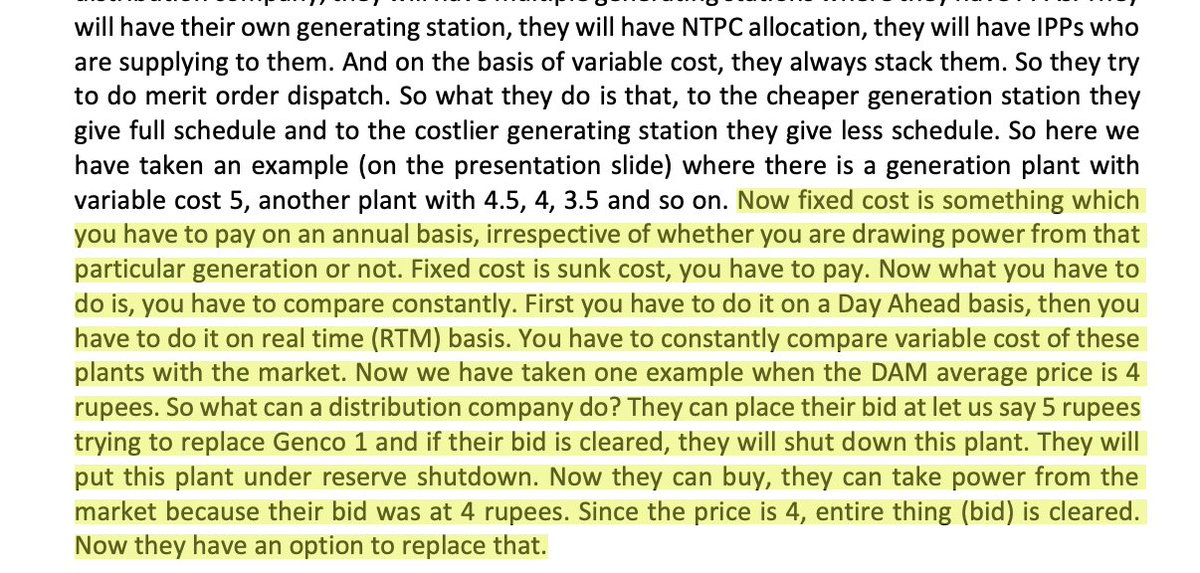
A DISCOM may have a long-term PPA. But if its contracted plant has ₹5/unit variable cost, and exchange power is available at ₹4, it can back down expensive generation and buy from the exchange.
This implies that RTM is not merely a last-minute balancing or emergency power tool. Discoms are saving costs.
They evaluate whether to run their expensive contracted plant? Or buy cheaper power from the exchange?
That decision creates volume.
Solar amplifies this further. During high-demand periods, daytime prices drop around ₹2/unit. If a DISCOM has thermal power with ₹5/unit variable cost, it can buy cheaper power from the exchange during solar hours.
Andhra Pradesh saved ₹2,350 crore during COVID while Telangana saved ~₹700 crore in FY26. Management guides that 10% of PPA-tied power could potentially be replaced through market participation. The incentive is an obvious no-brainer for Discoms.
Next aspect is regional diversity. India is not one uniform power market. Solar surplus often arises in Gujarat & Rajasthan. Wind generation is strong in Karnataka & Tamil Nadu. While the regional demand is affected by heat, agriculture, industry and rainfall.
This creates constant pockets of surplus and shortage.
I was shocked to learn that discoms are the largest buyers and sellers on the platform. Half of sell-side volume comes from state utilities while 80%+ of buy-side volume also comes from distribution utilities.
It's the same class of participating operating in different time in different regions.
So essentially, IEX doesn't need everyone to be short of power; it needs one participant to be surplus while another in deficit.
Next driver worth noting is demand shifting. Time-of-day tariffs are pushing consumption towards solar hours. In 2019, demand was more evening-heavy. By 2026, peak demand was closer to 3 PM on some days (around solar hours).
IEX Mgmt estimates ~50 GW of additional demand-shifting to solar hrs by FY35.
Why does this matter for IEX? Because solar power is abundant during the day.
If demand shifts into solar hours:
sell bids clear,
cheap power is absorbed,
DISCOMs reduce cost,
and exchange liquidity improves.
Again, more trading.
The next driver is BESS. While the whole market is excited and looking to invest in "BESS theme", few understand the dynamics of their business model. A battery is not just a power asset.
BESS merchants are arbitrageurs and traders. Buy during low-price solar hours (i.e. charge the battery). Sell during high-price evening hours (i.e. discharge the battery). Repeat this across hundreds of cycles.
That can create a new class of exchange participant.
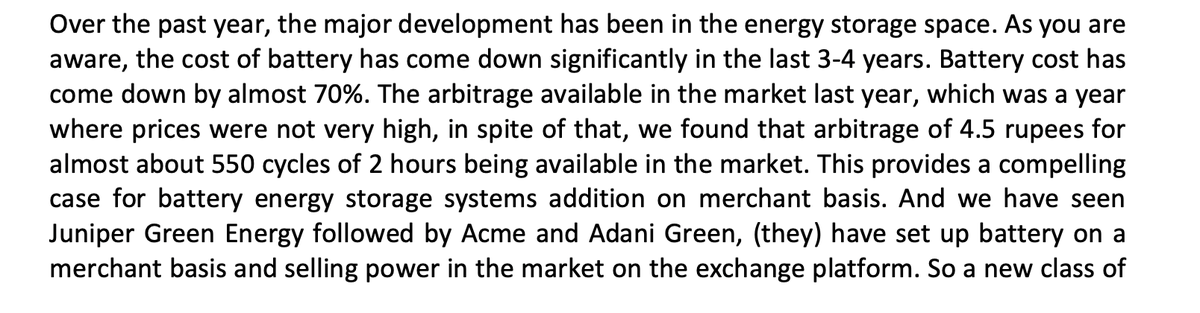
Battery costs have fallen ~70% in 3–4 years. Even in FY26, a low-price year, BESS merchants had opportunity of ₹4.5/unit arbitrage across ~550 two-hour cycles.
This is why merchant BESS matters for IEX. BESS will amplify the already accelerating RTM.
Last but not the least is FDRE - Firm and Dispatchable Renewable Energy projects promise a stable delivery profile. But we already know that solar and wind are variable. So developers overbuild. Because the surplus is uncertain and intermittent, it is hard to contract bilaterally. So, it naturally comes to the exchange.
Coal exchange is an optionality - I would not value it aggressively yet, but it is worth tracking.
The moat is that once coal exchanges start, existing coal e-auction platforms cannot continue beyond six months. Today, ~120 mt of coal is traded through e-auctions / marketplaces.
If coal moves from fragmented e-auctions to an exchange model, IEX gets a chance to replicate its power-exchange playbook:
more buyers + more sellers → better price discovery → deeper liquidity → more transactions.
If the rules force liquidity onto exchanges, coal can become a meaningful free option.
Putting it together, the operational flywheel of IEX is stronger than ever.
More renewables → more variability
More variability → more RTM
More solar → more price gaps
More price gaps → more BESS
More FDRE → more buy/sell imbalances
More active DISCOMs → more optimisation trades
Valuation:
I've read comments on forums investors saying that IEX is still expensive at 20+ PEx. I believe that PEx isn't the right approach in valuing this biz. Let me share a back of the envelope calc (I have done detailed modeling but would avoid that to make this complex)
Before valuing, one small but important concept: float.
When buyers and sellers trade on IEX, money does not instantly move from one party to the other. For a short period, settlement money / margins sit inside the exchange ecosystem.
IEX earns interest on this money. That interest income is economically valuable. This is similar to how insurers earn income on float - though the risk profile and rules are very different.
The float corpus itself does not belong to IEX shareholders. So we should not add the entire float balance to valuation like cash. What shareholders own is the income stream generated from that float.
So the valuation logic is:
Float value = after-tax float income × reasonable multiple
Let's get to valuation
Mcap of ₹11k crore
Less
1. Treasury assets: ~₹1,060 cr
2. IGX stake value: ~₹1,200 cr
3. Float income value: ~₹785 cr.
That leaves ~₹8,600–8,700 cr for the core electricity exchange. FY26 standalone op. EBITDA was ~₹514 cr.
So the market is valuing the core exchange at ~16–17x FY26 EBITDA.
Not cheap, not expensive either - rarely do such near-monopoly platforms trade at mid-teen multiples.
1 - IEX has 47.5% stake; estimated IPO value pegged by brokers at 2.2k-3k cr). After IPO/OFS, IEX reduces to 25%, but it receives sale proceeds for the stake sold.
2 - ₹69 cr float income × 76% post-tax × 15x
If investors demand 11% return and the core deserves 20x FY29 EBITDA, CMP of ₹131 implies FY29 core EBITDA of only ~₹621 cr; ~6.5% CAGR for the next 3 yrs.
Read my full thesis on IEX on Substack - https://t.co/JkJwL4Pw57
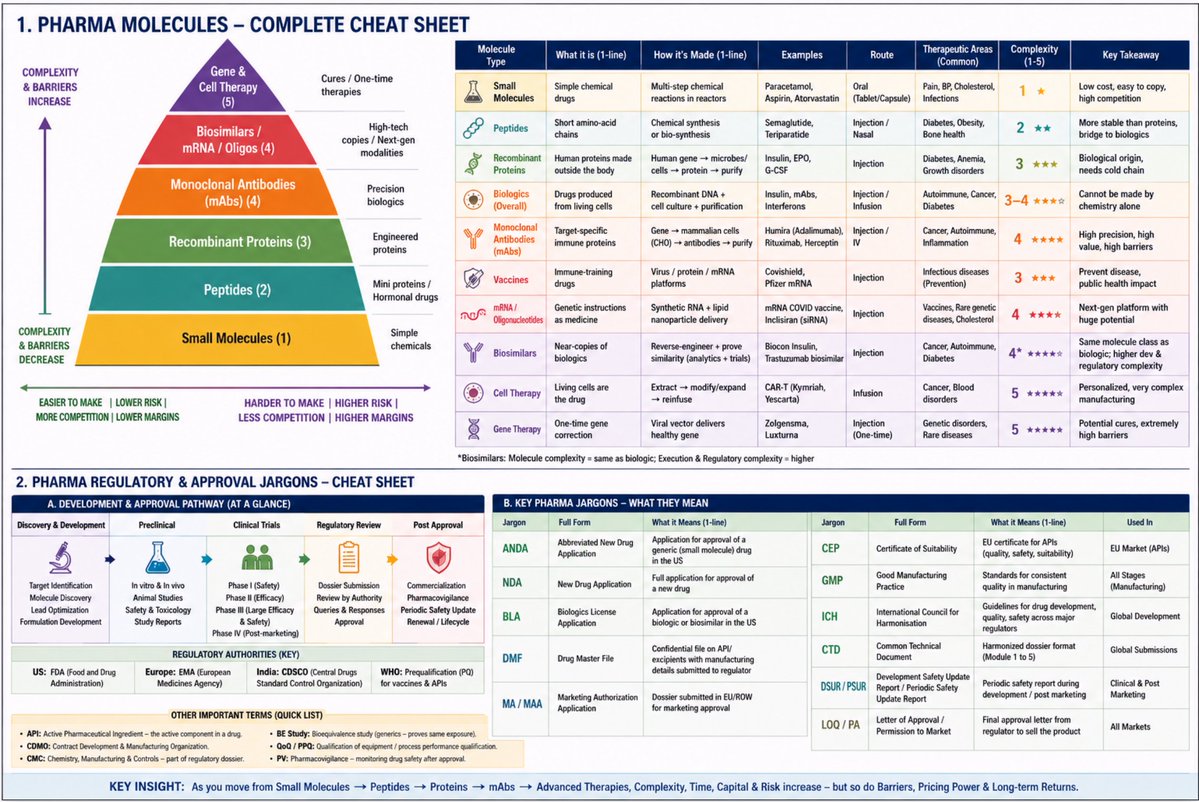
Pharma Cheat Sheet
As you all know, I am heavily invested in Pharma - it is by far my highest allocation, around 35-40%
For someone like me, with no background of pharma, it is extremely difficult to understand the basics and all the jargons related to different types of molecules, regulatory approvals etc.
So, I created this sheet sheet working with GPT, keeping an investor perspective in mind.
Hope it helps.. you can keep it as a reference.
I don't claim any accuracy, as I am not an expert.
Let's keep learning and sharing 🙂🙂
A student asked me: "Sir, if an ECG, Echo and LDL levels cannot accurately predict a heart attack, is there anything that actually can 100% predict it?"
In medicine, there is no such thing as 100%. But we do have better tools to measure risk. 👇
Timepass talk on Sunday
1. Sudeep Pharma
Sudeep Pharma is a manufacturer of excipients and specialty ingredients catering to the pharmaceutical, food, and nutrition industries. With a portfolio of more than 100 products, the company serves over 1,100 customers across 100 countries.
What are excipients?
Think of an excipient as the "delivery vehicle" or the supporting cast in a pharmaceutical formulation. While the Active Pharmaceutical Ingredient (API) is responsible for the therapeutic effect, it often constitutes only a small portion of a tablet or capsule. Excipients are the inactive ingredients, such as binders, fillers, stabilizers, and coatings, that provide the medicine with its structure, improve shelf life, enhance absorption, and ensure consistent delivery of the active drug.
If you have been tracking the Indian pharma ancillary space closely, the word 'excipients' should immediately bring two more names to mind: Sigachi Industries and Accent Microcell.
However, the structural economics of these businesses diverge completely based on their core chemistries. While Sigachi and Accent dominate the organic, cellulose-based excipient market (primarily Microcrystalline Cellulose), Sudeep Pharma operates in the inorganic, mineral-based excipient domain (Calcium and Magnesium salts).
To put their operational moats into perspective:
Cellulose-Based: Hard to engineer, but easier to qualify. Success depends on complex polymer physics and precision spray-drying, but the organic raw materials carry low regulatory risk.
Mineral-Based: Easier to synthesize, but brutal to purify. The chemical reaction is textbook, but stripping out mined heavy metals down to safe parts-per-million (ppm) levels requires an elite purification infrastructure.
We will leave it at that for now; a detailed forensic comparison of their manufacturing economics, margin profiles, and asset turns is a topic for another day!
Coming back to Sudeep Pharma, they currently operates across two established verticals and is building a third growth engine.
i) Pharmaceutical, Food & Nutrition (PFN): 56% of Revenue
Under this segment, Sudeep manufactures high-purity mineral-based ingredients such as calcium, zinc, iron, potassium, magnesium, and sodium compounds. These ingredients are critical inputs for regulated pharmaceutical, nutraceutical, and food applications.
The company is the first and only Indian manufacturer to receive USFDA approval for mineral-based ingredients, providing it with a strong competitive advantage in regulated markets.
ii) Specialty Ingredients: 44% of Revenue
The Specialty Ingredients division focuses on technology-driven, customized ingredient solutions designed to meet specific customer requirements. These products help improve nutritional delivery, enhance taste and texture, increase bioavailability, and ensure product stability across a variety of end-use applications.
This is the company's higher-growth and higher-margin segment, benefiting from increasing customer demand for differentiated and value-added ingredient solutions.
iii) Battery Materials: The Emerging Growth Driver
Sudeep is making significant progress in battery-grade iron phosphate, a key raw material used in Lithium Iron Phosphate (LFP) batteries.
The company expects to complete Phase-I of its battery materials project by the end of FY27, creating 25,000 TPA of capacity through an investment of approximately ₹300 crore. Management has outlined plans to invest a further ₹600 crore over the subsequent three years, taking total capacity to 100,000 TPA.
Customer engagement appears encouraging. The company is already working with 42 global customers, and six of them have successfully completed commercial validation.
Why are Q1FY27 margins expected to be under pressure?
Phosphoric acid, one of the company's key raw materials, has witnessed a sharp increase in prices. While Sudeep has initiated price hikes to pass on these higher costs, certain customer contracts incorporate a lag before revised pricing becomes effective.
As a result, Q1FY27 is likely to reflect only a partial benefit of the price increases, leading to temporary margin compression. Management expects margins to normalize from Q2FY27 onwards as the full impact of the price pass-through is realized.
2. Divgi Torq Transfer Systems
Divgi-TTS is a premier Indian automotive component manufacturer specializing in advanced drivetrain solutions, including engineered transfer cases, torque couplers, and transmission systems. It positions itself as an independent, high-tech player at the forefront of the automotive industry's structural shift toward electric vehicles (EV), dual-clutch transmissions (DCT), and advanced four-wheel-drive (4WD) systems.
After a prolonged slowdown, Divgi is entering a strong structural turnaround driven by a sharp recovery across its core verticals and an aggressive expansion into global markets
The Near-Term Trajectory (FY27): Financial growth is highly visible, anchored by a lucrative, exclusive one-time Indonesian government export order for 70,000 transfer cases. Split equally through its key domestic OEM partners, Mahindra & Mahindra and Tata Motors, this single program is projected to deliver an incremental ₹170–180 crore in revenue for FY27.
The Long-Term Sustainability (FY28 & Beyond): To counter the cyclical cliff of the one-time Indonesian order, management is scaling multiple independent, multi-year growth triggers. These include upcoming vehicle platforms like the Tata Sierra 4WD program, increased export volumes to the US via a Ford-related application, and entry into the high-volume electric 3-wheeler segment. Furthermore, its EV transmission vertical is poised to capture underpenetrated market share as newly approved proprietary designs ramp up for Tata Motors' Nexon and Curvv EV platforms.
3. Anthem Biosciences
Anthem Biosciences is a fully integrated CRDMO with capabilities spanning the entire drug discovery, development, and manufacturing value chain. It is among the few Indian companies offering services across both New Chemical Entity (NCE) and New Biological Entity (NBE) programs. Over the years, the company has built expertise across several advanced technology platforms, including RNA interference (RNAi), Antibody-Drug Conjugates (ADCs), peptides, lipids, and oligonucleotides.
The CRDMO segment contributes over 80% of Anthem’s revenues and enjoys industry-leading profitability. EBITDA margins stood at 43.4% for FY26 and expanded to 48.1% in Q4 FY26. No other listed Indian CRDMO operates at a comparable margin profile. Management attributes these margins to structural advantages arising from backward integration, process efficiencies, and disciplined cost control rather than any one-off benefit.
Rimegepant, the active ingredient in Pfizer’s blockbuster migraine therapy Nurtec ODT, is estimated to contribute nearly 20–25% of Anthem’s CRDMO revenues. With Nurtec generating more than $1.4 billion in sales during 2025, Rimegepant remains one of Anthem’s most commercially significant molecules.
Anthem is currently undertaking the largest capacity expansion program in its history. The company also added two new global Big Pharma customers during FY26, further strengthening its client base.
Over the last two to three quarters, Anthem commercialized four new molecules, taking its portfolio of globally commercialized products to 14. For each of these molecules, Anthem serves as the sole-source manufacturer of either the final Active Pharmaceutical Ingredient (API) or a critical regulatory intermediate.
External analysts estimate that the peak global commercial opportunity associated with the four newly commercialized molecules is approximately $10 billion. In addition, Anthem currently has 10 molecules in Phase III clinical trials, providing a strong foundation for future commercial launches and long-term growth.
That said, valuations are screamingly expensive at this point.
4. The WuXi AppTec Euphoria
The news that the Pentagon has added WuXi AppTec to its list of companies allegedly linked to the Chinese military dominated discussions across financial Twitter this week. However, much of the broader narrative appears either misplaced or misunderstood.
i) What happened?
The Pentagon updated its annual 1260H list, adding roughly two dozen entities, including high-profile Chinese companies such as Alibaba, Baidu, BYD, and WuXi AppTec, one of the world's largest CRDMO players.
The 1260H designation identifies companies that the U.S. government believes are either assisting China's People's Liberation Army (PLA) or are linked to Beijing's military-civil fusion strategy.
WuXi AppTec responded immediately, calling the designation "clearly a mistake" and reiterating that it is neither controlled by nor affiliated with any military or government entity, nor does it provide services to China's armed forces.
ii) How significant is WuXi's U.S. exposure?
Very significant.
Approximately 75% of WuXi AppTec's revenues are derived from U.S. customers. Sell-side analysts, including Bloomberg Intelligence, estimate that as much as $30.4 billion (206 billion yuan) of U.S.-linked revenue could be at risk between 2027 and 2030 if customers aggressively diversify away from the company.
iii) Does this mean U.S. pharma companies will stop working with WuXi immediately?
The simple answer is no.
The 1260H designation itself does not impose immediate sanctions, asset freezes, or commercial restrictions. However, it gains significance through its interaction with the Biosecure Act, which was signed into law in December.
The legislation restricts U.S. government agencies from contracting with organizations that rely on services provided by companies appearing on the Pentagon's Chinese military companies list.
Importantly, the framework includes a five-year grandfathering period, allowing existing pharmaceutical clients sufficient time to wind down contracts, transfer manufacturing processes, and establish alternative supply chains without jeopardizing eligibility for federal healthcare programs such as Medicare and Medicaid.
There is another important nuance. The restriction primarily applies to federally funded programs. If a pharmaceutical company operates both federally funded and privately funded projects, only the government-funded programs face direct compliance challenges. While maintaining separate supply chains introduces significant regulatory complexity and compliance costs, private commercial programs can technically continue working with WuXi.
iv) WuXi's reshoring strategy
WuXi is not standing still.
WuXi AppTec continues to expand its Delaware manufacturing footprint, with the objective of locating roughly 20-30% of its global capacity within the United States. Similarly, WuXi Biologics is relocating an estimated 30-40% of its capacity to U.S. facilities in an effort to mitigate future cross-border restrictions and reassure customers.
v) So, are Indian CDMOs immediate beneficiaries?
Not necessarily in the short term.
This development is unlikely to create an overnight revenue windfall for Indian CRDMOs. However, it does accelerate a trend that was already underway: supply-chain diversification away from China.
As large pharmaceutical companies reassess long-term manufacturing dependencies, Indian CRDMOs are likely to become key beneficiaries of incremental outsourcing mandates. The opportunity is less about immediate contract transfers and more about becoming part of the next-generation global supply chain architecture.
For example, Eli Lilly maintains substantial exposure to Chinese manufacturing partners but already works with companies such as Divi's Laboratories and Sai Life Sciences. The ongoing WuXi situation could encourage Lilly to gradually increase sourcing from Indian partners as part of a broader risk-mitigation strategy. Similar dynamics could play out across several large U.S. pharmaceutical companies, including Pfizer and others.
The key takeaway is that the WuXi episode is not an overnight revenue event for Indian CDMOs. It is, however, another catalyst pushing global pharma companies toward geographic diversification, and India remains one of the most credible alternatives available at scale.
5. Aegis Logistics
Aegis Logistics is one of India's leading logistics and supply-chain companies, specializing in the storage, handling, and distribution of clean energy products such as liquefied petroleum gas (LPG), ammonia, and liquid chemicals. The company operates a strategically located network of cryogenic and liquid storage terminals across major ports on both the western and eastern coasts of India.
Why the excitement?
Recent geopolitical developments and volatility in global energy markets have highlighted Aegis' unique business model. Through its VLGC-compliant infrastructure, extensive import capabilities, and strong global partnerships, the company can source LPG from the most economical global markets rather than being dependent on a single region. This flexibility enables Aegis to expand distribution margins during periods of supply disruption and price dislocation, turning market volatility into a competitive advantage.
That said, the bigger story is not the short-term opportunity, it is the long-term infrastructure platform that Aegis is building.
i) Significant Commissioning of Growth CapEx
Aegis is entering a phase where several large projects are expected to begin contributing simultaneously.
Liquid Storage Expansion
The first phase of a ₹1,675 crore expansion project at JNPT, comprising approximately 318,100 cubic meters of additional liquid storage capacity, is scheduled for commissioning in H1 FY27. In parallel, the Mumbai terminal will add another 64,000 kiloliters of liquid storage capacity during the same period.
Integrated Pipavav Ecosystem
Pipavav is evolving into a fully integrated LPG logistics hub. The new VLGC-compliant jetty is expected to be commissioned during CY2026, while the associated pipeline connectivity is scheduled to become operational in Q2 FY27.
Full-Year Asset Contribution
Cryogenic infrastructure commissioned at Pipavav and Mangalore during FY26 operated only for part of the year. FY27 will be the first year in which these assets contribute for the full twelve months.
ii) Multi-Modal Connectivity to Unlock Higher Throughput
For any terminal operator, storage capacity is only one side of the equation. The speed at which products can be evacuated determines overall throughput and asset utilization.
Several key connectivity projects are expected to come online during FY27:
The Jamnagar-Loni pipeline connection at Kandla has already been completed.
The Kandla-Gorakhpur LPG Pipeline (KGPL) is expected to connect Kandla in H1 FY27 and Pipavav in Q2 FY27.
New LPG rail gantries are under construction at both Mangalore and Pipavav, creating efficient and cost-effective evacuation routes into Central, Southern, and Western India.
These projects should significantly improve terminal utilization and throughput volumes across the network.
iii) Scaling the High-Margin Gas Distribution Business
Historically, Aegis' gas distribution operations were concentrated primarily around Mumbai and Kandla. Over the past few years, the company has transformed into a multi-regional platform with operations spanning Mangalore, Haldia, Pipavav, and other strategic locations.
Supported by this expanded infrastructure footprint, management is targeting a substantial increase in distribution volumes, with an ambition to reach approximately 2 million tonnes by FY28.
As distribution volumes scale over a largely fixed infrastructure base, operating leverage could become an increasingly important earnings driver.
iv) Early-Mover Advantage in India's Emerging Ammonia Economy
Aegis is also positioning itself to participate in India's evolving ammonia and clean-energy value chain.
The company is developing India's first independent ammonia terminal at Pipavav, with a static storage capacity of 36,000 metric tonnes. The project is expected to be commissioned in H1 FY27.
Importantly, approximately one-third of the terminal's capacity is already backed by a 15-year take-or-pay agreement with Hindustan Zinc, providing strong revenue visibility from day one. The remaining capacity will be available for third-party customers, creating opportunities for higher-margin throughput and distribution revenue.
The long-term opportunity could be substantial. CRISIL estimates that India could face an ammonia supply-demand gap of nearly 3 million tonnes by 2029. Through its strategic partnership with ITOCHU Corporation, which has acquired a stake in the Pipavav ammonia terminal, Aegis is positioning itself at the center of this emerging opportunity.
v) The Bigger Picture
Aegis Logistics is gradually transforming from a traditional storage terminal operator into a diversified clean-energy logistics platform. Between large-scale capacity additions, improving pipeline and rail connectivity, a rapidly expanding gas distribution business, and a first-mover position in ammonia infrastructure, the company appears to be entering a period where multiple growth drivers could begin contributing simultaneously over the next two to three years.
That's all for this edition. Have a great Sunday!
Disclaimer: None or buy or sell recommendations. This publicly available information is shared for learning and education purposes.