At the risk of sounding like a broken record, I repeat that IEX is among the cleanest beneficiaries of India’s energy transition. Went thru the latest analyst meet transcript - 40 pages, absolute banger.
India’s electricity cons. was flat in FY26, yet IEX electricity volumes grew 17%.
IEX is no more just a power/exchg liquidity moat. If you were to remember one keyword of this thesis it should be tradeable imbalance.
India's grid is becoming larger, greener, more weather-dependent, more regional, more time-sensitive, and more optimized. Every time the system has surplus in one pocket and shortage in another, a trade is created.
The evidence is RTM. DAM used to be whole of IEX; 95% of IEX volumes. Today, RTM is 34%, DAM is 39%. RTM is accelerating at 25%+ while DAM at high single digit.
Why is RTM slated to be the dominant segment of the market? Because India is not Europe. ~85% of DISCOM demand is still met through long-term PPAs.
DAM is mainly used for planned or marginal gaps.
RTM is used when reality changes after the plan is made.
In other words, DAM helps plan yesterday; RTM fixed the plan gap today. A state may sell power one day because wind generation is high. The very next day it can be a buyer if the winds don't blow.
So, that makes IEX a misjudged power-demand story. Growing evidence points that it's a grid-complexity thesis.
Electricity demand may grow 5–6% but exchange volumes can grow faster because the system structurally creates more: forecast errors, outages, surplus power, shortages, price gaps and last-minute balancing needs.
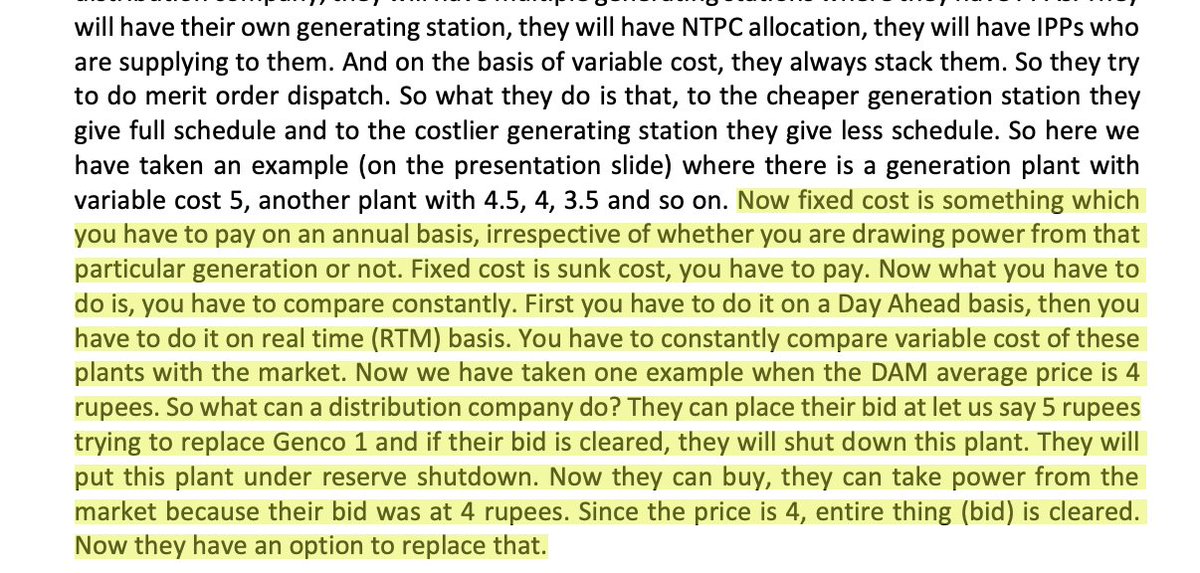
A DISCOM may have a long-term PPA. But if its contracted plant has ₹5/unit variable cost, and exchange power is available at ₹4, it can back down expensive generation and buy from the exchange.
This implies that RTM is not merely a last-minute balancing or emergency power tool. Discoms are saving costs.
They evaluate whether to run their expensive contracted plant? Or buy cheaper power from the exchange?
That decision creates volume.
Solar amplifies this further. During high-demand periods, daytime prices drop around ₹2/unit. If a DISCOM has thermal power with ₹5/unit variable cost, it can buy cheaper power from the exchange during solar hours.
Andhra Pradesh saved ₹2,350 crore during COVID while Telangana saved ~₹700 crore in FY26. Management guides that 10% of PPA-tied power could potentially be replaced through market participation. The incentive is an obvious no-brainer for Discoms.
Next aspect is regional diversity. India is not one uniform power market. Solar surplus often arises in Gujarat & Rajasthan. Wind generation is strong in Karnataka & Tamil Nadu. While the regional demand is affected by heat, agriculture, industry and rainfall.
This creates constant pockets of surplus and shortage.
I was shocked to learn that discoms are the largest buyers and sellers on the platform. Half of sell-side volume comes from state utilities while 80%+ of buy-side volume also comes from distribution utilities.
It's the same class of participating operating in different time in different regions.
So essentially, IEX doesn't need everyone to be short of power; it needs one participant to be surplus while another in deficit.
Next driver worth noting is demand shifting. Time-of-day tariffs are pushing consumption towards solar hours. In 2019, demand was more evening-heavy. By 2026, peak demand was closer to 3 PM on some days (around solar hours).
IEX Mgmt estimates ~50 GW of additional demand-shifting to solar hrs by FY35.
Why does this matter for IEX? Because solar power is abundant during the day.
If demand shifts into solar hours:
sell bids clear,
cheap power is absorbed,
DISCOMs reduce cost,
and exchange liquidity improves.
Again, more trading.
The next driver is BESS. While the whole market is excited and looking to invest in "BESS theme", few understand the dynamics of their business model. A battery is not just a power asset.
BESS merchants are arbitrageurs and traders. Buy during low-price solar hours (i.e. charge the battery). Sell during high-price evening hours (i.e. discharge the battery). Repeat this across hundreds of cycles.
That can create a new class of exchange participant.
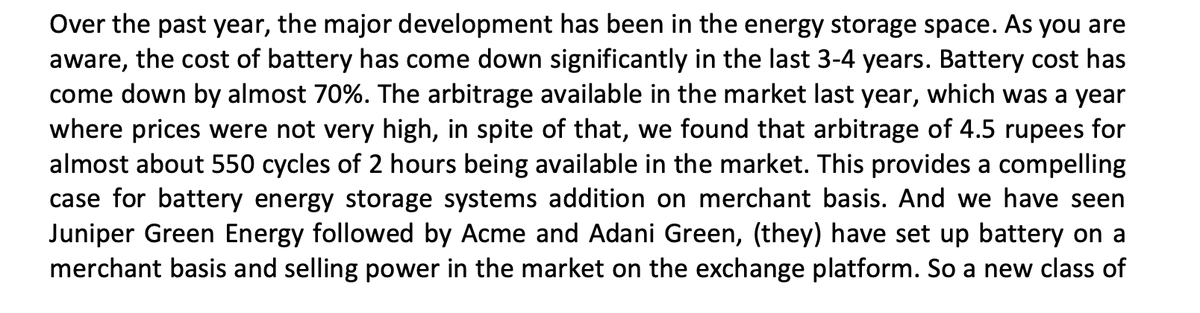
Battery costs have fallen ~70% in 3–4 years. Even in FY26, a low-price year, BESS merchants had opportunity of ₹4.5/unit arbitrage across ~550 two-hour cycles.
This is why merchant BESS matters for IEX. BESS will amplify the already accelerating RTM.
Last but not the least is FDRE - Firm and Dispatchable Renewable Energy projects promise a stable delivery profile. But we already know that solar and wind are variable. So developers overbuild. Because the surplus is uncertain and intermittent, it is hard to contract bilaterally. So, it naturally comes to the exchange.
Coal exchange is an optionality - I would not value it aggressively yet, but it is worth tracking.
The moat is that once coal exchanges start, existing coal e-auction platforms cannot continue beyond six months. Today, ~120 mt of coal is traded through e-auctions / marketplaces.
If coal moves from fragmented e-auctions to an exchange model, IEX gets a chance to replicate its power-exchange playbook:
more buyers + more sellers → better price discovery → deeper liquidity → more transactions.
If the rules force liquidity onto exchanges, coal can become a meaningful free option.
Putting it together, the operational flywheel of IEX is stronger than ever.
More renewables → more variability
More variability → more RTM
More solar → more price gaps
More price gaps → more BESS
More FDRE → more buy/sell imbalances
More active DISCOMs → more optimisation trades
Valuation:
I've read comments on forums investors saying that IEX is still expensive at 20+ PEx. I believe that PEx isn't the right approach in valuing this biz. Let me share a back of the envelope calc (I have done detailed modeling but would avoid that to make this complex)
Before valuing, one small but important concept: float.
When buyers and sellers trade on IEX, money does not instantly move from one party to the other. For a short period, settlement money / margins sit inside the exchange ecosystem.
IEX earns interest on this money. That interest income is economically valuable. This is similar to how insurers earn income on float - though the risk profile and rules are very different.
The float corpus itself does not belong to IEX shareholders. So we should not add the entire float balance to valuation like cash. What shareholders own is the income stream generated from that float.
So the valuation logic is:
Float value = after-tax float income × reasonable multiple
Let's get to valuation
Mcap of ₹11k crore
Less
1. Treasury assets: ~₹1,060 cr
2. IGX stake value: ~₹1,200 cr
3. Float income value: ~₹785 cr.
That leaves ~₹8,600–8,700 cr for the core electricity exchange. FY26 standalone op. EBITDA was ~₹514 cr.
So the market is valuing the core exchange at ~16–17x FY26 EBITDA.
Not cheap, not expensive either - rarely do such near-monopoly platforms trade at mid-teen multiples.
1 - IEX has 47.5% stake; estimated IPO value pegged by brokers at 2.2k-3k cr). After IPO/OFS, IEX reduces to 25%, but it receives sale proceeds for the stake sold.
2 - ₹69 cr float income × 76% post-tax × 15x
If investors demand 11% return and the core deserves 20x FY29 EBITDA, CMP of ₹131 implies FY29 core EBITDA of only ~₹621 cr; ~6.5% CAGR for the next 3 yrs.
Read my full thesis on IEX on Substack - https://t.co/JkJwL4Pw57
Over the last five years, I’ve listened to long-form conversations with numerous fund managers and investors. I’ve learnt a lot from them.
But beyond a point, the marginal utility starts falling drastically.
If one keeps coming back to the same idea, e.g. buy cheap assets, avoid cyclicals, focus on quality, never overpay; there is only so much more you can extract by hearing the argument for the 20th time.
I buy the argument of rereading and revisiting good ideas. But there is a difference between deepening understanding and repeatedly consuming arguments that merely reinforce what you already believe. The latter can creep into dogma.
Money managers are expert at explaining the past. Once an outcome is known, it is remarkably easy to build a clean narrative around why it was inevitable. The messiness, uncertainty and alternate possibilities that existed in real time are conveniently ignored. Everything looks obvious in hindsight.
This is one reason I now spend less time listening to investors and more time listening to founders, engineers, operators and builders. Especially those who bring first-principles thinking.
Money managers (incl. me), don't add any tangible value to a business, yet we often claim/appear to know more than the builders themselves.
Operators who have built businesses, survived near-bankrupt experiences, turned around broken companies or spent 20 years solving one single problem accumulate unmatchable amounts of tacit knowledge.
My north star once wrote that some Children’s books pack more wisdom per sq. inch than most non-fiction.
The reason, perhaps, is that when you are forced to simplify, you often get closer to first principles.
I was reminded of that while reading Charlie and the Chocolate Factory to my son last night.
Willy Wonka owns the greatest chocolate factory in the world. Other chocolate makers are envious and desperate to discover his secrets and start planting spies inside his factory.
Wonka eventually shuts the factory down. For years, there’s no production. Nobody goes in, nobody comes out.
Then one day, the chimneys start smoking again. The factory is running and chocolate is being made.
But still, nobody seems to enter or leave.
Charlie, a poor boy living nearby asks an obvious que: “Then who does all the work?”
Which is perhaps why adults are so good at not asking questions like it.
In my field, I find this pattern everyday - once a story is believed to be true, investors/analysts stop asking basic questions.
e.g. sure the co is growing revenues rapidly because it has a special product, but why are their receivable days worsening?
Why does an asset-light co not return capital to its shareholders but buy an unrelated business?
there could be many investing interpretations of these passages - but would like to hear from you. What investing or life lessons do you draw from these few pages?
https://t.co/j9j7J52stu
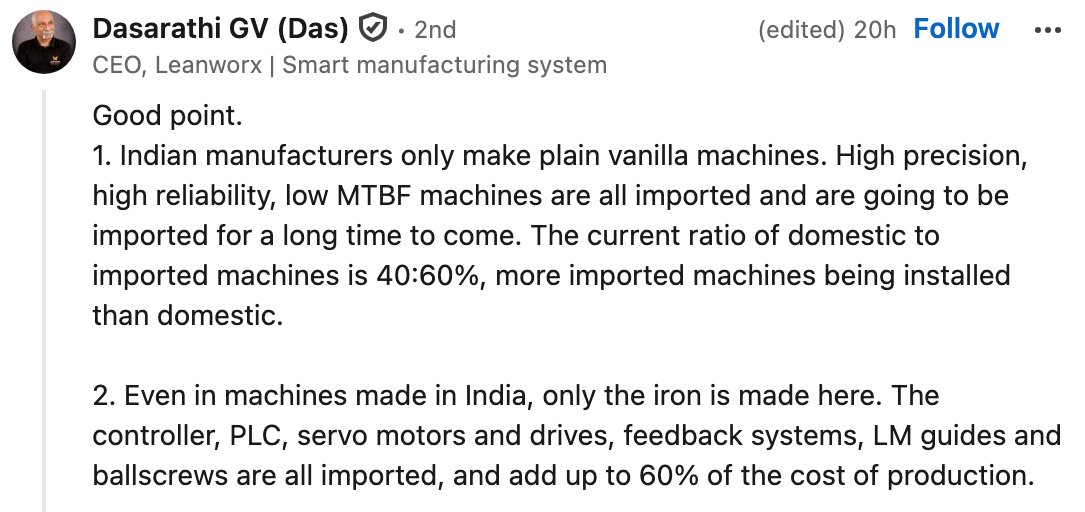
Most theses on CNC machines (latest infatuation of the street) I've read are preposterous and hasty.
One argument is that import restrictions will boost demand for local machines.
That works only when the domestic product is genuinely substitutable.
India manufacturing more aerospace, defence and high-precision components will certainly increase demand for machine tools.
But that does not mean the local CNC manufacturer will capture the most valuable part of that demand.
A T-1 supplier running a 200-cr programme will not risk even a small addition of tolerance drift or rejected parts for saving a few lakhs. It is buying repeatability, uptime, thermal stability, cycle time and years of proven production history.
One must not ignore institutional and career risk.
A production line built around Makino, Mazak or another globally proven platform is easy for an OEM/customer audit team to accept.
Would you as an auditor take that risk of losing your job?
The real moat in high-end capital goods is tech + installed base + application knowledge + accumulated failures + years of reliability.
It can’t be manufactured overnight.
That said, this is not an argument that Indian CNC machines lack capability.
Auto comps in our pf have developed machine-building knowledge to customise their own CNC setups for specific processes.
But that capability itself was built over years:
failed parts -> process amendments -> machine modifications -> better tooling - >accumulated shop-floor / tacit knowledge.
But they won’t share that recipe with others.
That tacit knowledge is precisely what separates a capable manufacturer from someone who merely owns similar machines.
That is the part investors are ignoring: You can buy the same machine but you can't buy the years of learning that make the machine productive.
In precision engineering, the moat hides in the scars accumulated while learning how to put these machines to best use.
Which is why I would be vigilant -> India’s import restrictions ≠ TAM for domestic CNC manufacturer.
Most theses on CNC machines (latest infatuation of the street) I've read are preposterous and hasty.
One argument is that import restrictions will boost demand for local machines.
That works only when the domestic product is genuinely substitutable.
India manufacturing more aerospace, defence and high-precision components will certainly increase demand for machine tools.
But that does not mean the local CNC manufacturer will capture the most valuable part of that demand.
A T-1 supplier running a 200-cr programme will not risk even a small addition of tolerance drift or rejected parts for saving a few lakhs. It is buying repeatability, uptime, thermal stability, cycle time and years of proven production history.
One must not ignore institutional and career risk.
A production line built around Makino, Mazak or another globally proven platform is easy for an OEM/customer audit team to accept.
Would you as an auditor take that risk of losing your job?
The real moat in high-end capital goods is tech + installed base + application knowledge + accumulated failures + years of reliability.
It can’t be manufactured overnight.
That said, this is not an argument that Indian CNC machines lack capability.
Auto comps in our pf have developed machine-building knowledge to customise their own CNC setups for specific processes.
But that capability itself was built over years:
failed parts -> process amendments -> machine modifications -> better tooling - >accumulated shop-floor / tacit knowledge.
But they won’t share that recipe with others.
That tacit knowledge is precisely what separates a capable manufacturer from someone who merely owns similar machines.
That is the part investors are ignoring: You can buy the same machine but you can't buy the years of learning that make the machine productive.
In precision engineering, the moat hides in the scars accumulated while learning how to put these machines to best use.
Which is why I would be vigilant -> India’s import restrictions ≠ TAM for domestic CNC manufacturer.
A popular fund manager recently defended his investments in IT.
I admire him and his contrarian investing style.
His argument is that AI will reduce the cost of software production, making many projects viable that were previously cost-prohibitive. Enterprises will therefore build more software.
This phenomena is called Jevons paradox: efficiency lowers the cost of something, and consumption rises enough to offset the decline in cost.
I initially bought the argument. Then I read the first two chapters of Brian Potter’s “The origins of Efficiency”.
It made me wonder whether Jevons is only one part of the story.
I explored this through the history of light bulbs, penicillin and Indian IT here:
https://t.co/bXGSReGv0m
One can write the exp. equity returns equation in many ways. Simply put:
ER = Biz growth + Cash returned + Δ expectations
During high growth phase, the middle part barely matters. Nobody wants buyback or dividends.
Strong growth -> higher expectations -> higher multiples (aka PE ratio) -> even better stock returns.
The moment a high-growth business misses what the market was expecting, the same loop runs in reverse:
Slower growth -> lower expectations -> multiple compression
Another way to think about returns is
ER = Biz outcome - expectations embedded in price
If the 2nd part of the eqn is 0 or -ve, you don't need a spectacular biz outcome to get decent returns.
A wise man once said - "The first rule of a happy life is low expectations. If you have unrealistic expectations you’re going to be miserable your whole life."
@CMeswani Excellent analysis. Got a lot of comments since it’s a hot topic- my post going viral was mostly luck. Many folks have done deeper analysis. One comment - it’s foolish to assume that IT cos won’t act knowing their biz is being disrupted. Your take?
One moat that I particularly like is the one forged by time.
In b2b, certain constructs require years of approval + proof of delivery across long cycles. Such a moat becomes more powerful if the product is 1–2% of the customer's end product or bill of material, but is critical for functioning of a larger system.
If a ₹5 lakh component can bring a ₹50 crore plant to a halt, the customer is unlikely to switch suppliers merely to save 10%.
These moats are often reinforced by installed base. If you have hundreds of installed systems and marquee client logos, you get priority.
Operating in such biz/ind is often very challenging. Orders and growth could be lumpy if the product is part of capex. Staying rational and balance sheet discipline favours sensible players over short-term greedy companies.
You'll end up having technicians who have seen the same product fail in fifty different ways. This adds tacit knowledge - again, difficult to acquire simply by putting capital upfront.
A competitor may still win a pilot order, but would need to demonstrate the product+ service reliability for years before scaling.
Economic profits don't come quickly, even if one pours capital into plant & machinery. That naturally repels irrational competitors, short-term disruptors and PE/VC money chasing quick returns. even if one pours capital on machinery. hence repels irrataional competitors, short term disruptors and PE/VC money.
Over time, weaker, irrational or simply unlucky competitors fold and the one that remains enjoys the fruits of their endurance.
Time becomes both the barrier to entry and the source of compounding. Survive long enough, stay rational, and every passing year can make the business harder to replicate.
https://t.co/vRjcQExIZp
Not an investment reco.
I find brand moats among the hardest to assess n value. Beyond the basics, its critical to deconstruct
- purchase frequency?
- How easy is the product to replicate and scale?
- Is there a secret recipe, process or distribution advantage?
- Who makes the buying decision + how fickle are they?
If the only barrier is capital, a co. (esp listed) with high margins is advertising the opp to competitors.
Consumer brands in India have become esp tricky to analyze because distribution itself has changed.
Categories that looked stable for decades are now constantly being raided by new-age brands. Funded and agile, these startups acquire customers fast, outsource manufacturing and reach shelves much faster. While they find it difficult to scale beyond 200-300 cr., they demonstrate what's possible, inviting more competition from
I increasingly believe that moat esp brand is.
Instead of fussing over valuing a moat, i think about -What exactly would a competitor need to do to take away their customers and how difficult is it today vs 5 years ago?
A rose by any other name would smell as sweet. - Abhishekspeare 😜
Shakespeare was right about love, but probably wrong about markets. Markets love labels - CDMO, China+1, electrificaiton...
In investing, the name transforms how something smells.
Of late, Precision engg is among the sexiest labels. Analysts drool hearing mission critical components made with less than human hair tolerance.
X is flooded with Ai-made value chain maps, some useful, some stretching the definition to fit their narrative.
Labels matter because they change the multiples investors are willing to pay. You wouldn't pay premium to a tier-4 machining job shop or a metal-cutting machine seller supplying factories in Rajkot.
But remember what you actually own underneath the label. Most of these are still cyclical capital-goods businesses where lumpiness is a norm. Cos often end up adding capacity near cyclical peaks, by the time new capacity comes onstream, competition catches up - adding pricing pressure. If demand/growth doesn't materialise, momentum reverses fast.
And not every co with a moat needs to call itself “precision engg”. For many genuinely high-quality manufacturers, precision is an inherent process of making the product, not a category they need to market themselves as.
Study the balance sheet and cash flows through previous cycles. Study what happened when utilisation fell. You may buy a co, buy you get the goodness and challenges of the industry it operates in.
Be cautious - question if you're paying 200 for a fancy envelope containing 100 rs. note, speculating that other fool will buy it for 300 rs. next month.
Manufacturing opportunity in India looks strong. But the label won’t protect me when the cycle turns.
I had written a short series on this theme incl. a couple of case studies - https://t.co/wBrXhGUuoX
Perfect hindsight is dangerous.
We form a neat story to explain why the now-known outcome was always inevitable.
A mediocre biz becomes a multibagger : the moat was apparent all along.
Explaining the past ≠ predicting it b4 hand
thesis+anti b4 outcome writes memory.
At the risk of sounding like a broken record, I repeat that IEX is among the cleanest beneficiaries of India’s energy transition. Went thru the latest analyst meet transcript - 40 pages, absolute banger.
India’s electricity cons. was flat in FY26, yet IEX electricity volumes grew 17%.
IEX is no more just a power/exchg liquidity moat. If you were to remember one keyword of this thesis it should be tradeable imbalance.
India's grid is becoming larger, greener, more weather-dependent, more regional, more time-sensitive, and more optimized. Every time the system has surplus in one pocket and shortage in another, a trade is created.
The evidence is RTM. DAM used to be whole of IEX; 95% of IEX volumes. Today, RTM is 34%, DAM is 39%. RTM is accelerating at 25%+ while DAM at high single digit.
Why is RTM slated to be the dominant segment of the market? Because India is not Europe. ~85% of DISCOM demand is still met through long-term PPAs.
DAM is mainly used for planned or marginal gaps.
RTM is used when reality changes after the plan is made.
In other words, DAM helps plan yesterday; RTM fixed the plan gap today. A state may sell power one day because wind generation is high. The very next day it can be a buyer if the winds don't blow.
So, that makes IEX a misjudged power-demand story. Growing evidence points that it's a grid-complexity thesis.
Electricity demand may grow 5–6% but exchange volumes can grow faster because the system structurally creates more: forecast errors, outages, surplus power, shortages, price gaps and last-minute balancing needs.
A DISCOM may have a long-term PPA. But if its contracted plant has ₹5/unit variable cost, and exchange power is available at ₹4, it can back down expensive generation and buy from the exchange.
This implies that RTM is not merely a last-minute balancing or emergency power tool. Discoms are saving costs.
They evaluate whether to run their expensive contracted plant? Or buy cheaper power from the exchange?
That decision creates volume.
Solar amplifies this further. During high-demand periods, daytime prices drop around ₹2/unit. If a DISCOM has thermal power with ₹5/unit variable cost, it can buy cheaper power from the exchange during solar hours.
Andhra Pradesh saved ₹2,350 crore during COVID while Telangana saved ~₹700 crore in FY26. Management guides that 10% of PPA-tied power could potentially be replaced through market participation. The incentive is an obvious no-brainer for Discoms.
Next aspect is regional diversity. India is not one uniform power market. Solar surplus often arises in Gujarat & Rajasthan. Wind generation is strong in Karnataka & Tamil Nadu. While the regional demand is affected by heat, agriculture, industry and rainfall.
This creates constant pockets of surplus and shortage.
I was shocked to learn that discoms are the largest buyers and sellers on the platform. Half of sell-side volume comes from state utilities while 80%+ of buy-side volume also comes from distribution utilities.
It's the same class of participating operating in different time in different regions.
So essentially, IEX doesn't need everyone to be short of power; it needs one participant to be surplus while another in deficit.
Next driver worth noting is demand shifting. Time-of-day tariffs are pushing consumption towards solar hours. In 2019, demand was more evening-heavy. By 2026, peak demand was closer to 3 PM on some days (around solar hours).
IEX Mgmt estimates ~50 GW of additional demand-shifting to solar hrs by FY35.
Why does this matter for IEX? Because solar power is abundant during the day.
If demand shifts into solar hours:
sell bids clear,
cheap power is absorbed,
DISCOMs reduce cost,
and exchange liquidity improves.
Again, more trading.
The next driver is BESS. While the whole market is excited and looking to invest in "BESS theme", few understand the dynamics of their business model. A battery is not just a power asset.
BESS merchants are arbitrageurs and traders. Buy during low-price solar hours (i.e. charge the battery). Sell during high-price evening hours (i.e. discharge the battery). Repeat this across hundreds of cycles.
That can create a new class of exchange participant.
Battery costs have fallen ~70% in 3–4 years. Even in FY26, a low-price year, BESS merchants had opportunity of ₹4.5/unit arbitrage across ~550 two-hour cycles.
This is why merchant BESS matters for IEX. BESS will amplify the already accelerating RTM.
Last but not the least is FDRE - Firm and Dispatchable Renewable Energy projects promise a stable delivery profile. But we already know that solar and wind are variable. So developers overbuild. Because the surplus is uncertain and intermittent, it is hard to contract bilaterally. So, it naturally comes to the exchange.
Coal exchange is an optionality - I would not value it aggressively yet, but it is worth tracking.
The moat is that once coal exchanges start, existing coal e-auction platforms cannot continue beyond six months. Today, ~120 mt of coal is traded through e-auctions / marketplaces.
If coal moves from fragmented e-auctions to an exchange model, IEX gets a chance to replicate its power-exchange playbook:
more buyers + more sellers → better price discovery → deeper liquidity → more transactions.
If the rules force liquidity onto exchanges, coal can become a meaningful free option.
Putting it together, the operational flywheel of IEX is stronger than ever.
More renewables → more variability
More variability → more RTM
More solar → more price gaps
More price gaps → more BESS
More FDRE → more buy/sell imbalances
More active DISCOMs → more optimisation trades
Valuation:
I've read comments on forums investors saying that IEX is still expensive at 20+ PEx. I believe that PEx isn't the right approach in valuing this biz. Let me share a back of the envelope calc (I have done detailed modeling but would avoid that to make this complex)
Before valuing, one small but important concept: float.
When buyers and sellers trade on IEX, money does not instantly move from one party to the other. For a short period, settlement money / margins sit inside the exchange ecosystem.
IEX earns interest on this money. That interest income is economically valuable. This is similar to how insurers earn income on float - though the risk profile and rules are very different.
The float corpus itself does not belong to IEX shareholders. So we should not add the entire float balance to valuation like cash. What shareholders own is the income stream generated from that float.
So the valuation logic is:
Float value = after-tax float income × reasonable multiple
Let's get to valuation
Mcap of ₹11k crore
Less
1. Treasury assets: ~₹1,060 cr
2. IGX stake value: ~₹1,200 cr
3. Float income value: ~₹785 cr.
That leaves ~₹8,600–8,700 cr for the core electricity exchange. FY26 standalone op. EBITDA was ~₹514 cr.
So the market is valuing the core exchange at ~16–17x FY26 EBITDA.
Not cheap, not expensive either - rarely do such near-monopoly platforms trade at mid-teen multiples.
1 - IEX has 47.5% stake; estimated IPO value pegged by brokers at 2.2k-3k cr). After IPO/OFS, IEX reduces to 25%, but it receives sale proceeds for the stake sold.
2 - ₹69 cr float income × 76% post-tax × 15x
If investors demand 11% return and the core deserves 20x FY29 EBITDA, CMP of ₹131 implies FY29 core EBITDA of only ~₹621 cr; ~6.5% CAGR for the next 3 yrs.
Read my full thesis on IEX on Substack - https://t.co/JkJwL4Pw57
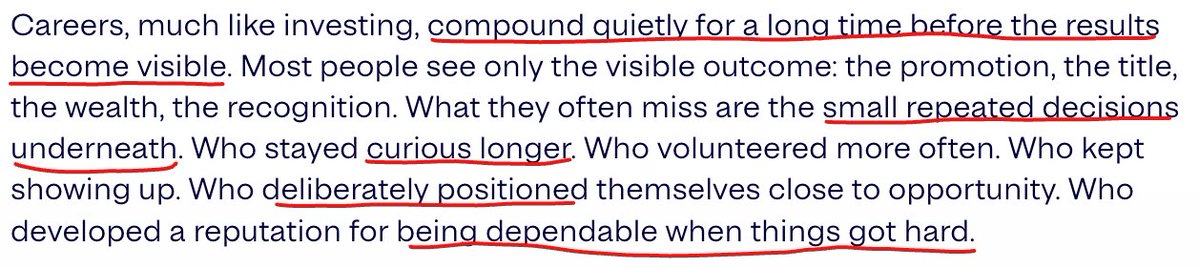
Excerpt from @gvravishankar 's brilliant piece on career advice. It has some unexpected lessons for investing too.
Def. going in my stack of supertexts that I reread every few months. note to self:
- Cultivate and nurture curiosity
- Learn relentlessly
- Be alert to rate of change
- Be high-agency - someone people want to work with
- Work hard; harder than what's reasonable - competition thins out near extremes
- Set a high bar for self
https://t.co/CccjRmkJTl