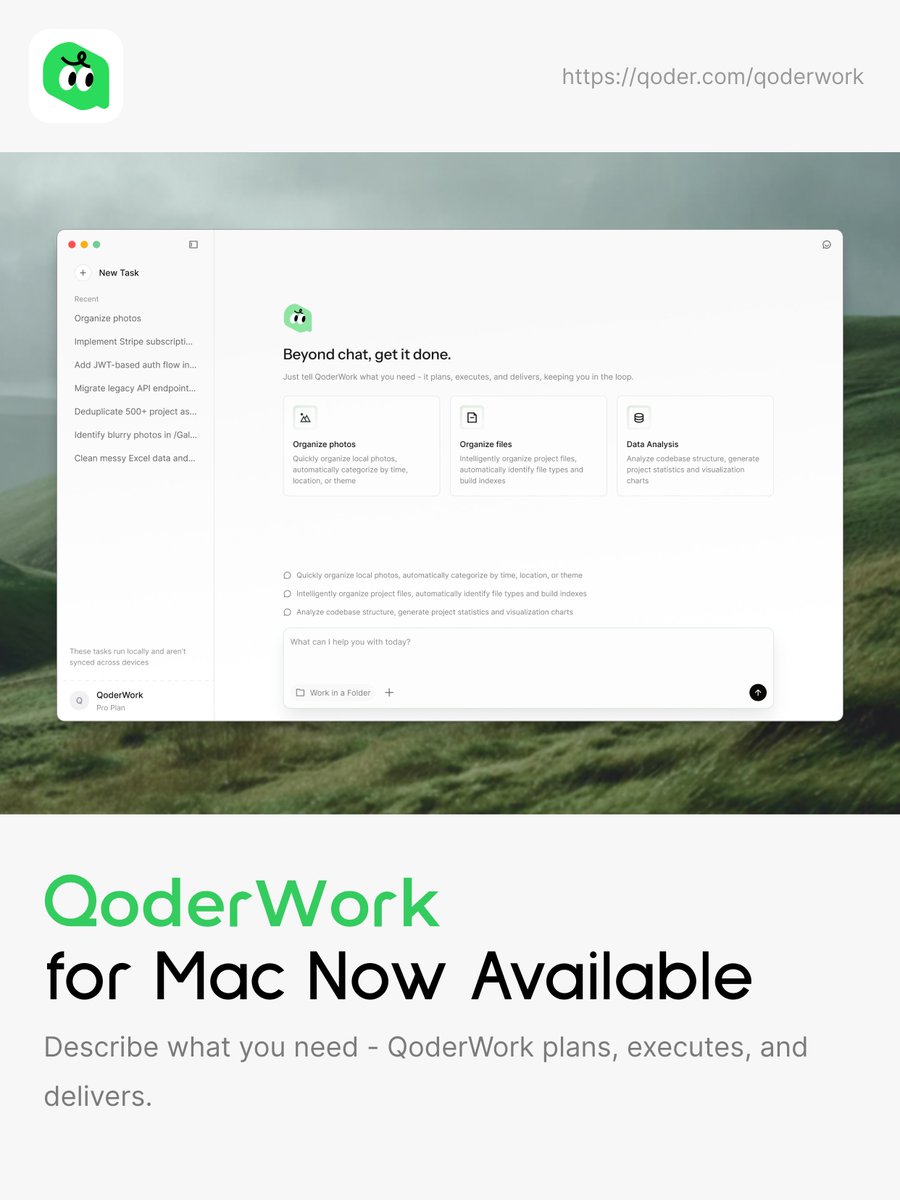
QoderWork for Mac is officially OPEN to everyone!
Since launching the QoFounder Plan, your mind-blowing creativity proved it’s time to break the boundaries.
No waitlist, no invite codes —just pure autonomous productivity for every Mac user.
Download now: https://t.co/N8oLTUJGv5
(Windows users: We see you! You’re in the final sprint of development. Stay tuned! 🛠️)
GLM-5 just launched — now available in Qoder.
On Qoder Bench — our benchmark for real-world software engineering tasks — GLM-5 outperforms Sonnet 4.5 and approaches Opus 4.5. At a fraction of the cost.
High demand expected — brief waits possible during peak hours. Scaling in progress.
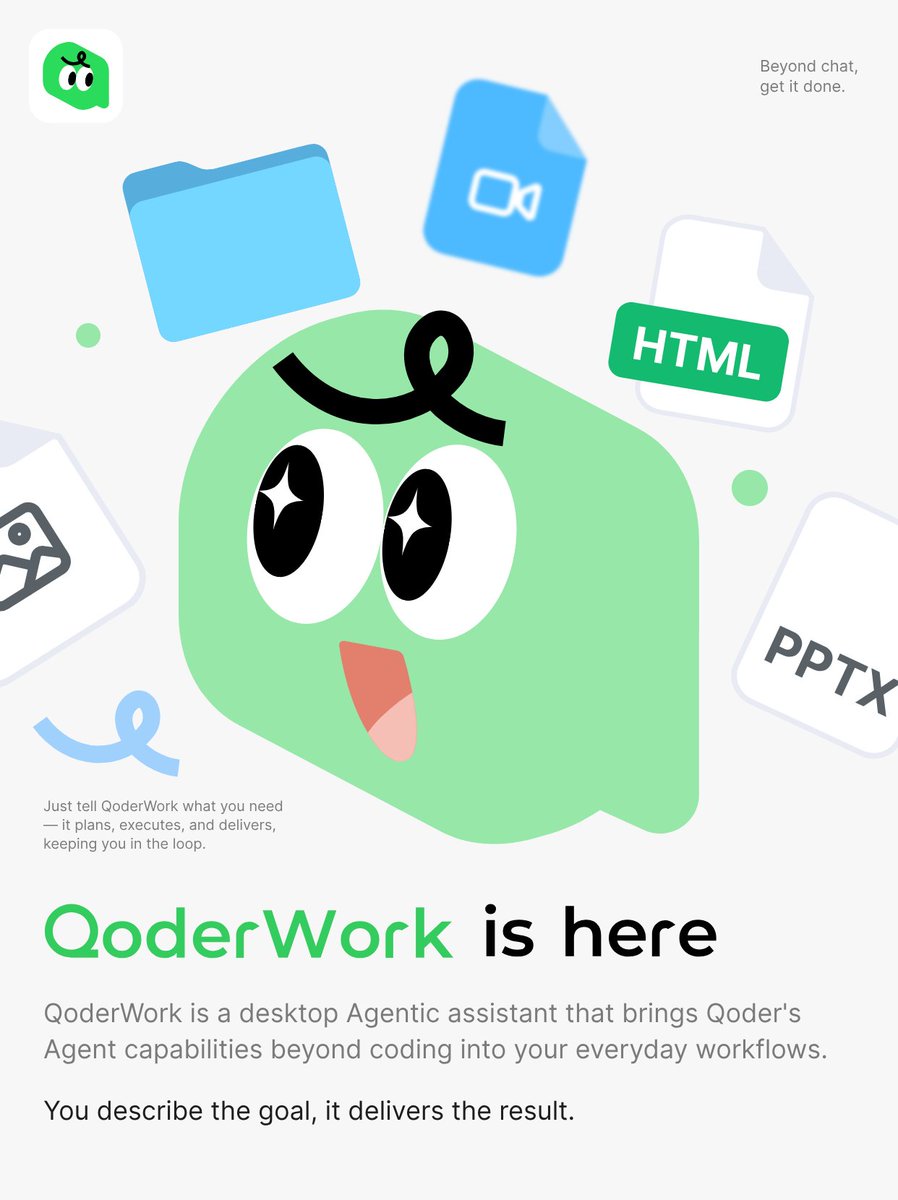
Introducing QoderWork — a desktop agentic assistant that brings Qoder's Agent capabilities beyond coding into your everyday workflows.
Describe what you need in natural language, and it handles file organization, data processing, document generation, and more.
🔗 https://t.co/wh2PfgIo3i
Meet Quest 1.0 !
- Built-in Agent Skills with elevated design taste
- Parallel execution: local + remote, multiple tasks at once
- From 0→1 to 1→∞, MVP to refactors
- Walk away while it builds. Check results when ready
👇 Watch our PM adds two features. No code written.
Meet Quest 1.0 !
- Built-in Agent Skills with elevated design taste
- Parallel execution: local + remote, multiple tasks at once
- From 0→1 to 1→∞, MVP to refactors
- Walk away while it builds. Check results when ready
👇 Watch our PM adds two features. No code written.
Quest 1.0 is live, powered by the SOTA coding and multimodal models.
Beyond engineering, Quest 1.0 is also perfect for vibe coders and creators.
Agent Skills are auto-loaded with good design taste.
You step back, it runs for hours, fixes itself.
Put Quest on. Hands off.
Check the demo 👇
Quest 0.2.29 is Live: more than just Quest 1.0
Browser Agent now controls your browser directly
- auto-captures page source, console logs, network traffic
- code > test > debug loop, fully autonomous
Most LLMs are trained for chat. Short back-and-forth.
When you give them a complex task, they... regress. Vague responses.
Quest's architecture is specifically built to fight this. Keep pushing it forward instead of letting it bail.
Quest verifies its own work before handing it to you. If something's off, it fixes it and re-checks.
Enhanced spec-driven development:
Before coding:
- Quest writes a technical spec
- You check if scope makes sense
- Agree on what "done" looks like
After coding:
- Quest checks against that spec
- Missing something? It adds it
- You review the result, not every step
We've had tasks run 26 hours. Continuously...
...when using Quest to rebuild Quest.
Interaction layer, state management, core agent loop. The whole stack.
What we did: described the requirement, reviewed the final code.
That's it.
Today Quest 1.0 is LIVE.
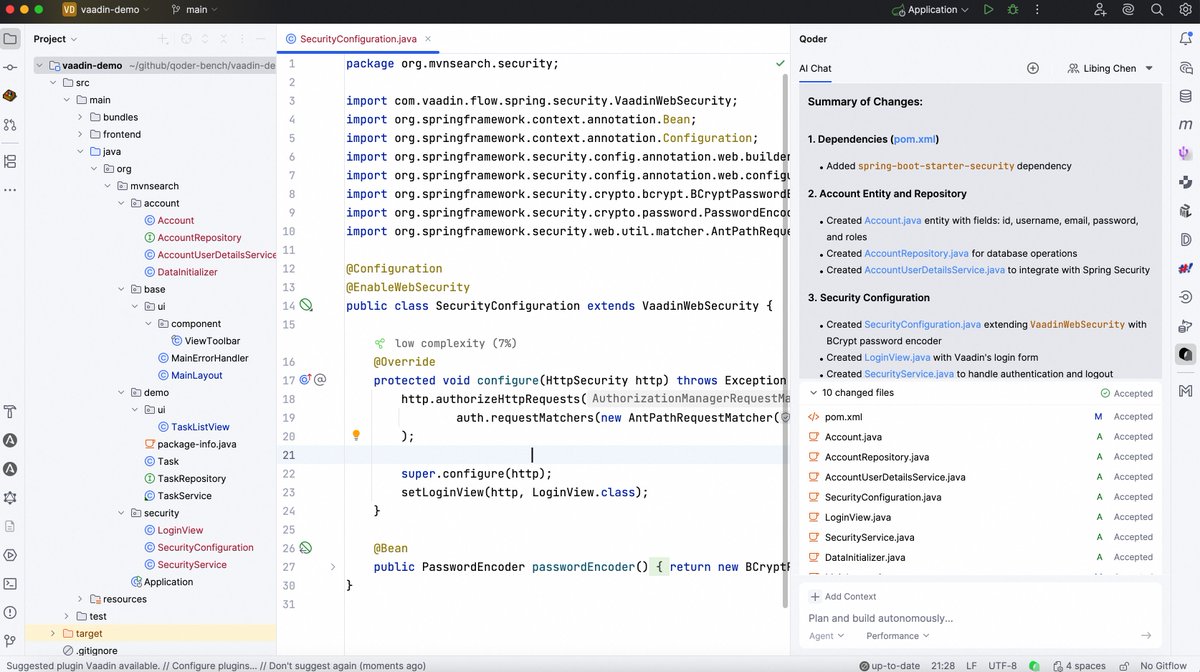
Traditional code completion predicts text. Qoder NEXT predicts intent.
Here's how our team built it, and why it hits 65% higher acceptance rate. 👇
Free to every user. Zero credits. Upgrade to v0.2.28 to try it.
NES was our "Next Edit Suggestions" feature. Useful, but limited.
In v0.2.28, we shipped Qoder NEXT. It's something else, a model trained on how developers actually edit code.
It predicts your next move: rename propagation, auto-imports, cross-file refactors.
Think ahead. Code NEXT.