“Estoy convencido de que en este día somos dueños de nuestro destino, que la tarea que se nos ha impuesto no es superior a nuestras fuerzas; que sus acometidas no están por encima de lo que soy capaz de soportar.”
- Winston Churchill
🧠 Poor sleep wrecks mood and memory. New mouse study finds bad memories → bad sleep.
Stressful memory engram cells spontaneously reactivated during sleep — fragmenting rest from the inside.
The stress doesn’t end when you close your eyes. 🧠💤
https://t.co/VSPRRJryxp
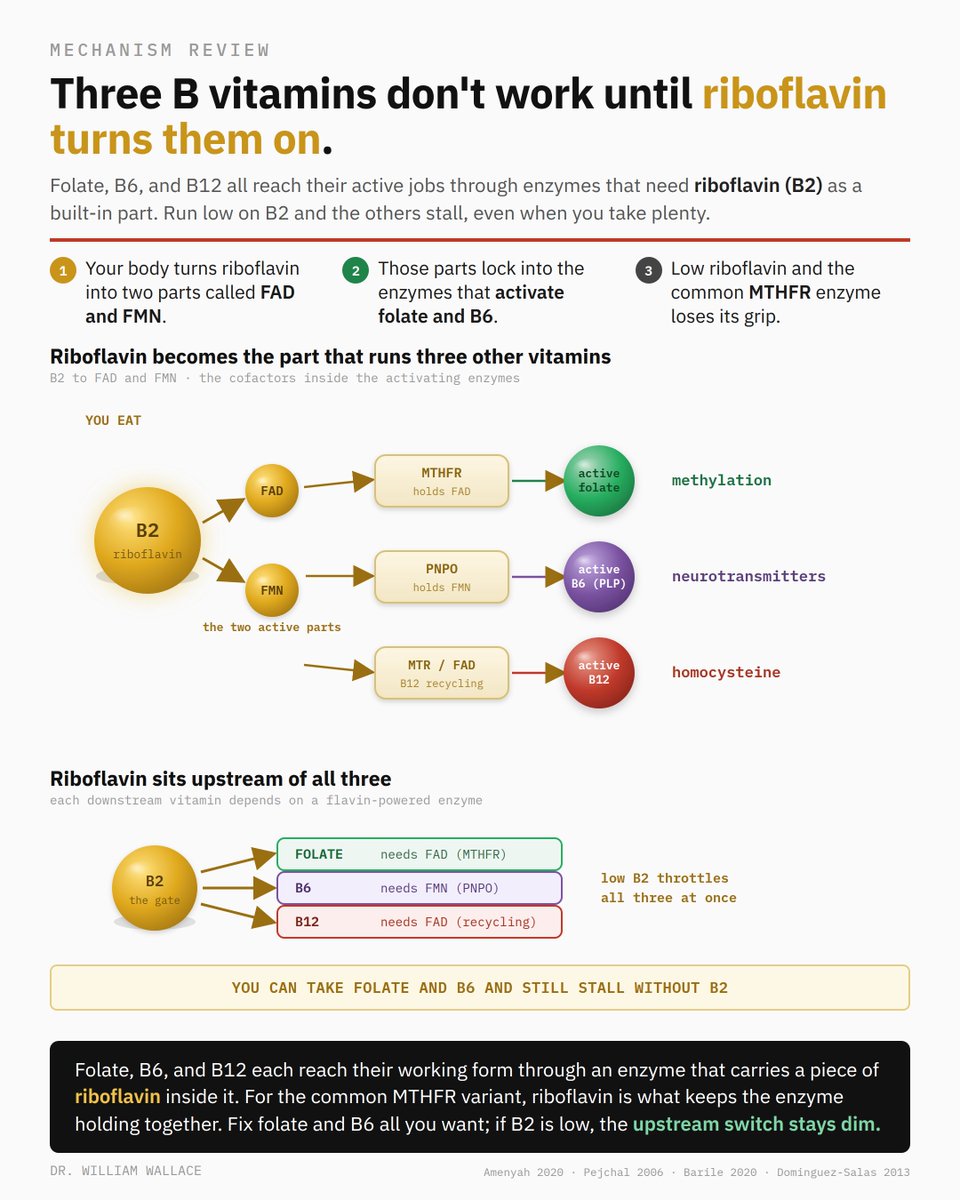
The MTHFR and folate conversation skips the vitamin one step above it.
Your body turns riboflavin (B2) into two parts, FAD and FMN. Those parts are built into the enzymes that activate folate, convert B6 to its active form, and let B12 work in the same cycle. B2 sits upstream of all three.
It matters most for the common MTHFR variant: that enzyme doesn't just run slow, it loses its grip on its riboflavin part. Giving riboflavin to people with that genotype lowers homocysteine, because it helps the wobbly enzyme hold the piece it keeps dropping.
The nuance: most people aren't B2 deficient, and the clear effect is specific to the MTHFR TT genotype, not a general fix. It's about removing a bottleneck in the deficient, not taking more for everyone.
Riboflavin (B2) absorption from a single dose maxes out around 27 mg. The surplus isn't all "wasted in your urine."
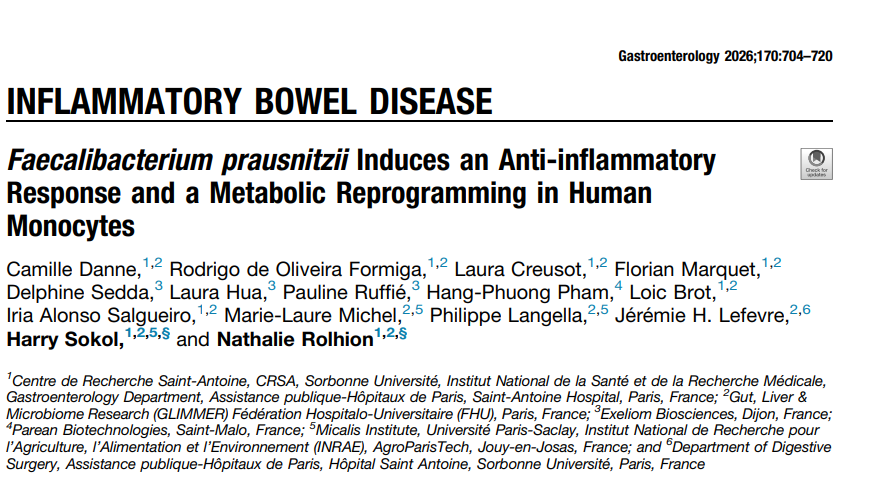
The fraction past that ceiling reaches your colon, where Faecalibacterium prausnitzii, a major riboflavin consumer and butyrate producer, uses riboflavin as an electron shuttle to survive against the oxygen-leaking gut wall.
In a 105-person RCT, riboflavin raised fecal butyrate with almost no shift in which bacteria were present. Same species, but likely more output.
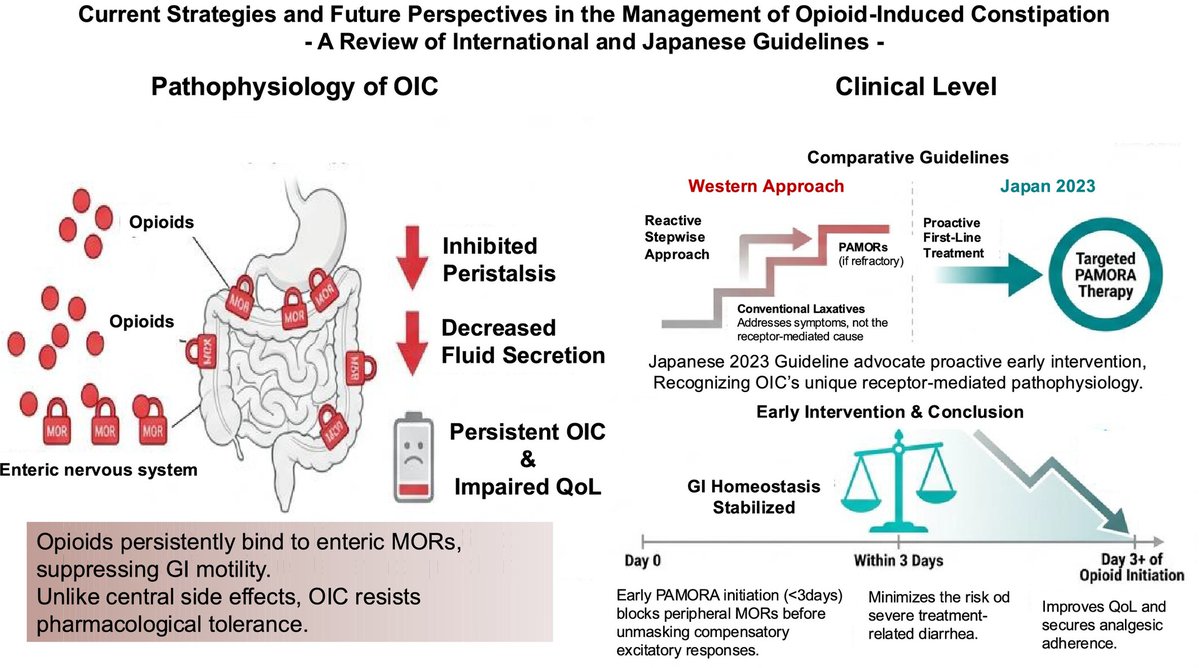
🆕🔥Current Strategies & Future Perspectives in Management of #Opioid-Induced #Constipation: Review of International & Japanese Guidelines‼️
⏬Dive into to learn more about most recent advances #mechanism-based early intervention💡
👉 https://t.co/m95GStpZEt
@ANMSociety@esnm_eu
The gut-brain signaling shapes eating behaviour and obesity
This timely review in @NatRevGastroHep updates what's new and relevant for your clinical practice:
https://t.co/m5QyOpV1Ha
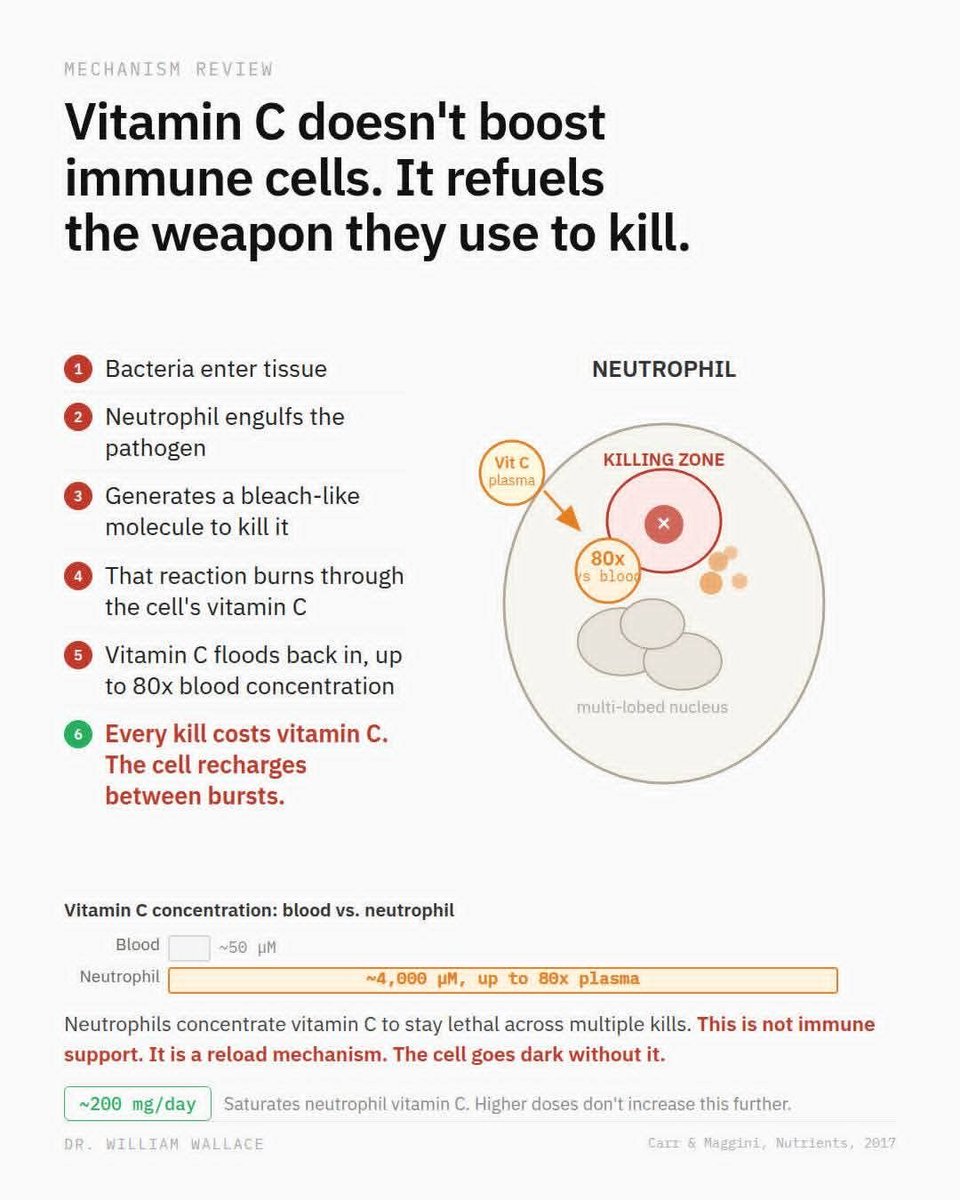
Vitamin C does not boost your immune system. It refuels the cells doing the actual "killing."
When a neutrophil engulfs a bacterium, it generates hypochlorous acid, the same chemistry as bleach, to destroy it. That oxidative burst works, but it burns through the cell's internal vitamin C in the process.
What most people miss: neutrophils actively pump vitamin C in from the bloodstream against the concentration gradient, accumulating it at up to 80 times plasma levels. This is an energy-requiring process. The purpose is to recharge the cell's antioxidant capacity between killing events so it can fire again.
This is why "vitamin C boosts immunity" misses the biology. The effect is not stimulatory, it is regenerative. The cell already has the machinery to kill. Vitamin C keeps that machinery operational across multiple pathogen encounters.
Practically: ~200 mg/day saturates plasma concentration, which corresponds to neutrophil saturation. Higher doses do not further increase intracellular levels in healthy individuals. Most people eating a reasonable diet are covered. Where this matters most is in infection, surgery, or sustained physical stress, contexts where vitamin C status is rapidly depleted and the recharge mechanism is under real demand.
Carr & Maggini, Nutrients, 2017
The modern lifestyle, with diets low in fiber and widespread antibiotic use, is increasing antibiotic resistance genes
Learn more about the impact on all ecosystems via @ASMicrobiology:
https://t.co/Ki1vEY1PJl
What an inspiring talk by @Prof_NickTalley on the causes and management of gastro-duodenal disorders
Current known causes of functional dyspepsia were known as early as 1910 and diet and nutrition touch almost every underlying cause!
#DDW2026@DDWMeeting
Another important presentation given at #DDW2026. From updated definitions and expanded pediatric criteria to key #IBS changes and a more global, biopsychosocial approach, this session broke down the evolution from Rome IV to Rome V and what it means for clinical practice.
CMPA in infants 🍼
eHF + synbiotic:
✅ ~86% improved in 4 weeks
⏱️ Many within 7–10 days
🙂 Parent QoL improved
Give it time before changing course
https://t.co/1kaGDxRKlI
#pediatrics#pedsgi#openaccess
Do infants need high iron formula? 🍼
2 vs 8 mg/L → no difference in:
🧠 Neurodevelopment
🩸 Iron deficiency
📏 Growth
Lower iron performed just as well (low-risk infants)
https://t.co/IYc9LgxNdT
#pediatrics#pedsgi#openaccess
🚨 Los nuevos Criterios de Roma V (2026) actualizan el diagnóstico de trastornos intestino-cerebro (DGBI):
✅ Dolor abdominal + discomfort (no solo dolor)
✅ Umbral más bajo: 3 días al mes (antes 1 día/semana en Roma IV)
✅ 14 nuevos dxs en niños
✅ Enfoque más humano 💯
🚨 Los nuevos Criterios de Roma V (2026) actualizan el diagnóstico de trastornos intestino-cerebro (DGBI):
✅ Dolor abdominal + discomfort (no solo dolor)
✅ Umbral más bajo: 3 días al mes (antes 1 día/semana en Roma IV)
✅ 14 nuevos dxs en niños
✅ Enfoque más humano 💯
🌟Hot off the press! Our newest special issue introduces an enhanced global conceptualization of disorders of gut–brain interaction from the Rome Foundation.
📖Browse the issue here: https://t.co/lNmQChnbyE
#GutBrainAxis#Neurogastroenterology#DGBI
Repetition changes your brain.
Repetition changes your brain.
Repetition changes your brain.
Repetition changes your brain.
Repetition changes your brain.
Repetition changes your brain.
Repetition changes your brain.
That’s why it works.