Single-sided liquidity provision for smarter exits.
Build onchain sell ladders and earn fees on your sells on @RobinhoodApp
CA: 0x87f13345389cb4564890b5f028a855
A sell order that earns while it waits.
Echelon lets you place one token as single-sided liquidity above market — without immediately selling part of it just to balance an LP.
Price climbs → your bands progressively convert into the paired asset.
Liquidity stays active → you earn trading fees along the way.
Then choose how the exit becomes final:
- Manual — the position stays in your wallet and you collect when you want.
- Auto-settle — Echelon records your minimum-proceeds floor at mint. Once a band clears it, anyone can trigger settlement, but the proceeds can only go back to you.
One asset in.
A programmable ladder out.
$ECHELON is live.
CA: 0x87f13345389cb4564890b5f028a85591d20cb326
The bigger idea behind Echelon isn’t just “limit orders onchain.”
It’s turning liquidity itself into an execution layer.
Your buy or sell intention becomes a ladder of active liquidity:
→ waits at your chosen ranges
→ converts progressively
→ can earn fees while active
→ works across multiple venues
→ can be manually or automatically settled
Liquidity that behaves like a strategy.
Echelon doesn’t want protocol security to depend on “trust us.”
The contracts it uses are publicly listed and source-verified.
Builders are designed to do one job: pull the asset, create the positions, refund what isn’t used, then finish holding nothing.
The infrastructure should be as inspectable as the UI is simple.
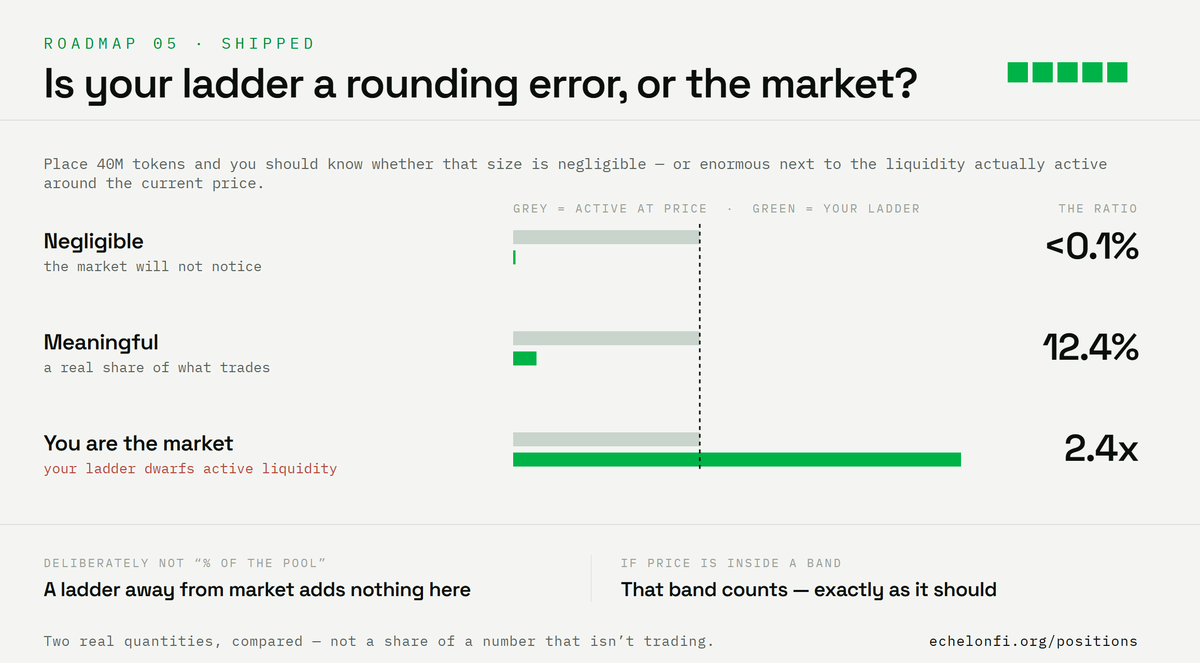
New on Echelon: Size vs. the market.
Place 40M tokens into a ladder and you should know whether that size is negligible — or enormous relative to the liquidity actually active around the current price.
Now every position shows exactly that:
12.4% · 2.4x · <0.1%
This is deliberately not labelled “% of the pool.”
Your ladder may sit entirely away from the current market and contribute nothing to active liquidity there. So Echelon compares two real quantities instead:
your ladder liquidity vs. liquidity active at the current price.
And if price is currently inside one of your bands, that band is included in the comparison — exactly as it should be.
Another roadmap item shipped.
https://t.co/IAgeFQOHAV
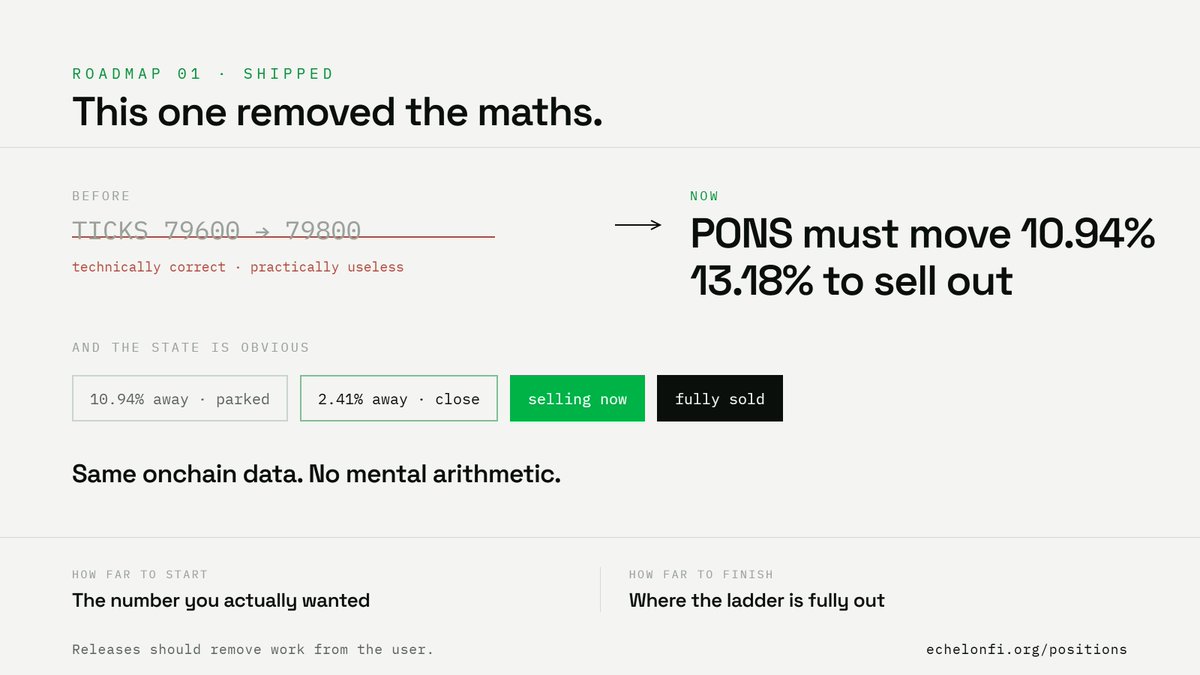
Positions used to tell you:
TICKS 79600 → 79800
Technically correct. Practically useless.
Now Echelon tells you:
10.94% until your ladder starts
13.18% until fully sold
Roadmap releases should remove work from the user.
This one removed the maths.
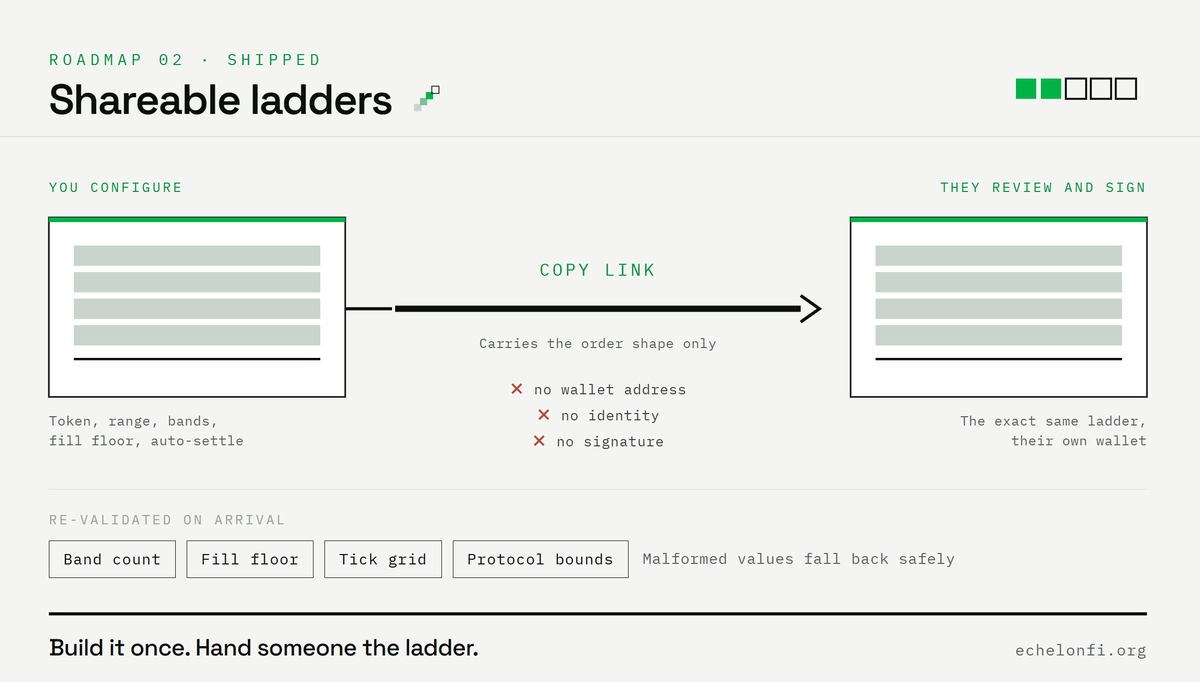
You can now build an Echelon ladder and send it to someone as a link.
Token. Range. Bands. Settlement settings.
They open it and the exact structure is rebuilt on their screen.
No wallet address or signature travels with it.
They review it, connect their own wallet and sign their own transaction.
Strategies become shareable.
Two Echelon users can want the exact same exit and still want different custody.
That’s why there are two modes:
Manual: position NFTs stay in your wallet and you decide when to settle.
Auto-settle: set a floor at placement and allow a sufficiently filled band to be settled without waiting for you to be online.
Same ladder. Different control model.
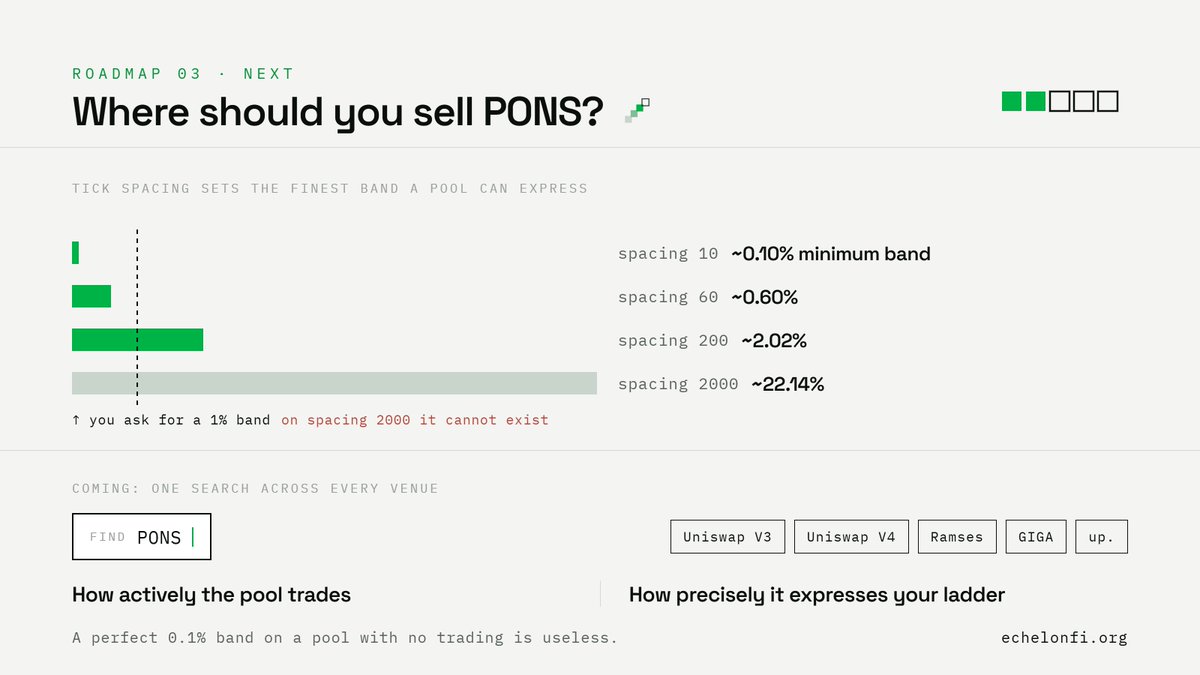
A 1% ladder band is not automatically a 1% band.
Every liquidity pool has its own tick grid. If that grid is too coarse, your requested range has to widen.
$ECHEON now tells you this before you choose the pool.
Execution precision should be visible before execution.
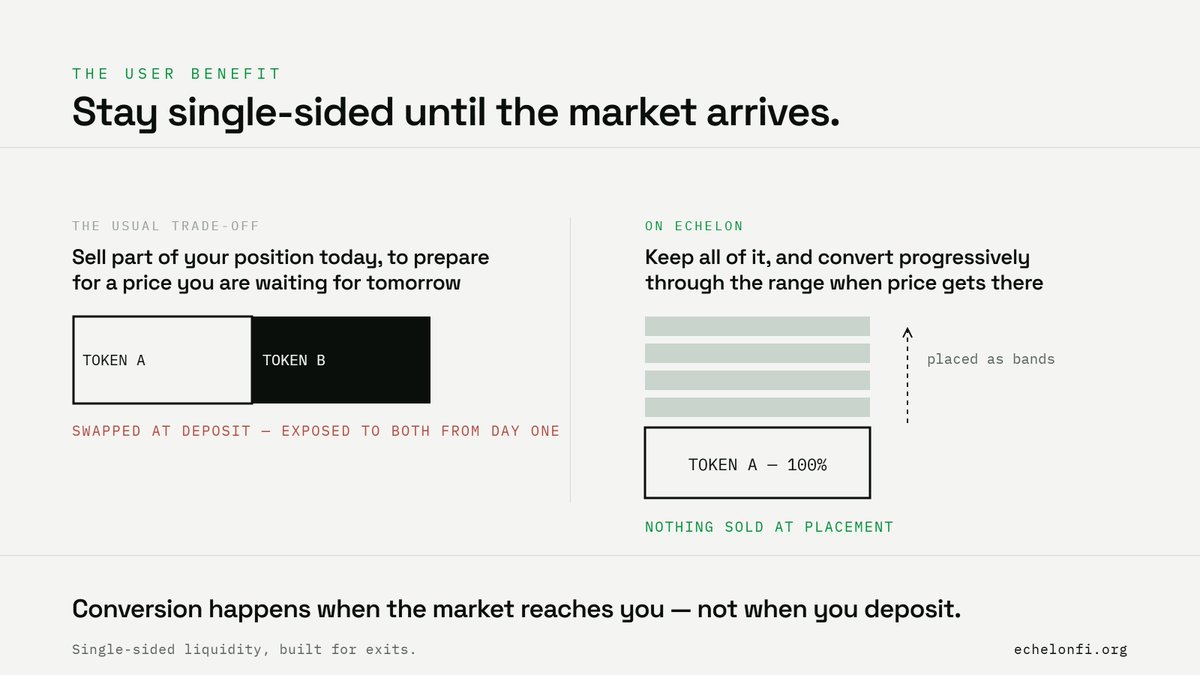
The user benefit of single-sided liquidity is simple:
You don’t have to sell part of your position today just to prepare for a price you’re waiting for tomorrow.
$ECHELON keeps you single-sided until the market reaches your bands.
Then conversion happens progressively through the range.
One of the biggest Echelon roadmap upgrades is already live:
one search across every integrated venue.
Search a token once and compare the pools available for your ladder — including trading activity and the precision each pool’s grid can support.
Less hunting. Better decisions before you sign.
Echelon is useful in both directions.
Want out?
Build a sell ladder above market.
Want in?
Build a buy ladder below market.
No upfront rebalance. Your asset only starts converting when price reaches the ranges you chose.
One liquidity primitive. Two sides of the market.
New on Echelon:
Know whether a pool can actually express your ladder before you pick it.
“Sell at +1%” is not something every pool can do.
Liquidity bands snap to the grid defined by each pool. On some pools, a 1% band stays 1%. On others, that same request may widen to 2.02%.
Echelon now asks for your band width up front and shows the answer directly in pool search:
→ holds 1.00%
→ 1.00% → 2.02%
→ 1.000% → 1.005%
Coarser pools stay visible because they can still build the ladder — they just widen it.
And finer isn’t automatically better. A perfectly precise band in a pool with no trading activity still won’t fill.
Now you can see the trade-off before choosing the pool.
https://t.co/MdxfCkN7FS
Most sell orders just wait.
On Echelon, your sell ladder is liquidity.
Place one token above market, let it progressively convert as price moves through your bands, and earn trading fees while those bands are active.
Your exit can work while it waits powered by $ECHELON
For users, the new cross-venue search removes guesswork.
Search a token once and Echelon shows where you can build the ladder, how active each pool is, and how precise its grid can be.
That means you can compare execution quality before committing:
→ tighter bands where the pool allows it
→ better visibility on real trading activity
→ easier comparison across venues
→ fewer dead-end ladder configurations
Whether you’re buying below market or selling above it, the goal is simple:
find the right pool before you place the ladder.
One search across every Echelon venue is now live.
Searching EchelonFi now shows every supported pool that trades it across Uniswap V3, Ramses, GIGA and up.
Each result tells you the things that actually matter before placing a ladder:
→ venue
→ trading activity
→ tick spacing
→ the finest buy/sell band that pool can express
So whether you’re laddering out above market or in below it, you no longer need four searches and a comparison in your head.
One token. Every venue. One place to decide where the ladder goes.
https://t.co/XGG6W32c5K
Where should you buy or sell $PONS?
Right now, answering that on Echelon means searching four venues separately — Uniswap V3, Ramses, GIGA and up. — then comparing the pools yourself.
That matters because pools don’t just differ by fees.
Next on the roadmap: one search across every Echelon venue.
Type $PONS → see every pool that trades it, its venue, actual trading activity, and the finest band its grid can express.
So whether you’re laddering out above market or in below it, Echelon will help answer the same question first:
where should this ladder actually go?
Where should you buy or sell $PONS?
Right now, answering that on Echelon means searching four venues separately — Uniswap V3, Ramses, GIGA and up. — then comparing the pools yourself.
That matters because pools don’t just differ by fees.
Next on the roadmap: one search across every Echelon venue.
Type $PONS → see every pool that trades it, its venue, actual trading activity, and the finest band its grid can express.
So whether you’re laddering out above market or in below it, Echelon will help answer the same question first:
where should this ladder actually go?
New on Echelon: shareable ladders.
Configure a sell ladder — token, range, bands, fill floor, auto-settle — then hit Copy link.
Send it to anyone and Echelon rebuilds the exact ladder on their screen, ready for them to review and sign with their own wallet.
The link carries only the order shape:
no wallet address, no identity, no signature.
Every shared value is re-validated on arrival against the same protocol bounds, including band count, fill floor and the pool’s own tick grid.
Malformed values fall back safely instead of quietly loading something unintended.
Build it once. Hand someone the ladder.
Turn your buy or sell strategy into a social activity.
Only at $ECHELON
The last few Echelon releases all point in the same direction.
More venues.
Clearer position states.
Publicly verified contracts.
Less abstraction between what the UI says and what is actually happening onchain.
Our goal is to make liquidity ladders understandable enough to use, transparent enough to verify, and portable enough to run across every major venue.
$ECHELON is building the execution layer around that.