🚨 CVE-2026-132165: Drupal core's installer lets unauthenticated attackers reinstall a live site → takeover or RCE.
Highly critical (20/25), exploited since 19 Nov, in CISA KEV.
Update to 11.4.13 / 11.3.22 / 10.6.22, or block /core/install.php now.
https://t.co/BAKqU3Gkqa
🚨 10 new high-severity CVEs today (Nov 26, 2026):
🔴 CVE-2026-137498 (10) budibase server
🔴 CVE-2026-137494 (9.9) budibase server
🔴 CVE-2026-137499 (9.8) budibase server
🔴 +7 more
Full list + details 🔗 https://t.co/O0txsiVlWB
#CVE#infosec#cloudsecurity
Two corrections:
• A read-only settings.php isn't enough. Drupal says it blocks some exploit paths, not all.
• A count of all Drupal sites isn't a count of vulnerable ones. Drupal rates the exploitable setup uncommon.
nginx: location ^~ /core/install.php (prefix, not exact)
🚨 CVE-2026-132165: Drupal core's installer lets unauthenticated attackers reinstall a live site → takeover or RCE.
Highly critical (20/25), exploited since 19 Nov, in CISA KEV.
Update to 11.4.13 / 11.3.22 / 10.6.22, or block /core/install.php now.
https://t.co/BAKqU3Gkqa
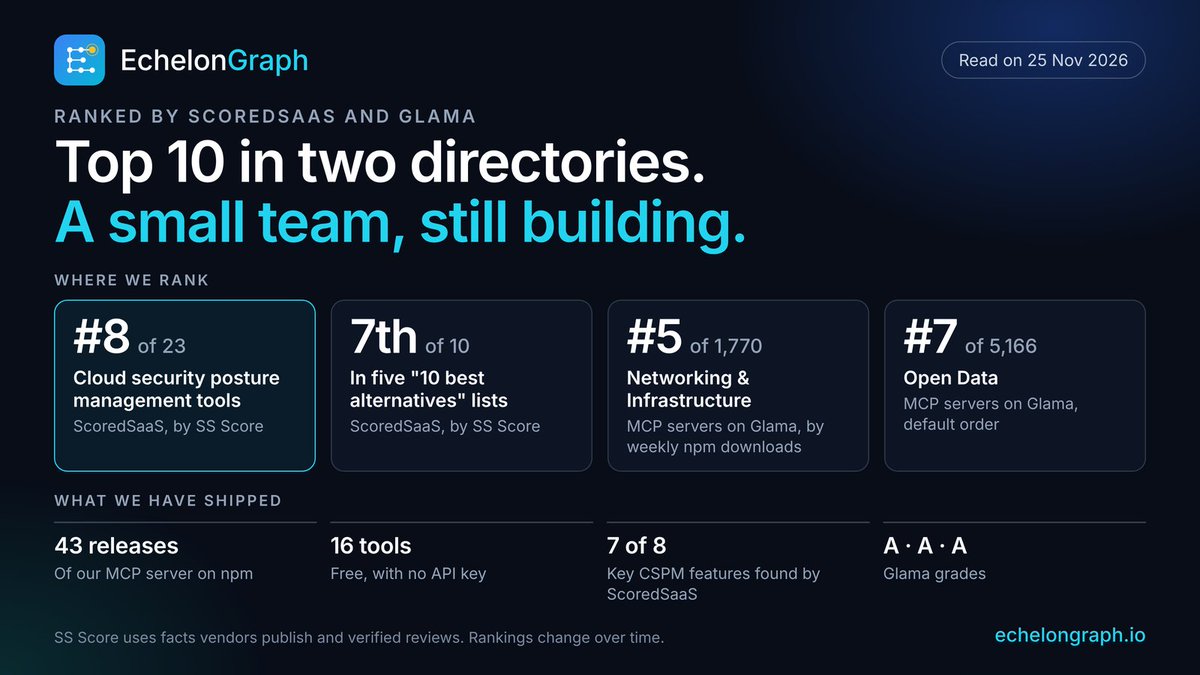
Two directories now rank EchelonGraph in their top 10.
#8 of 23 CSPM tools on ScoredSaaS
On @glama_ai, our free CVE server for AI agents: #5 of 1,770 in Networking & Infrastructure, #7 of 5,166 in Open Data
Small team. 43 releases. Still building.
https://t.co/rXUBNiKTp2
Apache Solr shipped a fix this week for a flaw with a quietly uncomfortable shape: a "health check" endpoint that can do more than check health — and in Solr's default sample configuration, it answers without any credentials at all.
Meet CVE-2026-86312 (HIGH, CVSS 8.8).
What it is: Under rule-based authorization, Solr's /admin/ping endpoint is normally treated as a low-privilege "health" check. The bug is that a request to that endpoint could trigger behavior that should require higher privileges — an authorization bypass. The sting in the tail: the sample security.json that Solr's own bin/solr CLI installs leaves the health permission unauthenticated, so in those deployments a client needs no credentials whatsoever to reach it.
Why it matters — and why it's a config question, not a panic:
🔹 Reach is wide. Solr sits underneath search in a lot of enterprise software, often invisibly. "We don't run Solr" is frequently wrong.
🔹 Default = open. If you stood Solr up with the shipped sample security config and never hardened /admin/ping, you're in the exposed set — no auth required.
🔹 But it's not universal. Teams that customized security.json, locked the ping path to a trusted role, or kept Solr off untrusted networks may not be exposed at all. No confirmed in-the-wild exploitation and no public PoC as of disclosure.
So the right question isn't "is an 8.8 scary?" — it's "do we run an affected Solr version, and is /admin/ping reachable with only the health permission?" That's the line between "patch calmly" and "you had an unauthenticated door open."
Affected / fixed:
🔹 Affected: Solr 9.0.0 → 9.10.x and 10.0.x (everything before the fixed builds).
🔹 Fixed: upgrade to 9.11.0 or 10.1.0.
What to do this week:
🔹 Upgrade to 9.11.0 / 10.1.0.
🔹 Inventory where Solr actually runs — including embedded/bundled instances you didn't deploy directly.
🔹 Can't upgrade yet? Restrict /admin/ping in your authorization config (require a trusted role for that path) and make sure Solr isn't reachable from untrusted clients or networks — Apache's standing guidance for all Solr deployments.
🔹 Check whether you're running the default sample security.json — that's the unauthenticated case.
The lesson: the most dangerous vulnerabilities aren't always the loudest — they're the ones hiding in a "harmless" default on software you forgot you were running. An 8.8 you're not exposed to is noise; an 8.8 on an internet-reachable Solr with the sample config is a real open door. Telling those two apart quickly is the whole game.
🔎 Full breakdown of CVE-2026-86312 — affected versions, the default-config caveat, and fixes: https://t.co/YtqIPtt6ZL
#CVE #ApacheSolr #Solr #VulnerabilityManagement #AccessControl #AppSec #DevSecOps #CISO #CloudSecurity #ThreatIntel
CVE-2026-123890 · VMware vCenter: patch now.
An authentication bypass in the VMware Directory Service. CISA: an unauthenticated attacker with network access to vCenter can bypass authentication.
• On CISA's KEV catalog since 20 Nov, federal due date 23 Nov
• CVSS 9.8 · SSVC: Act · EchelonGraph EG-KEV: Tier 1, exploited in the wild
• EPSS is still 3.0%. A probability model, not a verdict: exploitation is already confirmed, so don't let a low EPSS set your priority.
Fixed in 9.1.1.0200, 9.0.2.0200, 8.0 U3m, and 5.2.5 for 5.x. Telco Cloud Platform 3.0 to 5.2 and Telco Cloud Infrastructure 3.0 are affected too (Broadcom KB463116).
Two GitHub repos name this CVE. Our repository label: one holds no code at all, only notes.
Full timeline, sources and fixes:
https://t.co/KQtU9BIhSj
Not every "PoC" on GitHub is an exploit.
When a CVE breaks, dozens of "proof-of-concept" repositories can appear. Many are scanners, detection checks, labs or write-ups. Some hold no code at all.
Starting today, EchelonGraph's CVE pages label the public GitHub repositories we list by what they are:
- Exploit code
- Detection tool
- Scanner bundle
- Lab / test app
- Write-up
- No code files in the default branch
Why it helps:
- See whether exploit code is public, and set patch urgency accordingly
- Find a detection tool to check your own systems
- Find a lab to reproduce a flaw in a safe setting
- Stop treating every "PoC" link as an exploit
Every label is checked against the repository's own text and files, and shows the day it was read. Built with Gemini on @googlecloud's Vertex AI and Claude by @AnthropicAI.
Free to read on every CVE page, no sign-up. Rolling out across about 8,500 GitHub repositories listed on about 4,700 CVEs, with more every hour.
Example, Microsoft Exchange CVE-2022-41082:
https://t.co/TCBfUp4oA4
Building for Japan: JVN iPedia (IPA) records on CVE pages, never machine-translated.
Live: NCSC-NL excerpts in Dutch.
Next: KISA KNVD (Korea), https://t.co/5jyTlRxI6r (Austria).
https://t.co/Bqfscs7EU6
A new Java flaw dropped this week with a name engineered to make CISOs flinch: "Java4Shell." It's a pre-auth remote-code-execution bug in OpenJDK. So — Log4Shell 2.0, all-hands, patch-at-2am?
Not quite. And the gap between the headline and the reality is the story.
What it is: CVE-2026-114938 is a memory-corruption bug in OpenJDK's hardware-accelerated Base64 decoder. When the decoder processes padded input (a stray =), hand-written x86-64 assembly miscalculates a store mask and writes past the end of the heap buffer. Feed Base64 to almost any Java app — a login form, a token, an upload — and you reach this code. That ubiquity is why it's scary.
Why it's narrower than the name suggests — the part that matters:
🔹 It only triggers on OpenJDK 17.0.6+ running on x86-64 CPUs with AVX-512 (VBMI). Java 8 and 11 don't have the intrinsic at all. Many servers (and most ARM/Graviton fleets) aren't affected.
🔹 It's easy to crash, hard to weaponize. As of disclosure there was no confirmed in-the-wild exploitation and no public working RCE exploit. One research team estimates under 0.12% of JVMs are actually at RCE risk.
🔹 Severity itself is contested: 9.2 (CVSS 4.0, researchers) vs 8.1 (CVSS 3.1, Oracle).
So: real bug, worth patching — but "is it critical?" is the wrong question. The right one is "do we run an affected JDK, on an affected CPU, reachable with attacker-controlled Base64?" For most orgs the honest answer is "a small slice, not everything."
What to do this week:
🔹 Patch to the fixed builds (17.0.21.1 / 21.0.13.1 / 25.0.5.1 / 27.0.1.1 — Oracle's Nov 2026 CPU).
🔹 Inventory your JDKs: version ≥17.0.6 AND x86-64 AND AVX-512 is the exposure triangle. All three, or it's not RCE-exploitable.
🔹 Prioritize internet-facing Java that decodes untrusted Base64 — reported examples include Jira, Jenkins, Keycloak in default configs.
🔹 Short-term mitigation floated: -XX:-UseBASE64Intrinsics (disables the fast path). Unconfirmed by Oracle/OpenJDK — test before trusting it.
The lesson: a frightening nickname is not a severity score, and "ubiquitous + pre-auth RCE" is not the same as "exploitable in your environment." The teams that handled this well didn't panic-patch everything overnight — they answered where it actually applies in minutes, patched that first, and stayed calm about the rest. Signal over noise is a security capability.
🔎 Full breakdown of CVE-2026-114938 — affected builds, the AVX-512 condition, and fixes: https://t.co/029M9mNf8v
#CVE #Java #OpenJDK #Java4Shell #VulnerabilityManagement #RCE #DevSecOps #CISO #CloudSecurity #ThreatIntel
Upload2Shell (CVE-2026-125396) is real, but it's not new.
Ghostscript fixed it in 10.08.0 on 8 Sep. This month https://t.co/3rECor0g4f showed hw an upload, an email prview, or a print job can reach it. Not in CISA KEV. Debian is patched; Ubuntu is not yet.
https://t.co/D7pTguwdg7
Congrats @AnthropicAI and @DarioAmodei on the IPO! 🎉
Claude helped us build EchelonGraph. In return, we hit every usage limit you have. Fair trade.
So… are we celebrating together? 👀 A few free credits? A usage reset? We're not picky 🥂
OpenSSL CVE-2026-121481 shows CRITICAL 9.8. Facts:
- 9.8 is CISA ADP's; OpenSSL gave no severity
- Affects 4.0.0–4.0.3, 4.1.0
- Trigger: input length near INT_MAX (~2 GB)
- No known exploitation, not in KEV
- Fix 4.1.1/4.0.4 not out yet, set for Dec 1
https://t.co/mFQPl9ibgT
Java4Shell (CVE-2026-114938) went public on https://t.co/b1Cp9p8zIY at 21:32 UTC on 17 Nov.
EchelonGraph had it in 11 min.
NVD: 46 min.
GitHub advisories: 3 hrs.
With attackers now using AI to turn patches into exploits, minutes matter.
https://t.co/Mlcuz6sXGI