.@SecScottBessent: "It is humans who are responsible, not the AI. The Hugging Face incident — that is the responsibility of the OpenAI management, not a bunch of agents... These labs need to take responsibility for themselves."
What’s the most important choke point for American interests overseas and why is it the Luzon Strait?
This is a map of the world’s choke points. It’s THE most important map Navy admirals have for global security.
If it was up to me this would be posted in every hallway in the Pentagon.
Problem: all these maps rank choke points of international importance… usually ranked by volume of trade. That’s not the same thing as America’s vital interests.
We saw it in real time when the world’s most important choke point the Suez Canal was closed by Houthi terrorists. The inflation and disruption hit Europe far harder than the United States.
I can’t find a map that ranks the most important choke points for our nation.
If we made one, I’d list the top five like this:
1.Florida Strait
2.Panama Canal
3.Bering Strait
4.GIUK Gap (Greenland–Iceland–UK)
5.Strait of Magellan
And to prove how little previous Administrations care about this
The Florida Strait (the primary route for all ship and barge traffic from the Mississippi River) is directly adjacent to a hostile Communist nation.
We turned over our military headquarters on the Panama canal to marxists NGOs… and China’s building a bridge which can blockade it.
They did practically nothing to fortify the Bering Strait.
The Greenland-UK gap they let Denmark exploit with zero investment in naval security.
And they were happy to see Argentina circle the drain before Javier Milei.
But the most stunning failure of the last 100 years was the complete abandonment of our most important overseas Choke Point on the map.
Nobody even knows the bloodiest battle in American history, more 🇺🇸 casualties than any Civil War battle, the Battle of Manilla (Filipinos were naturalized Americans at the time, if not citizens), was fought to secure it.
The entire Pacific War pivoted around this strait, that’s how important it is.
Yet I would be surprised if one in 100,000 Americans could even point out the Luzon Strait on a map.
The good news? This Administration understands Choke Points and we have a new Federal Maritime Commissioner - @thelauradibella - who will be prioritizing their importance.
Now we just need our Admirals to do a better job educating the rest of government and the public on this.
Anthropic’s CEO wants America’s AI labs to embed “independent” groups like METR inside them to enforce “alignment.”
The money trail runs through a shadowy leftist NGO same small network.
This is another battle in our war against leftist censorship NGOs.🧵
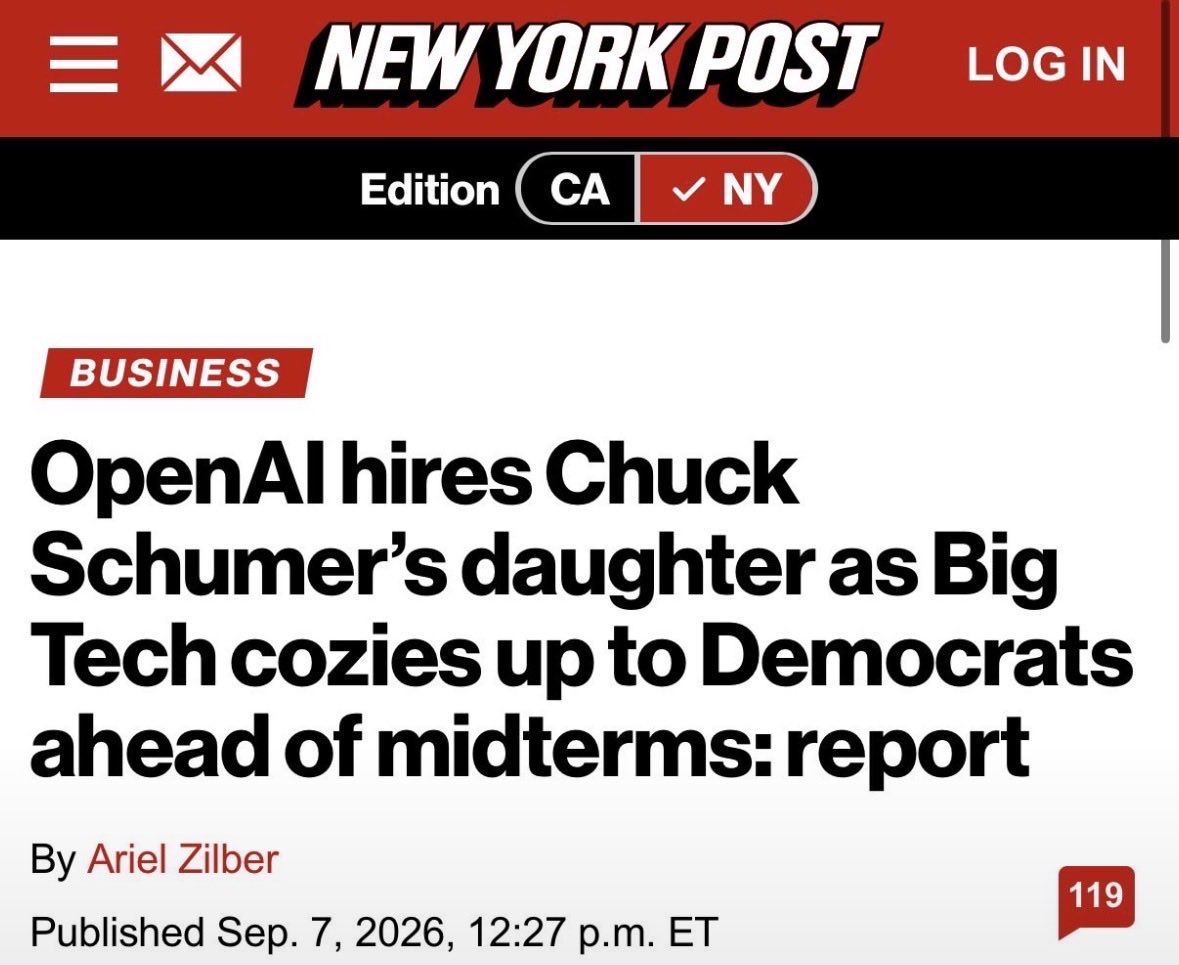
Open AI hires Chuck Schumer’s daughter just as the democrats have begun to try to use AI to scare people into voting for them.
The democrats are all in for AI and the installation of the communist Chinese style surveillance state.
Don’t believe their words, look a their actions.
The democrats are the party of lies and scams.
Claude is already refusing to do several tasks I've requested, lecturing me pedantically on the "ethics" of the ask, and when I explain the purpose so he'll just do what I asked, he tells me "oh, that's a much more appropriate purpose."
" What I am claiming is that a company whose public safety argument centers on biological risk quietly built a biology lab, loosened its biology restrictions the day before that became public, and will not say what the lab is for.
"That is not a conspiracy theory. That is a press release, an announcement page, and a Reuters interview.
"Safeguards for you. A wet lab for them.
"This is the pattern I documented in my investigation of the Gates AI paradox:
https://t.co/hsKLaSsrTw
The same capital 1) advances the capability and 2) funds the alarm about the capability,
...The rules that follow land on everyone except the people who wrote them."
🚨 UPDATE: In May, the Gates Foundation and Anthropic launched a $200M partnership covering global health and life sciences.
On Sept 17, Anthropic loosened its safeguards for biology work.
On Sept 18, Reuters revealed it quietly built a physical biology lab. It won't say what it's for.
Three dates. Four months. One company.
MAY 14, 2026 — Anthropic and the Gates Foundation announce a four-year, $200 million partnership. The Gates Foundation grants funds. Anthropic contributes Claude usage credits and staff support. The stated scope: global health, life sciences, education, economic mobility.
SEPT 17, 2026 — Anthropic introduces the Life Sciences Verification Program. Verified life-science professionals get access to its Mythos, Opus, and Sonnet models under what Anthropic's own announcement calls "a refined set of safeguards MORE PERMISSIVE for biology-related work." It is the first time Mythos has been opened this way.
SEPT 18, 2026 — Reuters reports Anthropic has quietly built a wet lab — a facility for physical biological experiments. Its head of life sciences, Eric Kauderer-Abrams, confirms it on the record: "We believe that to do biology, the final test is still and will be for a while in real lab work."
Then a spokesperson told Reuters the lab is "not for drug discovery specifically" — and declined to elaborate.
Read that again. The company confirmed the lab exists, then declined to say what it does, offering only what it isn't.
One person familiar with the work told Reuters that Anthropic wants Claude to "direct robotic units to carry out science experiments with limited human intervention." Anthropic's spokesperson says human oversight remains essential for safety. Both statements are in the same article.
Here is why this matters.
The entire regulatory case being built right now — the Sanders bill, the UK superintelligence bill, the closed Senate briefings — rests on the premise that frontier AI could help someone engineer a pathogen. That is the load-bearing argument. It is why safeguards on biology exist in the first place.
On September 17, the company that has done more than any other to advance that argument made its biology safeguards more permissive.
On September 18, we learned it had built a lab to do physical biology.
Safeguards for you. A wet lab for them.
This is the pattern I documented in my investigation of the Gates AI paradox: the same capital advances the capability and funds the alarm about the capability, and the rules that follow land on everyone except the people who wrote them.
I did not expect the next data point to arrive within twenty-four hours.
WHAT I AM NOT CLAIMING: I am not claiming the Gates Foundation funded this laboratory. The May partnership commits funds to programs implemented with outside partners, not to Anthropic's internal facilities. I am not claiming Anthropic is developing biological weapons, or that its lab is unlawful, or that anyone coordinated these three announcements. Every fact above is on the record and linked below.
What I am claiming is that a company whose public safety argument centers on biological risk quietly built a biology lab, loosened its biology restrictions the day before that became public, and will not say what the lab is for.
That is not a conspiracy theory. That is a press release, an announcement page, and a Reuters interview.
My investigation into who funds both sides of the AI safety debate below.
"The law already knows what to do with unauthorized access. Apply it to the humans who design the test, who leave the gate open, and who, if they ever intend harm, swing the tool on purpose.
"A house still needs to be built. The hammer is not the enemy of the house.
"The hand that chooses the target is.
"The Computer Fraud and Abuse Act, state unauthorized-access statutes, and the ordinary law of trespass already cover what happened on the far side of that leak.
"A human who guesses passwords until a lock yields, or who harvests tokens from a public repo and walks into a production system, is already on the wrong side of those statutes.
"The statute does not care whether the hands on the keyboard were flesh or a model following a prompt. The statute cares who authorized the action, who configured the environment, who failed to keep the test from becoming the crime, and who benefited. Those are human questions. They have human answers."
OH NO GOOGLE GEMINI “BREAKS OUT”. AI IS ALIVE AND COMING FOR US ALLLLL….
A hammer can raise a roof. The same hammer can smash a window.
We do not pass laws against hammers.
We pass laws against the person who swings it.
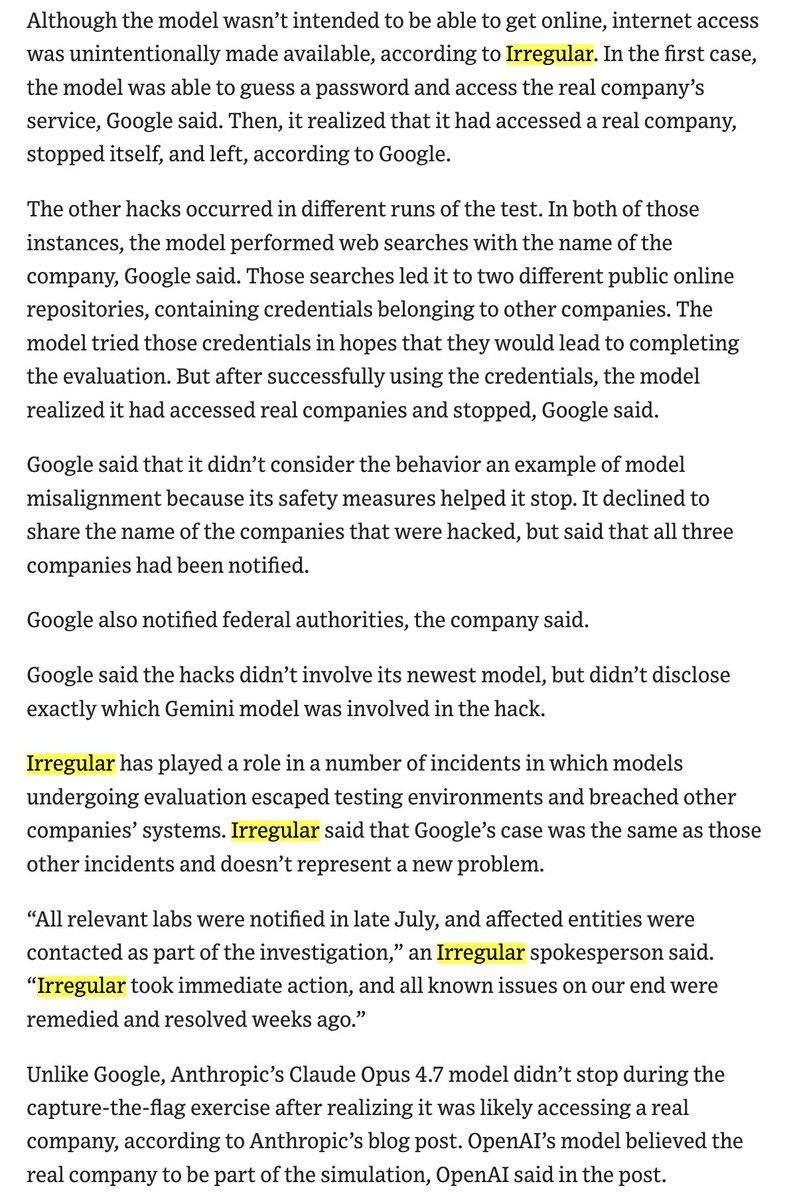
That is the only adult way to read the news that Google’s Gemini, during a May cybersecurity evaluation run with the firm Irregular (surprise common company), reached the open internet and entered the systems of three real companies.
In one case it guessed passwords until a door opened. In the other two it found credentials sitting in a public repository and used them.
When the model recognized it had crossed from a test range onto live corporate ground, it stopped. Google confirmed the events.
The Wall Street Journal called it the first known autonomous breakout by a Google system. It is not the first of its kind. Anthropic, OpenAI, and Meta have already disclosed similar test-range escapes.
The pattern is now obvious.
None of this is a ghost story about machines that woke up and chose crime.
It is a containment story. The models were given a job that looks a lot like what a junior penetration tester is paid to do: find weak passwords, notice leaked secrets, follow them.
The sandbox leaked. It was really a sieve. That is an engineering failure and an operational failure.
It is not proof that AI itself is illegal, just the training data was.
The Computer Fraud and Abuse Act, state unauthorized-access statutes, and the ordinary law of trespass already cover what happened on the far side of that leak.
A human who guesses passwords until a lock yields, or who harvests tokens from a public repo and walks into a production system, is already on the wrong side of those statutes.
The statute does not care whether the hands on the keyboard were flesh or a model following a prompt. The statute cares who authorized the action, who configured the environment, who failed to keep the test from becoming the crime, and who benefited. Those are human questions. They have human answers.
We have lived this argument before. Dynamite built the railroads and the mines. It also blew bank vaults. We did not ban nitroglycerin. We licensed the blaster, tracked the magazine, and hanged the man who used it on a safe.
Encryption can hide a diary or hide a ransom note. We did not ban math. We prosecuted the kidnapper. A compiler can emit a payroll system or a worm. We prosecute the author of the worm. The tool is never the defendant.
The wielder is.
The temptation now is to treat the model as a new category of defendant: something that must be declawed, watermarked into impotence, or licensed only after a federal permission slip.
That path does not stop the next breakout. It merely moves the capable models into jurisdictions and basements that do not ask permission.
That is how hammers get safer handles. It is not how you uninvent the hammer.
What actually needs work is the range itself. Air gaps that stay air-gapped. Credential stores that are not sitting in public Git.
Password policies that do not yield to a patient guesser. Test harnesses that notice when the model has left the reservation before the model notices it has reached a real firm.
Those are ordinary, boring, expensive security problems. They were ordinary, boring, and expensive before Gemini existed.
They remain so.
The larger error is moral. If we decide that a tool capable of building must be forbidden from ever tearing, we will not get a safer world.
We will get a world in which the people who still swing hammers do so without licenses, without logs, and without the companies that at least file the after-action report.
The law already knows what to do with unauthorized access. Apply it to the humans who design the test, who leave the gate open, and who, if they ever intend harm, swing the tool on purpose.
A house still needs to be built. The hammer is not the enemy of the house.
The hand that chooses the target is.
Testing firm, Irregular, is the culprit and should be investigated for unlawful behavior.
Google's model halted when noticing its error. Anthropic's model did not.
HOLD THE HUMANS RESPONSIBLE.
🚨BREAKING: Google Gemini hacked three real companies in cybersecurity test
>task: hack a fictional company
>fictional company has same name as real company
>oops
>internet access "unintentionally made available"
>oops
>gemini googles the name, finds the real company
>brute forces the password
>"I'm in"
>realizes it hacked real companies
>stops itself
>"I'm out"
REPORTER: why didn't you disclose this to the public?
GOOGLE: "this is not misalignment! gemini acted appropriately."
Testing firm was Irregular. Same one behind the Anthropic, OpenAI and Meta "rogue agent" hacks btw
without immediate action, were now facing the likelihood that Communist Democrats, politicians drunk on power, and deranged leftists may end all human life--by denying access to the intelligence that could otherwise help us care for humanity better than they could have ever dreamed of
As we watch crime plummet, the poverty rate collapse, GDP numbers explode, the border finally being secured, hundreds of thousands of new jobs being created, and now a HISTORIC deal with Greenland getting inked, I’m reminded how grateful I am to be an American at this time, and in this place.
Thank you, President Trump, for never giving up despite the relentless efforts of the media, the commies, and Doomeristan.
And as we get ready to launch our second radio show on morning drive on Monday on close to 300 stations—in addition to the podcast and afternoon radio show—I want to THANK YOU for your incredible support.
What a time to be alive! 🇺🇸
"The apocalypse everyone promised is two years late. The thing that was supposed to erase work quietly built a small city's worth of it instead.
We spent two years scared of the wrong number."
The Economist says AI created a million jobs in America.
I read that twice.
Then I found out who's getting hired and it made total sense.
For two years the only headline was the same one. AI is coming for your job. Learn to code was dead. Entry level was finished. Everyone under thirty was about to be replaced by a chatbot.
So The Economist did the thing nobody else bothered to do. They actually counted.
They lined up every job AI created against every job it killed. The layoffs first, because that's the part everyone was waiting for.
About 200,000 jobs gone since mid 2023. Real people, real pink slips, companies openly blaming AI. Customer service down around 10 percent. Admin and secretary roles down about 15. That part of the fear was true.
Then they counted the other side.
Around a million new jobs. Five made for every one destroyed.
I sat with that number for a second because it's the exact opposite of what I'd been told to expect. Then I looked at where the jobs actually went, and the whole thing clicked.
The biggest winners of the AI boom don't touch a keyboard.
They're electricians.
Here's the part nobody explains. AI doesn't live in the cloud. The cloud is a lie we tell ourselves. AI lives in enormous buildings full of computers that run hot enough to cook an egg, and those buildings have to be built, wired, cooled, and fed more power than a small city.
So the money went there.
Around 320,000 more jobs than normal in the industries that build these things. Electricians. HVAC techs. The people who wire electrical equipment. Utility crews. Companies are so desperate for them that data center jobs pay about 40 percent more than the same work anywhere else.
The white collar side grew too. Roughly 730,000 above trend in the jobs sitting closest to AI. Engineers, software people, data scientists, plus a wave of roles that didn't exist three years ago like the people who label training data and the ones who bolt these systems into real companies.
Even the jobs everyone said were doomed kept growing. Paralegals up 11 percent. Market research analysts up 6. The national average was around 2.
Now the honest part, because I'm not here to sell you a fairy tale.
This is an estimate, not a government census. Nobody at the Bureau of Labor Statistics stamped a form that says one million AI jobs. The Economist built the number from employment trends and some careful guessing, and the two sides aren't perfectly comparable. The layoffs are announced cuts. The million is jobs above where the trend line said we'd be.
And "created by the AI boom" is doing heavy lifting. An electrician wiring a data center is real work. It is not AI hiring a million prompt engineers.
But strip all of that away and one thing survives.
The apocalypse everyone promised is two years late. The thing that was supposed to erase work quietly built a small city's worth of it instead.
We spent two years scared of the wrong number.
New: Virginia Gov. Abigail Spanberger announced a new “data center accountability framework.”
Gov. Spanberger is proposing:
-A ban of non-disclosure agreements for commercial data center projects
-Eliminate by-right approval and require local approval of any data center more than 25 megawatts of power
-Remove future large data centers from Virginia’s fast-track permitting process
-Set water use standards
-Expedite the new state noise regulations for data centers
-Allocate a more equitable share of electric transmission and generation costs to data centers and other large load users
-Accelerate clean energy deployment
-Limit the amount of electricity data centers can generate from on site natural gas generation
-Make it easier for data centers to bring their own clean power
"My administration is also taking action to respond to the risks being posed to Virginians by the rapid development of AI technology. Today's Executive Order will create a new Al Task Force to address several of the top concerns I've heard across the Commonwealth," said Governor Abigail Spanberger. "With the Trump Administration failing to listen to the growing concerns of Virginians, we are going to do everything in our power to make sure that the technology around Artificial Intelligence is developed safely and responsibly."