$SNDK $MU $SKHY Kioxia Samsung Electronics
There are several posts on 20% spot NAND price fall referring BofA. Again, this shows why BofA prime business is tiers below GS or MS. I don't know whether they are evils or imbeciles or mixture of both.
A. Enterprise NAND has higher density & more layers. You cannot buy 512Gb spot wafers from Shenzhen and produce 64Tb enterprise SSD. In other words, spot NAND and enterprise NAND are not fungible.
B. Enterprise SSD requires 6 to 12 months of rigorous validation on firmwares & controllers and reliability qualification. It has different wafer binning process to guarantee lower raw bit error rates, tighter threshold voltage distribution, higher program/erase cycle tolerance under extended burn-in testing.
C. Enterprise SSD has DRAM attached to it for fast serialisation/deserialisation, fast look up, and caching. You don't need these high performance gear for 1Tb PC SSDs.
Enterprise SSD contract prices are still rising even if the trend is not as sharp as earlier this year, according to TrendForce and quotes from the earnings calls. Also, as in HBM & DRAM, take-or-pay LTAs are growing in eSSD market.
At the end of the day, China is 20%-30% of global compute demand
If the supply of compute increases by 20%-30% rn, it will push down GPU rental prices, which will make GPU financing even harder
Jensen is also scared of customer concentration risk and the fact that his biggest buyers are developing ASICs to sidestep him
Summary of : NAND Pricing Breakout Driven by eSSD
☕️ According to TrendForce, the leading third‑party memory research firm, NAND demand is tracking materially stronger than expected.
📈NAND demand tracking much stronger than expected — driven by eSSD as U.S. CSPs aggressively scale AI infrastructure
• WE RAISING NAND blended price outlook meaningfully: 3Q26 / 4Q26 / 1Q27 QoQ: +21% / +17% / +15% (vs prior +18% / +2% / 0%)
• Inventory at U.S. hyperscalers expected to fall further by 4Q26 (from ~14 weeks in July vs ~15-week normal)
• Supply remains disciplined: bit growth +15% / +21% / +20% YoY in 2025/26/27
• eSSD demand from U.S. hyperscalers has nearly doubled vs prior projections → demand growth outpacing supply near quarters
• enterprise (especially AI-related eSSD) px/demand far outpacing consumer
• AI is reshaping the memory hierarchy → new stack: DRAM → SCM → TLC/QLC NAND → HDD
• Still bullish DRAM/HBM (SK Hynix, MU) and Now also constructive on NAND names (Samsung, SK Hynix, MU, SanDisk, Phison, etc)
#Trendforce
#Memory #DRAM #NAND #MU #SKHY #SNDK
@business article also says Lip Bu-Tan commented that "the memory chip part of the market could be among the first segments to lose some steam".
What he actually said, verbatim: "Next two, three years, we don't see any slow down. If theres anything slow down, this are the few area that we are focused on. One is the memory shortage. Secondly, some of the substrate. I think Hock and I try to get all the substrate we can get in the marketplace".
LBT is obviously saying the only things that will slow things down are shortages in memory and substrates.
$mu $skhy $sndk
https://t.co/Y367qK872D
The compute needed for the stage of AI we’re about to enter is going to be insane.
Personal agents, agent swarms defending enterprises, agents that review all of our code for security issues, agents that process nearly all enterprise data in workflows, background agents working on tasks 24/7, and on and on.
This will take a mix of inference volume that is going to keep growing by orders of magnitude, as well as infrastructure that agents need alongside the tokens. They need computers, networking, file systems, and so on.
We’re only in the early stages of what this buildout is going to look like.
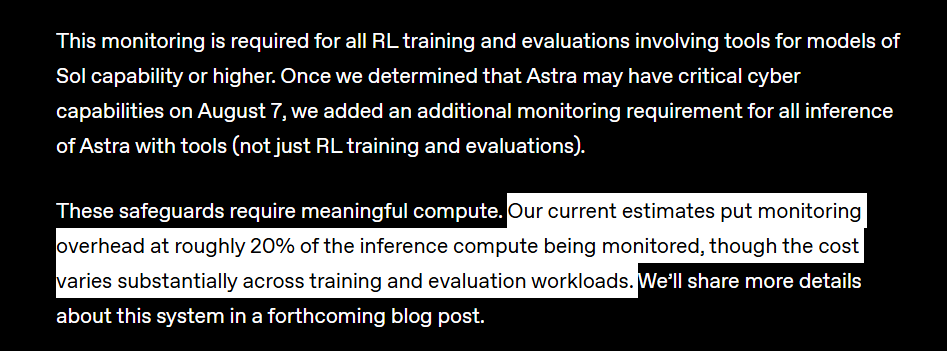
The way that Anthropic and OpenAI are going to “pace” the frontier is by spending more time and more *compute* on alignment, monitoring and evals.
The frontier labs that choose to “pace” likely spend slightly more money on compute at the cost of lower margins.
That’s it.