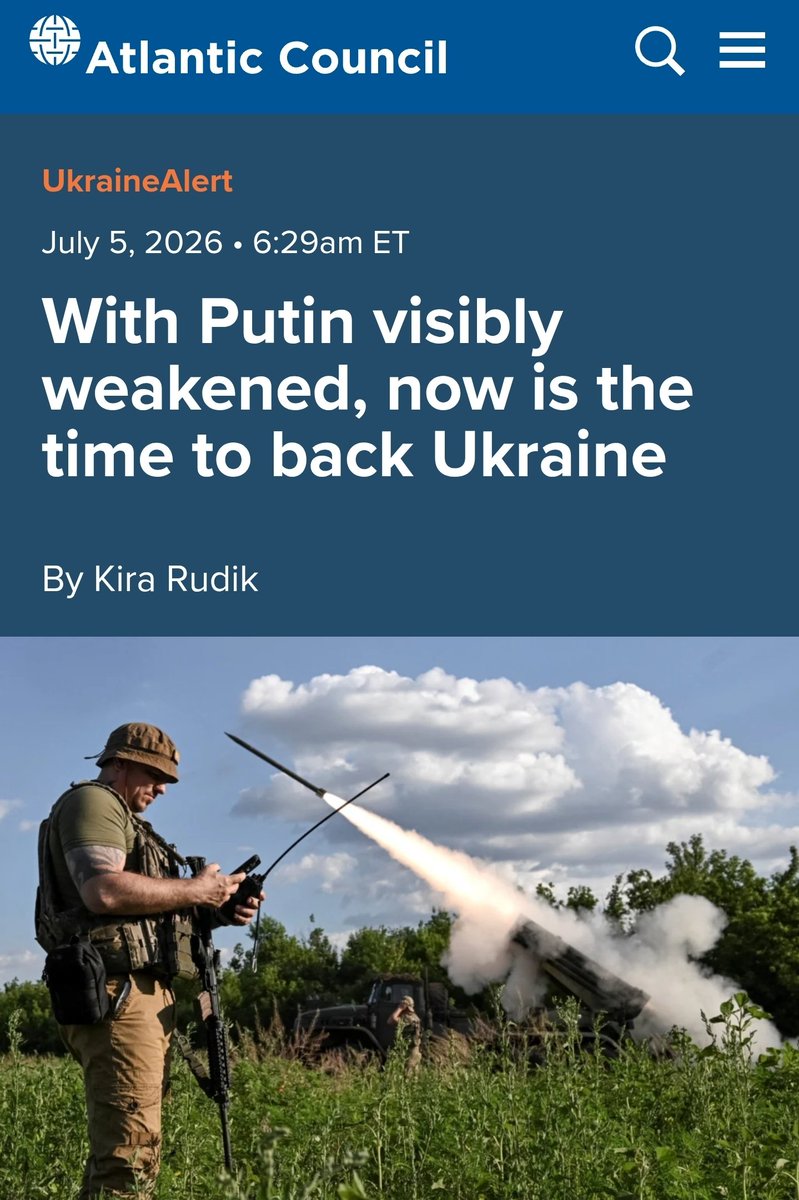
The Atlantic Council has published an article by MP Kira Rudyk @kiraincongress entitled "With Putin visibly weakened, now is the time to back Ukraine" — arguing that Putin is now weaker than at any time since the start of the invasion, and that is precisely why now is the time to press the advantage. Thank you for the excellent article; I’ll summarise the key points.
“In 2022, the invading Russian military was so confident of success that some troops reportedly packed dress uniforms to wear during the coming victory parade in Kyiv. Few could have imagined that four years later, Putin would be forced to drastically downgrade Russia’s own traditional Victory Day parade in Moscow due to fears of possible Ukrainian attack.”
From parade uniforms for Khreshchatyk to a parade in Moscow with Zelenskyy’s permission. The entire dynamics of the war in a single paragraph.
“Since the beginning of 2026, escalating Ukrainian missile and drone strikes on military and industrial targets inside Russia have succeeded in hampering the Kremlin war machine and sparking a fuel crisis that is threatening to destabilize Putin’s home front.”
“Ukraine’s success is directly challenging the unspoken social contract between the Kremlin and the Russian population. For years, Putin has promised ordinary Russians higher living standards while vowing to shield them from the negative consequences of his wars. In return, the general population has been expected to stay out of politics. With Russia’s cities under frequent bombardment and millions of people forced to queue for hours in search of fuel, this informal agreement is beginning to look outdated.”
This is a very accurate observation. Putin’s system is based not on love, but on a deal: you stay out of politics — we won’t let war into your home. Strikes by the Ukrainian defence forces have torn this agreement apart. Every queue for petrol in Voronezh, every fireball above an oil refinery, is a reminder to Russians that the Tsar is no longer honouring his side of the bargain. And a system that fails to keep its own promises cannot survive for long.
“None of this means the war is almost over. On the contrary, Putin has reacted to his declining fortunes by clamping down on domestic internet access inside Russia and escalating attacks on Ukraine’s civilian population.”
“Putin will not stop until he is stopped.”
And this must be repeated to everyone who dreams of a ‘ceasefire’. As it weakens on the front line, Russia always intensifies its terror against civilians and repression at home — this is its unchanging modus operandi. The empire’s weakness does not make it more peaceful. It makes it more vicious. And that is precisely why it must not be given a respite. It must be finished off whilst it is weak.
“While Russia is not on the brink of collapse, there is no escaping the fact that Putin is currently more vulnerable than at any time since Ukraine’s battlefield victories during the first year of the invasion. Western leaders should seek to exploit this weakness in order to secure a sustainable peace by boosting support for Ukraine.”
“If they fail to seize this opportunity, the cost of stopping Putin will only rise.”
This is the formula that every Western capital must take to heart. The price of stopping Putin today is weapons and money for Ukraine. The price of stopping Putin tomorrow is war on NATO territory. History has never seen a case where concessions to empires of evil have led to peace.
Iranian control of the Strait of Hormuz is detrimental to global commercial interests because it enables Iran to selectively determine which vessels may pass through the strait and at what cost. Iranian Ambassador to the People’s Republic of China (PRC) Abdolreza Rahmani Fazli stated on July 4 that Iran will give the PRC “special considerations” in determining the cost of “service” fees because the PRC is a “friendly country.”
Yesterday, Putin issued a threat against Ukraine’s European allies, calling for an "analysis" of each country’s involvement in every Ukrainian operation "in order to possibly make responsible decisions in the future, if necessary."
Judging by the latest news, Moscow is no longer merely waging a hybrid war against the West. It can be assumed that it is preparing the operational environment for a possible direct conflict with NATO, staying below the threshold that would trigger a collective military response.
My conclusion is based on three groups of reports that have appeared in the public domain over the past ten days.
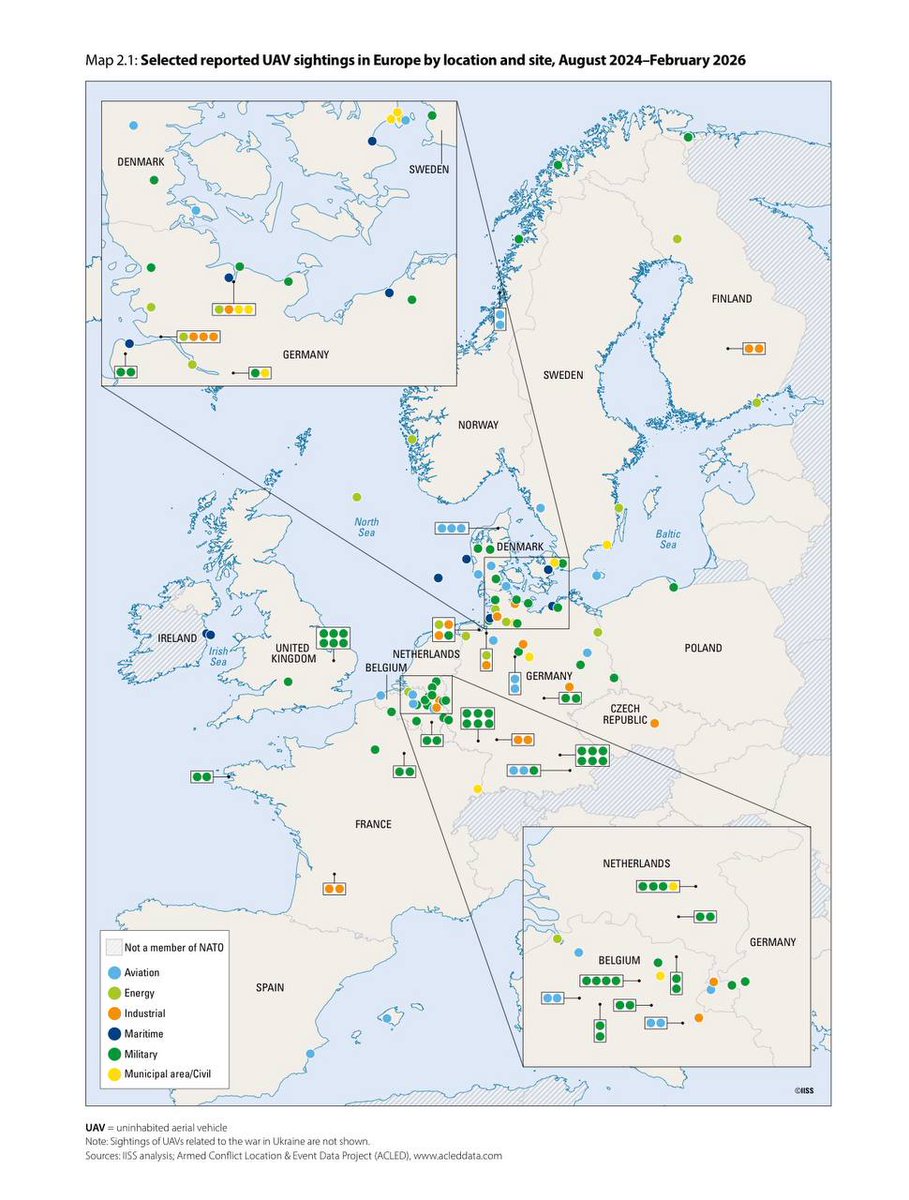
The first is the IISS report published on July 2. It says that between August 2024 and February 2026, 144 drone incidents took place in 13 countries, each time with tankers from Russia’s shadow fleet nearby.
The targets of these drones were NATO nuclear infrastructure sites: RAF Lakenheath, the Île Longue submarine base, and nuclear-sharing air bases in Belgium and the Netherlands. That is, Russia is effectively preparing the theater for future military operations - mapping air defenses and measuring response times.
The second group of news involves intelligence warnings. On June 22, Latvian intelligence reported signs of preparations for military provocations against the Baltic states or Poland.
On June 26, The Guardian confirmed these assessments, citing two countries on NATO’s eastern flank. A source in one of the countries said Putin may try to test U.S. guarantees toward the alliance’s smallest members.
On July 3, The Telegraph reported that the United States has been systematically informing Warsaw about Russian plans. The scenarios range from drone strikes on critical infrastructure and a simulated massive air attack to a limited incursion by Russian or Belarusian troops from Kaliningrad or Belarus, disguised as a navigation error or a rescue operation.
According to Polish sources, Moscow’s calculation is that, instead of opening fire, Poland would be forced under U.S. pressure to enter negotiations, and Russia’s central demand for "withdrawing troops" would be an end to Western support for Ukraine.
The third group of news concerns legitimization. On June 23, Putin spoke of "retaliation" against countries from whose territory drones are allegedly launched against Russia.
At the same time, Russia accused Latvia of providing territory for preparing attacks, while Ukraine’s Security Service exposed a network of 11 people paid by Moscow to carry out anti-Ukrainian actions in Poland.
We can see that Moscow is preparing the environment for a direct conflict - building the necessary infrastructure: intelligence, sabotage, and narrative.
It is important to pay attention to the method itself. Small provocations and incidents without a collective response show where the alliance’s threshold lies - and move it.
Charlie Edwards, co-author of the IISS report, summed it up this way: Russia has publicly demonstrated its ability to penetrate NATO airspace without triggering a collective response, and the gap between the alliance’s capabilities and its political will has become a strategic vulnerability.
Thus, at some point Moscow may feel that a limited operation - against Poland or one of the Baltic states - could bring a high return: for example, forcing NATO to negotiate a halt to aid for Ukraine.
Signs that the Kremlin is developing escalation decisions would include narratives about "Ukrainian sabotage from NATO territory," the transfer of forces to Kaliningrad and Belarus, the concentration of the shadow fleet near critical infrastructure, and tankers being escorted by warships.
@Gerashchenko_en Moscow should be on warning, that any single transgression or incursion into EU/NATO territory will be met with sudden overwhelming force. If we lack the balls for it, Putin will piss all over us.
US intelligence warns that Russia is planning an armed provocation on Polish territory within the next few months, potentially involving missile or drone strikes on strategic sites.
According to Polish security services, Russia could launch drone attacks on critical infrastructure, including power plants, or stage simulated airstrikes designed to force Poland to activate its air defense systems.
The authorities also do not rule out the possibility of a limited ground incursion by Russian troops across the border from Belarus or from the Kaliningrad region.
Source: The Telegraph
Italian Senator Carlo Calenda has delivered a brutal truth that every European leader needs to hear and repeat. Russia is not a misunderstood nation with “legitimate concerns.
” It is a regime of child-deporting kidnappers and civilian-slaughtering butchers. Its leadership consists of ruthless murderers who place zero value on human life and possess zero morality.
Those still muttering about “but Russia has its reasons” are either dangerously naive or actively carrying water for war criminals. There are no reasons.
There is only barbarism. The only language these savages understand is force.
The only answer is total resolve: arm Ukraine, give them everything they need, and let them smash the Russian army into the ground on the battlefield. Anything less is surrender dressed up as sophistication.
The Russian attack on Kyiv destroyed a Ukrainian Red Cross humanitarian warehouse.
It was one of the Ukrainian Red Cross’s key logistics hubs.
Russia deliberately causes more and more suffering to Ukrainian civilians.
❗️320,000 units of humanitarian relief items and equipment, with an estimated value of more than UAH 79 million, have been destroyed.
The warehouse contained critical equipment such as generators, heat pumps and medical equipment, strategic reserve of humanitarian relief items intended for emergency response to shelling, fires, evacuations and other crises.
The attack also damaged a cargo vehicle used to transport humanitarian assistance.
MORE | Iran's recent strikes against Bahrain and Kuwait may have sought, at least in part, to signal to the Gulf states that Iran may respond with force to Gulf opposition to Iranian control over the strait.
Iran also likely conducted these attacks to try to frame the United States as an unreliable security guarantor as part of its broader campaign to drive a wedge between the United States and its Gulf partners.
A Brigadier General who, in 12 years, rose from enlisted soldier to corps commander.
A military leader who understands what soldier-centric command truly means, and does everything in his power to provide his personnel with everything they need: from training and logistics to detailed operational planning and the development of a comprehensive ecosystem around the unit that exists to serve its fighters.
An officer who leads by example, demonstrating that the new generation of Ukraine's military has leaders capable of rapidly and effectively reforming the armed forces, rooting out the Soviet legacy, and outdated approaches.
A man without whom Azov's history cannot be written. The one who made Azov what it is known as around the world: a unit respected by allies and feared by enemies.
Today, Hero of Ukraine, Commander of First Corps Azov of the National Guard of Ukraine, Brigadier General Denys "Redis" Prokopenko, turns 35.
"Redis" has proven time and again that he is willing to do whatever it takes to preserve his personnel's lives. He risked his own life for his fighters during the darkest days in the unit's history because "risk is the business of the brave," and he stepped up to bear responsibility at the most critical moments.
The personnel of First Corps Azov of the National Guard of Ukraine congratulate the commander on his birthday and wish him strength, endurance, and success in our shared cause: the defense of Ukraine.
We stand with you always, ready to carry out every mission assigned to us.
Happy birthday, Commander!
"The only acceptable end to this war is Russia's defeat. It's in our deep strategic interest to give Ukraine the support they need to win this war."
- Mike Pompeo
Former CIA direction
Wow🫡
I urge everyone to sign the petition to expel russia from the UN 👉 https://t.co/SVN1lwHG1n
And also a petition calling for the resignation of Guterres 👉 https://t.co/IyVZExD0Dw
Russian Telegram channels report:
"Against the backdrop of the systemic destruction of our oil refineries, Kazakhstan has withdrawn from the ranks of those rescuing Russia from the gasoline crisis. Russian economist Vyacheslav Shiryaev writes about this in his blog. The Kremlin asked Astana to sell 50,000 tons of AI-92 gasoline. However, the request was rejected through informal channels. Officially, Kazakhstan's Minister of Energy, Erlan Akkenzhenov, stated that Astana had not received an official request from Moscow for gasoline supplies."
The Russian fuel crisis will reach its absolute peak in autumn…
📹: Moscow
@ChuckPfarrer They should have secured deposits weeks ago. I guess that is what happens when a bunch of generals are eliminated —twice in 6 weeks. No timely decisions.
SPECIAL DELIVERY: Ukraine’s ‘Bars' jet-powered Cruise Missile / Drone is a medium-range "Middle Strike" weapon. A composite materials fuselage is combined with minimal parts for faster, cheaper mass production.