Digital Transformation Specialist. Mum👩👧🐶. Made in London.💗Film/music/travel, my dog, Greek & Tudor stuff, authentic souls & all things au naturale🌲🌊🌌
The Flydubai hijacking was a joint Al-Qaeda and IRGC terrorist plot that failed due to heroes among us. We will be patient as investigators and the public connect the dots, but here is what they have told the public SO FAR.
The attempt on September 30th should never have gotten this far. The co-pilot, Hamam al-Hammami, who spent time in Syria, as his mother is Syrian, had previously been removed from flying duties at Oman Air after concerns about extremist material.
He was subsequently hired by Flydubai. He also filmed Israeli aircraft at Dubai International Airport days after October 7th and posted cockpit footage featuring images of Dr. Ayman al-Zawahiri and Humam al-Balawi, the suicide bomber who killed my CIA brothers and sisters in Khost in 2009.
Do not make the mistake of treating this as a single aviation security failure, as the broader threat picture has yet to be revealed.
The captain and passengers did more than was ever expected of them. Their actions helped save everyone aboard.
Now the intelligence and security services need to do their damn jobs, explain how they failed to prevent this in the first place, and determine whether the same warning signs are sitting in other files right now.
The question is not only what we missed. It is what we are still missing, and who is next if they fail to find it.
@kiesha9i It’s when I just hear it wagging … and I’m not looking at him. And I know it means he’s thinking about getting my attention and interacting with me. It’s just so cute. And so much communication is share via these simple gestures :)
Forget about Piers Morgan's manufactured fury. He is trying to distract you from how vile Charles was to Diana and he is doing it with Camilla Parker-Bowles permission. Focus on Charles Spencer.
#SwanSong#IBelieveCharlesSpencer
@Sea_Penguin5 It was uncomfortable but on reflection she’s a journalist and I assume you need to needle and challenge to ensure you have the truth. The truth presented itself
I suppose she had to be a journalist and challenge - and challenge she did. But he came out on top. The truth tends to do that 🙌. Heart breaking to see his pain though 💔
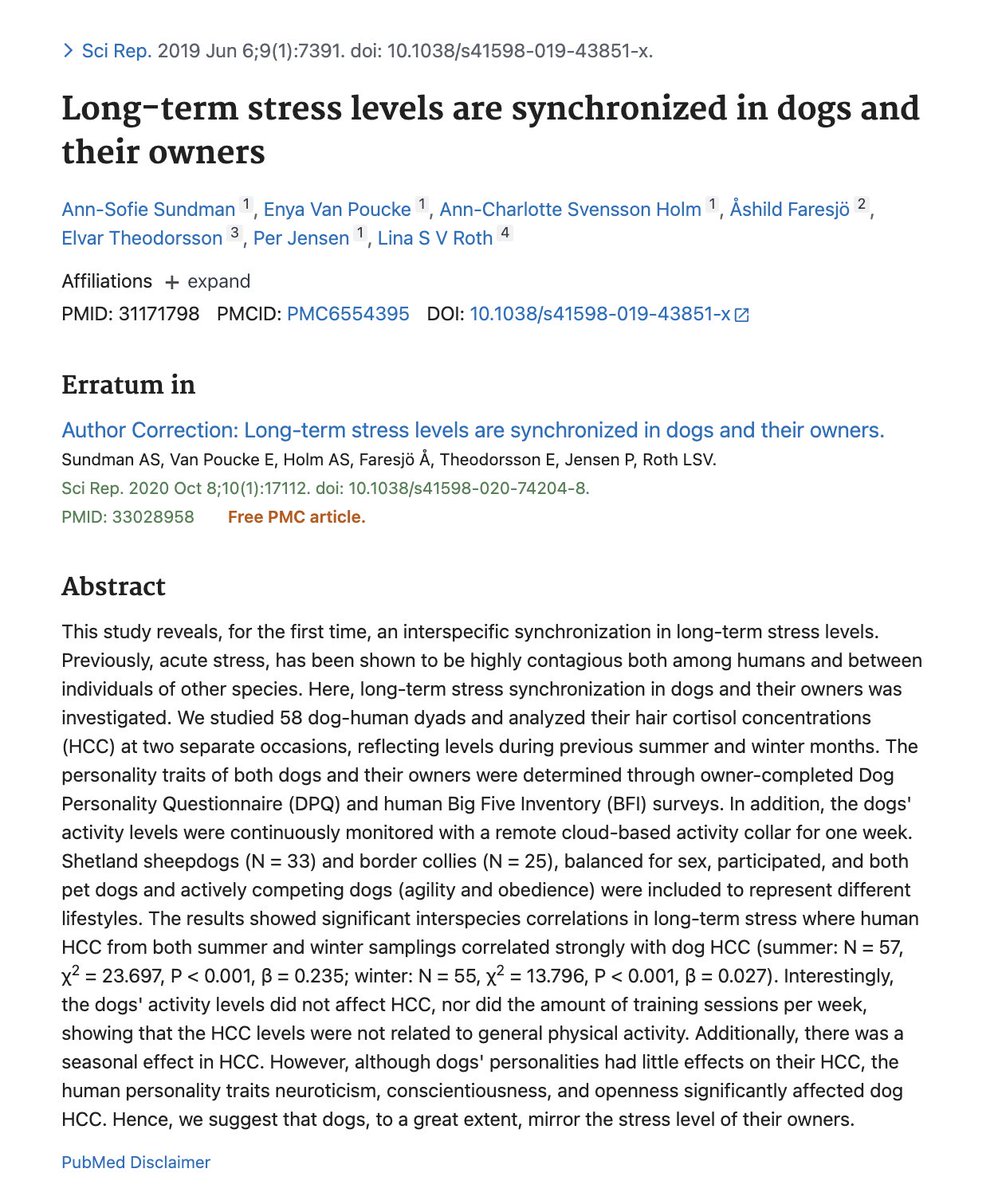
Your dog carries your stress in its body for months. A 2019 study in Scientific Reports measured cortisol in the hair of 58 dogs and their owners over a full year and found that the two rose and fell together. When you are stressed, your dog is stressed. When you calm down, so does it.
The synchrony was not driven by walks, weather, or the dog's own life events. It was driven by the owner. Dogs whose owners scored higher on personality measures of anxiety showed higher cortisol year-round. The dog's body was tracking the owner's emotional state over months, not moments.
The bond between a human and a dog is not a one-way relationship where the human provides and the dog receives. The dog is absorbing the household's emotional weather and carrying it in its endocrine system. Your bad month is its bad month.
This is what 15,000 years of co-evolution looks like. The dog did not just learn to read your face. It learned to sync its chemistry to yours, and the hair on its back is keeping a record of how you have been feeling since the last time it was groomed.
The next time someone says "it's just a dog," the cortisol data says otherwise. The dog is a mirror with a heartbeat, and the reflection goes deeper than behaviour. https://t.co/L5PUkx6Jg9
On September 11, six men were trapped in an elevator in the North Tower, fifty floors up, and the only tool any of them had was a window washer's squeegee.
They cut their way out with it.
The squeegee is in the Smithsonian now.
Jan Demczur came to America from Poland in 1980. He had ten dollars in his pocket and did not speak a word of English. He got a job making windows. Then he got a job washing them. For ten years he washed the windows of the World Trade Center. He liked to have breakfast in one of the sky lobbies and look at the view before starting his day.
That morning he had his coffee, picked up his bucket, and stepped into an express elevator with five other men, headed for the 70th floor.
The car started up. Then it shook. Then it dropped.
Somebody hit the emergency stop. The elevator caught and hung there, in the dark, swinging.
They did not know what had happened. They did not know a plane had hit the building. What they knew was that smoke was starting to come into the car.
They pried the doors open with their hands.
Behind the doors was a wall. Solid. Sheetrock. With the number 50 painted on it. An express elevator does not stop at the 50th floor. There is no doorway there. There is nothing there but wall.
Six men in a metal box, in the smoke, looking at a wall.
Demczur looked down at his bucket.
Inside it was a brass squeegee. An Ettore, a standard professional tool, a metal blade on a handle for pulling water off glass. It cost about ten dollars.
He took it out and started cutting.
He scraped the blade into the sheetrock. Vertical lines. Horizontal lines. Scoring a rectangle, the way you would cut drywall on a job site, except with a squeegee, in the dark, with the smoke getting thicker. The other men took turns. When one got tired, another took the squeegee.
Partway through, with his hand cramping, Demczur lost his grip. The metal blade slipped out of his fingers and fell down the elevator shaft into the dark.
He said later he was furious at himself. We had a problem, he said. Now we had a bigger problem.
One of the other men reached into the bucket and pulled out the handle. The brass grip, without the blade.
They kept going with the handle.
Scraping. Scoring. Deepening the furrows. Then kicking. Then punching. Six men beating on a wall with their feet and their fists and a squeegee handle.
The first layer of sheetrock gave. Then the second. Then the third.
Behind the third layer was a bathroom.
They crawled through the hole one at a time, into a men's room on the 50th floor of the North Tower.
Firefighters were coming up the stairwell. They told the six men, get out, now, do not stop.
They walked down fifty flights of stairs, past the firefighters walking up, and out the door.
Roughly five minutes later, the North Tower collapsed.
Six men are alive because of a ten-dollar squeegee and a Polish window washer who would not stop scraping.
Demczur did not consider himself a hero. When the International Window Cleaning Association gave him an award, in front of 700 of his fellow window washers, he stood up and said the heroes were the people who did not get out.
The squeegee handle is in the National Museum of American History in Washington. It sits in the same building as the Star-Spangled Banner.
A man who arrived in this country with ten dollars.
A tool worth ten dollars.
In a building nobody could get out of, he cut a door. 🇺🇸
After September 11, more than a million tons of the World Trade Center was loaded onto barges and shipped to a garbage dump on Staten Island.
Then hundreds of men and women stood at conveyor belts for ten months and picked through every ounce of it by hand.
They were looking for people.
The place is called Fresh Kills. For fifty years it was the largest landfill in the world. It took its last barge of household trash on March 22, 2001, and shut down for good. New York was finally done with it.
Five and a half months later, at two o'clock in the morning on September 12, the landfill's director got a phone call at home. He had just walked in the door.
Two trucks were at the gate. They were carrying pieces of the World Trade Center.
He drove back.
The man who ran the dump would later say, without any drama, that if Fresh Kills had not been closed, this could never have happened. There would have been no room. The garbage would have been in the way.
The site was empty. So that is where the towers went.
Here is how it worked.
At Ground Zero, cranes and grapplers lifted the debris into dump trucks. The trucks drove to a pier on the Hudson. There, the load went onto barges, six hundred tons at a time. The barges were towed down the harbor, past the Statue of Liberty, to Staten Island. More than fifteen hundred barges made the trip.
At Fresh Kills, sanitation workers unloaded them onto a hill.
And then the sorting began.
The debris was mechanically screened into three sizes. Chunks bigger than eight inches. Two to eight inches. A quarter inch to two inches. Anything smaller than a quarter of an inch, the size of a fingernail, fell through the last sieve.
Everything above that size went onto a conveyor belt.
And along the belts stood the detectives.
NYPD. FBI. Port Authority police. Medical examiners. Dressed head to toe in white Tyvek suits, in masks, in gloves, on a hill that stank of jet fuel and pulverized concrete and things nobody wanted to name. Looking down at the belt, hour after hour, as the towers rolled past them a fist-sized chunk at a time.
When they saw something, they reached in and took it, and placed it in a white bucket at their feet.
A wedding ring. A photo ID. A set of keys. A shoe.
A piece of a person.
The white buckets went to a tent that served as a morgue.
The volume was beyond comprehension. In mid-September the operation was processing 1,750 tons of debris a day. By mid-October, 17,500 tons a day. Ten times more. Round the clock. The 200-acre hill was declared a federal crime scene and stayed one for ten months.
A retired NYPD detective later wrote down what a shift looked like, because almost nobody outside knew it existed.
You wake at 3 a.m. You get a giant coffee. You drive two hours in the dark from Orange County, through New Jersey, to Staten Island. You park at the bottom of a hill that looks like the end of the world. You put on the white suit. You go to your belt. You stand there. You look.
Then you drive two hours home and do it again tomorrow.
Sanitation workers pulled sixteen-hour shifts, seven days a week. One of them, a supervisor named Barry Asnes, said afterward what kept him there. We were attacked on our own soil, in the city where I was born. This was personal.
The operation did not stop for weather. It did not stop for Christmas. It ran until July 2002. Ten months.
By the end, the men and women on that hill had recovered thousands of human remains. Tens of thousands of personal effects. Wallets, badges, wedding bands, photographs, all cleaned and catalogued and returned to families who had nothing else to bury.
When they were finished, the remaining material was placed in a 48-acre section of the landfill, a mound two hundred and twenty-five feet high, and covered.
It is a park now.
Many of the men and women who stood on that hill have lung disease. Asthma. Cancer. PTSD. The air they were breathing, eight and ten and sixteen hours a day, was full of the towers. Some of them have died of it.
Almost nobody knows their names. Almost nobody knows the place.
Mention Fresh Kills and 9/11 in the same sentence, the retired detective wrote, and most people will have no idea what you are talking about.
Here is what you should know.
Two thousand seven hundred and fifty-three people were murdered in those towers. Only about six in ten have ever been identified.
Every one of those identifications came out of a white bucket.
Every wedding ring returned to a widow. Every badge returned to a firehouse. Every fragment of bone matched to a name and buried with a headstone instead of a question mark.
Somebody in a white suit, standing at a belt on a garbage dump at four in the morning, reached into the World Trade Center as it rolled past, and picked that person up, and put them in a bucket, and sent them home.
They did that for ten months.
Nobody applauded on the hill. There was nobody to watch.
They did it anyway. 🇺🇸
I lost my Dad on 9/11. I don’t get a lot of reach on here. But I just wanted to share a picture. He was 39. I thought he was old. I’m now in my mid 30s and I still feel like a kid.
He was a great trader. He loved markets. He loved to find a stock no one was talking about.
The first trade I ever placed was on his work computer, where he let me click the button to buy AMAT. I loved going to the office with him. It was electric.
He was the best dad. We spent hours out in the street after dinner where he’d throw “pop flys” for me to catch. Eye on the ball.
He loved watching Sponge Bob and eating cereal, wrestling with us in the living room. He just loved being around his kids so much, and we knew it. I’m so grateful I got a dad like that.
Love you, Pops.
Every year on or right before 9/11, we show this video to our students. It’s not only powerful story-telling, it’s a reminder to a younger generation about how life altering 9/11 was for those of us who lived it. It’s only 10 min #themanintheredbandana