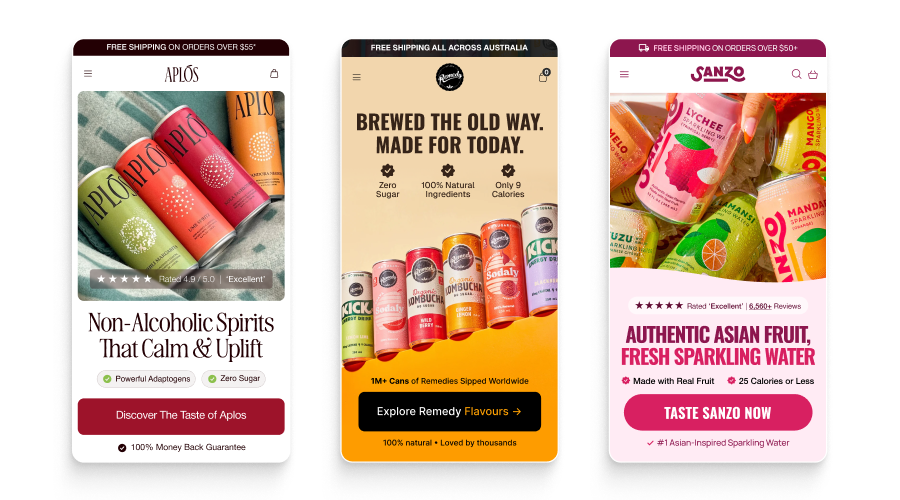
Scale profitably with high-converting Shopify funnels, tailored to capitalise on your winning ads, angles and traffic sources.
Get in touch 👇🏽
https://t.co/BG8GZWhf08
The biggest compliment ourselves and our clients receive is other brands consistently ripping our pages 1:1
I see these ecom gossip pages post like 5 of our pages and 5 rips every single week
Extremely humbling
Every business is a funnel. Not metaphorically. Literally. I’m talking about proper businesses, proper brands.
You take an unknown human being, expose them to an idea, and through a sequence of interactions, convert them into someone who hands over money and feels good about it. That’s literally all commerce has ever been.
Your market stall trader in 1200s Florence was running a funnel. Your door-to-door salesman in 1960s Ohio was running a funnel. Your Shopify store is running a funnel. The difference isn’t the mechanism - it’s the medium.
Every civilisation that figured out how to reliably move people from stranger to customer at scale became wealthy. Every one that didn’t, didn’t.
The internet didn’t invent funnels. It just made the cost of running them collapse. What used to require a salesforce of thousands now requires a few pages, a few apps and a paid ads budget. That tradition is the most significant transfer of leverage in the history of trade.
Now AI is becoming a mechanism. It writes copy and develops pages and can help you to test variants. Reads the data and provides reports etc. But transmitting the feeling of desire to buy a product you didn’t know exist 5 minutes ago isn’t within its capabilities.
It cannot understand what it feels like to want something. To distrust a brand because of colours or fonts. To hesitate at checkout because the price feels like a risk you can’t afford this month. To be convinced despite yourself.
AI has no experience of being human. It only has a model of it, and a model of persuasion is not persuasion.
The medium keeps changing. Market stalls to door-to-door to Shopify to whatever comes next. But the thing being moved - a human mind from doubt to decision - that has never changed and never will even if 98% of the population become hedonist incels.
Which is why direct-response expertise will never fall out of favour, not because the tactics age well, but because the principles underneath them are permanent.
Understanding why people buy, what makes them hesitate, what makes them trust, what makes an offer feel like a no-brainer rather than a risk - these aren’t copywriting skills, they’re human skills expressed through whatever medium happens to exist at the time.
Hopkins didn’t know what a landing page was, Ogilvy never ran a Shopify split test, Halbert never touched a Meta ad account, and none of that mattered because they understood the constant underneath all of it.
That understanding is the only expertise that compounds across every medium shift. Every time the mechanism changes, the people who built their knowledge on principles pick it up and keep going, while everyone who built their knowledge on the last mechanism starts over.
AI is just the latest version of that shift, and the people who will use it best, integrate it into their agencies and brands for a net positive result - ultimately are the ones who never needed it to think for them.
Some facts on decision making process of cold website visitors in ecom:
94% of first impressions are design-related. If the visual aesthetic doesn’t land immediately, most people won’t stick around to evaluate the product.
75% of consumers admit to making judgements about a company’s credibility based on its website design alone.
7 seconds is the widely cited average time a visitor takes to form a brand impression. Some studies put it lower.
38% of people will stop engaging with a website if the content or layout is unattractive.
Do with that what you will.