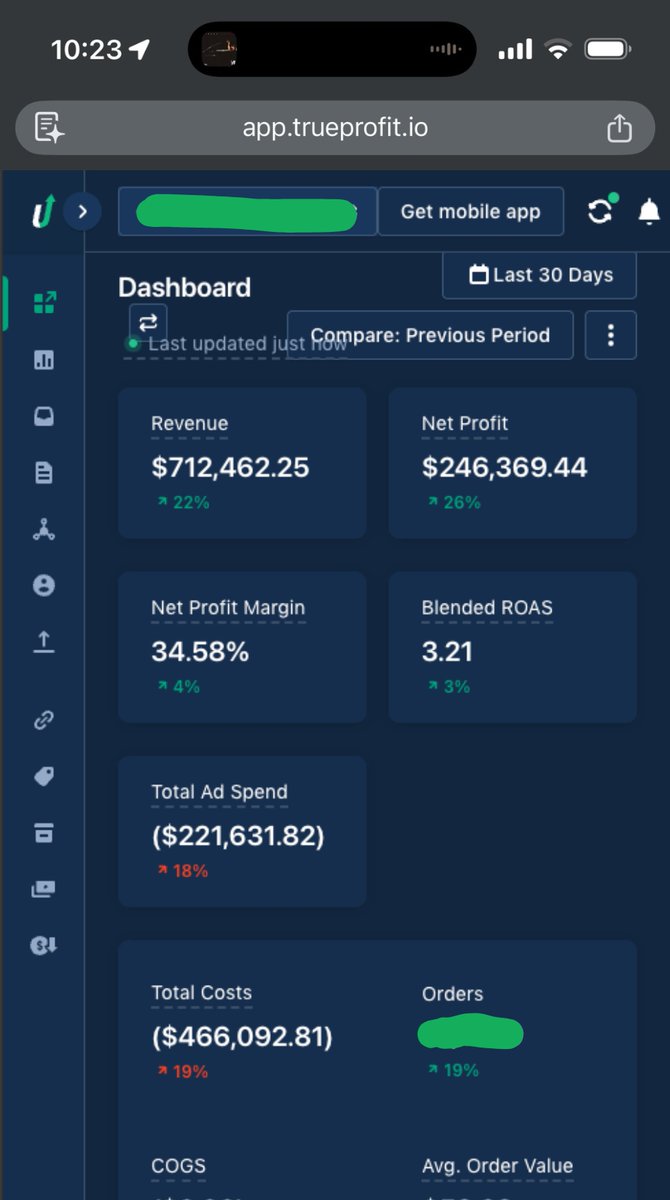
Anthony went from $5K days to $140K/day
Doing the boring work everyone's too lazy for…
He surveyed his own customers
Everyone else is buried in spytools using MCPs.
And AI just put those same tools in everyone's hands.
So you're all staring at the same winning ads. Already copied to death.
The only edge left is going where your competitors can't.
Straight to the source.
Ask 100 of your own customers one question and the pattern in their answers is a case you can act on.
Something that lives only in your account.
It hands you two things:
1) Fresh angles
Back to Anthony. Stuck at $5K days when he joined.
He set up a simple survey on his confirmation page.
A chunk of the answers kept coming from grandparents. Explaining exactly why they bought.
Not the avatar he'd been targeting. He built an ad around it anyway.
It popped off. $140K/day nine months later.
Scroll spy tools all day and you're pulling angles that worked for someone else.
Probably already saturated. Everyone staring at the same tool found it too.
Your own case doesn't have that problem. Nobody else can see it yet.
If you don't know what to ask, the 4-Question Framework does most of the work:
- what they've been dealing with that led them here
- what they tried before and what pissed them off about it
- what the result looks like if a genie granted the wish
- what almost stopped them from buying
Run those on your confirmation page and you'll have infinite ad ideas.
2) Fresh products
Most ecom dudes copy what others in the space are launching.
Supplement brand adds protein. Bag brand drops a wallet.
Same customer, same category. Makes sense.
You build it for 3 months, launch, and it flops.
Budget burned. Cooked.
Meanwhile Comfrt, a hoodie brand, launched a blanket.
It became the most sold blanket in America. 70%+ repeat rate across the brand.
They just listened to their customers.
When the next product comes from customer signal, the launch is already warm.
The people who asked for it are ready the day it drops.
You already paid to acquire them. No extra CAC. Pure margin.
Your customer is already telling you what to build next.
You're just not listening.
And most of you only survey the people who already bought.
That's half a case.
Survey the ones who almost didn't. And the ones who bought and sent it back.
Buyers tell you why it worked.
Everyone else tells you why it almost didn't, or why it broke.
The ones who didn't buy: what stopped them, what confused them, what would've changed their mind.
The ones who returned it: what it didn't do, what they expected instead.
Now you've got the full case instead of half of it.
That's the customer lens.
The better you can align yourself with the lens of the customer instead of the lens of the operator, the better your overall marketing and brand will do.
It's how you find white space your competitors can't even see.
Tis the way of the chad scaler.
We spend $100,000+ per day on $META.
Here are 4 things you can copy to unlock similar scale:
1. Partnership Ads
=> This should be 60% of your budget
=> Pair with influencer specific LPs
2. Ad specific landing pages
=> Messaging in the ad matches LP
=> Product matches for catalogue style brands (check out Linjer ad library. Collection pages show same products as in ads)
3. Non US markets
=> 40%+ of our spend. 60%+ of our revenue
=> Localised ads, LPs and websites
4. Localised pricing
=> Some markets we take the CM hit and absorb the VAT. The higher CR pays for the lower CAC on a PC3 basis (see video of me explaining PC3 on my timeline)
Ecom is the #1 best business in the world in 2026.
And I'm not saying that because I built one to $260M.
I'm saying it because the math is undeniable:
1. No cap on revenue
— we went from $0 to $103M in annual revenue in under 5 years
2. No one physical location required
— we ran a global business from a laptop
3. No inventory risk if you structure it right
— subscription model means predictable demand
4. No VC required
— we raised $0 and kept virtually all the equity
5. Customers pay you before you fulfill
— unlike almost every other business model
6. Retention compounds
— every subscriber you keep is revenue you don't have to re-earn
7. Data ownership
— you know exactly who your customer is, what they buy, and when they churn
8. Exit multiples are extraordinary
— we sold for $260M on $103M revenue
I've been in mobile technology. Fitness. Cannabis. Children's health.
Nothing compounds like a well-structured ecom brand with a subscription model and strong unit economics.
The ceiling doesn't exist.
The only question is whether you pick the right category, build the right product, and have the patience to let it compound.
Most people quit before the compounding becomes visible.
Comment "X" if you want my full playbook of everything I learned while building my business and how you can too :)
**must be following + retweet to receive.
Alright, let's get into it. This is my bulletproof 2026 Meta campaign structure, and yes, I'm dropping it for free because I genuinely don't care, this is what gurus are charging you 20K courses for 😂
Before I even get started: I already know what's coming in the comments. Some nerd is going to show up and start preaching about the 1CBO Consolidated structure like. Cool. Maybe it works for your little $500/day account. But let me be very clear, I have never, not once, seen a brand sustain $500K+ per day consistently on a single CBO at scale. Not one. If you have receipts, slide in. Until then, sit down.
This structure isn't theory. It's not something I read in a course or saw in some guru's carousel post. It was built in the trenches, tested across multiple accounts, multiple verticals, real money on the line, and it has allowed me to scale brands faster than most people think is possible while actually staying profitable.
That last part matters more than the scaling, by the way. Scaling broke is easy. Scaling with margin is the game.
I'm not going to tell you what products, what brands, what niches, or what creative angles I'm running. Those questions will be ignored. Not because I'm gatekeeping, but because the structure is the structure. It works. The variables are on you.
Comments are open. Smart questions only. If you come in with something basic, don't expect a response.
Do with this what you want. THANK YOU FOR YOUR ATTENTION TO THIS MATTER — SCALESURFER OUT🤙
If your ads go unprofitable every time you try to scale, this is why ⬇️
It took me 6.5 years and millions spent on FB to figure out what actually unlocks consistent $10K-20K days with strong margins.
And It's not better ads or a better offer.
It's something 95% of us in ecom completely ignore and keeps us from hitting those massive days that we work so hard for.
And if you're stuck at low budgets and go unprofitable every time you try to scale, I guarantee you're of that 95% that are ignoring it.
So here's a 20 min loom video I made showing exactly what it is and how to implement it in less than 30min.
This took me 6.5 years to learn. It'll take you 20 minutes.
Just Like & comment "Send" and I'll DM it.
(must be following)
$130k+ brands don’t improvise static ads
they follow a visual framework that stays consistent
strong hierarchy, clean spacing, high contrast, instant clarity
so the message is understood before the scroll moves on
most static ads fail because they look accidental
random layouts, crowded text, weak focus
this guide breaks down how top brands design
to look deliberate, premium, and trustworthy
without turning design into a complicated process
no theory
no filler
just reusable layouts that compound
i packaged the full system into a short guide
rt + comment “CANVAS” and i’ll send it
(follow for dm)
Include this in your image ad generation prompts and you'll see a night and day difference in output.
It's wild how many people are still going into Claude or Chat and asking "Make me a great ad for xyz" and expecting to get anything good (let along great).
The Prompt Enhancer:
"After generating each ad concept, run it through this mandatory validation protocol before finalizing:
STEP 1: SPAWN 5 HOSTILE PERSONA REVIEWERS
For each target persona, simulate 5 distinct versions of that person in different mindstates:
The Scroll Zombie: Seeing this ad at 11:47pm, half-asleep, thumb moving fast. They've seen 200+ ads today. What makes them NOT stop? Be brutally specific about what fails to interrupt the pattern.
The Burned Skeptic: They've bought 3 similar products that didn't work. They actively distrust advertising. What in this ad triggers their BS detector? What looks "too good to be true"? What screams "ad" instead of "content worth stopping for"?
The Comparison Shopper: They're aware of every competitor. What does this ad fail to differentiate? What would make them think "I can get this cheaper/better elsewhere"? Why would they screenshot this and keep scrolling to research later (and never come back)?
The Hostile Interpreter: They read everything in the worst possible light. What could be misunderstood? What feels manipulative, cringe, or tone-deaf? What would make them screenshot this to mock it in a group chat?
The Almost-Buyer: They're actually interested but looking for any reason NOT to act right now. What friction points give them an excuse to "come back later"? What unanswered question lets them justify inaction? What emotional hesitation does the ad fail to resolve?
STEP 2: EACH REVIEWER MUST ANSWER ALL 4 LAYERS
For every persona reviewer, force answers to:
THUMB-STOP FAILURE ANALYSIS: "In the first 0.5 seconds, I would keep scrolling because ___." (Visual pattern interrupt failures like wrong colors, generic imagery, nothing unexpected, no cognitive disruption)
HOOK REJECTION ANALYSIS: "Even if I stopped, I'd scroll past within 2 seconds because ___." (Headline/hook failures like it doesn't speak to MY specific pain, feels generic, unclear what this is about, no curiosity gap)
TRUST COLLAPSE ANALYSIS: "Even if I read further, I wouldn't click because ___." (Credibility failures — no proof, feels like every other ad, stock photo vibes, claims without evidence, brand looks amateur)
ACTION RESISTANCE ANALYSIS: "Even if I clicked, I wouldn't buy because ___." (Conversion failures like it is unclear offer, too much commitment, no urgency that feels real, risk feels higher than reward, no social proof at point of decision)
STEP 3: TALLY AND PRIORITIZE
Compile all objections into a ranked list. Any objection raised by 3+ reviewers is a CRITICAL FAILURE that must be addressed. Any raised by 2 is a HIGH PRIORITY. Singles are WORTH ADDRESSING if the fix doesn't compromise other elements.
STEP 4: REBUILD WITH OBJECTION IMMUNITY
Revise the ad concept to neutralize every Critical and High Priority objection. For each fix, explain:
The specific objection being addressed
The exact creative change made
Why this change neutralizes the objection WITHOUT introducing new weaknesses
STEP 5: SECOND PASS. SAME 5 REVIEWERS.
Run the revised concept through all 5 reviewers again. If any Critical Failures remain, repeat Steps 4-5. The ad is only approved when zero Critical Failures and ≤2 High Priority objections remain (with documented reasoning for why those are acceptable tradeoffs)."
Running ads to multiple awareness stages is how you unlock efficient scale.
You need to understand that your market isn't one homogeneous group in the same awareness stage.
It's a bunch of small pockets at different stages of awareness.
And if you want to unlock the biggest & most efficient scale possible, you need ads and funnels running for all of them simultaneously.
A lot of marketers make this mistake:
They think their entire market is in one awareness stage and only run ads & funnels for that stage.
Usually they focus on the bottom - people who already know about the product and just need an offer to buy.
But that's only a small percentage of your total addressable market.
The bigger opportunity is moving people through the awareness stages until they're ready to buy.
Here's how to think about it using the 5 awareness stages:
Unaware and Problem Aware
These people either don't know they have a problem or just realized they have one.
They're not looking for your product yet.
Run long form videos: VSLs or TikTok native content that educates and identifies the problem.
Send them to advertorials, long form sales pages or quiz funnels.
These warm them up and educate them about their problem and the solution.
Solution Aware
They know what type of solution they need but don't know why yours is the best one.
Run third party comparison ads (us vs them).
Show why your mechanism works better than alternatives.
Send them to comparison funnels written by third parties that directly show why you're the better choice.
For example:
- We reviewed the top 5 [product category]. This was the clear winner.
- The best [product category] tested and ranked by a [authority figure]
Product Aware
They know about your product specifically but haven't bought yet.
They need proof it works.
Run testimonials and social proof ads.
Landing pages should be heavy on reviews, before/afters, and trust signals.
Most Aware
They're ready to buy. They just need a reason to do it now.
Run offer and FOMO ads.
Send them straight to your product/offer page.
The key is running all of these simultaneously.
Not just focusing on one awareness stage in your account.
If you only run ads for problem aware and unaware people, you're educating your audience but your competitors are stealing the conversions.
They're running higher awareness stage ads and capturing the people you warmed up (this is what Grüns and IM8 are doing to AG1)
If you only run ads for most aware customers, you're leaving 95% of your potential market on the table.
You're ignoring everyone who isn't ready to buy yet and that's not scalable.
So build funnels and run ads for all stages at the same time.
That's how you unlock the biggest possible market and actually scale efficiently.
Nano Banana + n8n is legitimately insane 🤯
Google's Nano Banana creates studio-quality static ads.
But manually generating variations one-by-one takes forever.
This n8n automation generates 1,000+ ad variations in minutes.
Fully automated.
Perfect for DTC brands & media buyers who need fresh creative for testing without hiring designers.
Here's the problem:
You need 50+ ad variations to test angles, but Nano Banana only outputs one image at a time.
Manually uploading and tweaking prompts for each variation kills hours.
This n8n automation solves it:
→ Upload ONE product image via n8n form
→ OpenAI Vision analyzes your product automatically
→ AI generates custom image prompts (you choose quantity: 50, 100, 1000+)
→ Nano Banana creates static ad images in bulk
→ All images auto-stored in Box for instant access
No manual prompting.
No designer bottlenecks.
No waiting on agencies.
What you get:
→ Hundreds of unique ad variations from one upload
→ Different angles, backgrounds, compositions
→ Production-ready static ads
→ Perfect for testing creative on Meta/TikTok
Built 100% in n8n.
Want the complete n8n template?
> Comment "BANANA"
> Like this post
And I'll send it over (must be following so I can DM)