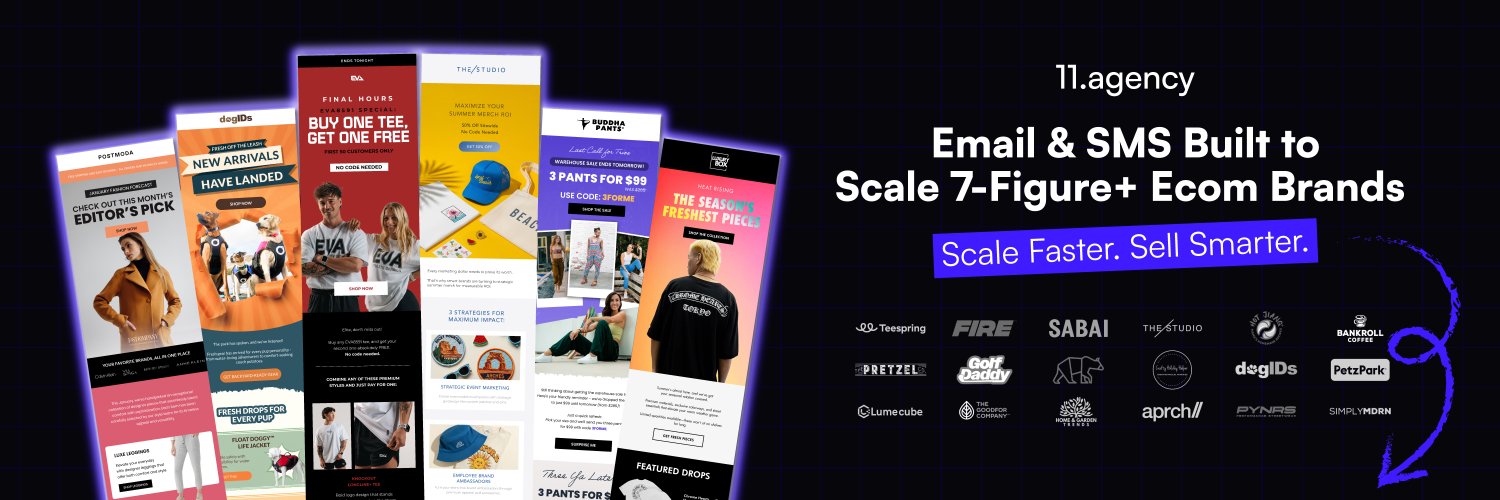
Want to know how top eCommerce brands make millions from email?
In The 11th Hour, I share the exact strategies we’ve used to generate $50M+ in revenue for 85+ brands, delivered straight to your inbox twice a week.
Subscribe here 👉 https://t.co/kLQNdcLVEq
But the honest answer underneath all of it is that the one thing I can't hand to anyone else is being the guy who brings in the deals.
Everything else I can build a team around eventually. That part stays mine.
We're closing two clients a week right now and the thing nobody tells you is that scaling sales is the easy part.
The hard part is getting yourself out of the actual work fast enough that the work doesn't collapse behind you.
It keeps moving. Every time I fix the thing that's holding us back, the new thing that's holding us back is also me.
I don't hate it. It's actually kind of a fun problem to keep chasing, figuring out where the wall is this week.
Hot take that's gonna annoy some of you: identity resolution tools are not the problem.
They work. They actually catch real people who shopped on their phone, bought on their laptop, and your native tracking never tied together.
A normal signup form pulls maybe 3-5% of your traffic onto your list.
A tool like OpenSend or https://t.co/g3mQGPO2na can pull 20-25%. That's not snake oil, that's real cross-device shoppers you were losing.
Here's the part everyone gets wrong though.
Those people never signed up for YOU specifically. They're way more top of funnel, they open less, they convert worse, they complain more.
And you just dumped them straight into your main welcome flow. The same flow that goes to people who actually typed their email in and hit subscribe.
Now their bad numbers are dragging down deliverability for the people who genuinely wanted to hear from you.
The fix isn't to ditch the tool. Give those addresses their own flow. Own copy, own KPIs, own deliverability you can watch on its own.
Then you can actually answer the only question that matters: is this worth what I'm paying for it? You can't answer that when they're hiding inside everyone else's numbers.
The thing that kills me about subscription brands is they build the whole thing backwards.
I open up the flows and there's a thank you, a charge reminder, a shipping notice, and then... nothing. Silence.
For a whole month.
Like the sale was the finish line.
It's not. The sale is the START.
Now you have to make this person actually use the thing every day, feel it working, see themselves getting closer to whatever they bought it for.
A supplement brand isn't selling pills, they're selling the person who finally sticks with it.
And you taught that person nothing. So they forget to take it, the bottle sits on the counter, and month two the card runs again and they cancel.
And the brand acts SHOCKED.
You didn't lose them in month two. You lost them the day after delivery when you went quiet.
Saw a cross-sell flow fire the second someone placed an order.
The box is still sitting in a warehouse in Ohio.
They haven't touched the thing they bought, and you're already asking them to buy the next one.
Sell them on what, exactly. The vibes?
Shopify pipes a delivered event straight to Klaviyo.
Trigger off that, the moment the box actually lands on the porch, not the second the card gets charged.
Placed order is just a guess about fulfillment. Delivered is real.
Then it's product first, cross-sell later. Teach them how to use the thing.
Let them actually like it. THEN show them what goes with it.
Go pull your last 13 weeks of campaigns and rank them by revenue.
Every time I do this in an audit it's the same. About a third of the sends drove almost all of it, and the rest made next to nothing while still costing deliverability every time they went out.
Nobody looks at the distribution. Volume hides it.
You sent a pile of campaigns, revenue is up, everyone moves on.
The point isn't to send less. It's that you can't tell which sends are actually working until you line them up and look.
What was the topic, was it tied to a stage of the funnel, was the copy built for a real segment or just blasted at everyone.
Then stop running the stuff that does nothing.
Audited two accounts this week and both did the same dumb thing.
The welcome flow names the discount code in the first email, then never mentions it again.
The whole reason someone is on your list is that code. They gave you their email to get it.
And then the flow brings it up once and goes quiet for five emails.
Remind them of the code until they actually use it.
Then put real urgency in the last two emails. Tell them it's expiring and this is the last send.
I see this constantly and I genuinely don't get it.
Auditing an account last week, every flow looked totally normal. Then the checkout flow. 2% opens.
My first instinct is always copy or subject line. But 2% isn't a copy problem.
2% is nobody real opening it.
So I drill into the recipients and it's James Smith, James Smith, James Smith. Page after page of fake names getting stuffed into the abandoned checkout by a bot.
Here's the part that actually pissed me off. This wasn't just tanking one flow.
Every fake email bounces. Bounces wreck your sending reputation. And you've got one subdomain doing all the sending, so the damage doesn't stay in that corner, it spreads to everything.
Meaning the real customer who actually wants to hear from you now lands in spam instead of the inbox. Because of some bot the brand never knew was there.
And the founder was sitting there about to rewrite the email.
The email says your discount expires in 24 hours. The code is WELCOME10, and it has never expired.
Your repeat buyers know this. So does anyone who's ever pasted it from a coupon site.
The countdown is real, but the deadline is theater. The people you most want to convince are the ones who see through it first.
If you want the urgency to be true, the code has to actually die. One-time codes do that, and on Shopify you can auto-apply them in the button so nobody copies anything.
The city won the championship last night and I've never seen New York like this.
Strangers hugging strangers. Nobody in that crowd decided to get along, it just happened, because every single person was pointed at the same thing.
That's the part that stuck with me at 2am. None of us tried.
Race, who you voted for, who you love, none of it was the variable anymore. The environment did the work people usually credit to willpower.
I've lived here a year and change and the longer I'm here the more the place pulls on me. The room you're in is the thing nobody audits.
It's true for the people you build a business around. Same for the customers you're trying to keep.
Most brands think retention is the next clever email. It's not.
The ones who keep people built a place nobody wants to leave.
Anyway. Go Knicks.
I keep opening small accounts and finding the fifth flow half-built while the signup form has been sitting there untouched for a year.
That form is converting a trickle of the traffic already hitting the site. Nobody's looked at it.
When your list is under 10k, another flow doesn't grow it. The growth is the people landing on your site every day who never get onto the list in the first place.
You need a handful of flows done really well, and that's where the flow work ends. They're there to catch what's already moving, not to fill the list.
The RFM splits and the deep segments can wait until you've got the volume to make them worth it. Right now they'd just be dressing up the back end of a funnel that's barely filling at the front.
The visitor who's already on your site is the cheapest growth you will ever get, and most of them are walking right past a form nobody's bothered to fix.
A brand almost always knows its own brand better than any vendor does. Nearly 100% of the time.
That's true of my own agency compared to the brands we work with, and admitting it used to make me feel like I was bad at my job.
More and more brands don't want retention done for them anymore. They want their hands on the execution, because the brand instinct lives in-house and they can feel it.
The funny thing is most of them don't actually know much about retention. They just know they want to be the ones touching it.
So my job quietly changed. I stopped being the guy typing in the account and started being the guy who hands them the plan, the projections, and the deadline.
They know their customer better than I ever will. I know retention better than they do. I keep them honest on the parts they can't see.
Honestly some of the best work I do now is just keeping a sharp in-house team pointed at the right thing.
Most brands will pour everything into one perfect Father's Day campaign, dial in the subject line, the offer, the click. Then someone clicks it, adds to cart, gets distracted and leaves.
And the abandoned-checkout email that fires has no idea Father's Day is even happening.
The holiday lives in that one campaign and nowhere else. The welcome flow, the abandoned-checkout flow, the post-purchase follow-ups all act like it's a normal Tuesday.
You spent everything getting that click, and the rest of the email program never got the memo.
At some point it's just easier to hand a person a direction than to keep generating blind.
The real risk of automating something you don't understand isn't a bad email. It's that you lose track of what's actually running in the account.
That's the part nobody mentions when they say AI built the flow in a minute. The minute is real, and getting from nothing to a draft is genuinely useful.
But when one of those flows underperforms, there's no thread to pull on. You can't learn from it or build on it, you can only regenerate and hope the next roll lands better.
No notes on what worked, what didn't, what got tested against what. The tool spit out flow after flow and kept none of the reasoning.
So you're left holding the output with nothing behind it.
Took over a Klaviyo account this week and the first thing I hit was a graveyard of flows. The brand had come off a third-party AI email tool, and what got handed over was a pile of abandoned-checkout and checkout flow versions stacked on top of each other.
It was obvious which one was live, and that part was easy. What I couldn't find was any versioning history, or any record of what they'd actually tried.