#PureMediaBuyingValue Day 44
A good media buyer should know when to scale and when to prepare for scale.
Those two things are not the same.
A lot of people see one good day and immediately want to push the budget, but the real question is not only if the campaign looks good today.
The real question is whether the account is actually ready to hold more pressure.
Do we have enough creative backups?
Is tracking stable?
Is the product page converting properly?
Is stock ready?
Can fulfillment handle more orders?
Is the client ready to move fast if something breaks?
Is the offer strong enough to survive more traffic?
Because scaling does not only increase revenue.
It also increases every weak point in the business.
A small tracking issue becomes a bigger reporting problem.
A small page leak becomes more wasted spend.
A small stock problem becomes lost momentum.
A weak creative pipeline becomes account fatigue.
That is why I do not look at scaling only as increasing budget.
I look at scaling as stress testing the whole system behind the campaign.
Sometimes the best move is not to scale instantly.
Sometimes the best move is to prepare the account so when you do scale, the business can actually handle it.
Anyone can increase budget.
Not everyone knows if the account is ready for it.
#ecommerce #mediabuying #meta #shopify #growth #cny #d2c #dropship #dropshipping #ecom
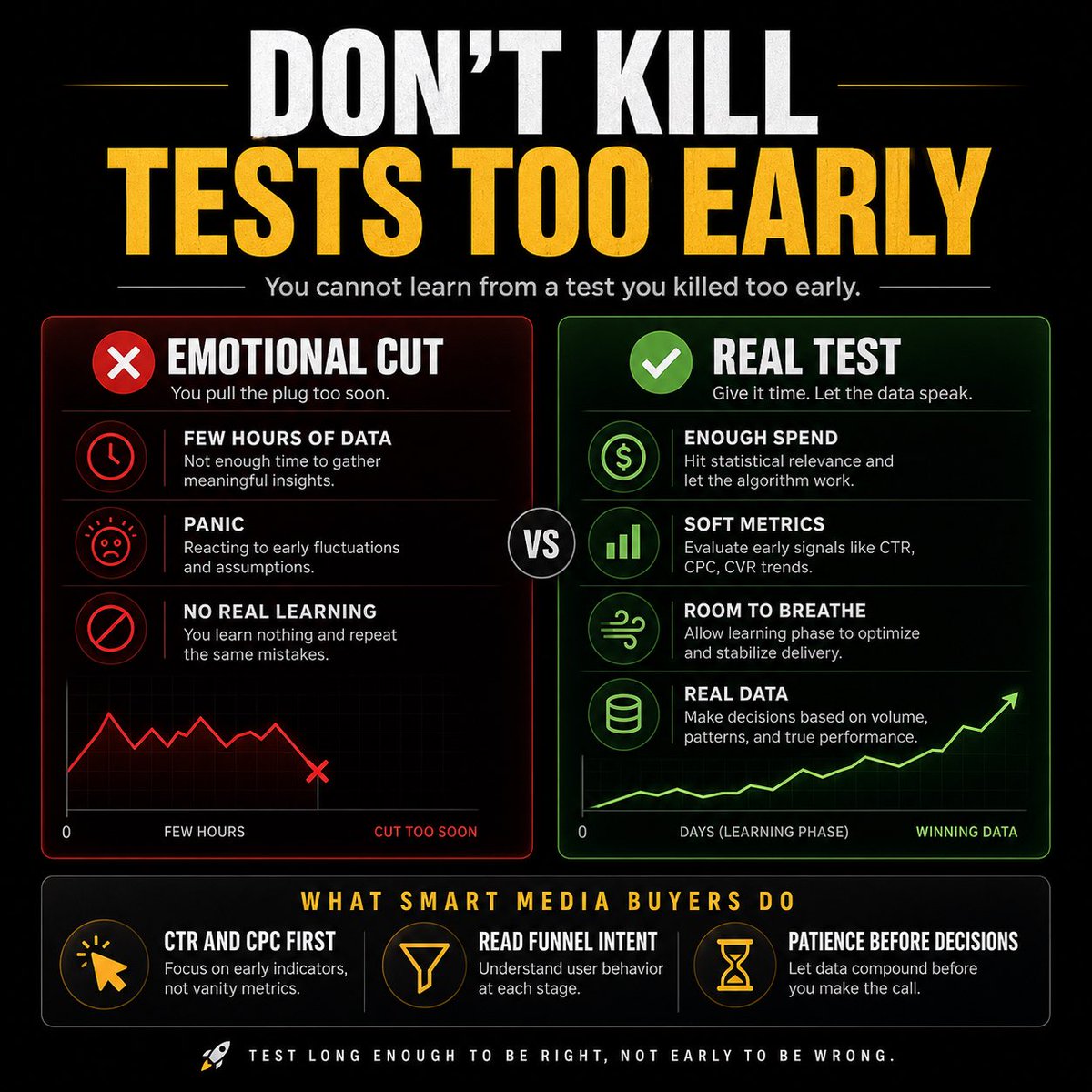
You cannot learn from a test you killed too early.
A lot of people say they are testing creatives, but in reality they are just launching ads, checking the account too fast and killing anything that does not look good immediately.
The problem is that Meta needs some space to find pockets of buyers, especially when the pixel is cold, the account has been inactive or the creative is entering a completely new audience.
Sometimes the first few hours look ugly.
Sometimes the first day looks average.
Sometimes the ad needs enough spend and enough delivery before the data actually starts telling you if the idea is weak or if you simply did not give it enough room to breathe.
That does not mean you should let bad ads burn money forever.
It means you need rules, patience and a clear read of soft metrics before making emotional cuts.
If CTR is terrible, CPC is expensive and nobody is moving through the funnel, that is one thing.
But if the creative is getting attention, clicks are affordable and people are showing intent, killing it only because purchases did not come instantly can make you lose a good test before it had a real chance.
Most people do not lose because they test bad ideas.
They lose because they never let the test become real data.
#ecommerce #mediabuying #meta #shopify #growth #d2c #dropship #dropshipping #ecom
Scaling days are earned on boring days.
A lot of people only want the exciting part of media buying.
The big screenshot.
The crazy ROAS day.
The scale from $500 to $5,000.
The moment where everything looks like it finally clicked.
But most of the work that creates those moments happens on the days where nothing looks special.
Reading the same metrics again.
Checking if the funnel is still healthy.
Waiting instead of panicking.
Testing creatives even when the last batch was average.
Fixing small page issues.
Communicating with the client before problems become expensive.
Making the offer clearer.
Keeping the account clean.
Not touching something just because you are bored.
That part is not exciting, but it is the part that makes the exciting days possible.
You do not earn scale only on the day you increase the budget.
You earn it during all the boring days where you stayed consistent, protected the test and kept improving the things that nobody sees.
Most people want the reward without respecting the process.
But in media buying, the boring days are not wasted days.
They are the days that build the account.
#ecommerce #mediabuying #meta #shopify #growth #d2c #dropship #dropshipping #ecom
#PureMediaBuyingValue Day 43
A good media buyer should know when the problem is creative fatigue and when the problem is buyer fatigue.
Those two things are not always the same.
Creative fatigue happens when the ad itself starts losing power, CTR drops, CPC rises, cost per ATC gets worse and the market is clearly not reacting to the message like before.
Buyer fatigue is different.
That is when the same audience has already seen the same product, same offer and same promise too many times, even if you keep changing the creative format around it.
You can make a new UGC.
You can make a new image.
You can change the hook.
You can change the first three seconds.
But if the core message is still the same and the same people are already tired of the offer, performance can still struggle because the problem is not only the creative.
The problem is that the market segment needs a new reason to care.
That is where new angles, new offers, new bundles, new use cases, new avatars or a different funnel can matter more than just another version of the same winning ad.
Not every drop means the creative is bad.
Sometimes the audience already understood the message and decided they do not care anymore.
Good media buying is knowing the difference between refreshing the ad and refreshing the reason to buy.
Because changing the wrapper does not help much if the offer inside feels old.
#ecommerce #mediabuying #meta #shopify #growth #cny #d2c #dropship #dropshipping #ecom
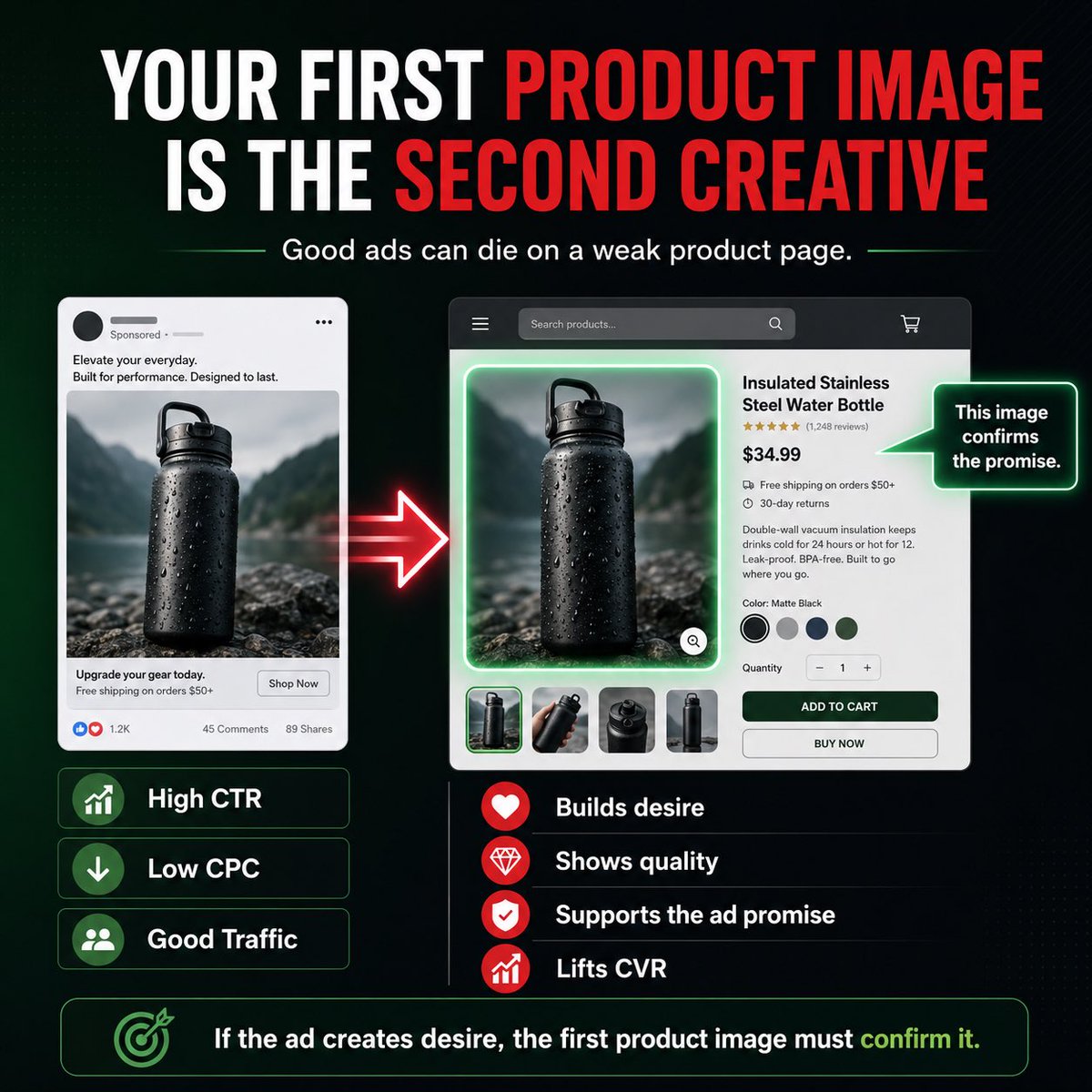
Your first product image is the second creative.
A lot of people think the job of the ad is just to get the click, but once the person lands on the page the first product image immediately takes over, and if that image does not make the product feel clear, desirable and easy to understand, a lot of good traffic dies in the first few seconds.
You can have a strong CTR, low CPC and solid traffic quality, and still struggle because the first image on the page looks too basic, too generic or simply does not show the product in the best possible way.
That first image should not just exist because every product page needs one.
It should do a job.
It should instantly show what the product is, how it looks, how it feels, why it is different and why the person should keep scrolling instead of bouncing.
If the ad created the desire, the first product image has to confirm it.
If the ad promised quality, the image has to make that quality feel real.
If the ad sold a transformation, the image has to support that story instead of making the product feel flat.
This is why I look at the first product image almost like I look at a creative.
Because in many cases it is not really part of the page only.
It is the second creative in the funnel.
And sometimes fixing that one thing does more for CVR than changing ten ads.
#ecommerce #mediabuying #meta #shopify #growth #cny #d2c #dropship #dropshipping #ecom
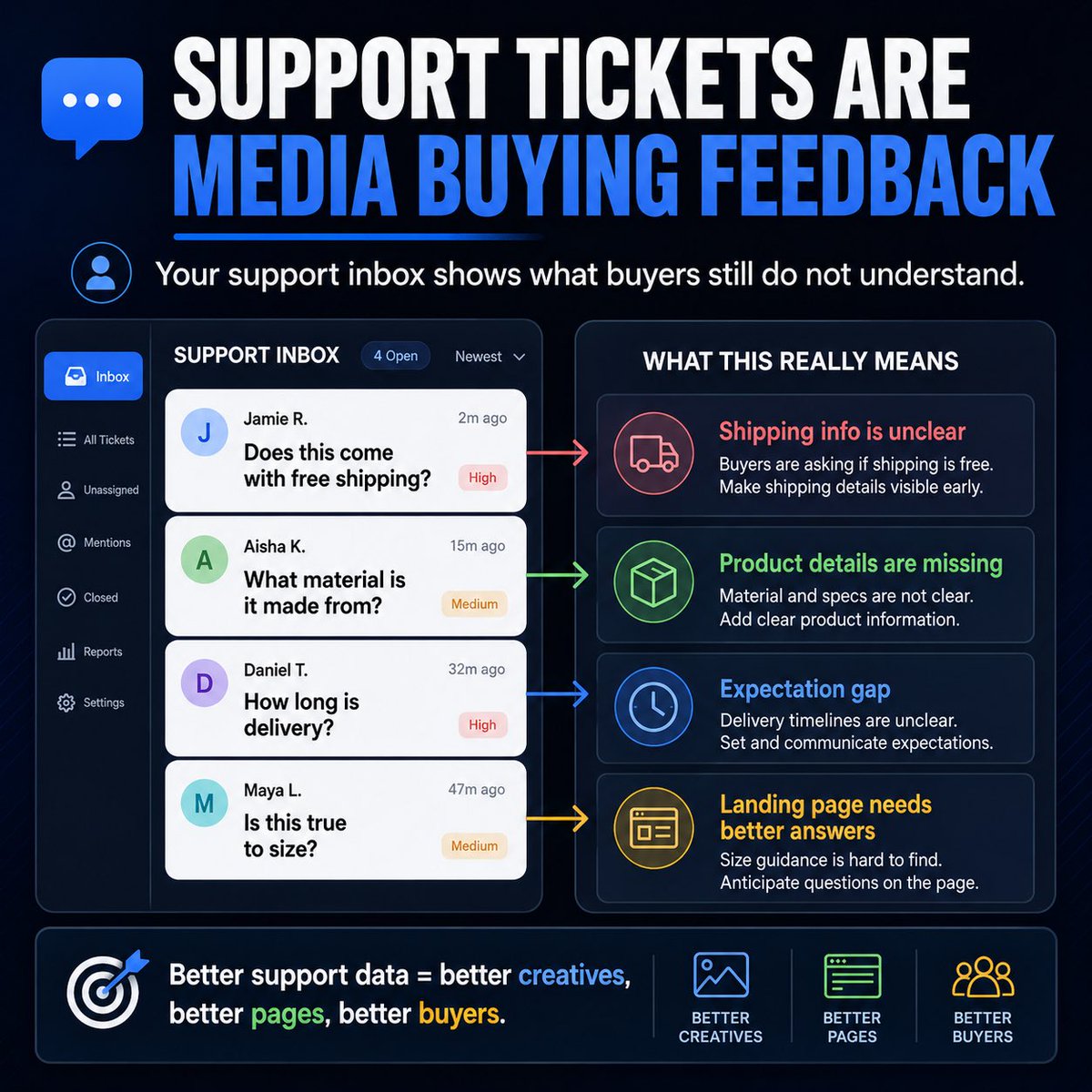
Support tickets are media buying feedback.
A lot of people treat customer support like something that happens after the sale, but for me it is one of the clearest places to understand why buyers hesitate before buying.
If people keep asking about shipping, then shipping is not clear enough.
If they keep asking about materials, then the product page is not explaining the product properly.
If they keep asking about sizing, delivery time, guarantees or how the product works, then those are not just support questions.
Those are conversion problems.
And the best part is that the buyer is literally telling you what is missing.
You do not need to guess every objection from your head when the support inbox, comments, reviews and DMs are already showing you what people are unsure about.
That feedback can become better product page sections, better creative angles, better FAQs, better hooks and better trust builders inside the funnel.
Good media buying is not only looking at Ads Manager.
It is reading every place where the buyer shows friction.
Because if 20 people ask the same question, that question should not stay only in support.
It should be answered before the next buyer even has to ask.
#ecommerce #mediabuying #meta #shopify #growth #cny #d2c #dropship #dropshipping #ecom
A buyer can survive a mediocre ad, but a bad checkout kills the sale fast.
One thing I keep seeing is people blaming Meta, creatives or targeting too early, while the real problem is that the buyer journey breaks right at the moment when the customer is finally ready to pay.
The ad does its job.
The product page does enough.
The customer adds to cart.
Then checkout ruins everything.
Shipping suddenly feels too expensive, delivery time is not clear, taxes appear late, payment options feel weak, trust is missing, or the final price simply looks different from what the buyer expected a few clicks earlier.
That is why I always say checkout is not some small backend detail, because in ecommerce it is part of conversion and part of media buying too.
You can have strong CTR, healthy CPC, solid ATC rate and still lose money if the final buying step creates doubt.
A lot of stores do not have a traffic problem.
They have a trust problem at the end of the funnel.
And the worst part is that this type of issue is expensive, because you keep paying for traffic while the buyer keeps finding a reason not to finish the order.
If your checkout has friction, your ads are basically sending qualified people into a leak.
Before changing campaigns again, first check what the buyer sees in the last 30 seconds before payment.
Sometimes the problem is not how you got the click.
It is what happens after it.
#ecommerce #mediabuying #meta #shopify #growth #cny #d2c #dropship #dropshipping #ecom
#PureMediaBuyingValue Day 41
Omnichannel is not about being everywhere.
It is about making sure every channel helps the buyer move closer to purchase instead of each channel acting like a separate business.
A lot of ecommerce brands think omnichannel means running Meta, Google, TikTok, email, SMS, affiliates and influencers at the same time, but if the message is different everywhere, the offer is not aligned and the buyer journey feels disconnected, then you do not have omnichannel, you just have traffic coming from many places.
Meta can create demand.
Google can capture demand.
Email and SMS can recover and retain demand.
Influencers can build trust.
Organic can warm people up.
Retargeting can bring them back when they are closer to buying.
But all of that only works properly when the customer sees one clear story across the whole journey.
If the ad promises one thing, the landing page says another thing, email pushes a different offer and retargeting uses a completely different angle, the buyer gets confused and confused buyers do not convert as easily.
Good media buying is not only managing campaigns inside one platform.
It is understanding how every touchpoint affects the final decision.
Because most buyers do not purchase after seeing one ad one time.
They see the ad, visit the site, leave, check reviews, see retargeting, open an email, search the brand and then maybe buy.
That is why omnichannel matters.
Not because every brand needs to be on every channel.
But because every channel you use should make the buyer journey clearer, not more confusing.
#ecommerce #mediabuying #meta #shopify #growth #cny #d2c #dropship #dropshipping #ecom
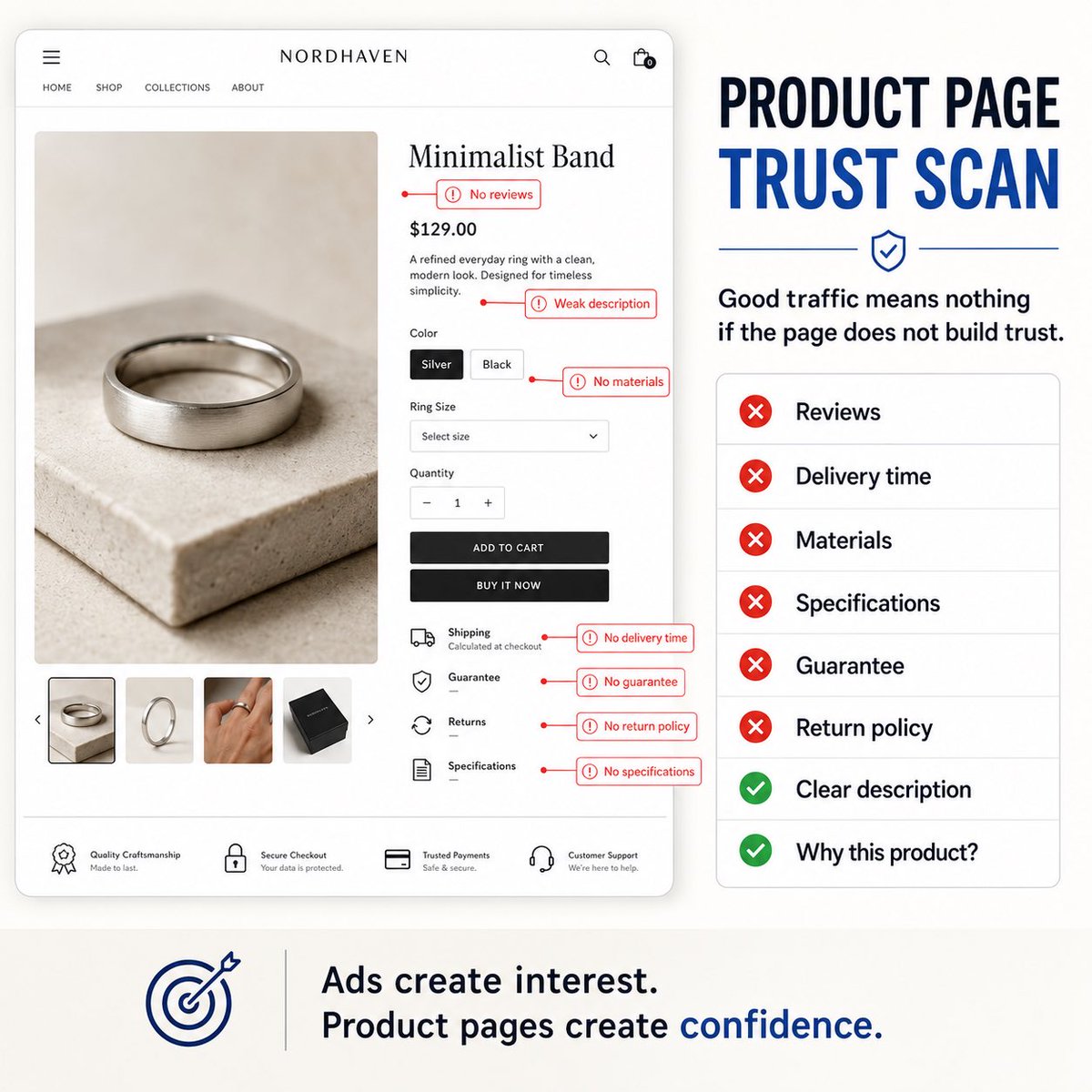
The product may be good, but the page does not prove it.
A lot of stores have products that can actually sell, but the product page does not give the buyer enough reasons to trust the purchase.
No reviews.
No clear delivery time.
No materials.
No specifications.
No guarantee.
Weak description.
No real explanation of what makes the product different.
And then everyone starts blaming Meta because the campaign has traffic, clicks and sometimes even add to carts, but the buyer reaches the page and still has too many unanswered questions before they feel safe enough to buy.
That is why product page trust is part of media buying.
If the ad creates interest but the page does not create confidence, the funnel will leak no matter how many creatives you launch.
People do not buy only because the product looks nice.
They buy when the page removes enough doubt.
A good product page should answer the questions the buyer is already thinking:
What is this made from?
Will it work for me?
When will it arrive?
Can I trust this store?
What happens if I do not like it?
Why should I buy this one and not another one?
If the page does not answer those questions, the buyer has to guess.
And confused buyers usually do not buy.
#ecommerce #mediabuying #meta #shopify #growth #d2c #dropship #dropshipping #ecom
#PureMediaBuyingValue Day 40
One product can have multiple buyers, but not every buyer is buying it for the same reason.
This is something a lot of brands miss when they test creatives, because they keep pushing one main angle and assume the whole market reacts to the product in the same way.
But one avatar might care about price.
Another avatar might care about convenience.
Another one might care about status.
Another one might care about solving a very specific pain.
And another one might already want the product, but needs proof, trust or a stronger reason to buy now.
That is why different avatars need different creatives, because if you only speak to one type of buyer, you are not really testing the full market, you are only testing one version of the demand.
Same product.
Different reasons to buy.
Different hooks.
Different objections.
Different emotional triggers.
A good media buyer should not only ask “is this product working?”
They should ask “which buyer is this product working for?”
Because sometimes the product is not dead.
You are just speaking to the wrong avatar.
#ecommerce #mediabuying #meta #shopify #growth #cny #d2c #dropship #dropshipping #ecom
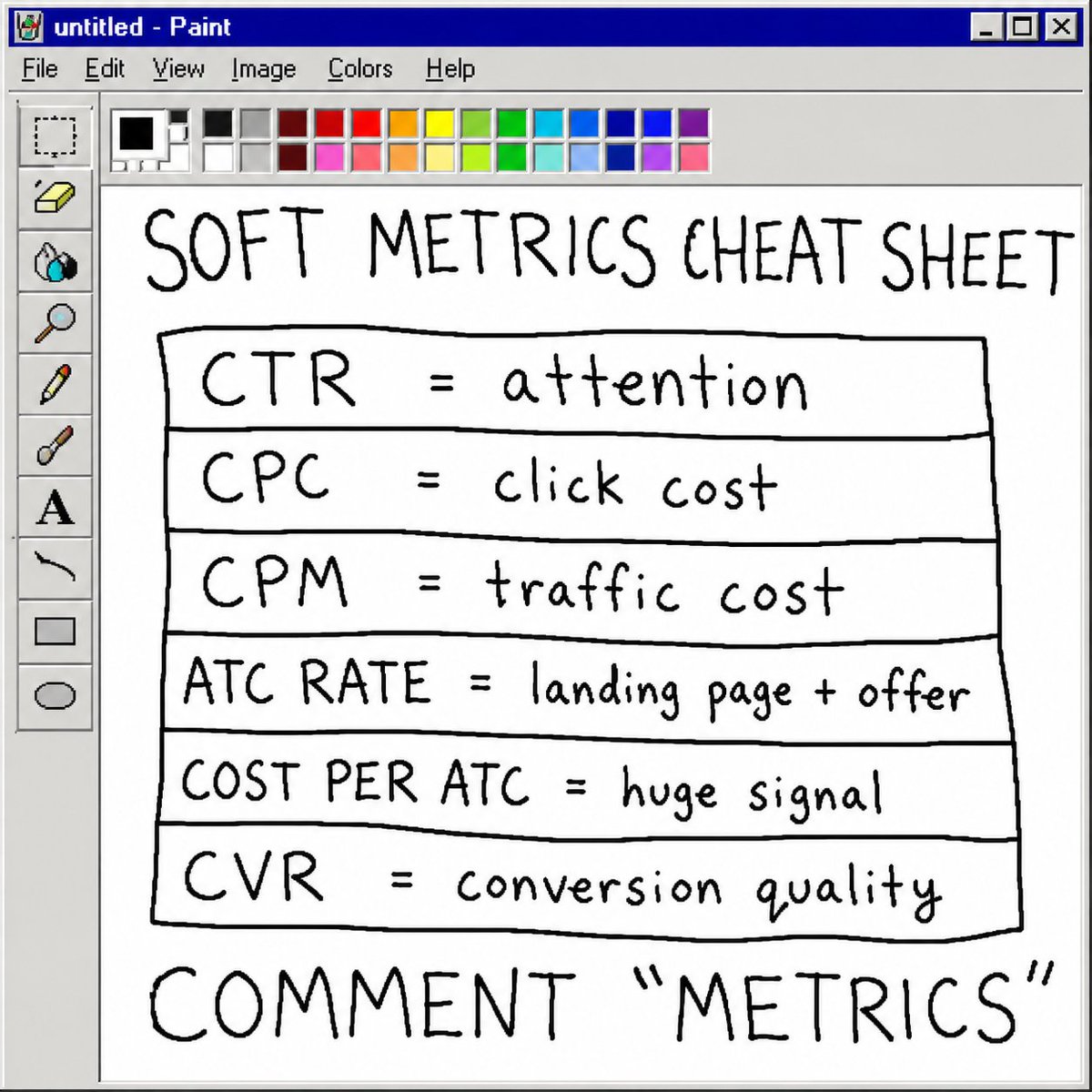
ROAS is late.
Soft metrics speak first.
Most people wait for purchases before they decide if a campaign is good or bad, but in reality the funnel usually starts showing the problem much earlier through CPM, CPC, CTR, landing page views, cost per ATC, ATC rate, checkout rate and CVR.
If CTR is low, the creative probably does not have a strong enough hook or angle.
If CPC is too high, the audience or creative is too expensive to reach.
If people click but do not land, the page might be slow or broken.
If ATC rate is weak, the product page is probably not creating enough trust, desire or clarity.
If checkout rate drops, the cart, shipping, price or payment flow might be creating friction.
That is why I made a simple Soft Metrics Cheat Sheet For Meta Ads.
Nothing fancy.
Just a practical breakdown of what each soft metric usually tells you, where to look when something is off and how to avoid killing campaigns only because ROAS has not shown the full answer yet.
Good media buying is not guessing.
It is reading the path before the final result appears.
Comment METRICS and I’ll send it over.
#ecommerce #mediabuying #meta #shopify #growth #d2c #dropship #dropshipping #ecom