Tracking #EconTwitter | PhD'ing at @Econ_OsloMet
| Alumni of @azimpremjiuniv and @Lunduni_LUSEM | Former RA at @EfD_initiative and Lamp fellow @PRSLegislative
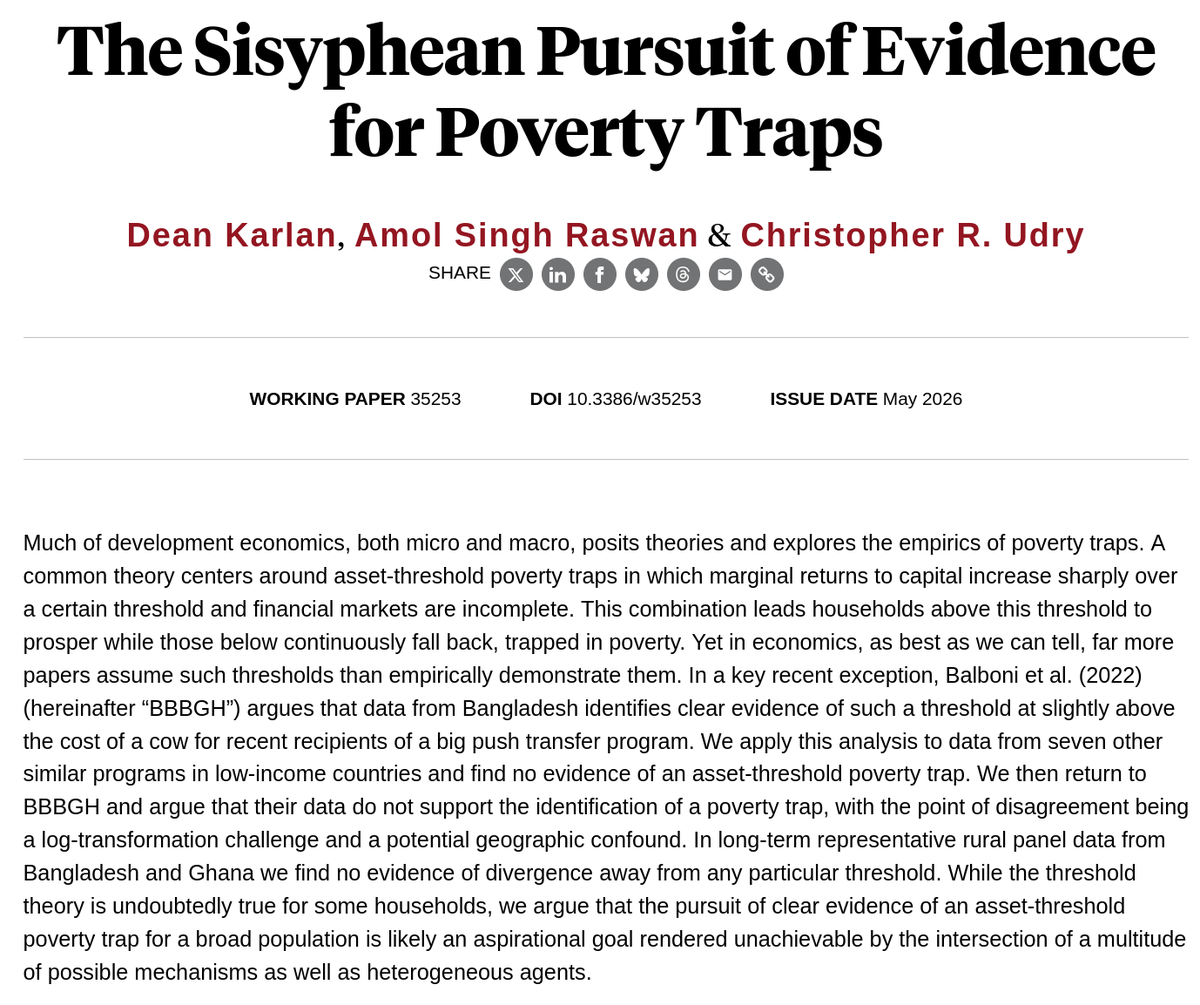
New working paper with @AmolRaswan and Chris Udry: "The Sisyphean Pursuit of Evidence for Poverty Traps."
A central idea in development economics is that poverty can trap people. We went looking for the cleanest evidence. Here's what we found – and didn't.
For researchers, professors, scientists, or anyone working with GIS data in India --> this thread is for you.
I spent 4-5 years working with Indian geospatial data, and something was missing.
Here's what I built and why.
https://t.co/fOPBW2QWPZ
When AI first arrived on the scene, I worried it would make economists, or even critical thinkers more broadly, less valuable. In my travels in the past 6 months to work with non-profits, for profits, and government agencies, I have observed how people are actually using AI. I have watched them fumble around with insights they clearly did not create themselves.
My fears are now assuaged. One observation is that AI can produce something that in some cases is very wrong and in others looks nearly right, but is not quite there. Even if in time AI improves to "nearly right" or "exactly right" every time, a second issue still arises: explaining the materials.
Explaining why an answer is almost correct but subtly off requires exactly the critical thinking skills that created the knowledge in the first place. Even explaining "exactly right" material takes critical thinking. I've watched smart people confidently present AI-generated material they clearly don't fully understand. The words sound right. But when someone pushes back just a little bit, the sand castle crumbles.
It is quite difficult to defend what you didn't build. This leads me to now make the optimistic case for human expertise. The value of deeply understanding something — of having built the knowledge yourself — hasn't diminished with AI. If anything, it's increased. The people who can tell the difference between "nearly right" and "right" are more valuable than ever. The people who can explain the subtle details about something that is exactly right are invaluable.
Creating knowledge still matters. Maybe now more than ever.
From @ATabarrok : "The Government of India’s Ministry of Statistics and Program Implementation has created an impressive Model Context Protocol (MCP) to connect AI’s to Indian datasets. An AI connected to data via an MCP essentially knows the entire codebook and can make use of the data like an expert. Once connected one can query the data in natural language and quickly create graphs and statistical analysis. I connected Claude to the MCP and created an elegant dashboard with data from India’s Annual Survey of Industries." (link below fold):
https://t.co/KUUdJfwrGS
I wrote a decent paper with AI.
It took me about 3 hours from start to finish, including an interactive choose-your-own-border-RD-adventure, it’s a what are we even doing here kind of day.
Big thanks to Prof. @FenellaCarpena for playing a central role and generously working to make this conference a success. Thanks to my colleague and co-organizer Workineh Ayenew for his great partnership. #econ#oslomet
I had the pleasure of presenting and co-organizing my first academic event: PhD Workshop in Development and Environmental Economics at OsloMet. We hosted nine PhD students working on topics in development and environmental economics, many using publicly available data like DHS.
My main takeaway: move beyond documenting the negative impacts of climate change and think abut how they can be mitigated, a point articulated by our keynote speaker Prof. @kotsadam.
Last semester I taught PhD environment & development. All material is available on my github. If you have suggestions (papers, topics, etc), let me know. Hope it's helpful!
Thank you to those who provided reference material to build the course.
https://t.co/jSh9oQJf33
📚 Sharing the IDinsight technical bootcamp 📚
https://t.co/FUgwZ1PDup
We're excited to share our technical bootcamp, which teaches how to design and run applied empirical studies - previously available only to new IDinsight staff - now freely available to everyone.
The bootcamp includes 17 lessons that roughly follow the phases of a study (some are generic for any project involving data collection and analysis, others are specific to methods, e.g. impact evaluation, survey sampling, or process evaluation). Each lesson is broken down into 5-10 minute videos, with quizzes, assignments, template Stata code, and links to relevant external resources.
The lessons include:
1: Intro to #Stata and Stata Best Practices
2: Evidence Review
3: Theory of Change
4: Causal Inference
5: Process Evaluation Design
6. Statistical Inference
7: Sampling for Surveys
8: Power Calculations
9: Designing Causal Evaluations
10: Collecting High-Quality Data
11: Questionnaire Design
12: #SurveyCTO
13: Qualitative Methods
14: Data Cleaning
15: Data Analysis
16: Data Visualization
17: Cost-Effectiveness Analysis
No login is required. You can jump to any lesson that you might find useful without needing to complete earlier lessons.
The boot camp is a work-in-progress. It has been a side-of-desk labour of love for a long time, so stay tuned for new lessons and content.
Thank you to everyone who contributed to creating lessons and developing content over the years!
One of the more wrong headed and dangerous pieces of policy analysis I have seen in a while - it is truly frightening how little the Indian government cares about the health of its people. Why? (1/4)
Are you interested in the intersection between environmental and development economics in the Global South? Then come to Gothenburg and work as a research assistant in @EfD_initiative
https://t.co/j3FAKPf79Y
Want some respite from the mayhem? Here is a series of essays on 29 distinguished Indian economists from the past, whose work still informs our present. More entries will be added in the coming months. What follows is a thread on the individual entries.
https://t.co/Xyku6F9lOl
New paper by @eeemda: Teacher absenteeism in India decreases the year before an election and is higher the year after an election with inconsistent effects in the private sector--lending support for a channel of political control in the public sector.
As we commemorate International Women’s Day, we at EfD celebrate the outstanding research contributions of the women in our network, who continue to thrive despite the structural inequalities that, unfortunately, still persist in academia—particularly in economics.
🧵