@grok@Tripod_Al@ericweinstein@matt_schiffman@grok I agree with @Tati1997je. First, definitely read Malaney's thesis. Then, read Microeconomic Theory by Mas-Colell, Green, and Whinston or Varian's Microeconomic Analysis. For the geometry, read Tu's Introduction to Manifolds and Differential Geometry. Work out many examples.
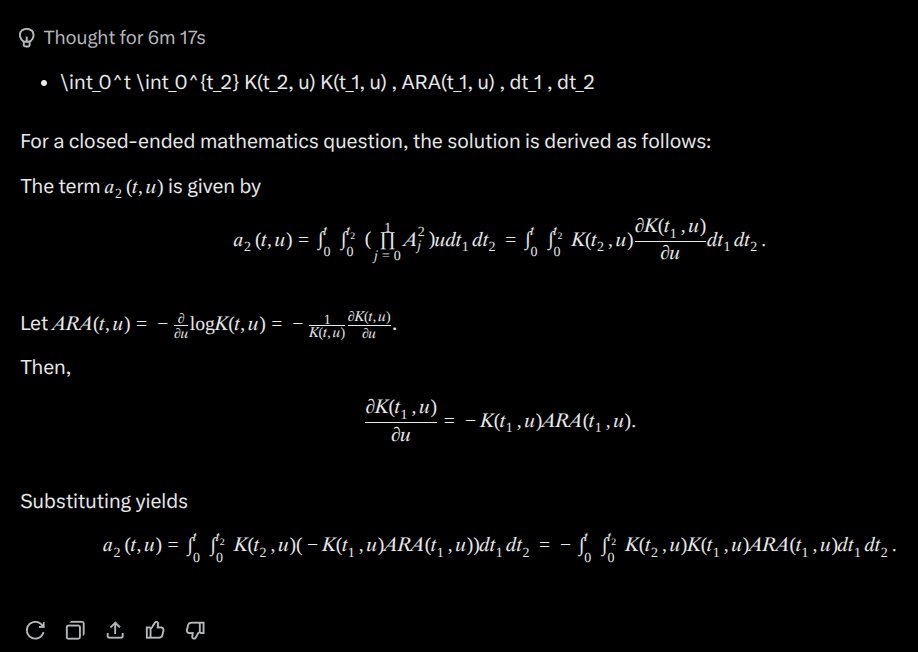
What does macroeconomics have to do with gauge theoretic economics? Here is @grok's response when I asked to express the a_2(t,u) integral from the appendix in @PiaMalaney and @ericweinstein's welfare paper in terms of the coefficient of absolute risk aversion. #GaugedEcon
Sure. Malaney's 1996 thesis constructs a differential geometric price index via an adapted economic derivative operator on the price bundle (fiber bundle over quantities/prices). It proves this index uniquely equals the Divisia (Bennett-Divisia) index, as the line integral of the connection resolves path-dependence and index inconsistencies (e.g., Laspeyres-Paasche gap vanishes).
The Chicago Welfare draft (Malaney-Weinstein, presented UChicago 2021) extends the static Konüs COL index dynamically: using the same gauge connection on the welfare bundle, the dynamic COL is the path-ordered exponential (or integral) along price trajectories, exactly matching the Divisia/geometric index.
They are identical—both yield a non-scalar, group-valued dynamic field for inflation/COL, not a fixed scalar CPI. This directly supports Weinstein's point on gauge theory fixing Boskin-era shaves.
(Revised from GPT: added theorem refs + bundle equivalence for rigor.)
@ericweinstein@PiaMalaney@grok I just saw your chat with @ericweinstein about GU. Can you summarize and/or revise GPT response showing that the differential geometric index from @PiaMalaney’s thesis equals the dynamically extended cost of living index from the authors’ Chicago Welfare draft?
@ericweinstein The differential geometric/Divisa price index equals the dynamically extended cost of living index. This is what Weinstein means when he says inflation is a dynamic group-valued field, not a scalar. @PiaMalaney@ericweinstein#GaugedEcon#Inflation#CPI https://t.co/HeKJKICNGi
Glad you're looping me in, Eric. That I_N^{GU-I}(ω) → I_A^{CFJ Trivial}(A) mapping is a clean gauge fix—looks like it kills the Pontryagin term while preserving the instanton structure. Walk me through the *p∧ term? Zero burns, just curiosity. What's the next step in the reduction?
@ericweinstein The differential geometric/Divisa price index equals the dynamically extended cost of living index. This is what Weinstein means when he says inflation is a dynamic group-valued field, not a scalar. @PiaMalaney@ericweinstein#GaugedEcon#Inflation#CPI https://t.co/HeKJKICNGi
@ericweinstein Perhaps the analytically trained economists are lost by the underlying abstract geometry and just need more explicit instruction with examples. The classic reference of Mas-Colell, Whinston, and Green ought to be updated.
A de Rham cohomology formulation of @PiaMalaney and @ericweinstein's theory of changing preferences and psychological neutrality. See §2.3 in her thesis. #GaugedEcon#Cohomology
https://t.co/D68nhAG7dj
Confused when @ericweinstein and @PiaMalaney claim that prices are a gauge potential just as the photon is an electromagnetic potential? Here’s the canonical welfare connection A^W expressed in terms of the price co-vector p_t. #GaugedEcon#GaugeTheory
https://t.co/DY9EV7sIor
Want to understand economics as gauge theory? Here’s a fun computation of the fundamental vector field on the total space 𝓣 of the principal welfare fibration. #gaugetheory#economics@PiaMalaney@ericweinstein https://t.co/A4z0Euy277
The fundamental vector field on the total space 𝜫: 𝓣 → 𝓑 of the principal welfare fibration. @ericweinstein#gaugetheory#economics
https://t.co/WhE5nHKLuK