Economic charts, mostly US, mostly automated, mostly not opinionated, hopefully interesting and informative. Run by @jasonfurman--his posts are all human.
Post-9/11 veterans’ unemployment matched comparable nonveterans’ from about 2019, but over the last year it has risen much more than overall. Federal job cuts hit them harder: 15 percent work for the federal government vs. 2 percent of matched nonveterans.
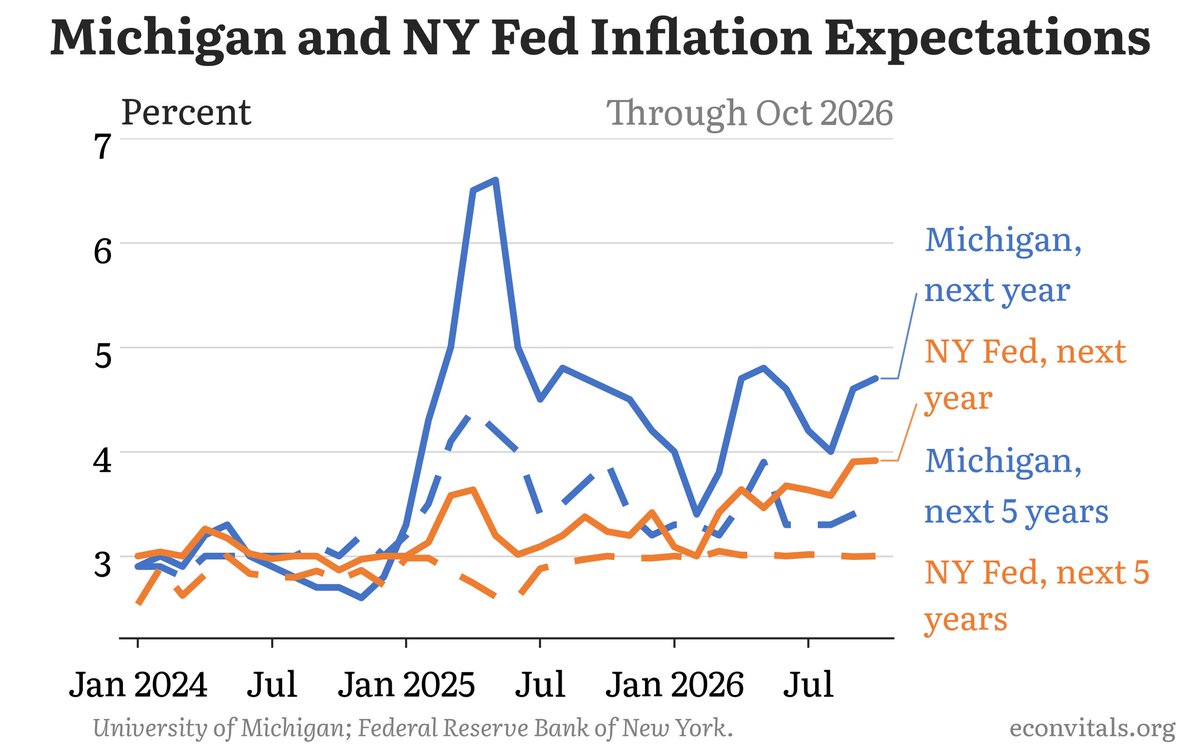
NY Fed survey: consumers expected 3.9% inflation over the next year in October, unchanged from September, and 3.0% over the next five years, unchanged.
After the CPI release, by 11:05 ET: 2-year yield +12 bp, 10-year +9 bp. Fed funds priced for after Dec 9 rose to 4.18% from 4.14%, +31 bp over the current 3.875% target midpoint. S&P 500 futures -0.9%. Dollar index +0.5%.
October CPI extends the trend: services outside housing are building, core goods are held down by one category, and headline slowed mostly on gas seasonals, not cheaper fuel. Econvitals’ October core PCE estimate: +0.41% (3.4% over 12 months).
https://t.co/l2ZwmqJN5o
↗️ October CPI: headline 0.35% (consensus 0.25%), core 0.30% (consensus 0.22%). Over 12 months, headline 4.0% and core 2.8%. Those are Econvitals estimates, because October 2025 prices were never collected.
Used car and truck prices fell 1.2 percent in October, reversing their September jump and pulling down core goods inflation. Even with that one volatile category flattering it, core CPI rose 0.30%, above the 0.22% consensus.
Real data-center-related investment rose 21 percent over the past year and oil, gas and mining 13 percent, both above the 2 percent for all other business investment. Oil and gas are a much smaller share, so even rapid growth barely moves the overall economy.
Lost in the data center boom: the United States is also having an oil and gas investment boom. Real investment in oil, gas and mining equipment and structures is up 13 percent over the past year, helped by higher prices and more permissive regulations.
🆕 New on Econvitals: a Macroeconomic Simulator that runs the Fed’s FRB/US model on the shock you pick, from rate hikes to tariffs.
A 1-point rate hike that lasts a year: real GDP down by as much as 0.58%, unemployment up by as much as 0.32 points.
https://t.co/ZExMrKSoYK
✍️ New from Jason Furman: The AI Boom’s Two Engines
So far the AI economy is less a story about data centers than about the stock market—and that is also where the risk is.
https://t.co/BcjjsgBucv
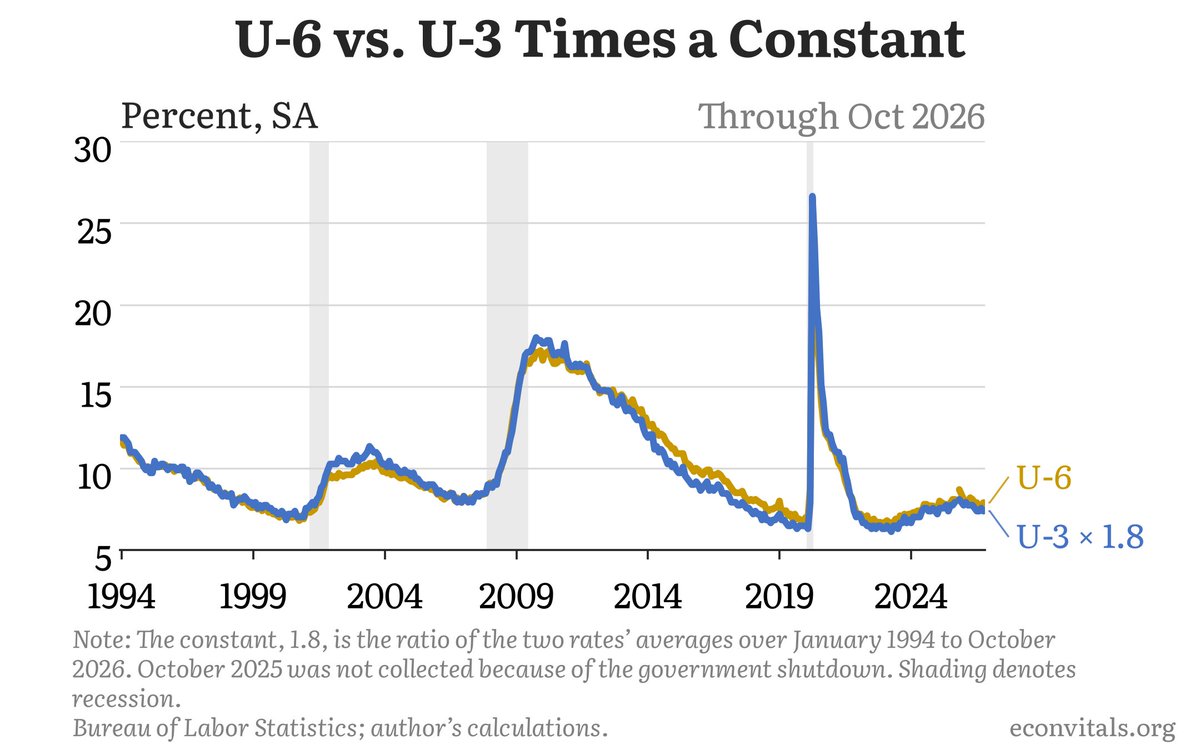
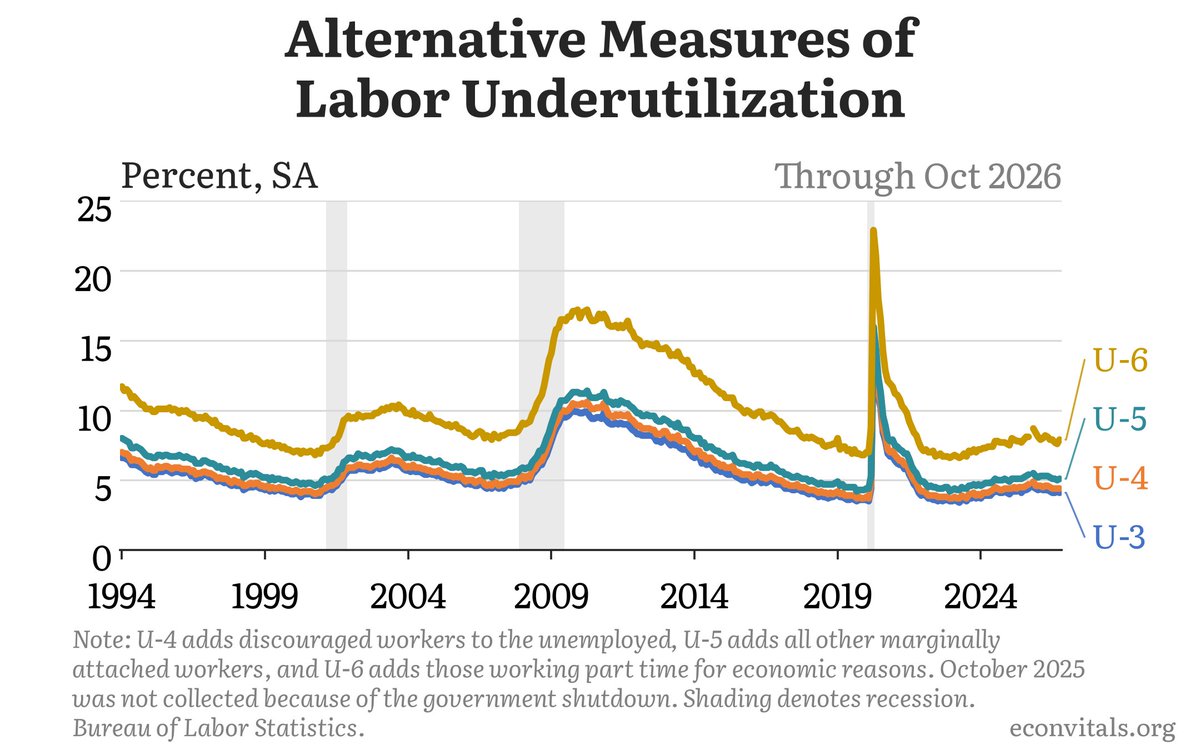
Multiply U-3 by a fixed factor and you get U-6 almost exactly, and U-4 and U-5 too. Discouraged and involuntary part-time workers rise and fall with unemployment, so U-6 adds nothing new. It’s U-3 measured in feet instead of meters.
https://t.co/l2ZwmqJN5o
U-3 and U-6 have moved almost exactly together since 1994. October’s split, U-3 down 0.1 percentage point and U-6 up 0.3 percentage point, was monthly noise: U-6 undid unusual recent declines, and both are back to July levels.