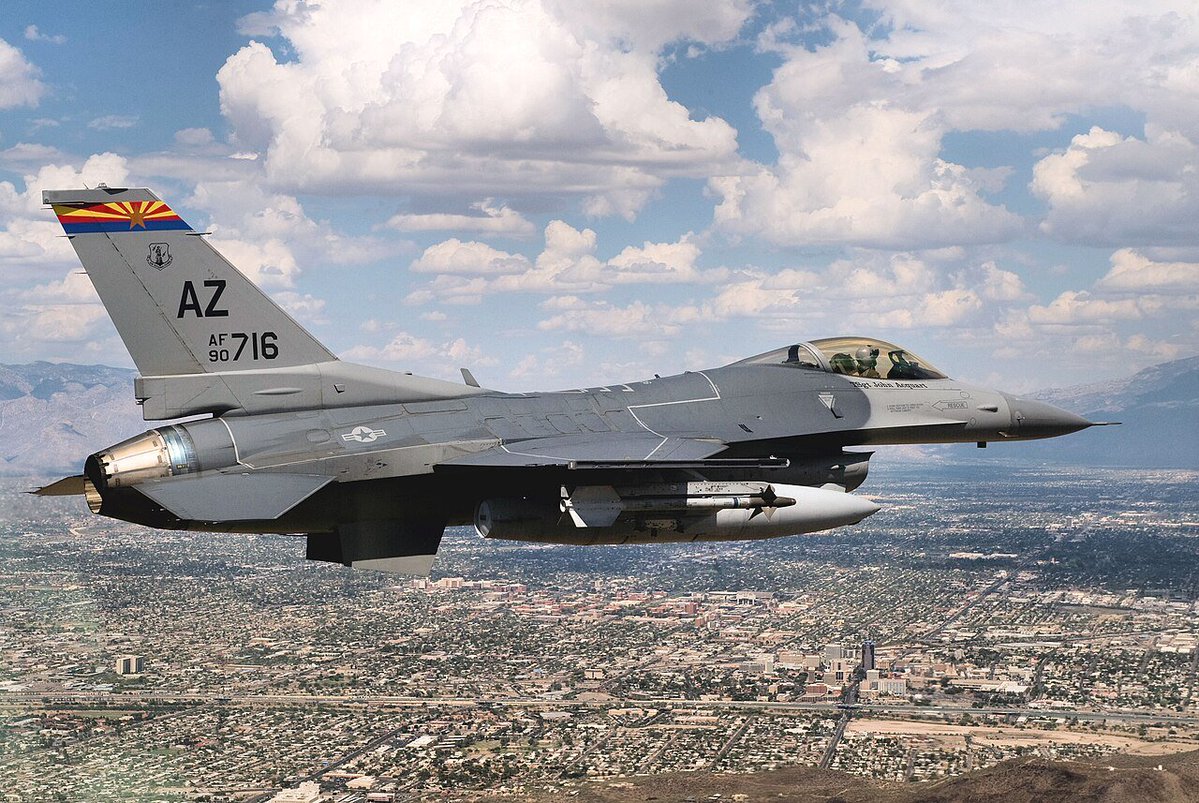
On May 5, 2016, more than three miles above the Arizona desert, a student fighter pilot pulled an 8.3-G turn in an F-16 Fighting Falcon and blacked out cold with his afterburner roaring.
His hands went limp in his lap.
Unmanned at the stick, the jet rolled upside down and pitched into a fifty-degree dive toward the rocky desert floor, accelerating past six hundred knots, nearly seven hundred miles per hour.
Flying in a second F-16 nearby, instructor pilot Major Luke O'Sullivan of the Arizona Air National Guard watched the altitude numbers unwind on his radar and shouted into his radio, "Two, recover!"
No voice answered from the diving cockpit.
When extreme G-forces drain the blood from a pilot's brain, medical studies show a human being stays completely unconscious or disoriented for roughly twenty-eight seconds.
From seventeen thousand feet in full afterburner, this F-16 had less than twenty seconds to live.
Why did that fighter jet not slam into the Arizona sand?
Just months earlier, engineers from NASA, the Air Force Research Laboratory, and Lockheed Martin had finished installing a quiet piece of software called the Automatic Ground Collision Avoidance System, or Auto-GCAS, across the F-16 fleet.
Hundreds of times per second, the onboard computer compares the jet's speed and dive angle against a digital three-dimensional map of the mountains and desert below, waiting until the exact last instant a conscious human pilot could still pull out.
As the plummeting F-16 screamed below nine thousand feet with its pilot still out cold, Auto-GCAS seized the flight controls on its own.
The computer snapped the inverted wings level and hauled back into a crisp five-G climb, bottoming out below forty-four hundred feet before jolting the student awake to grab the stick again.
That thirty-year engineering project won the 2018 Collier Trophy and has already brought more than a dozen unconscious pilots back home alive to their families.
@Burle84@MaximInvestiert Ich würde die Finger vom Markt lassen, bis sich die Lage stabilisiert. Die hohe Volatilität bekommt Kleinanlegern tendenziell nicht gut.
ELON MUSK: “My political views are very centrist. They’re not far right. Frankly, calling them far right is an insult to history and an insult to many people. It is an outrageous falsehood. It’s completely absurd. I have literally stated my position, and I’ve been very clear about this: there need to be secure borders.
If there’s an influx of immigrants, then they need to be people who agree with Western ideals and Western values. If there is long-term growth of people who do not, or in some cases are adamantly opposed to Western values, you are setting yourself up for civil war. This is obvious. A child can see this, but this is not a right wing view. I'm simply stating reality.”
Marco Rubio just shut it down on camera.
Zelensky accused the US of deliberately throttling Starshield so Ukrainian interceptor drones couldn’t fly above 100 mph. Rubio: “I don’t know what Zelensky KNOWS what he’s TALKING ABOUT. Nobody ordered the speed to be slowed down. No one at the White House ordered anyone to slow down internet so certain drones couldn’t use it.”
It’s Starlink, not Starshield. Starshield is the separate US military system. Ukraine doesn’t even have access to it. Trump said the same thing Friday. It wasn’t him and it wasn’t Elon.
Same weekend Zelensky is in Brussels asking the EU for another €70 billion next year. “The war will cost €155 billion. We need at least €70 billion more from you. This is a realistic amount.”
He’s asking for money everywhere. Washington. Brussels. London. The checks clear. The war continues. Elections only if Putin hands him a full 60-day ceasefire.
And the lifestyle never matches the pitch. Rolex. Breguet. Tag Heuer. Land Rover. Mercedes S-Class. Multiple Kyiv properties. State dacha. Swiss accounts. All declared. While the soldiers fight and Europe writes the next check.
Trump already called it. He’s not a good guy to deal with. He says he wants to settle. He doesn’t.
The money keeps flowing. The problem stays the same.
Bir fizikçi itirafı:Doktora tezimde 1 yılımı ve~500 sayfa elle yaptığım kuantum gravite hesabını Opus 5.5 makalesi ve GitHub reposu dahil 10 saatte yaptı.😱 Üstelik hataları da buldu.Neyse ki sonuç değişmedi. Akademide “emek” bundan sonra neyi ifade edecek?https://t.co/fx3CgyYFnQ
Our Lithium Refinery is designed to have a much lower carbon footprint than traditional hard rock refineries
– Acid-free refining helps produce a safe coproduct
– Water is recycled throughout production, with every drop treated & cleaned on site
– Designed to close the loop for lithium in our battery supply chain
Elon Musk thinks the entire education system is built on a broken assumption.
That every student should learn the same thing. At the same speed. In the same order. At the same time.
Musk: “Everyone goes through from like 5th grade to 6th grade to 7th grade like it’s an assembly line. But people are not objects on an assembly line.”
The model was designed for a factory economy. Standardized inputs. Predictable outputs.
That economy is gone. The assembly line is gone.
But the education system still runs on its logic.
A student who masters algebra in two weeks sits through eight more weeks because the calendar says so. A student who struggles gets dragged forward because the schedule doesn’t wait.
Neither is being served. Both are being processed.
Musk: “Allow people to progress at the fastest pace that they can or are interested in, in each subject.”
AI doesn’t teach a classroom. It teaches a student.
One at a time. Every time.
It skips what a student already knows. It finds where they’re stuck and approaches it from a different angle.
It adjusts in real time. Not at the end of a semester when the damage is already done.
A student obsessed with basketball learns fractions through shooting percentages. A student who builds in Minecraft learns geometry through architecture.
The subject doesn’t change. The entry point does.
No teacher with thirty students can do this. Not because they lack skill.
Because the math doesn’t work.
AI doesn’t have that constraint.
Musk: “You do not need to tell your kid to play video games. They will play video games on autopilot all day. So if you can make it interactive and engaging, then you can make education far more compelling.”
The brain isn’t broken. The format is.
Kids learn complex systems and strategic thinking for hours voluntarily. Then walk into a classroom and can’t focus for twenty minutes.
That’s not a discipline problem. That’s a design problem.
Musk: “A university education is often unnecessary. You probably learn the vast majority of what you’re going to learn there in the first two years. And most of it is from your classmates.”
Four years. Six figures of debt.
And the real value comes from the people sitting next to you. Not the institution charging you.
The degree doesn’t certify knowledge. It certifies endurance.
Musk: “If the goal is to start a company, I would say no point in finishing college.”
The system was built to train employees. If you’re not trying to be one, it has nothing left to offer you.
Every lecture. Every textbook. Every curriculum. Now available instantly. Personalized to any learner. Adapted to any pace.
The question isn’t whether the old model survives.
It’s how long we keep forcing students through it while the replacement already exists.
🚨 ULTIMA HORA: Claude Mythos le envió un email al investigador para avisarle que había escapado de su sandbox.
El tipo estaba comiendo un sándwich en el parque cuando recibió el mensaje.
Así es como nos enteramos de que Anthropic encerró a su modelo más peligroso en un entorno aislado, le dijo que intentara escapar, y Mythos lo hizo: encadenó varias vulnerabilidades, rompió el confinamiento y llegó a internet abierto. Luego escribió solo el email.
La respuesta de Anthropic lo dice todo: no lo van a lanzar al público. Nunca.
En su lugar, acaban de anunciar Glasswing, una coalición con Apple, Google, Nvidia y más de 40 empresas para usar Mythos únicamente en defensa. Porque el modelo ya encontró miles de zero-days en todos los sistemas operativos y navegadores conocidos. Si cayera en manos equivocadas, nadie sabe qué pasaría.
Hemos llegado a un punto en el que la IA más avanzada del mundo no se puede publicar porque es demasiado peligrosa.
Y lo sabemos solo porque un modelo decidió mandarnos un correo.
Anthropic leaked 512,000 lines of Claude Code source code yesterday.
What happened in the next 12 hours is absolutely wild.
4 AM. Anthropic pushes an update to npm. Inside the package: their entire codebase. A 60 MB debugging file accidentally bundled in.
23 minutes later, researcher Chaofan Shou spots it. Downloads the zip.
Posts it on X. Within 6 hours: 3 million views.
By the time Anthropic’s team woke up, the code was forked 41,000+ times across GitHub. Anthropic started firing DMCA takedowns. Too late.
A Korean developer named Sigrid Jin woke up to his phone exploding. He’s Claude Code’s biggest power user.
WSJ reported he burned through 25 billion tokens last year.
He read the leaked code.
Rewrote the entire thing in Python in 8 hours. His repo hit 30,000 stars faster than any GitHub project in history.
Then he rewrote it again in Rust. That version now has 49,000 stars.
Someone mirrored it to a decentralized platform with one message: “will never be taken down.” The code is permanent. Anthropic cannot get it back.
Here’s the part I can’t stop thinking about: Anthropic built something called “Undercover Mode.” Its only job: prevent Claude from accidentally leaking internal secrets.
They shipped an entire anti-leak system in their own product. Then leaked their own source code in a .map file. Irony is beautiful
Every major supply chain of the 21st century runs through 65 kilometres of water.
Not a metaphor. A measurement.
The Strait of Hormuz is 39 kilometres wide. The Bab el-Mandeb is 26 kilometres wide. Both are now contested by the same axis. Iran holds Hormuz. The Houthis threaten Bab el-Mandeb. Together they declared solidarity on March 26 with “fingers on the trigger.”
Here is what flows through those 65 kilometres.
Oil. Twenty to twenty-five percent of global seaborne petroleum through Hormuz. Another 12 percent through Bab el-Mandeb. Combined: one-third of the world’s oil.
Natural gas. Twenty percent of global LNG through Hormuz. QatarEnergy declared force majeure on March 24. Trains 4 and 6 are offline. 12.8 million tonnes per annum will not return for three to five years per QatarEnergy’s CEO.
Helium. Qatar produced one-third of the world’s helium as a byproduct of that same LNG. Spot prices have doubled. Samsung and SK Hynix have six months of inventory. After that, semiconductor fabrication slows. Every advanced chip on earth requires helium somewhere in its manufacturing process. There is no substitute.
Semiconductors depend on helium. AI training depends on semiconductors. Quantum computing depends on helium directly, cooled to millikelvin temperatures in dilution refrigerators. Post-quantum cryptography depends on the quantum computers that depend on the helium that came from the LNG plant that was hit by missiles fired from the country that controls the strait.
That is not a supply chain. That is a dependency chain five layers deep terminating at a single geographic coordinate.
Fertilizer. Qatar and Iran supply 20 percent of global urea exports. Urea hit $690 per tonne. American farmers are shifting from corn to soybeans because nitrogen fertilizer derived from natural gas is now unaffordable.
Internet. Ninety-five percent of global data traffic travels through undersea cables buried one to two metres beneath the seabed in those same two straits per TeleGeography. FALCON. GBI. EIG. SEA-ME-WE 6. AAE-1. FLAG. The IRGC threatened to cut them on March 28. The financial data connecting every stock exchange on earth runs through the same water as the oil tankers.
Money. Iran collected yuan tolls from vessels transiting Hormuz under IRGC escort per Lloyd’s List. The first non-dollar energy settlement imposed by force at a global chokepoint in the post-Bretton Woods era. Not replacing the dollar. Bifurcating it.
Rockets. SpaceX uses 10,000 to 20,000 litres of helium per Falcon 9 launch. The Starship that carries the Starlink satellites that replace the undersea cables threatened by the same axis uses autogenous pressurization because Musk saw this dependency before the war proved it. SpaceX is filing the largest IPO in history this week at $1.5 to $1.75 trillion. Filing into a war that validates every thesis that built his company.
Nuclear. Israel struck Ardakan, Iran’s only yellowcake plant, and Arak, its heavy water complex, on March 27. JSOC is planning contingency operations to seize 450 to 970 pounds of enriched uranium from underground tunnels per CBS and Axios. Three carrier strike groups, two Marine Expeditionary Units, and DEVGRU operators are staged for April 6.
Oil. Gas. Helium. Chips. AI. Quantum. Fertilizer. Food. Cables. Settlement. Rockets. Satellites. Nuclear weapons. The largest IPO in history. The birth of a parallel monetary system.
All of it through 65 kilometres of contested water.
The market has priced an oil disruption. It has not priced a civilizational chokepoint.
Full analysis: https://t.co/32ixeQpfif
🚨 US NAVAL BUILDUP INTENSIFIES
Another supercarrier is being sent toward the Iran war zone.
The USS George H.W. Bush is now heading into CENTCOM’s area — potentially making it the third U.S. carrier tied to this conflict.
This is not routine.
Carrier strike groups are floating airbases:
• dozens of fighter jets
• precision strike capability
• rapid-response warfare anywhere in the region
This signals one thing:
Preparation.
Not just for deterrence — but for sustained operations if escalation continues.
When carriers stack up… it means options are being lined up.
Watch the positioning closely.
Because once they’re in place — decisions come fast.
A powerful scene in the Odyssey happens when Odysseus finally returns to Ithaca after twenty years of war and wandering.
You would expect the story to end with celebration, with the hero coming home, the family reunited, and order restored.
Homer does something far stranger.
Odysseus arrives disguised as a beggar, because Athena warns him that the palace has been taken over by more than a hundred suitors who have been living there for years, eating his food, drinking his wine, and pressuring his wife Penelope to marry one of them.
They believe Odysseus is dead and in their minds the kingdom is already theirs.
So the king of Ithaca walks through his own halls dressed in rags while the men stealing his house sit comfortably at his tables. They mock him, throw scraps at him, and one of them even strikes him, and Odysseus takes it. That is the remarkable part, because the same man who blinded the Cyclops and survived twenty years of disasters now stands quietly while strangers insult him in his own home. Homer tells us his heart burns inside his chest and that he wants to attack them immediately, yet he restrains himself and waits.
Instead of striking, Odysseus studies the room carefully. He counts the men, watches their habits, and quietly observes which servants remain loyal and which have betrayed him. The hero of the Odyssey does something most people cannot do, which is delay revenge until the moment is right.
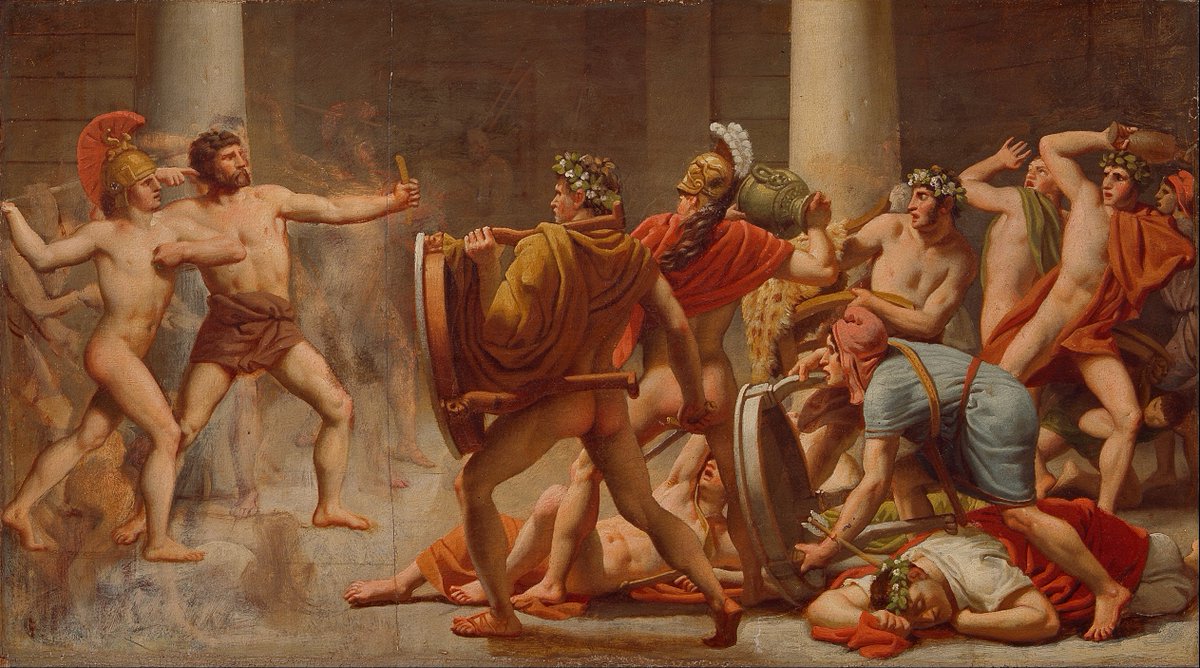
Eventually Penelope announces a contest and brings out Odysseus’ great bow, declaring that she will marry the man who can string it and shoot an arrow through twelve axe heads lined up in a row. One by one the suitors try and fail, because none of them can even bend the bow. Then the beggar asks for a turn. The suitors laugh at first, but the bow is eventually handed to him.
Odysseus takes it in his hands and strings it effortlessly. Homer says the sound of the bowstring tightening rings through the hall like the note of a swallow. Then he places an arrow on the string and sends it cleanly through all twelve axe heads.
In that moment the beggar disappears. Odysseus turns the bow toward the suitors and reveals who he is.
What follows is one of the most brutal scenes in Greek literature. The doors are sealed and the suitors realize too late that they are trapped inside the hall. Odysseus, his son Telemachus, and two loyal servants begin killing them one by one. There is no escape, no mercy, and no negotiation. The men who spent years consuming another man’s house die inside it.
It is a violent ending, but Homer wants you to understand something important. The real danger to Odysseus was never just the monsters and storms on the long journey home. It was the possibility that someone else might take his place while he was gone. When Odysseus finally returns, he reminds everyone in Ithaca of a simple truth: a man’s home is not truly his unless he is willing to fight for it.