1. Many people have DM’ed me about my Substack + the private X account since last night’s podcast.
While the Substack = long-form articles, the private X account has proven incredibly important this week.
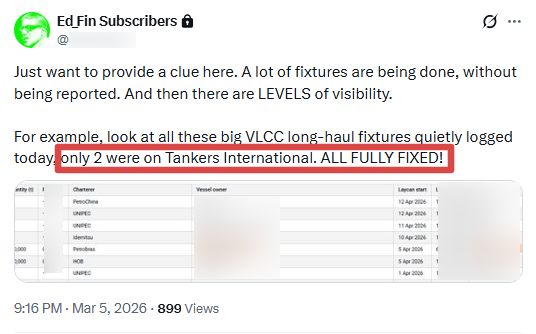
e.g. Yesterday, I shared new VLCC fixtures most people aren’t seeing:
This was a great weekend for determining who to mute. Those most eager to broadcast their vapid market takes did you a favor by identifying themselves so plainly. 🙏🏻
Offshore and Borr
Saipem's Scarabeo 9 won contracts for 8 firm wells this week, 5 of them TotalEnergies E&A wells in Suriname, Guyana’s neighbor. Suriname is gassier than Guyana so far but a 220k b/d oil project starts in 2028 and Petronas is now exploring w/ 7G drillship DS-18
Suriname is unlikely to match Guyana’s success, but the Dutch-speaking nation will be a meaningful source of deepwater rig demand for the next decade. Suriname’s discoveries are mostly 800–1,200m water depth, making it largely a drillship and semisub market, though Borr has had a jackup exploring shallow water prospects in Suriname for Petronas since July 2026, contracted through January 2027.
- Borr, a >$2B HY issuer, is a levered jackup pure-play: forward net leverage exceeds 7x, its equity trades with high beta, and its bonds now trade in low-to-mid 80s. The bonds sold off ~2 pts on 2027 EBITDA guidance flat to 2026, implying >7x net leverage persists another year and making downgrades to Caa1/CCC+ far more likely.
- Many credit funds are allergic to CCCs, but the rating isn’t sign of near-term restructuring. It signals the agencies question if the capital structure is sustainable, though some issuers recover. Borr has the liquidity to wait out the cycle and assets with strong earnings potential, but it needs jackup demand to cooperate. Historically, a Caa1/CCC+ issuer carries roughly a 15–30% chance of an LME or restructuring within three years. I believe its on the lower end of this range b/c there’s no JU orderbook.
- The Bear Case: Despite talk of 90% modern JU marketed utilization, Borr has only 52% contract coverage for 2027. They are having trouble getting to and above 80% utilization. Borr’s capital structure was arguably underwritten on demand from Aramco’s 13 million bpd capacity expansion (from 12 million bpd), roughly 10% (or more) of benign-market jackups, which was shelved in January 2024, two months after Borr’s debut HY deal.
Borr has a good, modern fleet. They need to be 85-90% utilization. They are adding work in the $130k’s. The question is whether there’s a bid at $110–120k that would fill the fleet to that level, or whether the gap left by weaker Middle East demand is too large to price through. The conflict has hit jackup demand in the Middle East, which accounts for 35–40% of the global market.
Prospector 5 may have contingent liabilities, pending the independent investigation. Oil underpins Gabon’s economy, so excessive fines risk being counterproductive and the insurance proceeds provide Borr liquidity.
- Bull Case: Borr closed on the acquisition of 7.5 net rigs in early 2026, all that have been paid for and have EBITDA upside. Their liquidity is adequate and not dependent upon an RCF. The benign jackup market doesn’t need a repeat of Aramco’s 40+ incremental rigs in 2022–23. Even a gradual 10-rig return would be material: 2–3% of global supply, and a larger share of the benign fleet.
If Borr can get to 85-90% utilization at merely $120-$130k dayrates, net leverage improves to 4-5x which is still leveraged but more sustainable than current forward levels.
- In distressed credit, fundamental analysis often becomes less relevant. In this universe, credit performance relies upon understanding the equity sponsor’s option value per the terms of the indenture and anticipating how they’ll use it. If you look at Borr’s bonds, you need to understand the indenture and that not every rig sits in the collateral package for the senior secured notes.
“In the first half of November, 184 container ships carrying 2.1m TEU transited the Suez Canal. That is 131,000 TEU/day, +20% more than the same days of October, and ~3/4 of the pre-crisis level.”
♦ “Japan is offering Southeast Asian nations the use of unused oil tanks for stockpiling as the region looks to bolster energy security after the US-Iran war exposed its vulnerability.”
— Bloomberg