📊Are you a young African statistician (18–35)?
Help shape Africa’s data future in a 10-minute survey🌍
🔎Take part in YASA’s research if you’re based in Africa or diaspora studying/working in statistics, demography, maths & data science
🔗Participate: https://t.co/iaixhjVBya
📢 #UpdatedEmailAlert
The application email for the project based PhD opportunity has been updated.
📩 Submit applications to: 𝐌𝐚𝐫𝐢𝐚𝐭𝐨𝐮.𝐁𝐀𝐃𝐆𝐈𝐄@𝐥𝐬𝐡𝐭𝐦.𝐚𝐜.𝐮𝐤
Learn more & apply👉 https://t.co/wwjHgy8fQv
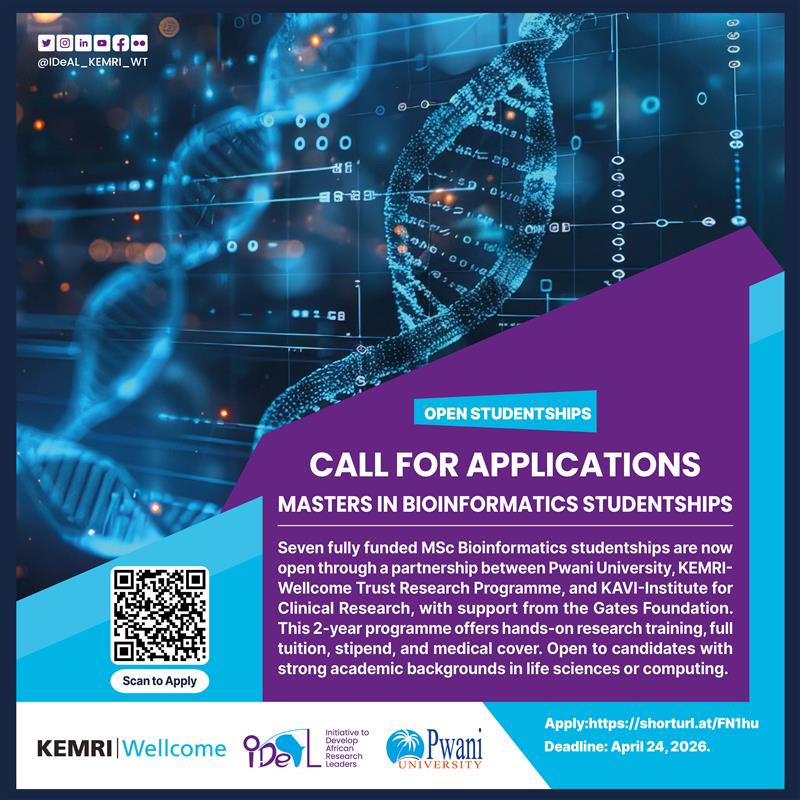
📢Call for Applications: MSc Bioinformatics Studentships!
Are you passionate about using data to solve real-world biological challenges?
Apply for the fully funded MSc Bioinformatics studentships and gain hands-on research experience through a partnership between @PU_Kilifi , @KEMRI_Wellcome, and KAVI Institute for Clinical Research, with support from the @GatesAfrica.
What you get:
💡 Fully funded 2-year programme (tuition, stipend & medical cover)
🧬 Hands-on research training in bioinformatics
🤝 Learn from leading scientists and institutions
🎓 Open to graduates in life sciences or computing
🔗 Apply here 👉: https://t.co/vbBe3wo8jZ
🗓️ Deadline: April 24, 2026
📍 Programme starts: September 2026
All the best!
📢#FellowshipOpportunity for African Scientists
Applications are now open for the @GSK 𝐀𝐟𝐫𝐢𝐜𝐚 𝐎𝐩𝐞𝐧 𝐋𝐚𝐛 𝐏𝐨𝐬𝐭𝐠𝐫𝐚𝐝𝐮𝐚𝐭𝐞 𝐅𝐞𝐥𝐥𝐨𝐰𝐬𝐡𝐢𝐩, a fully funded opportunity at @mrcunitgambia.
Learn more & apply👉https://t.co/lsilIzCgMG
#DataScience
Statistical physics plays a foundational role in modern ML, DL, and RL by providing tools to analyze high-dimensional systems with many interacting components. Concepts like energy landscapes, entropy, and phase transitions help explain how models learn and generalize. In machine learning, energy-based models define probabilities as p(x) ∝ exp(−E(x)), linking learning to minimizing energy. In deep learning, loss surfaces resemble complex energy landscapes, where ideas from spin glasses and thermodynamics explain optimization dynamics, flat minima, and generalization. In reinforcement learning, exploration–exploitation trade-offs mirror temperature-driven dynamics, with entropy regularization encouraging diverse policies. Techniques like simulated annealing and Langevin dynamics further bridge physics and learning. In real life, these principles power advances in optimization, generative modeling, robotics, and complex decision systems, where understanding randomness and structure leads to more robust intelligent behavior.
https://t.co/GiohhOx9bP
The hypergeometric distribution models sampling without replacement from a finite population. If a population of size N contains K successes, and we draw n samples, the probability of observing k successes is: P(X = k) = [C(K,k) C(N−K,n−k)] / C(N,n). Unlike the binomial distribution, probabilities change after each draw since items are not replaced. In probability and statistics, it is fundamental in exact tests like Fisher’s exact test and in modeling finite populations. In machine learning, it appears in feature selection, rare event modeling, and evaluating overlaps (e.g., enrichment analysis). In real life, it is used in quality control (defective items in a batch), card games, lottery systems, and biological studies like gene set enrichment, where outcomes depend on draws from limited pools.
IBT2026 Call for Classroom HOSTS now open!
The @AfrBioInstitute invites applications from institutions interested in hosting participants of the IBT2026.
To apply, please click on this link: https://t.co/GEBAjVm8Tj
Applications close on Friday, 10 April 2026
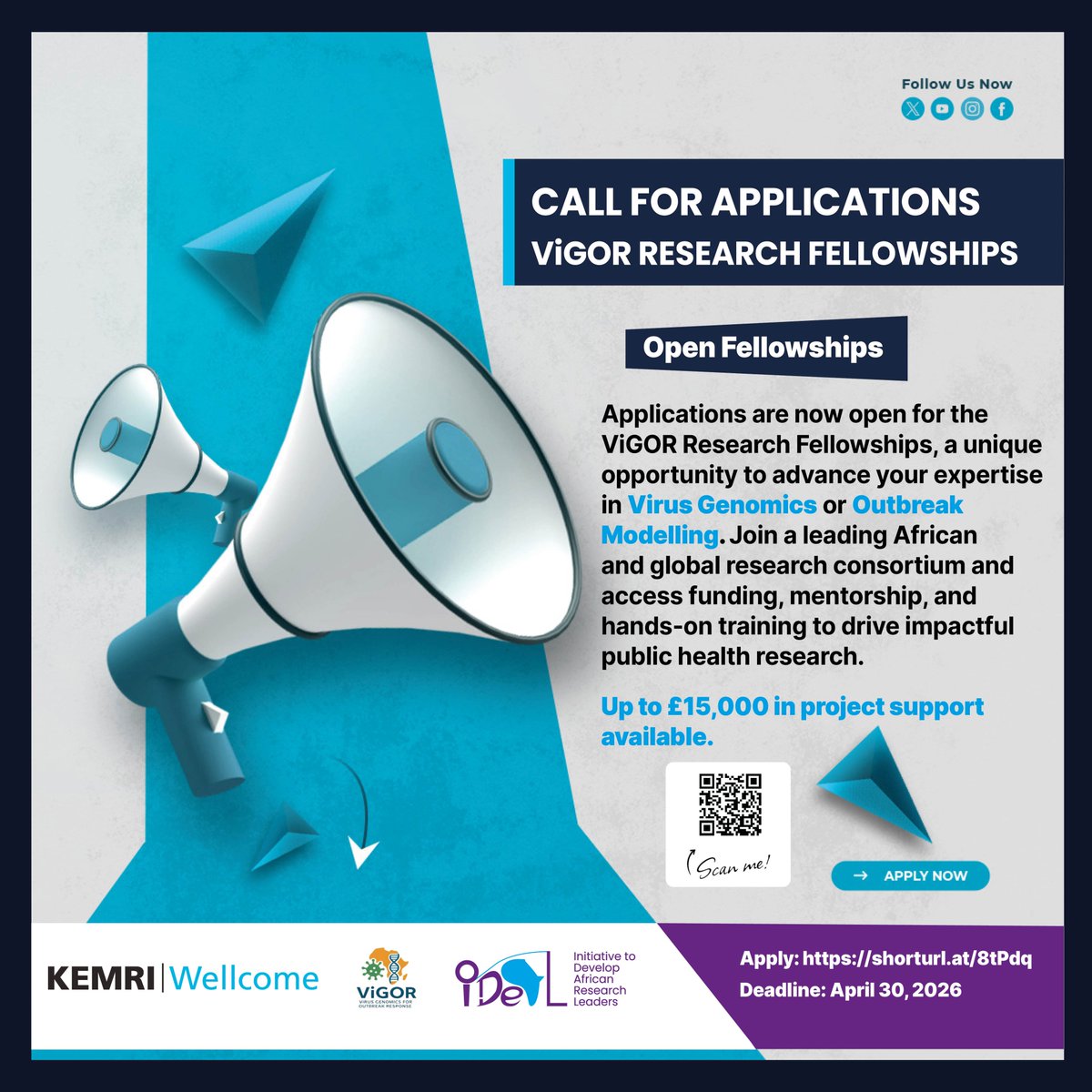
🚨 Call for Applications: ViGOR Research Fellowships!
💡Are you ready to advance your expertise in Virus Genomics or Outbreak Modelling?
Apply for the Virus Genomics for Outbreak Response Research Fellowships to join a leading African and global research consortium and shape public health responses across Africa and beyond!
💡 Up to £15,000 in project support available
🤝 Mentorship + hands-on training
🔗 Apply here👉 : https://t.co/DCMBQeFadt
🗓️Deadline: April 30th, 2026
Random forests are powerful ensemble learning methods that combine multiple decision trees to improve predictive accuracy and reduce overfitting. Mathematically, each tree is trained on a bootstrap sample, and at each split a random subset of features is chosen, introducing decorrelation. The final prediction is an average (regression) or majority vote (classification): ŷ = (1/B) ∑_{b=1}^B T_b(x). This reduces variance while maintaining low bias. In statistics, random forests approximate complex nonlinear functions and provide measures like feature importance. In machine learning, they are widely used for tabular data, offering robustness and interpretability. In deep learning, they are sometimes combined with neural features or used as baselines. In reinforcement learning, they can approximate value functions or policies in structured environments. In real life, they power applications in finance, healthcare, and risk modeling.
https://t.co/WKfLR2fcmA
Spatio-temporal statistics studies data that varies across space and time, capturing dependencies that standard models miss. Mathematically, a common model is X(s,t) = μ(s,t) + ε(s,t), where ε has covariance Cov[(s,t),(s′,t′)] = C_s(s,s′) · C_t(t,t′). Gaussian processes often model this structure, with kernels like k((s,t),(s′,t′)) = k_space(s,s′)k_time(t,t′). In probability and statistics, this helps quantify uncertainty and correlations across regions and time periods. In machine learning, spatio-temporal models power forecasting using graph neural networks, transformers, and GP-based methods that learn spatial relations and temporal dynamics jointly. Applications include climate prediction, traffic forecasting, epidemic modeling, and satellite data analysis, where understanding how patterns evolve across both space and time leads to more accurate predictions and better decision-making.
https://t.co/wNqfrmofOT
Nous parlons souvent de modèles, d’entraînement et de performance …
Mais que se passe-t-il lorsque ces modèles sont confrontés à de légères perturbations ou à des situations imprévues ?
Comment effectuer un fine-tuning robuste tout en évitant une dégradation des performances ?
C’est autour de cette question que nous aurons le plaisir d’accueillir Jonas NGNAWE, doctorant en informatique au Mila – Quebec AI Institute et à l'Université Laval, ainsi que chercheur invité au Stanford Trustworthy AI Research (STAIR) Lab.
Il nous présentera son article intitulé :
« ROBUST FINE-TUNING FROM NON-ROBUST PRETRAINED MODELS: MITIGATING SUBOPTIMAL TRANSFER WITH EPSILON-SCHEDULING »
📅 Samedi 28 mars à 15h30
🔗 Lien d’inscription
https://t.co/NzDgrFJIsI
#ArtificialIntelligence #MachineLearning #AIResearch #MLResearch #FineTuning #AdversarialAttack #ReadingGroup #GalsenAI
Femme Inspirante de la Semaine | Prof. Sophie Dabo
"Ils avaient juste besoin d'un coup de pouce, et c'est ce dont je suis la plus fière."
C'est ça, Give to Gain incarné.
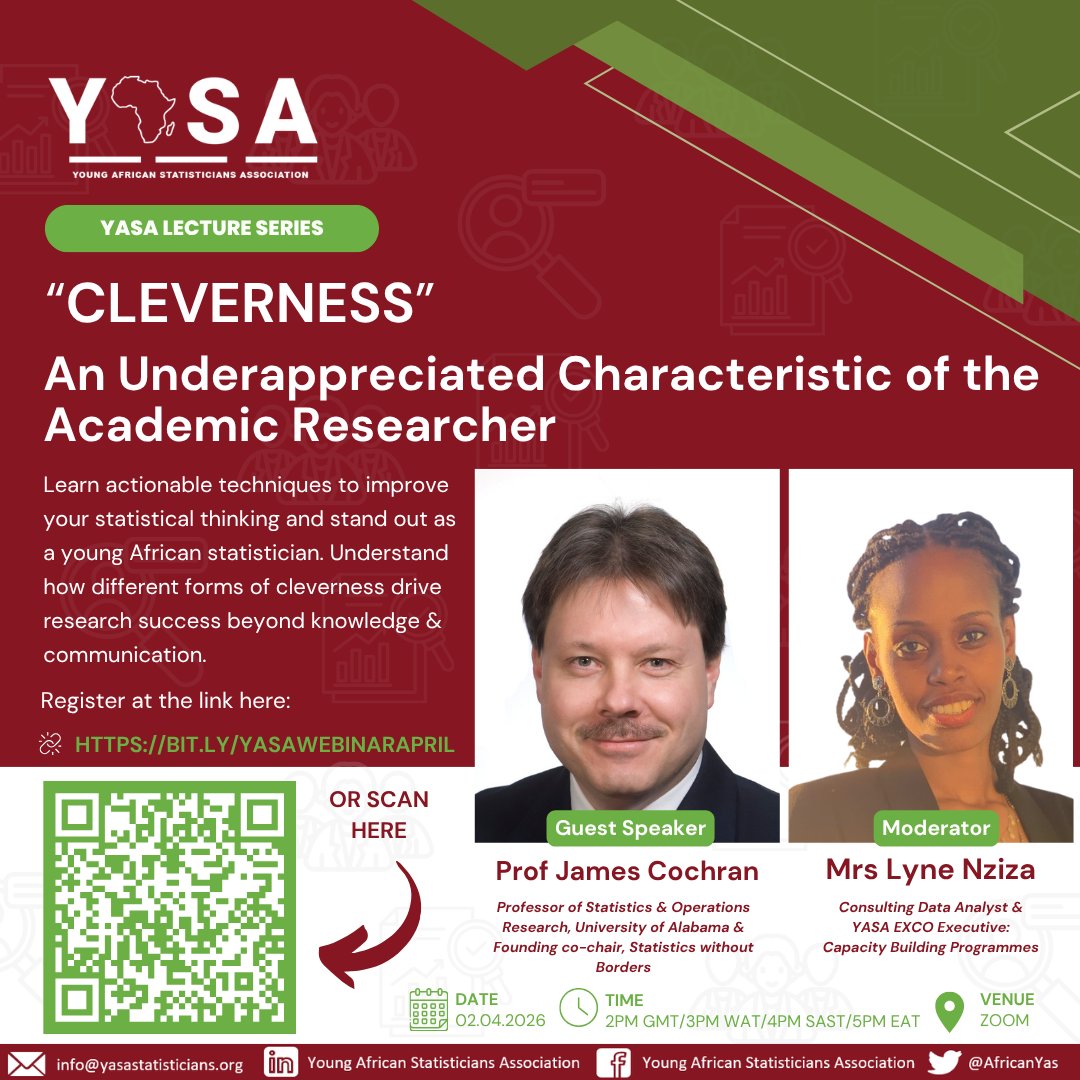
📢Upcoming Webinar Alert!📢
💡Bayesian Statistics and understanding of Cancer.
Co-hosting with the Junior Section of the International Society for Bayesian Analysis (j-ISBA).
🎙Dr Adolphus Wagala
🗓27 Feb 2026
🕐1PM WAT | 2PM SAST | 3PM EAT
🔗Register: https://t.co/cawZ0lYbIB
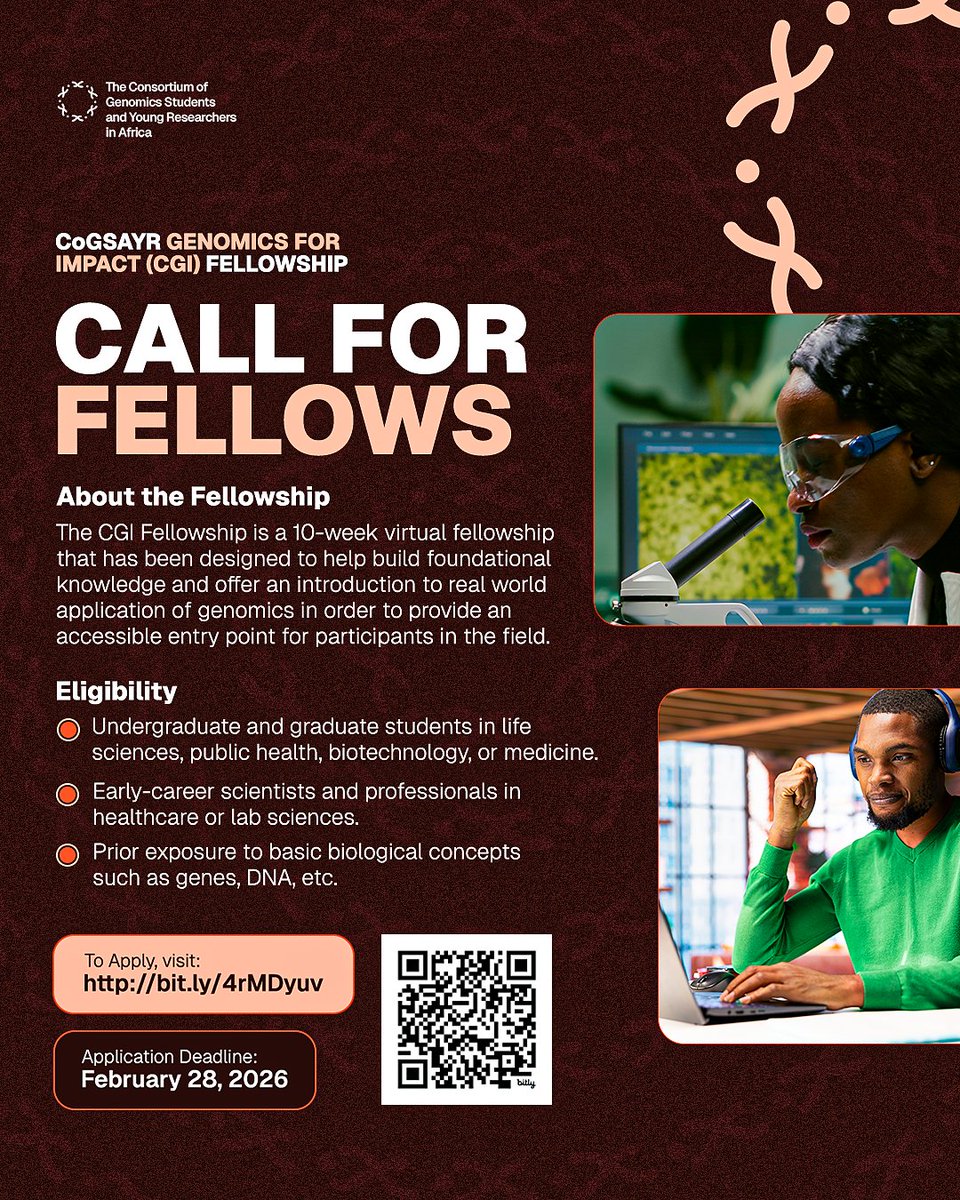
Introducing the CoGSAYR Genomics for Impact (CGI) Fellowship✨️.
The CGI Fellowship is a 10-week virtual program designed to do expand access to practical genomics training in a beginner-friendly, locally-relevant format.
🔗 https://t.co/8izwcwNVRQ
Deadline: 28 February 2026
We’re hiring at AIMS South Africa!
We’re looking for a Communications Coordinator to help shape and coordinate how we tell our stories — across research, education, and impact. Hands-on. Digitally fluent. Independent.
Apply here: https://t.co/BAK1lXu70C







![probnstat's tweet photo. The hypergeometric distribution models sampling without replacement from a finite population. If a population of size N contains K successes, and we draw n samples, the probability of observing k successes is: P(X = k) = [C(K,k) C(N−K,n−k)] / C(N,n). Unlike the binomial distribution, probabilities change after each draw since items are not replaced. In probability and statistics, it is fundamental in exact tests like Fisher’s exact test and in modeling finite populations. In machine learning, it appears in feature selection, rare event modeling, and evaluating overlaps (e.g., enrichment analysis). In real life, it is used in quality control (defective items in a batch), card games, lottery systems, and biological studies like gene set enrichment, where outcomes depend on draws from limited pools.](https://pbs.twimg.com/media/HEIPMUHXgAAz8vS.jpg)


![probnstat's tweet photo. Spatio-temporal statistics studies data that varies across space and time, capturing dependencies that standard models miss. Mathematically, a common model is X(s,t) = μ(s,t) + ε(s,t), where ε has covariance Cov[(s,t),(s′,t′)] = C_s(s,s′) · C_t(t,t′). Gaussian processes often model this structure, with kernels like k((s,t),(s′,t′)) = k_space(s,s′)k_time(t,t′). In probability and statistics, this helps quantify uncertainty and correlations across regions and time periods. In machine learning, spatio-temporal models power forecasting using graph neural networks, transformers, and GP-based methods that learn spatial relations and temporal dynamics jointly. Applications include climate prediction, traffic forecasting, epidemic modeling, and satellite data analysis, where understanding how patterns evolve across both space and time leads to more accurate predictions and better decision-making.
https://t.co/wNqfrmofOT](https://pbs.twimg.com/media/HERhORHbYAEnKu9.jpg)