🚨 Thrilled to share that two of my papers have been accepted to @aclmeeting SRW 2025! 🧠🌍
They tackle key challenges in low-resource learning, African NLP, and inclusive speech recognition, grounded in linguistic insight and practical efficiency. @McGill_NLP@Mila_Quebec
📝 1. Rethinking Full Finetuning from Pretraining Checkpoints in Active Learning for African Languages
⚡ The challenge: In active learning (AL), it is common to use Finetuning All (FA). This means retraining the model from its original checkpoint on the entire labeled dataset after every round.
❗ But this strategy is computationally expensive, especially for large models and African languages with limited data.
🔍 We investigate an alternative: Continual Finetuning (CF), where the model is updated only on newly acquired samples after each AL round.
📊 We analyze when CF is sufficient. It performs comparably or better when the language is included in pretraining or is typologically similar (for example, Bantu languages).
⚖️ For more distant or underrepresented languages, FA still offers greater stability.
✅ CF yields approximately 35% savings in memory, FLOPs, and training time. It is a compelling option for scalable multilingual AL.
🗣️ 2. Advancing African-Accented English Speech Recognition: Epistemic Uncertainty-Driven Data Selection for Generalizable ASR Models
🎤 The problem: ASR systems often fail on African-accented English due to data scarcity and underrepresentation.
🧪 We combine epistemic uncertainty, Bayesian active learning, and core-set selection to efficiently adapt state-of-the-art ASR models (Wav2Vec2, HuBERT, etc.).
📏 We also introduce U-WER, a new metric to track how model uncertainty evolves across difficult accents.
✅ Results: 27% WER improvement, 45% less data required, and stronger out-of-distribution generalization, with a model-agnostic, open-source pipeline.
🌍 Both papers contribute to building inclusive, efficient, and linguistically grounded AI systems for African languages and accents.
📩 Paper links and code will be shared soon.
Happy 5th anniversary to our incredible partner, @AfricArxiv ! 🎉We applaud their remarkable achievements and the profound impact they've made in advancing scholarly research in Africa and beyond. Here is to many more years of collaboration and success! ❤️🌍#AfricArxiv
Join us to celebrate Black excellence in AI. It’ll be in person at Mila, so spread the word around you.
We’ve amazing speakers, panel discussion, food, music, dance etc - in short it’ll be lots of fun and you don’t wanna miss that 😉
@black_in_ai@Mila_Quebec@mcgillu
We are thrilled to have David Ifeoluwa Adelani in the 3rd Nepal Winter School in AI. David will present his research on NLP for Low-resourced Languages.
David is also an active member of Masakhane NLP for African Languages leading the Lacuna NER project.
@davlanade@MasakhaneNLP
We are thrilled to have Chris Emezue in the 3rd Nepal Winter School in AI, 2021.
https://t.co/jsPOq5zF7x
Looking forward to know more about his work on Language technologies involving low resourced African Languages.
@ChrisEmezue
We are thrilled to have Bonaventure Dossou in the 3rd Nepal Winter School in AI, 2021.
https://t.co/jsPOq5i3IX
Looking forward to know more about his work on Language technologies involving low resourced African Languages. More about him here https://t.co/ECTS4hNSLV
@bonadossou
Thanks to both @ChrisEmezue and @bonadossou for the great talk in the UCREL CRS series on "Advances in NLP for African Languages" ... watch on YouTube, details below ⬇️⬇️⬇️
We are thrilled to announce a new focused #MachineLearning conference: International Conference on Lifelong Learning Agents (CoLLA) https://t.co/ueLgjFzrTR 1/
Delighted to share the acceptance of our paper "FSER: Deep Convolutional Neural Networks for Speech Emotion Recognition" with my partner @bonadossou, at the Affective Behavior Analysis in-the-wild (ABAW) workshop at International Conference on Computer Vision @ICCV_2021
Another great mind of African NLP celebrating his birthday today. Thanks for your active work, inspiration and motivation.
Happy warm and loving birthday to our beloved @ChrisEmezue. The sky is the limit 🎂
Join us on May 7th to see the dynamic duo @bonadossou & @ChrisEmezue speak about Advances in #NLProc for African Languages!
https://t.co/dV6bAjK4L1
1/ We (@ChrisEmezue and I) are delighted to officially introduce you, the FFRTranslate: the first Neural Machine Translation engine from Fon to French and vice-versa.
Official website: https://t.co/CZ6J2sJYtm
@bonadossou and @ChrisEmezue keep amazing us.
Great paper, really relevant for ASR in African Languages.
Let's hope it draws inspiration to more discoveries in the field.
Okwugbé, first ASR initiative for Fon and Igbo is now available. Such a nice work with @ChrisEmezue.
We open-source codes and data to encourage similar works on low-resourced African Languages 🤗.
Fon: https://t.co/vdtyd3NQkR
Igbo: https://t.co/TWtrjxZQTq
Happy birthday to our beloved member @bonadossou. Keep shining and inspiring. We wish you the best, many more years and research for the humanity in general and particularly for the African NLP!
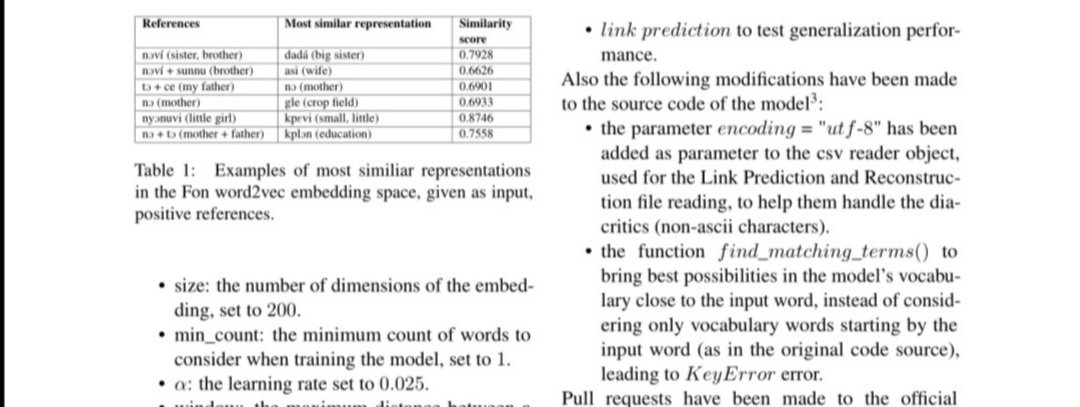
I wanted to share subsequently few notes about my accepted accepted. This one is with @M___Sabry. After describing how word embedding works, with full explanatory guidelines, we created Word2vec and Poincaré embeddings for Fon and Nobiin.
This one w/@ChrisEmezue is about the importance of involving human in the data collection and cleaning process. We performed phrase-based tokenization on the datasets w/- natives interference in the cleaning process, and 👇🏾
We present a state-of-art ASR model for Fon, as well as benchmark ASR model results for Igbo. Our linguistic analyses provide valuable insights and guidance into creation ASR models for other African low-resourced languages, as well as guide future NLP research for Fon and Igbo.
Okwugbé that means speak the language, in combined Igbo and Fon. Using Fon and Igbo as our case study, we conduct a comprehensive linguistic analysis of each language and describe the creation of End-to-End, deep neural network-based speech recognition
models for both languages.