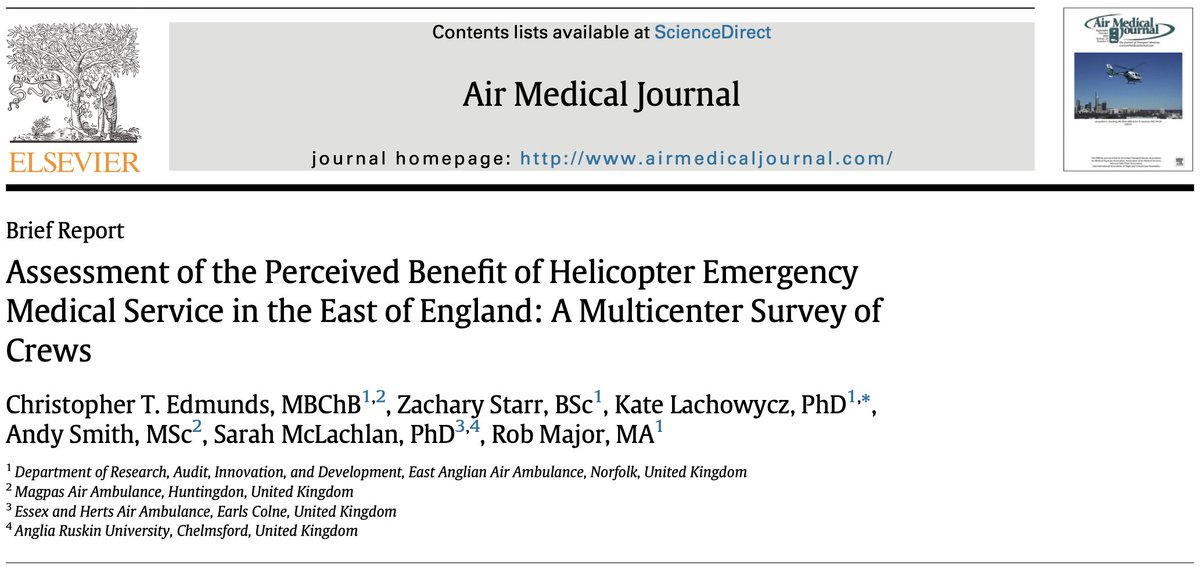
New open-access paper from @EAAARAID
What is the value of HEMS?
Not just the intervention. Not just the aircraft. Not just speed. This study asks crews what HEMS actually adds at the scene.
Free full paper: https://t.co/rwgkFFWXdv
The key question before deploying EVR:
Right patient?
Right time?
Experienced team?
Integrated pathway through definitive care and ICU?
If yes, EVR may help. If not, it may simply add delay and harm.
New in EMJ - free open access:
Endovascular resuscitation: an expert practice review
A practical overview of REBOA, SAAP and ECPR for emergency physicians managing the sickest patients in shock or cardiac arrest.
Please read / comment / share
DOI: 10.1136/emermed-2025-215376
ECPR has the strongest evidence base for refractory OHCA, but only in selected patients and mature systems.
The signal is not just about ECMO - it is about rapid recognition, rapid cannulation, catheter lab access and expert post-cannulation care.
We are based in Cambridge @EastAngliAirAmb HMED88 / Anglia2. However, sometimes the closest Major Trauma Centre is in London. Popped into @HEMSRLH today - always a pleasure.
8/8
The future of cardiac arrest resuscitation may be less about giving the same drug, the same way, to everyone - and more about targeted physiology, invasive monitoring, and precision delivery during CPR.
1/8
In cardiac arrest, adrenaline reliably improves ROSC - but has not consistently translated into better long-term neurological survival.
Our comment asks whether the problem is not adrenaline itself, but how and where we deliver it..
Open access: https://t.co/qbXmQRdwRo
7/8
This is not a call for routine practice change today.
It is a call for prospective evaluation of haemodynamically guided intra-aortic adrenaline as part of modern endovascular resuscitation pathways.
A plausible, testable adjunct between standard ALS and ECPR.
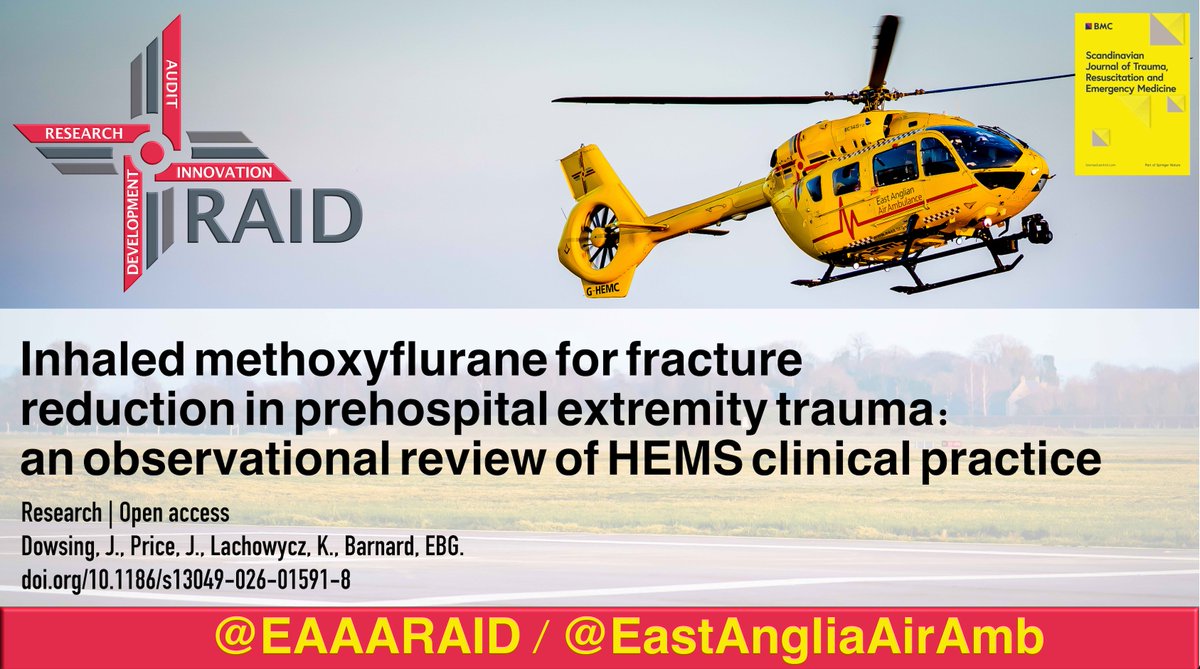
1/ New from @EAAARAID in @SJTREM: observational review of Penthrox for prehospital fracture/dislocation manipulation & reduction in HEMS practice.
In selected limb trauma, methoxyflurane supported successful M&R without IV procedural sedation in more than half of patients.