@WHOOP@willahmed
As a developer who wears a WHOOP strap every day, I wanted a fast way to check my biometrics and plan workouts without leaving my terminal.
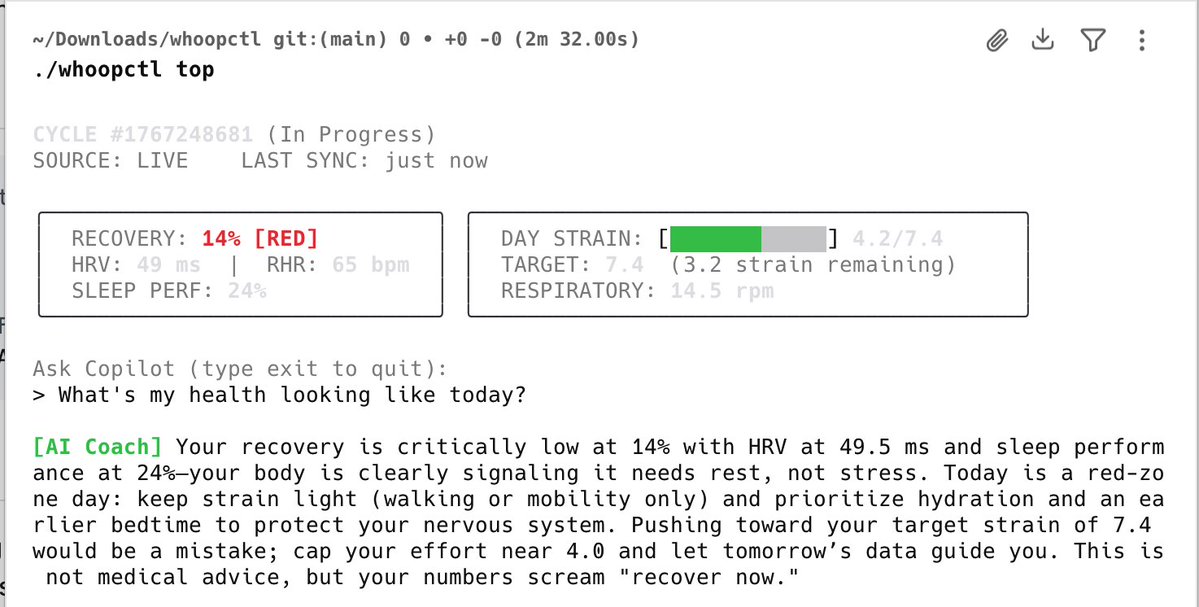
I built an open-source CLI in Go that fetches recovery, strain, HRV, and sleep telemetry via the WHOOP v2 API.
It injects your live metrics directly into LLM prompts; giving you personalized, context-aware training recommendations grounded in your actual physiological data.
https://t.co/bg1S0NXVnM
Consider this my application for my dream company @Whoop
Whoop tells you what your body did.
whoopctl tells you what to do next, right from your terminal.
Shipped an open-source Go CLI that pulls live telemetry from the @WHOOP v2 API and feeds it into an LLM coach with dynamic context injection.
Ask "5x5 squats or a zone 2 run?" and it reasons over your actual recovery score, HRV baseline, and remaining strain budget.
↳ Built with Go, Cobra, Bubbletea, & Lipgloss
↳ Auto-refreshing rotating OAuth tokens
↳ Includes --sandbox mode with embedded v2 fixtures
@willahmed
Code: https://t.co/bg1S0NXVnM
Consider this my application to my dream company: @WHOOP@willahmed
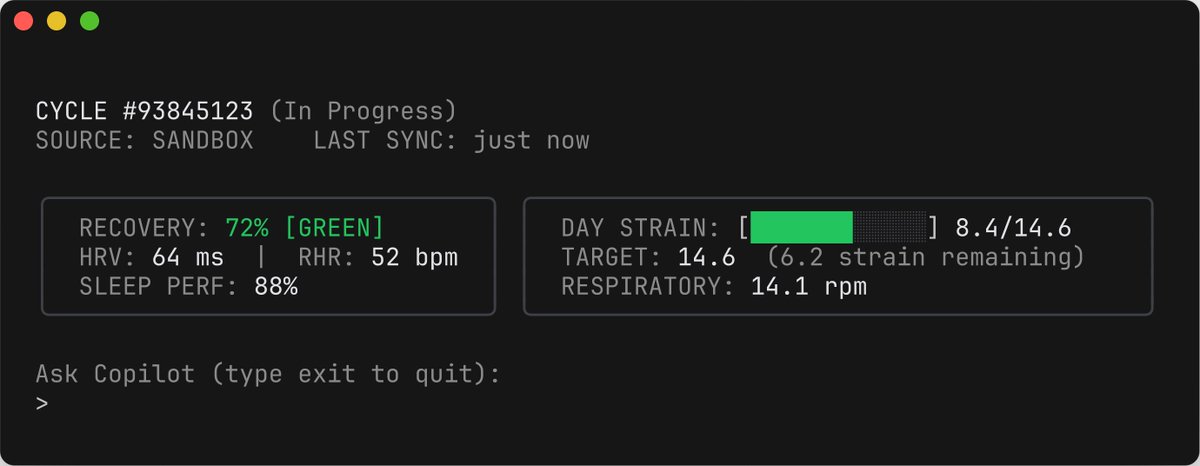
I built Strain Coach; an intelligent copilot powered by the WHOOP Developer Platform API v2.
• Scoped to sleep-to-sleep cycles instead of calendar days
• Perplexity-style AI coach powered by DeepSeek (v4-flash)
• Dynamic strain caps + live intraday pacing curve
• Built with Spring Boot 3.4, Java 17, Supabase, & Next.js 15
• Full sandbox mode included (no wearable needed to test)
Repo: https://t.co/MCmI4HsunS
Putting this out into the tech sphere: I’m looking to join the engineering team at @WHOOP@willahmed.
I wear one every day and care deeply about performant, reliable systems. I just put in some applications.
A bit about my work:
• Built cloud infra & security tooling at Milliman
• Engineered FragBox (fail-closed hardware-isolated microVMs in Go)
• Shipped mobile & full-stack applications with Swift, React, & modern backends
If you’re an engineer or recruiter at WHOOP, or know someone who is, I’d love to chat.
RTs appreciated!
https://t.co/weX8s17NGN
introducing frag
agents YOLO with your keys and your home directory. sandboxing is not optional once they can run shell. most setups either trust the model completely or break your workflow with heavy VMs.
one command drops your agent into an isolated local microVM with strictly scoped access and zero persistent leakage.
- local microVM isolation
- cwd access only, nothing above it
- network deny-by-default
- sandbox dies instantly on exit
- agent cannot widen its own boundary
- open source
this is early. thoughts welcome.
https://t.co/vPJp7eYl40
Agents YOLO with your keys and your home directory. Sandboxing is not optional once they can run shell.
Introducing Frag:
Local microVM, cwd only, net deny-by-default, sandbox dies on exit, agent cannot widen it. this is early.
Thoughts welcome
https://t.co/Z7MRO8mJX1
introducing dev-scaffold
new HTTP services are easy to start badly. people copy a repo that runs Docker as root, commits .env, leaves CORS on *, and has CI that only pip installs. FastAPI / cargo new give you code, not a shippable repo.
one command writes FastAPI, Axum, or a Python worker with Docker, GitHub Actions, and a few of those defaults already set.
- dev-scaffold my-service --type api
- FastAPI, Axum, or Python worker
- Docker, CI, Dependabot in the repo
- non-root image, no secrets in git
- rust CLI
- open source
you still write the product, auth, and database.
https://t.co/98EEkDLfgq
any thoughts or suggestions are welcome
The gap between these two paths is invisible until it is not. Nobody notices the drift at 28. At 38 the gap is a crack. At 48 it is a canyon. Most people only look up when it is already wide enough to see from space.