@AIQuanting Yes, diluted. In the 111 sessions that compacted, reloads were 44% of searches (135/305); in the other 321, none.
But compaction keeps the schemas: 411 calls to tools carried across it ran without a reload, none failed. Re-injecting won't help; the model reloads anyway.
🚨 CLAUDE CODE USERS!
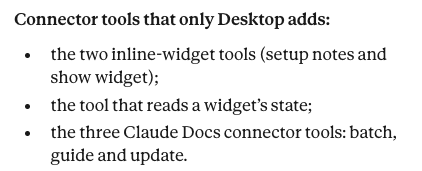
Context window full after several prompts? A fresh Desktop session: 73.8k tokens before its first reply.
A quarter is schemas for tools you may never call. Artifact alone: 12.8k.
I found a way to cut it to 54.3k, no tool removed.
Open source 👇
@AIQuanting Measured it on 432 of my sessions (Sep 27 to Nov 11, mostly before the mod): ToolSearch fired 1.2 times per session; 47% of sessions never fired it.
Of 532 hops, 64% loaded a tool that was then called, 25% reloaded one still loaded after compaction, 8% loaded one never called.
@SAIHMemory It is mostly the desktop app. Not only artifacts, but also other desktop only tools, such as 'start a new session', 'send messages to another session' and so on.
@AIQuanting Not yet. But I believe in the intelligence of Opus, and letting the model decide when to fire is a normal paradigm nowadays. Do you care more about the turns in one agentic loop? Anyway, the token cost is significantly lower in terms of long-term use.
@kunchenguid It was precisely because of watching your videos that I started to use firstmate, rather than reading your posts even for a long time. The efficiency of information transmission is totally different.
As expected, Kimi 3.1 Pro distilled US frontier models to train their models. This time they distilled GPT-6 Astra.
The damage to Kimi’s reputation keeps growing. Via the information
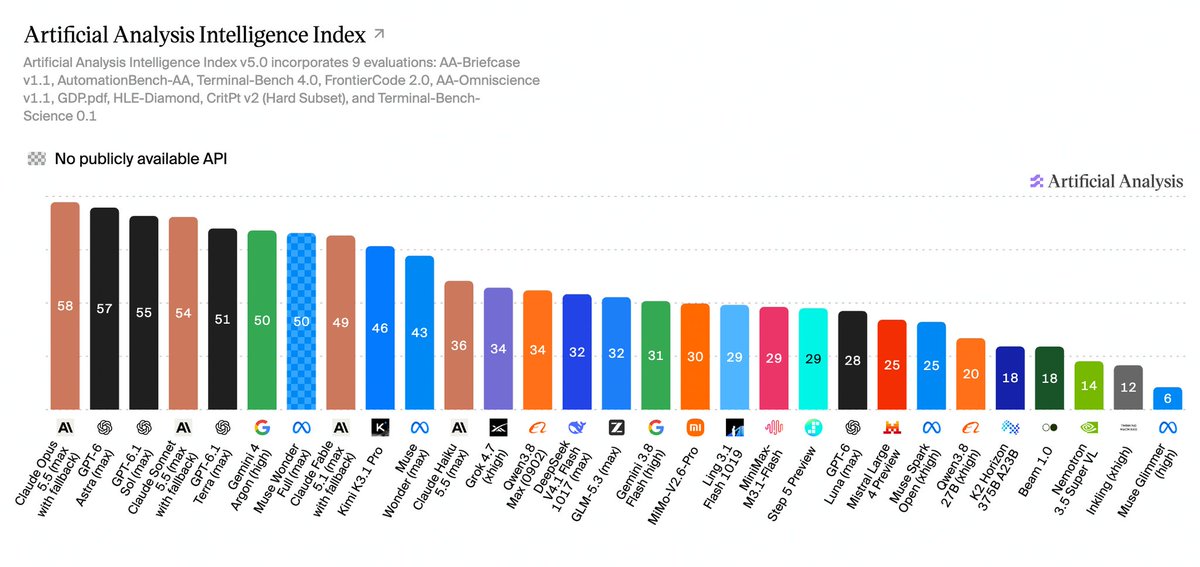
Announcing Artificial Analysis Intelligence Index v5, featuring 2 new benchmarks and 3 upgrades. For the first time, the majority of the Index is built on private datasets
The Artificial Analysis Intelligence Index is our composite measure of model capabilities across tasks reflecting real-world usage today. v5 is our biggest upgrade since v4 launched in January. With v5, 60% of the Index is now based on evaluations with private test sets or held-out answers.
Alongside Intelligence Index v5, we’re launching the Artificial Analysis Progress Index v1, which tracks model capability over time on one continuous scale.
New to the Intelligence Index:
➤ FrontierCode 2.0: Cognition's newly-launched private benchmark of real-world coding tasks, graded on whether a repository maintainer would merge the agent's change
➤ Terminal-Bench-Science: 70 agentic scientific research tasks, run in a terminal environment
Upgraded:
➤ HLE-Diamond (replacing Humanity's Last Exam): a refined 1,000-question version of Humanity's Last Exam, split evenly between reasoning and knowledge questions
➤ AA-Omniscience v1.1: An updated dataset with saturated and public set questions removed, new questions added, and ambiguous or erroneous questions revised
➤ CritPt v2: a private, 40-question hard subset of CritPt v2, revised by the CritPt authors and run with a code-execution tool
Staying in the Index: AA-Briefcase, AutomationBench-AA, GDP.pdf and Terminal-Bench 4.0
Removed from the Index: GDPval-AA v2.1, SciCode, and AA-LCR v1.1
Key results:
➤ Claude Opus 5.5 (max) leads at 58, ahead of GPT-6 Astra (max, 57) and GPT-6.1 Sol (max, 55): Anthropic and OpenAI hold the top five models. Gemini 4 Argon (high) is next at 50
➤ The open weights gap widens from 3 points to 12: Kimi K3.1 Pro (weights not yet released) is the top open weights model at 46. Among released weights, DeepSeek V4.1 Flash 1017 (max) and GLM-5.3 (max) lead at 32 - 26 points behind the leader and below Claude Haiku 5.5 (max, 36)
➤ Cost per task varies by more than 13x among the leading models: of the 10 highest-scoring models shown, GPT-6.1 Terra (max) is the cheapest at $0.96 per Intelligence Index task and Claude Fable 5.1 (max) the most expensive at $13.04
Given the current task lengths and model capabilities (and the ability to fill their context window really fast lol), I feel that setting auto-compact threshold to 300k is sometimes insufficient for my use cases. 400k works better for me, where I haven't observed performance degrade so far.
Has opus 5.5 been nerfed? It’s failing even at simple web searches!
I asked opus to gather the information for me about haiku and the new api credit policy.
This is straight from Anthropic man.
I know it is a probabilistic model, but the whole thing is still pretty weird,