🚩😴 ¿CUÁLES SON LAS CARACTERÍSTICAS MÁS IMPORTANTES PARA QUE EL DESCANSO NOCTURNO TENGA UN IMPACTO POSITIVO EN LA SALUD?
⚠️Las características que se asocian a mejores marcadores de salud y rendimiento son:
—Regularidad a la hora de irse a dormir y despertarse.
—Menos de <2h de diferencia entre nuestros horarios de despertarse y acostarse entre días laborables y no laborables.
—Irse a dormir antes de las 23:59h.
—Despertsrse antes de las 8:59h.
‼️Revisión sistemática de +90.000 participantes con datos de salud cardiovascular, composición corporal y rendimiento cognitivo.
"Your body can only use 25-30g of protein per meal. Anything above that gets wasted."
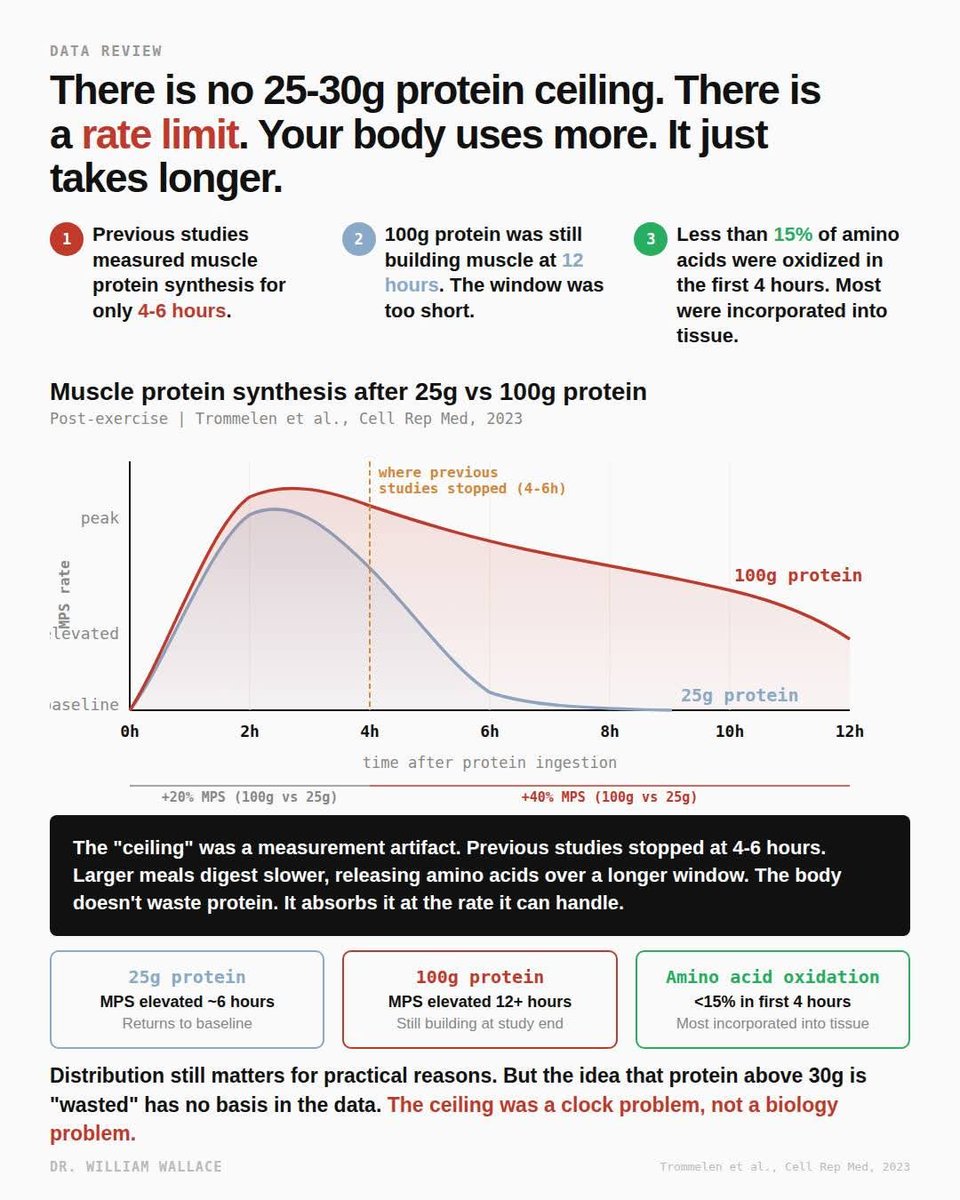
This claim has been repeated in fitness nutrition for over a decade, and it was built on studies that measured the right thing over the wrong timescale.
Moore 2009 gave six young men 0, 5, 10, 20, or 40g of egg protein after leg-only resistance exercise and tracked muscle protein synthesis for four hours. MPS plateaued at 20g. Witard 2014 repeated a similar dose-response with whey protein after unilateral leg exercise in 48 resistance-trained men and found MPS rose 49% at 20g and 56% at 40g over four hours, with the authors concluding 20g was sufficient for maximal stimulation. Case closed, or so it seemed. The problem wasn't the dose. It was that a 4-hour window captures the peak response to 20g but only the opening chapter of what 40g is doing.
Think of digestion as a funnel with a fixed flow rate. Pour a cup of water through it and it drains in minutes. Pour a gallon and it doesn't overflow. The funnel just drains at the same rate over a longer period. Protein behaves the same way. A smaller dose gets absorbed and used quickly. A larger dose digests over a longer window because the stomach slows gastric emptying and the intestine releases amino acids gradually. Muscle tissue keeps incorporating them wave after wave. The "ceiling" in those early studies wasn't a biological saturation point. It was what you see when you stop watching before the larger dose finishes working.
Trommelen et al. (2023, Cell Reports Medicine) tested this directly. They randomized 36 recreationally active young men to 0g, 25g, or 100g of milk protein after a 60-minute whole-body resistance session and tracked muscle protein synthesis for twelve hours using a quadruple isotope tracer. In the first four hours, myofibrillar protein synthesis was only about 20% higher after 100g than after 25g. In the four-to-twelve-hour window, that gap widened to roughly 40%. That later window is where the bigger dose actually separates from the smaller one, and it's exactly where every prior dose-response study stopped measuring. The authors also reanalyzed the oxidation data from Moore and Witard and concluded that postprandial amino acid oxidation represents less than 15% of the increment in ingested protein. The paper states it plainly: "Protein ingestion has a negligible impact on whole-body protein breakdown rates or amino acid oxidation rates."
Caveats belong in the read. This was young recreationally active men following a single bout of resistance exercise. Not trained athletes, not women, not older adults, not a longitudinal hypertrophy trial. A 2024 Witard commentary in the International Journal of Sport Nutrition and Exercise Metabolism flagged that the finding may not translate to resistance-trained young women with different anabolic kinetics.
Practically: you don't need to portion exactly 25-30g of protein every three hours to avoid "wasting" it. Larger meals extend the anabolic window rather than capping it. Distribution across the day still matters for satiety, blood sugar, and hitting your daily target. But the rigid per-meal rule has weaker biology behind it than previously believed.
Sources:
https://t.co/AHrjZkIGRp
https://t.co/Cq27xvSl92
https://t.co/HPFcXBTlKV
https://t.co/SPjf72NSX9
https://t.co/q5hcTQ50FP
Y también se incluyó por supuesto un tema muy importante hoy en día sobre el “Aprender a Comer” impartido por el Lic. Edgar Noe Curiel Velázquez, Coordinador de Nutrición y Promoción a la Salud ISSSTESON.
(2/2)
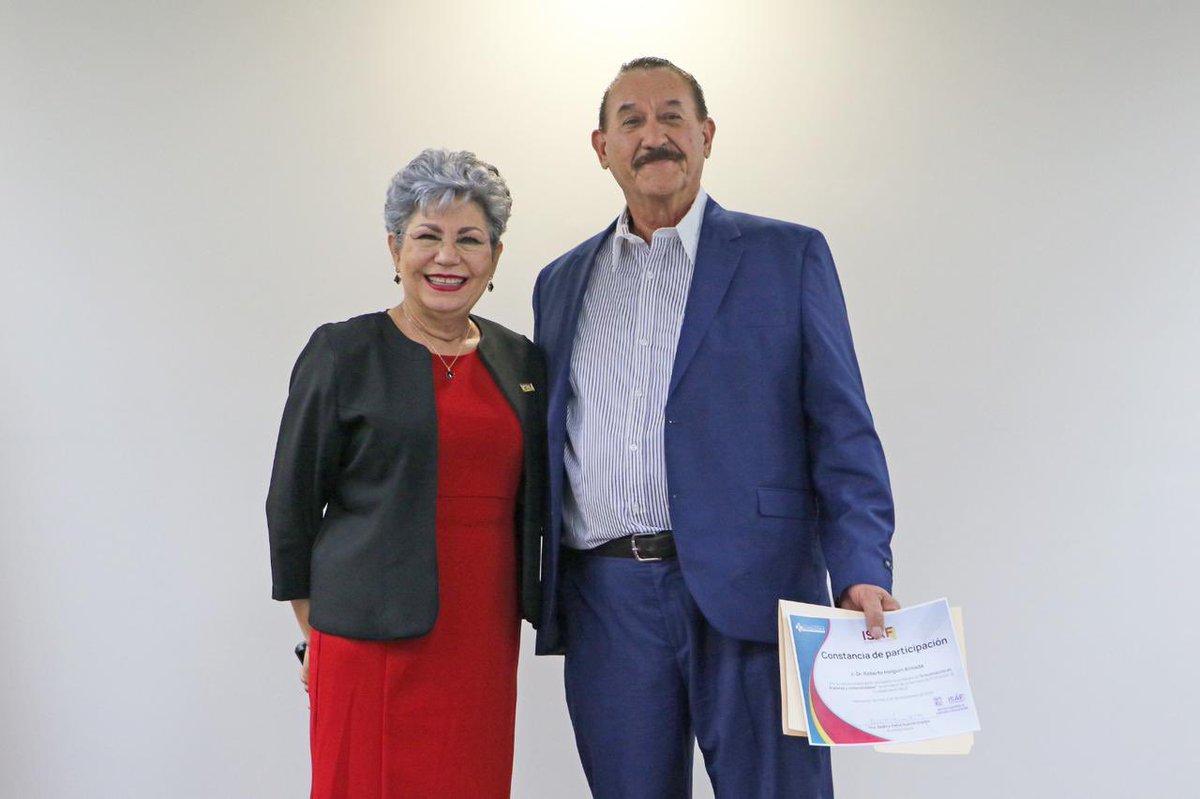
Concluimos nuestro tercer día en esta Semana de Promoción del Cuidado de la Salud en ISAF con los temas de “Atención a la diabetes y comorbilidades”, por parte del Dr. Roberto Holguín Almada, Director de Servicios Médicos de la Casa del Diabético.
(1/2)
Esta mañana @edgar_curiel Nutriólogo, nos habla sobre las 6 recomendaciones básicas para Aprender a Comer, no solo bajar de peso y estar en línea, sino para recuperar la salud ! #nutricion#salud
@SSesenra Ahora de grande y con niños en el retrovisor, prender la luz interior es más para no dejarlos dormir y no prenderla es para hacerlos dormir, supongo algo de eso habrá sucedido en el principio de los tiempos
👨⚕️🙌🏻¿CUÁL ES EL MEJOR EJERCICIO FÍSICO PARA LA SALUD?
🚩🚩Hasta ahora, no había habido ningún estudio a medio-largo plazo que comparara directamente ejercicio de fuerza, ejercicio cardiovascular y sedentarismo.
Vamos a verlo🧵👇🏻